Climate Change, Disasters and Internal Displacement in Asia and the - - PowerPoint PPT Presentation

climate change disasters and internal displacement in
SMART_READER_LITE
LIVE PREVIEW

Climate Change, Disasters and Internal Displacement in Asia and the - - PowerPoint PPT Presentation

Climate Change, Disasters and Internal Displacement in Asia and the Pacific: A Human Rights-Based Approach https://rwi.lu.se/disaster-displacement/ Dr Matthew Scott Head of People on the Move Thematic Area matthew.scott@rwi.lu.se Photo cc by


slide-1
SLIDE 1

Climate Change, Disasters and Internal Displacement in Asia and the Pacific: A Human Rights-Based Approach

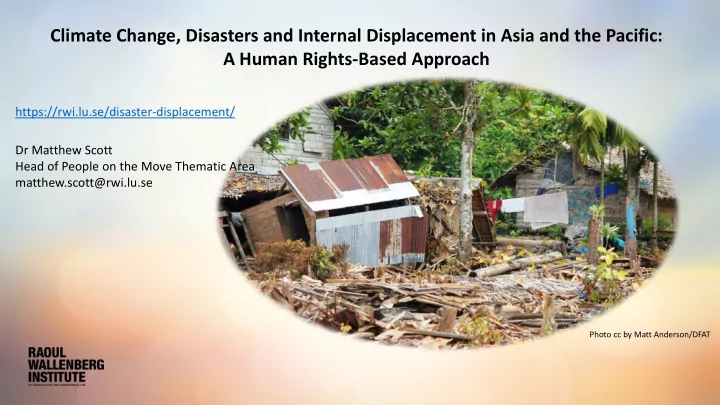
Photo cc by Matt Anderson/DFAT
https://rwi.lu.se/disaster-displacement/ Dr Matthew Scott Head of People on the Move Thematic Area matthew.scott@rwi.lu.se

slide-2
SLIDE 2

Overview

  • Research impetus, questions and countries
  • Three outputs
  • Two key take aways
  • Next steps
slide-3
SLIDE 3

QUESTIONS For each of the 10 countries: 1) To what extent does domestic law and policy reflect key rights-based international standards and guidelines relating to displacement? 2) To what extent is the domestic legal and policy framework reflected in one specific instance of displacement?

Research frame, questions, countries

FRAME: Human Rights in DRM

  • GP20
  • Sendai Framework for DRR – Paragraph

19(c)

  • GPDRR 2019 Co-Chairs’ Summary
  • FRDP Goals 1 and 3 – eg Priority Actions i(f)
  • n HRBA and i(p) on displacment
  • APMCDRR 2020 agenda

China Cambodia Thailand Myanmar Philippines Indonesia Nepal Bangladesh Solomon Islands Vanuatu

slide-4
SLIDE 4

1. Background brief on international standards and guidelines relating to displacement in the context

  • f disasters and climate change
  • Consolidates international standards and

guidelines in an accessible summary document.

  • Provides the baseline from which the 24

principles used to analyse the national law and policy frameworks derive

Three research outputs – 1 – Background Brief

slide-5
SLIDE 5

Background Brief

  • 1. Follows GPID structure, with sections on prevention of displacement, during

evacuation and throughout displacement and towards durable solutions

  • 2. Incorporates principles from
  • Guiding Principles on Internal Displacement
  • Sendai Framework on Disaster Risk Reduction
  • UNDRR Words into Action Guidelines
  • Guidance on Protecting People from Disasters and Environmental Change through Planned Relocation
  • Planning Relocations to Protect People from Disasters and Environmental Change: A Toolbox
  • Agenda for the Protection of Cross-Border Displaced Persons in the Context of Disasters and Climate Change
  • IASC Operational Guidelines on the Protection of Persons in Situation of Natural Disasters
  • IASC Guidelines for Integrating Gender-Based Violence Interventions in Humanitarian Action
  • The Comprehensive Guide for Planning Mass Evacuations in Natural Disasters
  • The Sphere Project: Humanitarian Charter and Minimum Standards in Humanitarian Response
  • IASC Framework on Durable Solutions
  • Durable Solutions Analysis Guide and the Durable Solutions Indicator Library
  • UN Principles on Housing and Property Restitution for Refugees and Displaced Persons (the ‘Pinheiro Principles’)
  • CEDAW, General Recommendation No 37 on Gender-Related Dimensions of Disaster Risk Reduction in the Context of

Climate Change

  • 3. Consolidates this material into 24 core principles, which are then used to evaluate

national law and policy

slide-6
SLIDE 6
  • 2. Law and policy reports
  • Charts displacement over past ten years
  • Consolidates Concluding Observations from treaty

monitoring bodies relating to climate change, disasters and displacement

  • Presents the domestic legal and policy framework for

the country

  • Drawing on the 24 principles derived from the

Background Brief, evaluates the extent to which domestic law and policy reflects international standards

  • Makes some concluding observations
  • Intended to generate discussion in planned

consultations / blended learning / serve as a tool for domestic/international actors working with the issue

Three research outputs – 2 – Law and Policy Reports

slide-7
SLIDE 7

Observations from Vanuatu and the Solomon Islands

  • 1. NPCCDID 2018 expressly

rights-based approach, aligned with FRDP 2016-2030

  • 2. NPCCDID calls for integration
  • f displacement into

development planning

  • 3. Attention to particularly

vulnerable groups in Evacuation Centres policy

  • 4. Self sufficiency requirement?
  • 5. More on protection beyond

emergency phase of displacement?

  • 6. Detailed engagement with

durable solutions in NPCCDID

  • 1. NDMP 2018 expressly

aligned with FRDP 2016-2030

  • 2. Need to develop a national

strategy on planned relocation (now initiated)

  • 3. Focus on IDPs in evacuation

and camp management in NDMP 2018

  • 4. Self-sufficiency requirement?
  • 5. Express incorporation of

GPID and IASC Guidelines in SOPs

  • 6. No treatment of durable

solutions

slide-8
SLIDE 8
  • 3. Academic volume
  • Examines a specific instance of disaster displacement in the

country

  • Considers the extent to which the legal and policy framework

described in the law and policy report contributed to the prevention of displacement, protection during evacuation and throughout displacement and facilitated durable solutions.

  • You will hear more about this from Tess and Joseph

Three research outputs – 3 – Academic volume

slide-9
SLIDE 9
  • 1. Strong legal and policy frameworks need support for

implementation: Both countries have taken considerable steps to develop robust frameworks, grounded in the FRDP 2016-2030 and expressly integrating rights-based principles. How is this working in practice now? What challenges and opportunities?

  • 2. Potential for peer exchange given both countries are working on

rights-based approaches, within the context of the FRDP

Key policy take aways from Vanuatu and Solomon Islands research

slide-10
SLIDE 10

Next steps

Consult widely on priorities of actors in the region and develop programmes in partnership Develop and deliver a blended learning course, drawing on local expertise and facilitating peer to peer exchange Present key findings at APMCDRR 2020 in Australia