Addressing Climate Change in Agriculture Dan Burgar Kueliki - - PowerPoint PPT Presentation

addressing climate change in agriculture
SMART_READER_LITE
LIVE PREVIEW

Addressing Climate Change in Agriculture Dan Burgar Kueliki - - PowerPoint PPT Presentation

Addressing Climate Change in Agriculture Dan Burgar Kueliki Directorate General for Agriculture and Rural Development Portlaoise, Ireland, 8 February 2017 Where do we come from Paris Agreement Global commitment to transition to


slide-1
SLIDE 1

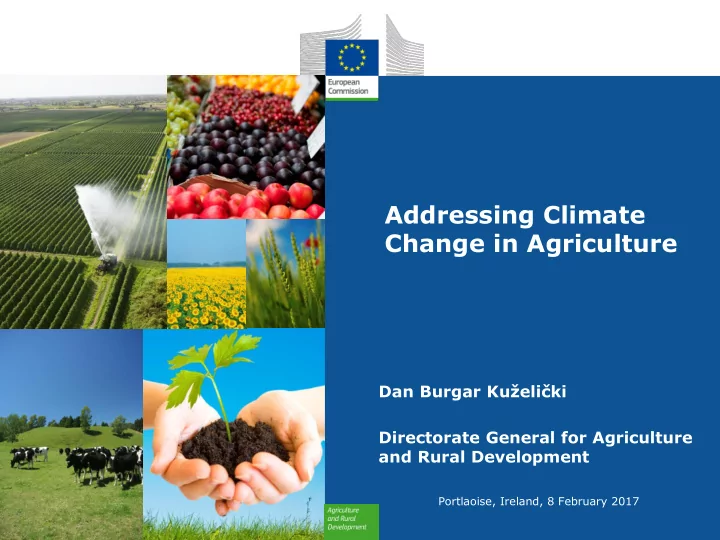
Addressing Climate Change in Agriculture

Dan Burgar Kuželički Directorate General for Agriculture and Rural Development

Portlaoise, Ireland, 8 February 2017
slide-2
SLIDE 2

Where do we come from …

slide-3
SLIDE 3
  • Global commitment to transition to a low-

emission economy, holding the increase in the global temperature to well below 2C

  • Highlights need to harness the potential of land

use to contribute to global GHG mitigation efforts

  • Acknowledgement of the importance of food

security

  • Entered into force 4 November 2016

Paris Agreement

slide-4
SLIDE 4

European Council Conclusions on agriculture:

  • Acknowledge the lower mitigation potential of

agriculture and land use sector

  • Their multiple objectives
  • The need to ensure coherence between the EU's food

security and climate change objectives

  • Encouraging sustainable intensification of food production,

while optimising the sector's contribution to GHG mitigation and sequestration, also through afforestation

slide-5
SLIDE 5
  • 40 % Greenhouse Gas Emissions (domestic EU)

ETS

  • 43 %

Including: Power/Energy Sector and Industry, Aviation

Max 280 MtCO2eq

Full flexibility

Max 100 MtCO2eq

Effort Sharing Regulation

  • 30 %

Non-CO2 emissions from Agriculture Buildings Transport Waste F-gases Other small sectors

  • utside ETS

Land Use, Land use change and Forestry "No-Debit" Afforestation Deforestation Managed grasslands Managed croplands Managed forest

Non-ETS

  • 30%

2030 Climate and Energy Framework

slide-6
SLIDE 6

Agriculture emissions

slide-7
SLIDE 7
slide-8
SLIDE 8

 Reduction of non-CO2 in agriculture is possible, but we need to consider that:

  • With no change in policy GHG decrease is slight - 2.3%
  • The costs: Total subsidies needed to reduce negative

consequences are considerable (12.7-15.6 bio. Euro)

  • Without financial support, there will be negative

consequences:

  • On production
  • e.g. changes in beef herd size can vary from -6.6% to -16% in the EU-28
  • Emission leakage

Limited mitigation potential of the sector Support is needed to avoid serious negative effects

slide-9
SLIDE 9

Larger production effects with no subsidies

Beef supply: %-change vs. the baseline (2030)

20% emission target, no subsidies 20% emission target, 80% subsidies

slide-10
SLIDE 10

EcAMPA 2 shows how mitigation technologies contribute to the overall emission reduction target

Source: EcAMPA2 report (2016)

* The mitigation effects linked to genetic improvement measures cannot be analysed in isolation and are added to mitigation achieved by changes in production.

slide-11
SLIDE 11

Common Agricultural Policy

  • cross-compliance mechanism
  • 'green payment'
  • Rural Development Programs
  • Horizon 2020
  • European Innovation Partnership for Agricultural Productivity and

Sustainability (EIP-AGRI)

Priority 4 (2 873 M€) Priority 5 (439 M€) Other Priorities, (608 M€)

P4+P5 84,4 %

Irish RDP:

  • Priority 4+5
  • Almost 244 million EUR is allocated to

climate- related issues

  • Investments into energy efficiency
  • Supporting climate-friendly agricultural

practices

  • Carbon conservation and sequestration

How to achieve multiple objectives

slide-12
SLIDE 12

Future CAP

Public consultation on Modernisation and simplification of the Common Agricultural Policy post 2020 https://ec.europa.eu/agriculture/consultations/cap- modernising/2017_en This public consultation is open until the 2nd May 2017.

Way forward …

slide-13
SLIDE 13

Thank you for your attention!

http://ec.europa.eu/agriculture/index_en