ADDITIONAL RESOURCES ON REVENUE IDEAS FOR THE TEXAS EDUCATION - - PDF document

additional resources on revenue ideas for the texas
SMART_READER_LITE
LIVE PREVIEW

ADDITIONAL RESOURCES ON REVENUE IDEAS FOR THE TEXAS EDUCATION - - PDF document

Lisa Christensen Gee Senior State Tax Policy Analyst Institute on Taxation and Economic Policy ADDITIONAL RESOURCES ON REVENUE IDEAS FOR THE TEXAS EDUCATION FINANCE COMMISSION APRIL 19, 2018 DISTRIBUTIONAL CONSIDERATIONS 30% 25% 20% 15%


slide-1
SLIDE 1

Lisa Christensen Gee Senior State Tax Policy Analyst Institute on Taxation and Economic Policy 1

ADDITIONAL RESOURCES ON REVENUE IDEAS FOR THE TEXAS EDUCATION FINANCE COMMISSION APRIL 19, 2018

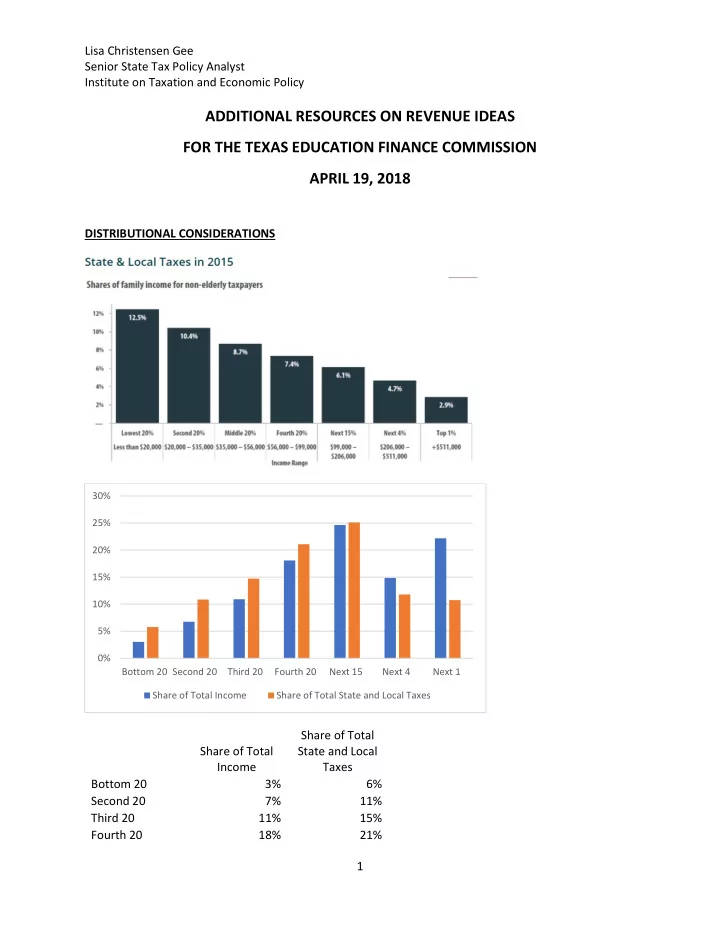
DISTRIBUTIONAL CONSIDERATIONS Share of Total Income Share of Total State and Local Taxes Bottom 20 3% 6% Second 20 7% 11% Third 20 11% 15% Fourth 20 18% 21%

0% 5% 10% 15% 20% 25% 30% Bottom 20 Second 20 Third 20 Fourth 20 Next 15 Next 4 Next 1 Share of Total Income Share of Total State and Local Taxes

slide-2
SLIDE 2

Lisa Christensen Gee Senior State Tax Policy Analyst Institute on Taxation and Economic Policy 2 Next 15 25% 25% Next 4 15% 12% Next 1 22% 11% Top 20 62% 48%

  • Observations:
  • Starting out, Texas has an unbalanced tax system (folks are paying a higher share of

total tax than the amount of income they have).

  • Every revenue option discussed today is going to have the impact of agitating this

imbalance—raising a higher share of the tax on families with less of the income.

  • From the perspective only of tax adequacy (setting aside issues of fairness), part of the

long-terms answer needs to be shifting away from reliance on taxpayers with less of the income. E-CIGARETTES

  • BNA, Extras on Excise: While States Start Taxing E-Cigarettes, Proposed Federal Restrictions Go

Up in Vapor: https://www.bna.com/extras-excise-states-b73014449960/

  • Current E-Cigarette Taxes
  • Based on Percentage of Purchase Price:

▪ California - 27.30 percent of wholesale price ▪ District of Columbia - 67 percent of wholesale price ▪ Minnesota - 95 percent of wholesale price ▪ Pennsylvania - 40 percent of retail price

  • Based on Milliliters of Consumable Product:

▪ Kansas - $0.20 per milliliter ▪ Louisiana - $0.05 per milliliter ▪ North Carolina - $0.05 per milliliter ▪ West Virginia - $0.075 per milliliter

  • States considering it
  • In 2015 alone, 23 states contemplated excise taxes for e-cigarettes, indicating that e-

cigarette taxes are on many jurisdictions’ radar and that more legislation and regulations are sure to follow. ELECTRIC CARS

  • Green Tech Media: https://www.greentechmedia.com/articles/read/13-states-now-charge-

fees-for-electric-vehicles#gs.3xZ38eQ

slide-3
SLIDE 3

Lisa Christensen Gee Senior State Tax Policy Analyst Institute on Taxation and Economic Policy 3 GROCERIES

  • CBPP, Which States Tax Food for Home Consumption? (2017):

https://www.cbpp.org/research/state-budget-and-tax/which-states-tax-the-sale-of-food-for- home-consumption-in-2017

  • About

▪ 45 states and DC levy general sales taxes. Most have eliminated, reduced, or

  • ffset the tax as applied to food for home consumption.

▪ 32 and the District of Columbia exempt most food purchased for consumption at home from the state sales tax.

  • West Virginia is the state that most recently eliminated its sales tax on

food (effective July 1, 2013). ▪ 6 tax at lower rates; they are Arkansas, Illinois, Missouri, Tennessee, Utah, and Virginia ▪ 4 states— Hawaii, Idaho, Kansas, and Oklahoma — tax groceries fully but offer credits or rebates offsetting some of the taxes paid on food by some portions of the population.

  • These credits or rebates usually are set at a flat amount per family
  • member. The amounts and eligibility rules vary, but may be too narrow

and/or insufficient to give eligible households full relief from sales taxes paid on food purchases.

  • 3 states continue to apply their sales tax fully to food purchased for home consumption

without providing any offsetting relief for low- and moderate-income families. They are Alabama, Mississippi, and South Dakota.

  • PEW, Decried As Unfair, Taxes on Groceries Persist in Some States:

http://www.pewtrusts.org/en/research-and-analysis/blogs/stateline/2016/08/16/decried-as- unfair-taxes-on-groceries-persist-in-some-states MARIJUANA

  • Interested in learning more?
  • Talk to state revenue departments in Colorado, Washington, Nevada, and Alaska.

▪ CO & WA the longest standing

  • Precedence in red states and among conservative politicians?
  • Nevada and Alaska now tax
  • John Boehner (pronounced Bayner) new spokesperson for a cannabis company
  • Tax Foundation, Marijuana Legalization and Taxes: Lessons for Other States from Colorado and

Washington: https://taxfoundation.org/marijuana-taxes-lessons-colorado-washington/

slide-4
SLIDE 4

Lisa Christensen Gee Senior State Tax Policy Analyst Institute on Taxation and Economic Policy 4 MILAGE TAX

  • ITEP, Pay-Per-Mile Tax Is Only A Partial Fix: https://itep.org/wp-

content/uploads/vmttax0514.pdf MOTOR FUEL TAX

  • ITEP, Building A Better Gas Tax: https://itep.org/wp-

content/uploads/bettergastax/bettergastax.pdf

  • ITEP Analysis:
  • Increasing motor fuel tax (gasoline and diesel) by 15 cents a gallon would raise $2.9

billion in CY 2018. OVER THE COUNTER DRUGS

  • States where over the counter drugs are exempt: https://blog.taxjar.com/sales-tax-state-

prescription-nonprescription-medication-taxable/

  • 10: TX, MN, VA, MD, PA, DC, NY, CT, NJ, VT
  • 4 states no sales tax: AK, MT, MH, DE
  • All others tax

PROPERTY vs. SALES TAX

  • Nationwide
  • 40% property tax exported
  • 22% sales tax exported
  • In TX, about the same
  • Due to preferential treatment of commercial properties and agriculture
  • Agriculture exemption approaches $4 billion

PROPERTY TAX EXEMPTIONS

  • Pitfalls: Despite intentions, so many ways economic incentives fail to live up to their stated goals
  • Primarily a windfall

▪ Taxes make up on average 1.8% of total business expenses—have to be

  • perating on really thin margins for that to make a difference

▪ Academic estimates show 9/10 decisions in which incentives were given would have occurred regardless

  • Benefits don’t stay in state

▪ Purchase equipment out of state ▪ Hire out of state workers ▪ Increased federal taxes

slide-5
SLIDE 5

Lisa Christensen Gee Senior State Tax Policy Analyst Institute on Taxation and Economic Policy 5

  • Displacement not growth

▪ One company benefiting at the expense of competitors ▪ Poaching from another jurisdiction not the same as generating new activity

  • Neglected alternatives

▪ Incentives come at the cost of other economic development—investments in public education, infrastructure, workforce development, etc.

  • Good Jobs First, About Property Tax Abatements: https://www.goodjobsfirst.org/accountable-

development/property-tax-abatements

  • Good Jobs First, Protecting Public Education from Tax Giveaways to Corporations:

http://www.goodjobsfirst.org/sites/default/files/docs/pdf/edu.pdf

  • Good Jobs First, Reform #4: Protect Schools from Tax Giveaways:

https://www.goodjobsfirst.org/accountable-development/key-reforms-protecting-schools

  • Good Jobs First, On Economic Development Subsidy Reforms:

https://www.goodjobsfirst.org/accountable-development/key-reforms-overview

  • ITEP, Tax Incentives Costly for States, Drag on Nation: https://itep.org/wp-

content/uploads/taxincentiveeffectiveness.pdf

  • PEW, How States Are Improving Tax Incentives for Jobs and Growth:

http://www.pewtrusts.org/en/research-and-analysis/reports/2017/05/how-states-are- improving-tax-incentives-for-jobs-and-growth

  • PEW, State Tax Incentive Evaluation Rankings: http://www.pewtrusts.org/en/research-and-

analysis/analysis/2017/05/03/state-tax-incentive-evaluation-ratings

  • TX: http://www.pewtrusts.org/en/research-and-analysis/fact-sheets/2017/05/state-tax-

incentive-evaluation-ratings-texas ▪ Making progress (adopted a plan for regular evaluation) ▪ Could do even better

  • No specified time for review—better to adopt a schedule
  • Create role for professional staff or outside experts to study

RIDE SHARING

  • ITEP, Taxes and The On-Demand Economy: https://itep.org/wp-

content/uploads/ondemandeconomytaxes0317.pdf

  • ITEP, Taxing the Gig Economy: https://itep.org/taxing-the-gig-economy/
  • Taxi rides are one service that has long been among those typically exempt from most

state and local sales taxes

  • BUT there are more than half a dozen states that apply their sales taxes to taxis and

similar services.

slide-6
SLIDE 6

Lisa Christensen Gee Senior State Tax Policy Analyst Institute on Taxation and Economic Policy 6 ▪ In the context of the on-demand economy, this matters because Uber and other transportation network companies (TNCs) are providing a service nearly identical to taxi rides. But their tax treatment has not always reflected this fact. SALES TAX BASE EXPANSION

  • Sales tax on services
  • Tax more services than most states (good)
  • Some room for improvement (tax expenditure report good source for information on

this) ▪ Professional services (legal, accounting)

  • Can exempt business to business transactions

▪ Why tax automative services but not professional?

  • Blue vs. white collar
  • Opportunities keeping up with 21st Century Economy

▪ Digital goods SALES TAX HOLIDAYS

  • ITEP, Sales Tax Holidays: An Ineffective Alternative to Real Sales Tax Reform:

https://itep.org/wp-content/uploads/SalesTaxHolidays2016.pdf

  • ITEP, States May Finally Be Learning Their Lesson On Back-to-School Sales Tax Holidays:

https://itep.org/states-may-be-finally-learning-their-lesson-on-back-to-school-sales-tax- holidays/

  • North Carolina eliminated its holiday in 2013 (as part of a larger income tax cut package)
  • Florida has recently pared its holiday back considerably
  • 2017 Georgia lawmakers decided the loss of $70 million to state revenues for important

services like schools and public safety was not worth the trouble

  • Tax Foundation, Sales Tax Holidays: Politically Expedient, But Poor Tax Policy, 2017:

https://taxfoundation.org/sales-tax-holidays-2017/

  • Sales tax holidays do not promote economic growth or significantly increase consumer

purchases; the evidence (including a new 2017 study by Federal Reserve researchers) shows that they simply shift the timing of purchases. Some retailers raise prices during the holiday, reducing consumer savings. OTHER NON-INCOME TAX STATES

  • Income Tax Offers a Bright Future for Alaska: https://itep.org/wp-

content/uploads/AKPITvsSalesTax.pdf

slide-7
SLIDE 7

Lisa Christensen Gee Senior State Tax Policy Analyst Institute on Taxation and Economic Policy 7

  • Comparing the Distributional Impact of Revenue Options in Alaska:

http://dhss.alaska.gov/abada/Documents/BethelMaterials5-16- 17/Comparing%20the%20distributional%20impact%20of%20revenue%20options%20in%20Alas ka.pdf