ADAPTIVE SIGNAL CONTROL - When is it the right choice? JOINT - - PowerPoint PPT Presentation

adaptive signal control when is it the right choice joint
SMART_READER_LITE
LIVE PREVIEW

ADAPTIVE SIGNAL CONTROL - When is it the right choice? JOINT - - PowerPoint PPT Presentation

ADAPTIVE SIGNAL CONTROL - When is it the right choice? JOINT TSITE/ITS TN FALL MEETING Clarksville, TN October 7, 2014 Agenda What is adaptive signal control? Benefits Is adaptive signal control the right choice, then Things


slide-1
SLIDE 1

ADAPTIVE SIGNAL CONTROL - When is it the right choice?

October 7, 2014
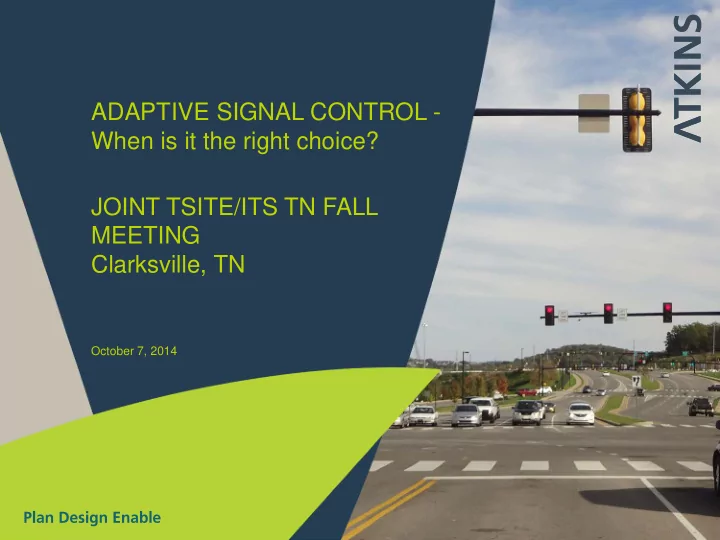
JOINT TSITE/ITS TN FALL MEETING Clarksville, TN

slide-2
SLIDE 2

Agenda

2

  • What is adaptive signal control?
  • Benefits
  • Is adaptive signal control the right choice, then…
  • Things to consider when selecting your system
slide-3
SLIDE 3

What is Adaptive Signal Control?

3

U.S. Dept. of Transportation – Federal Highway Administration

Technologies that capture current traffic demand data to adjust traffic signal timing to optimize traffic flow in coordinated traffic signal systems Capability of adjusting signal timing based on current conditions which may include adjustments to: Cycle Length Split Offset Phasing Modifications

slide-4
SLIDE 4

What is Adaptive Signal Control?

4

  • How does adaptive signal control technology (ASCT)

generally work?

– Collect data in real-time from sensor systems to identify traffic

conditions

– Evaluate alternative signal timing strategies on a model of traffic

behavior

– Implement the “best” strategy according to some performance

metric

– Repeat …

Collect Real-Time Data Evaluate Timing Strategies Implement “Best” Timing Strategy

slide-5
SLIDE 5

Benefits of Adaptive Signal Control

5

  • Reduced travel time along corridor
  • Reduced intersection stop delay
  • Increased average speeds
  • Reduced fuel consumption
  • Reduced emissions
  • More efficient use of the roadway network
  • Will not

– Add capacity to the roadway – Eliminate saturation if roadway is over capacity

slide-6
SLIDE 6

The first step…

6

  • Use the system engineering process to determine your:

– Needs – Issues – Problems – Objectives

  • Develop functional requirements
  • Don’t identify a solution and then look for a problem!
slide-7
SLIDE 7

Criteria for Selection

7

  • Variability – little to no clear consistency in traffic

volumes over a period of time

  • Predictability – Historical data cannot be used to define

consistent traffic trends

slide-8
SLIDE 8

Is ASCT the Appropriate Solution?

8

Identify and Validate Issues

  • Do you have the staff and/or budget to operate and maintain?
  • Is traffic highly variable and unpredictable?
  • Are side street volumes low?
  • Is the volume-to-capacity ratio less than 1?

Identify Potential Candidate ASCT (System Engineering Process) Identification of other Potential Solutions

  • Traffic Responsive System
  • Regularly Scheduled Signal Timing Optimization

ASCT might be the appropriate solution

NO YES

Implement ASCT Evaluate ASCT (Before & After Study)

slide-9
SLIDE 9

Adaptive Signal Control

9

  • Not all ASCT are the same!

– Detection type and placement – Central software – Algorithms – how they optimize signal operations – Hardware needs – Software features – Cost – both initial and long-term

slide-10
SLIDE 10

Adaptive Signal Control Technologies

10

  • SCOOT
  • SCATS
  • InSync
  • RHODES
  • OPAC
  • ACS Lite
  • Trafficware SynchroGreen
slide-11
SLIDE 11

Differences

11

  • Each vendor solution may have pros and cons:

– How to accommodate over-capacity conditions – Quantity or specific type of detection needed – Value of side street movements – Phasing flexibility – Set up time – On-going maintenance – Preemption/prioritization accommodations

  • Corridor vs. grid deployment
slide-12
SLIDE 12

Agency impacts

12

  • Initial cost ($30k to $65k / intersection)

– Central software – Hardware – Detection – Communications

  • Weekly maintenance (6 to 14 hours/week)
  • Yearly operations and maintenance costs ($1k to $25k /

intersection)

  • Percent downtime (2% - 9%)
  • Training (40 – 60 hours)
slide-13
SLIDE 13

Things to consider

13

  • Without vehicle detection – system won’t work
  • Without communications – system won’t work
  • Increased level of training for signal staff
  • Larger up front cost when compared to more

traditional methods

  • Not always popular with your regular commuter

who expects consistency day to day – education / awareness campaigns can help this

slide-14
SLIDE 14

More things to consider

14

  • Emergency preemption, pedestrian calls, and

transit priority can create difficulties for some systems

  • Working with a “black box” which may require

heavy vendor reliance

  • Steep learning curve
  • Most adaptive systems require more detection

than would be deployed for semi-actuated traffic control and traffic responsive plan selection methods

slide-15
SLIDE 15

Lessons Learned

15

  • Generally good return on investments
  • Detection is everything
  • Basic signal timing plans must still be developed for when

detection fails

  • Economy of scale
  • Adaptive is not a cure-all
  • Adaptive is not a set it and forget it
  • Another tool for the traffic engineer’s toolbox
slide-16
SLIDE 16

Points to Remember

16

  • Don’t identify a solution and then look for a problem!
  • Deployment should be based on sound engineering

needs analysis

  • Understand the long term implications of deployment
  • Select the system that best addresses your problem and

needs

  • Go in with your eyes wide open
  • Adaptive is not a cure-all – IT IS ANOTHER TOOL!!
slide-17
SLIDE 17

So, when is Adaptive the right solution?

17

  • And the answer is:

SOMEWHERE BETWEEN NEVER AND ALWAYS!

slide-18
SLIDE 18

Thank you

18

Gerald Bolden, PE, PTOE Atkins North America Gerald.bolden@atkinsglobal.com

slide-19
SLIDE 19

19

slide-20
SLIDE 20

20

slide-21
SLIDE 21

Understanding the limitations

21

  • ASCT…

– Over-saturation conditions – Pedestrian and bike volumes – Heavy reliance on detection and communications – Vendor support

  • The agency…

– Sufficient staff and budget to maintain the system – Long term commitment