ACTION ON ENERGY 2.305pm 24 January 2014 Followed by drinks - - PDF document

action
SMART_READER_LITE
LIVE PREVIEW

ACTION ON ENERGY 2.305pm 24 January 2014 Followed by drinks - - PDF document

ACTION ON ENERGY 2.305pm 24 January 2014 Followed by drinks reception until 6.30pm Sad Business School, Park End Street, Oxford OX1 1HP Welcome Agenda Plenary 2.304pm I am delighted to welcome you to this first OxFutures Tim

slide-1
SLIDE 1

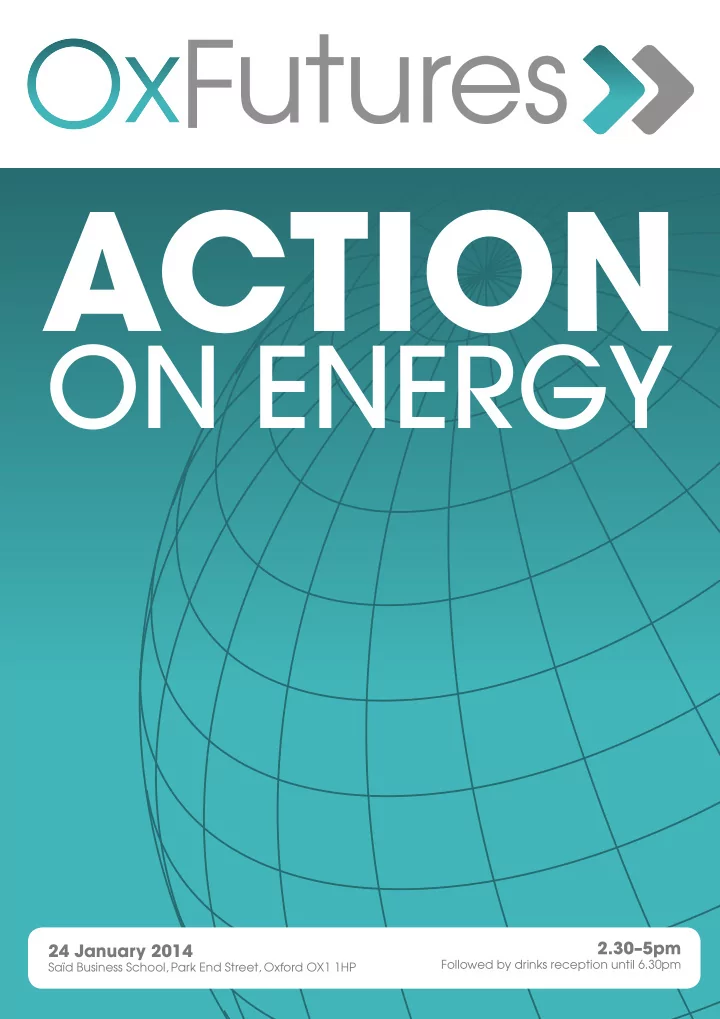
24 January 2014

Saïd Business School, Park End Street, Oxford OX1 1HP

2.30–5pm

Followed by drinks reception until 6.30pm

ACTION

ON ENERGY

slide-2
SLIDE 2

I am delighted to welcome you to this first OxFutures

  • event. We have invited you here because you can make

things happen, whether it is in our businesses, schools, universities, public bodies or our local communities. Our ambition is to position Oxfordshire at the forefront of low carbon innovation and to lead on the UK’s transition to a sustainable energy future. We believe that low carbon economy thinking can be a powerful driver

  • f economic and social benefit, and there are many

excellent examples of this in our county already. By working together as an effective network of leaders, we can replicate success and deliver those economic, environmental and social benefits at scale. OxFutures has been kick-started with funding from Europe to leverage investment of £20 million into local energy projects over the next two years. Today is the beginning of that process: listen to our inspirational speakers, connect with each other, and decide what role you can play in the creation of our own local sustainable energy future. Barbara Hammond CEO Low Carbon Hub

  • 3. How do we mobilise new
investment that solves problems and delivers positive outcomes? Contributors: Daniel Brewer (Resonance), Sam Clarke (Low Carbon Oxford North), Steve Drummond (Bainton Capital Partners), Wendy Twist (Low Carbon Hub), Caroline Mason. Seminar Room A
  • 2. How do we scale up
renewable energy locally and create long-term value for businesses and communities? Contributors: Adriano Figueiredo (Low Carbon Hub), Als Parker (Low Carbon Hub), Luke Marion. Founders Room
  • 1. What is the potential for low
carbon innovation to drive economic development locally? Contributors: Anne Augustine (Low Carbon Oxford), Tony Hart (Future Business Pre-Incubator), Dr Cameron Hepburn, Leo Johnson, Catherine Bottrill. Nelson Mandela Lecture Theatre This will be an opportunity to ask direct questions of the speakers and we would like your input on the practical action we can take to scale up action on energy.

Agenda Welcome

Jonathon Porritt CBE, Co-founder Forum for the Future Jonathon will share his insights into the national energy picture and his positive vision of a new energy future with communities at its heart. Tim Stevenson OBE, Lord-Lieutenant of Oxfordshire Tim will introduce the event. During his term of office, Tim wants to help create cross-fertilisation between the many low carbon initiatives across the county and start a dialogue around an OxFutures vision. Dr Barbara Hammond, CEO Low Carbon Hub Barbara will outline the energy challenge for Oxfordshire and talk us through the potential for low carbon innovation to drive the local economy.

Plenary 2.30–4pm Group discussions 4–5pm Drinks & networking 5–6.30pm

Discussion on low carbon innovation, cross-sectorial partnerships and investment

Martin Chilcott, CEO 2degrees Martin will share his personal views and chair a panel discussion around the economic opportunities
  • f low carbon innovation, the role of
business-community partnerships, and new types of investment and funding. Dr Cameron Hepburn, Professor of Environmental Economics Cameron will discuss the finance mechanisms that will drive low carbon innovation and look at what leadership we need from businesses and political institutions to take this forward. Luke Marion, Finance Director Oxford Bus Company Luke will describe the development
  • f the Oxford Bus Company’s solar
PV scheme – the biggest in Oxford – installed under the Low Carbon Hub’s Community Benefit Model. Caroline Mason CBE, Chief Executive Esmée Fairbairn Foundation Caroline will explain what is meant by socially responsible
  • investment. She will share some
innovative examples of ordinary people getting involved with social investment to deliver local regeneration and social cohesion. Catherine Botterill, CEO Pilio An environmental sustainability expert, Catherine will share her insights of working with UK businesses and households to reduce environmental impacts. She will talk about the relationship between research, innovation and the market. Leo Johnson, Co-author, Turnaround Challenge Leo will talk about the case for “a new form of industrial economy” fit to meet the social, economic, environmental and governance challenges confronting society. 1 2

For general enquiries about OxFutures please contact Mairi Brookes on 01865 252212 or oxfutures@oxford.gov.uk

www.oxfutures.org

slide-3
SLIDE 3 Caroline Mason CBE, Chief Executive Esmée Fairbairn Foundation Before joining the Esmée Fairbairn Foundation, Caroline was the Chief Operating Officer at Big Society Capital, the social investment wholesaler set up by the UK Government from dormant accounts. Prior to that, Caroline was Chief Operating Officer at Charity Bank and also the co-founder of Investing for Good, a social investment advisory firm and one of the UK’s first Community Interest Companies. Before joining the social sector, she had an eighteen-year track record of creative and innovative product development in the financial services sector. Caroline is a board member of Social Enterprise UK and Ethex. She is also a trustee of CAADA and is on the advisory board of Big Society Capital. Jonathon Porritt CBE, Co-founder Forum for the Future Jonathon is an eminent writer, broadcaster and commentator on sustainable
  • development. He founded Forum for the Future in 1996, which is now the UK’s
leading sustainable development charity, with 70 staff and over 100 partner
  • rganisations including some of the world’s leading companies. In addition, he is
Co-director of The Prince of Wales’s Business and Sustainability Programme which runs seminars for senior executives around the world. He is a trustee of the Ashden Awards for Sustainable Energy and is involved in the work of many NGOs and charities as patron, chair or special adviser. His latest book, The World We Made, was published in October 2013. Tim Stevenson OBE, Lord-Lieutenant of Oxfordshire Tim was appointed Lord-Lieutenant of Oxfordshire in 2008. He has an MA in Jurisprudence from Worcester College, Oxford, was called to the Bar in 1971, and is a member of the Inner Temple. He received an OBE in 2004. Tim was Chief Executive of Castrol International and later Burmah Castrol. He was Chairman of Travis Perkins PLC from 2001–10, Chairman of Morgan Crucible PLC 2006–12, and is currently Chairman
  • f Johnson Matthey PLC. He was also Chair of Governors of Oxford Brookes University
and a Member of Council at Modern Art Oxford. Luke Marion, Finance Director Oxford Bus Company Luke qualified as a Chartered Accountant in 2005 and was awarded ICAS’s gold medal for best overall performance. He then worked for the UK division of Reckitt Benckiser, a FTSE top 20 company . As Commercial Controller for the UK, he developed various programmes aimed at improving the sustainability of the business, for example reducing packaging materials, utilising recycled materials in packaging, reducing freight mileage, and limiting the use of harmful propellants in air freshener products. He joined Oxford Bus Company as Finance Director in 2012.

All about our speakers

Catherine Bottrill, CEO Pilio Catherine is an energy and environmental sustainability expert working with UK businesses and households to reduce environmental impacts. In 2011 she co-founded Pilio, the first spin-out company from the University of Oxford’s Environmental Change Institute. Pilio invented an online building energy analytics software – iMeasure (for households) and sMeasure (for businesses) – that has a rapidly growing client base, including Ambassador Theatre Group, the Church of England and Whitbread PLC. This software enables clients to assess the energy performance of an individual building or across a portfolio of buildings to target energy use and to work towards reduction goals. Martin Chilcott, CEO 2degrees Martin is a social and environmental entrepreneur. Currently, most of his time is spent as CEO of 2degrees which helps organisations collaborate and realise opportunities for efficiency and growth by being more sustainable. Martin also founded market-leading specialist education consultancy Place Group, which works on education initiatives such as the Acadamies Programme and Free Schools. Although Martin’s passion is for fast growth entrepreneurial businesses, he has also worked as Global Head of Innovation at Proxicom Inc. and Group Marketing Director of the global IT integrator, Dimension Data PLC. Dr Barbara Hammond, CEO Low Carbon Hub Until 2010, Barbara’s role was in Government, including running the UK’s renewable energy programmes. Her current roles are CEO of the Low Carbon Hub, a social enterprise launched in 2012 to bring community energy and carbon reduction to scale; Director of Low Carbon Oxford programme, a city-wide initiative to reduce emissions; and Chair of West Oxford Community Renewables (or WOCoRe). She is also on the Community Energy Contact Group, working with Government on the strategy for community energy. Leo Johnson, Co-author Turnaround Challenge Leo Johnson is the co-author of Turnaround Challenge: Business and the City of the Future (published 2013). He is a Visiting Fellow at the Smith School of Enterprise and Environment at Oxford University and the presenter of the BBC World News programme One Square Mile. He is also the co-founder of the strategy advisory firm Sustainable Finance, a trustee of the New Economics Foundation, and was formerly with the Technical and Environment Department of the World Bank’s IFC. Leo is a Judge for the FT Boldness in Business Awards and co-founder of the Prix Pictet – a prize for photography around sustainability issues for which Kofi Annan is the Patron. Dr Cameron Hepburn, Professor of Environmental Economics Cameron is an economist with an expertise in energy, resources and the environment. He is Professor of Environmental Economics at the University of Oxford, based at the Smith School and the Institute for New Economic Thinking at the Oxford Martin School. He is also Professorial Research Fellow at the Grantham Research Institute at the London School of Economics and Fellow of New College, Oxford. He has degrees in law and engineering, a doctorate in economics and 30 peer-reviewed publications in economics, public policy, law, engineering, philosophy, and biology. He has also provided advice on energy and environmental policy to governments and international institutions around the world. He is now a founder-investor in the social enterprise and clean energy sectors. 3 4
slide-4
SLIDE 4

The OxFutures initiative is mobilising large-scale investment to develop renewable energy and energy efficiency projects across the city and county.

The aim is to position Oxfordshire at the forefront of low carbon innovation and lead on the UK’s transition to a sustainable energy future. OxFutures has been kick-started by a grant from Intelligent Energy Europe to leverage investment of £20 million into local energy projects by 2016. The vision is for the River Thames and the rooftops of Oxfordshire to be the power stations of the
  • future. Communities, businesses and the public sector will “power up” by developing renewable
energy schemes and “power down” by reducing energy use. This will deliver untold economic, social and environmental benefits for Oxfordshire. Oxfordshire has a huge potential to “power up” by generating its energy through local renewable
  • sources. Under the OxFutures umbrella, the Low
Carbon Hub is leading on community energy. The Hub works with corporate partners, schools and communities to develop finance and manage renewable energy schemes for community
  • benefit. The Hub’s £12.5 million pipeline of
renewable projects includes eight community microhydro schemes along the Thames, solar PV projects on community buildings, a cohort of solar schools, as well as 3.5MW of solar PV with local businesses across Oxfordshire. Oxfordshire also has huge potential to “power down” by reducing energy use to enable us to save money and live in warmer, more energy- efficient homes. OxFutures aims to make domestic energy savings of 19,600MWh over the next two
  • years. One of the key aims of this project is to
tackle fuel poverty locally. Oxford City Council and the Low Carbon Hub are currently running a pilot scheme in Barton to improve the energy efficiency of local homes. This project will deliver renewables on the public
  • estate. The first phase is the Low Carbon Hub’s
solar energy scheme for Oxfordshire schools. Individual schools are struggling to develop their
  • wn projects in isolation but by working together
the scheme will be able to gain economies
  • f scale and raise funds for groups of school
installations at the same time. This will provide cheaper, green electricity for the schools for 20 years as well as an ethical investment opportunity for the wider community. The project is also exploring renewables on the park and ride car parks and other public sector assets. The Low Carbon Hub is working with Resonance, Oxford City Council and Oxfordshire County Council to develop a revolving loan fund for major renewable energy and energy reduction projects across the city and county. This will enable timely construction of Low Carbon Hub renewable projects with corporate partners, the public sector and communities. The first phase of the fund will leverage investment for renewable installations on the public estate and underwrite start-up funding for community energy schemes.

Public estate project Investment fund Powering up

Low Carbon Hub The Low Carbon Hub is a social enterprise that works to lower carbon emissions across Oxfordshire by developing renewable energy and energy reduction projects for the benefit of local
  • communities. Under the OxFutures umbrella,
the Hub is developing a pipeline of community renewables across the county as well as creating a model to retrofit local households to create warmer more energy- efficient homes, and protect against the inevitable rise in fuel prices. www.lowcarbonhub.org 01865 246099 info@lowcarbonhub.org @LowCarbonHub

Powering down

Projects

Oxford City Council, Oxfordshire County Council and local social enterprise, the Low Carbon Hub, are working in partnership to take action on energy across Oxfordshire. The partnership is co-funded by the Intelligent Energy Europe programme of the European Union. The reputation of the councils builds trust in the programme and the Low Carbon Hub brings innovation, enterprise, and new skills to existing relationships with local communities: a powerful combination. Oxford City Council Oxford City Council is a local authority with an ambitious carbon management plan in place for their own estate and a variety of live partnership projects working towards a reduction in the city’s overall carbon
  • emissions. In 2011 Oxford City Council
achieved their target 25% reduction in their
  • wn carbon emissions by employing a
range of energy and fuel saving measures, investing in renewable energy generation and engaging their workforce around positive behaviour change. Oxford City Council has been named as an exemplar local authority by the Carbon Trust and is leading Low Carbon Oxford pathfinder
  • rganisations in the City to achieve a
40% reduction in carbon emissions in Oxford by 2020. www.oxford.gov.uk 01865 249811 @OCC_CarbonTeam IEE Programme The OxFutures initiative has been funded by Intelligent Energy Europe, under its Mobilising Local Energy Investment programme, to scale up investment into a renewable energy infrastructure for
  • Oxfordshire. The Oxford project was one
  • f only three projects in the UK to receive
  • funding. OxFutures will secure the City
  • f Oxford’s target to reduce its carbon
emissions by 40% by 2020, and to reach the Oxfordshire County Council target of a 50% reduction in carbon emissions by 2030, based on 2008 levels. Oxfordshire County Council Oxfordshire County Council manages a diverse property portfolio – offices, libraries, fire-stations and schools. It has recently signed a ten year contract with Carillion to reduce energy consumption by 25% on top of the reductions already achieved. The contract includes remote monitoring of energy consumption to engage staff in managing their own energy use. The County Council also supports the successful CAG (Community Action Group) Programme. Initially focused on waste reduction, CAGs are now including renewable energy and energy efficiency in their activities. www.oxfordshire.gov.uk 01865 815702 @OxfordshireCC

OxFutures partnership

5 6 The sole responsibility for the content of this publication lies with the authors. It does not necessarily reflect the opinion of the European Union. Neither the EACI nor the European Commission are responsible for any use that may be made of the information contained therein.
slide-5
SLIDE 5

Follow us on Twitter:

@OxFutures

#OxFutures #ActionOnEnergy

WiFi information

Delegates registered for the OxFutures event may use the conference wireless network to access the Internet from the ground floor of the business school site. Make sure your device is associated to the “SBS-CONF” wireless network; no special configuration is required. Open a web browser and view a page on the Internet. You will be directed to a secure login site and then asked for the username and password. Username: Jan_2014 Password: Jan_2014

For general enquiries about OxFutures please contact Mairi Brookes on 01865 252212 or oxfutures@oxford.gov.uk

www.oxfutures.org