
SLIDE 1
Deborah Harford Executive Director, ACT October 17, 2013
Presentation to City of North Vancouver
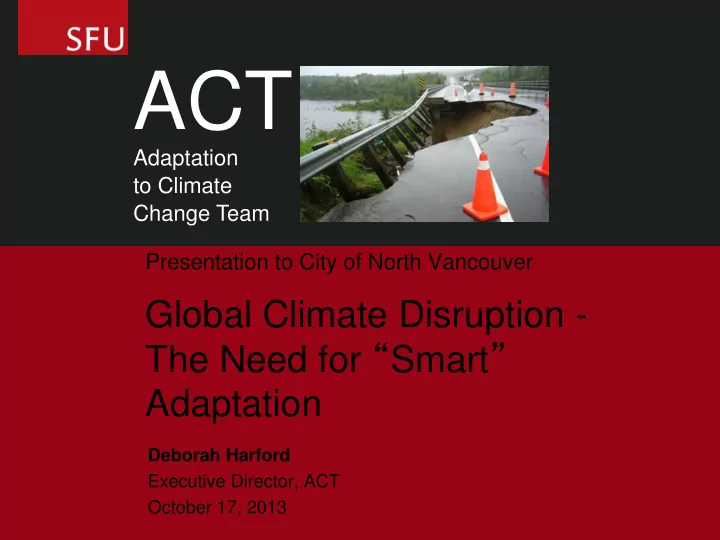
Global Climate Disruption - The Need for Smart Adaptation
ACT
Adaptation to Climate Change Team
ACT Adaptation to Climate Change Team Presentation to City of - - PowerPoint PPT Presentation
ACT Adaptation to Climate Change Team Presentation to City of North Vancouver Global Climate Disruption - The Need for Smart Adaptation Deborah Harford Executive Director, ACT October 17, 2013 The Need for Adaptation AND Mitigation
Deborah Harford Executive Director, ACT October 17, 2013
Presentation to City of North Vancouver
Global Climate Disruption - The Need for Smart Adaptation
Adaptation to Climate Change Team
The Need for Adaptation AND Mitigation
The Need for Adaptation Planning
Carbon dioxide emissions will continue to contribute to warming and sea level rise for more than a millennium, due to the time scales required for removal of this gas. ~ The Fourth Assessment Report of the Intergovernmental Panel on Climate Change (IPCC 2007) Smart adaptation proposes that we prepare for the short and long term effects of climate change while we work to reduce emissions (mitigation).
“Smart” Adaptation
Adaptation is intended to reduce vulnerability and enhance resilience, defined as follows by the IPCC: “The ability of a social or ecological system to absorb disturbances while retaining the same basic structure and ways
capacity to adapt to stress and change.” It is important to couple efforts to mitigate the cause of the problem with efforts to adapt to the current and anticipated effects of climate change. (Save time, money… Lives?!)
Conclusion
Adaptation planning can protect communities, resource sectors, and critical infrastructure.
It will save time & money if we consider adaptation and mitigation as one issue/seek win-win solutions.
Aspects of Vulnerability
The extent of damage from climate change depends to a great extent on vulnerability: Exposure
Sensitivity
Adaptive capacity
Climate Change Threats and Impacts
Extreme weather (increased severity and frequency
hurricanes, tornados, flooding): impacts infrastructure; transportation; human health. Water shortages (both ongoing and during extended droughts): Impact agricultural sector, energy sector, tourism sector, human settlements, ecosystems. Changes in the cryosphere (permafrost, sea ice, lake ice, snow): Impact northern livelihoods/human settlements/infrastructure; mental health; natural resource extraction based-industry and communities; road and marine transportation routes; ecosystems. Disease, pest and invasive species migration: Impacts human health; economic base in resource- dependent communities (fisheries, forestry, agriculture). Coastal and shoreline erosion due to sea level rise, storm surges and increased storminess: Impacts human settlements; fisheries; health; water supplies. Climate refugees? Already arriving…/Arab Spring?
Observed Impacts: Sea Level Rise
Maldives
Photo source: New York Times and AP Photo/Mohammed Seeneen
Oct 17, 2009: The President of the Maldives, an island chain that at its highest point is only 8 feet above sea level, conducts an underwater cabinet meeting to sign a document demanding action at Copenhagen. Models project that the Maldives will be submerged by climate change- driven sea level rise within 100 years.
Observed Impacts: Canada/World 2013
Calgary Toronto Colorado Russia
Flood Infrastructure Adaptation
Spend $1 now and save $5 later…. Think in terms
E.g.: Copenhagen’s award-winning 2013 Adaptation Plan: Roads become rivers; parks become lakes.
Observed Impacts: Swiss Glacier
Glaciers: 70% of fresh water GW 30%; SW 0.9% Himalayas: 1.3BN Andes: 77M Canada: Columbia River relies on runoff Responses: Conserve water Improve storage Ag innovation Ecosystem health The Morteratsch Glacier (2013) has receded 1.6 km since 1950
Observed Impacts: African Drought
Drought in Kenya in 2009 killed crops and livestock, leaving 3.8 million people without food. 2013 saw the fifth Africa Drought Adaptation Forum, which featured plans at the community, industry and individual levels to build resilience.
Observed Impacts: South American Coffee
70 percent of coffee producers are smallholder farmers growing
fluctuations in temperature and rainfall. Shade trees can buffer crops from climate extremes such as heavy winds, rainfall, and temperature increases while sequestering carbon.
National Nigeria: Building Nigeria's Response to Climate Change Project Australia: Climate Adaptation Flagship UK: UKCIP Regional BC: CBT CACCI Netherlands: Flooding Defense Act Australia: Murray-Darling Basin Council Municipal City of Vancouver: Adaptation Plan New York: New York City Panel on Climate Change Jakarta: Great Sea Wall Sectoral U.S. Department of Agriculture: USDA Climate Change Adaptation Plan Engineers Canada: Public Infrastructure Engineering Vulnerability Committee Munich Re: Building alliances around climate insurance
Adaptation Strategies: Examples
Adaptation to Climate Change Team
For more information about ACT, our policy reports, and adaptation resources, please go to:
www.sfu.ca/act
ACT thanks past and present partners:
Zurich Financial Services, Wilburforce Foundation, Bullitt Foundation, BC Ministry of Environment, AMEC Earth & Environmental, BC Hydro, Plutonic Power, INAC, Environment Canada, Real Estate Foundation of BC.