acquire specific skill sets outside of your method book. January - - PDF document

acquire specific skill sets outside of your method book
SMART_READER_LITE
LIVE PREVIEW

acquire specific skill sets outside of your method book. January - - PDF document

1/24/10 Developing Middle School The Problem Building the 21 st Century Percussionist Percussionists Percussion education has grown by leaps and bounds in the past twenty years. Depending solely on your band or orchestra method


slide-1
SLIDE 1

1/24/10 ¡ 1 ¡

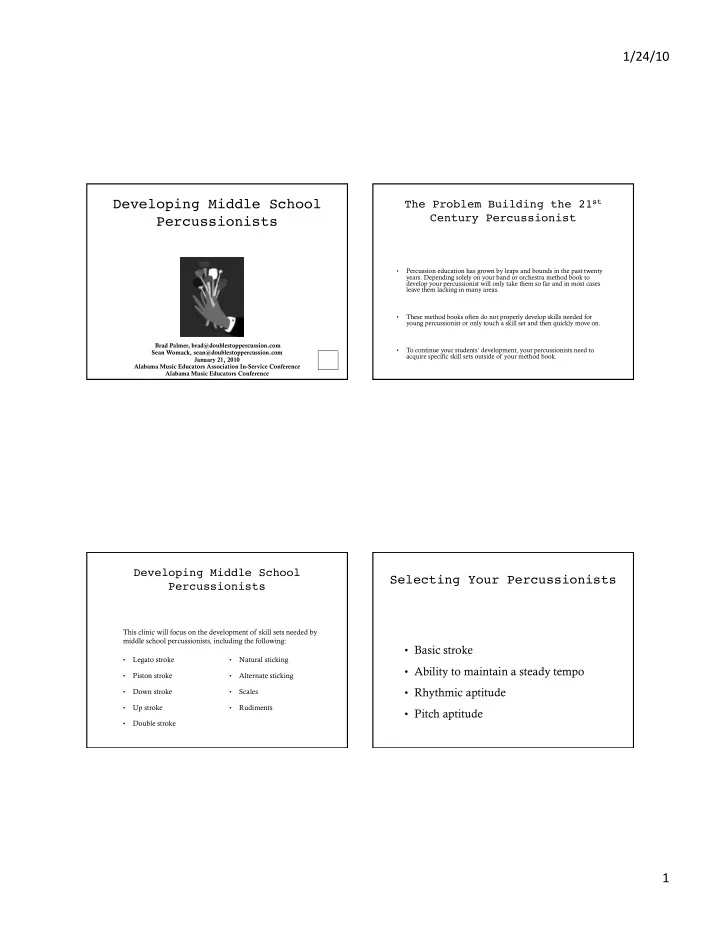
Developing Middle School Percussionists

Brad Palmer, brad@doublestoppercussion.com Sean Womack, sean@doublestoppercussion.com January 21, 2010 Alabama Music Educators Association In-Service Conference Alabama Music Educators Conference

The Problem Building the 21st Century Percussionist

  • Percussion education has grown by leaps and bounds in the past twenty
  • years. Depending solely on your band or orchestra method book to

develop your percussionist will only take them so far and in most cases leave them lacking in many areas.

  • These method books often do not properly develop skills needed for

young percussionist or only touch a skill set and then quickly move on.

  • To continue your students’ development, your percussionists need to

acquire specific skill sets outside of your method book.

Developing Middle School Percussionists

  • Legato stroke
  • Piston stroke
  • Down stroke
  • Up stroke
  • Double stroke
  • Natural sticking
  • Alternate sticking
  • Scales
  • Rudiments

This clinic will focus on the development of skill sets needed by middle school percussionists, including the following:

Selecting Your Percussionists

  • Basic stroke
  • Ability to maintain a steady tempo
  • Rhythmic aptitude
  • Pitch aptitude
slide-2
SLIDE 2

1/24/10 ¡ 2 ¡

The Grip

  • The fulcrum
  • Thumb and first finger on the fulcrum
  • Fingers gently wrap around the stick/mallet,

but remain in contact with the stick

  • No space between fingers or the stick

The Stance

  • Drum/Keyboard waist height
  • 6-12 inches away from the instrument
  • Beads together in the center of head/bar
  • 90 degree angle

Legato Stroke

  • Legato - in a smooth flowing manner, without breaks between

notes

  • This stroke should have a full range of motion, starting from the
  • wrist. The fingers should remain in contact with the stick at all
  • times. This is the most basic and one of the most utilized strokes

percussionists use.

Starting the Legato Stroke

  • R R R R R R R R L L L L L L L L
  • R R R R L L L L R R R R L L L L
  • R R L L R R L L R R L L
  • R L R L R L R L R L R L
  • R L R R L R L L R L R R L R L L
  • These and many other sticking patterns can be found in “Stick Control”

by George L. Stone.

  • These sticking patterns can be developed and used in middle school, as

well as throughout high school.

slide-3
SLIDE 3

1/24/10 ¡ 3 ¡

Continuing the Legato Stroke

R R R R R R R R L L L L L L L L R R R R R R R R L L L L L L L L R

  • Snare Drum

Legato Strokes

  • Legatos with 16th Notes

R R R R R R R R L L L L L L L L R R R R R R R R L L L L L L L L R L R L Sim.

  • Snare Drum

Legato Stroke adding 16th notes

  • The Piston Stroke

The piston stroke is utilized on keyboard instruments and is similar to the legato stroke. The piston stroke starts at the top and returns to the top, which creates efficient movement across the keyboard and allows for a fluid stroke.

The Piston Stroke

  • The Piston Stroke
slide-4
SLIDE 4

1/24/10 ¡ 4 ¡

Basic Timing Elements

  • Once students begin to understand the concept of legato and

piston strokes, apply those ideas to basic timing exercises.

  • These exercises will help percussionists develop a stronger

rhythmic vocabulary.

  • In addition, they will help students understand natural and

alternate stickings.

8th Note Timing

  • Snare Drum

Keyboard

R L R L R L R L R L R R L R R L R L R L R L R L L R L L R L R L R L R L R L R R L R R L R L R L R L R L L R L L R L R L R L R L R R L R R L R L R L R L R L L R L L R L R R L R L R L R L R R L R R L R L R L R L R L L R L L R L R

  • 8th Note Timing
  • Combining 16th and 8th Notes 


Alabama Texas

R L R L R L R L R L R L R L R L R L R L R L R L R R L R L R L R L R L R L R L R L R L R L R L R L R

  • 1

Alabama Texas

  • 3
  • Natural Sticking and 


Alternate Sticking

  • Natural sticking is based on hands playing on a specific beat,

which allows the rhythm patterns to be played with the same sticking throughout a given passage.

  • Alternate sticking simply alternates hands through a specific

rhythmic passage while moving back and forth from right to left hand.

slide-5
SLIDE 5

1/24/10 ¡ 5 ¡

Natural and Alternate 
 Sticking Examples

R L R L R L R L R L R L R L R L R L R R L R R L R R L R R L R L R L R L R L R L R L R L R L R L R L R L R L R L

  • Natural Sticking
  • Alternate Sticking

16th Note Timing

  • Snare Drum

Keyboard

R L R L R L R L R L R L R L R L R L R R L R R L R R L R R L R L R L R L R L R L R L R L R L L R L L R L L R L L R L R L R L R L R L R L R L R L R L R R L R R L R R L R R L R L R L R L R L R L R L R L R L L R L L R L L R L L R L R L R L R L R L R L R L R L R R L R R L R R L R R L R L R L R L R L R L R L R L R L L R L L R L L R L L R L R

5

R L R L R L R L R L R L R L R L R R L R R L R R L R R L R L R L R L R L R L R L R L R L L R L L R L L R L L R L R

  • 16th Note Timing
  • Down Strokes, Up Strokes, and

Staccato Strokes

  • A down stroke is used to stop the stick at the bottom. It has

a similar range of motion from the wrist, but uses the ring and pinky fingers to stop the stick and not allow it to rebound.

  • An up stroke starts from the bottom and stops at the top of

the stroke. It has a similar range of motion and comes from the wrist.

  • A staccato stroke, also called a tap, is played low, short, and

detached.

Accents and Taps

Accents and taps use down, up, and staccato strokes to create two different heights. These exercises should also be developed in 8th notes, 16th notes, and triplets.

R L R L R

  • Basic Accent and Taps
slide-6
SLIDE 6

1/24/10 ¡ 6 ¡

Countdown

R L R L R L R L R L R L R L R L R L R L R L R L R L R L R L R

  • Countdown
  • 4-2-1 Sequence with 16th and

Triplet Groupings

R L R L R L R L R L R L R L R L R L R L R L R L R L R L R L R L R L R L R L R L R L R L R L R L R L R L R L R L R L R L R L R L R R L R L R L R L R L R L R L R L R L R

  • 16th Note Accent Pattern
  • Triplet Accent Pattern
  • Double Stroke
  • The double stroke is used to create rolls and drags. This

stroke is similar to the legato in its range of motion and

  • rebound. It differs in that the player must use the back two

fingers, ring finger and pinky, as well as the wrist, to get the second note to sound.

  • A good double stroke will come from one motion and create

two even notes.

Double Strokes Using 
 Alabama Texas

  • R

L R R L L R L R R L L R L R L R R L L R R L L R R R L L R L R R L L R L R R L L R R L L R L R L R

  • 2

Alabama Texas

  • 4
slide-7
SLIDE 7

1/24/10 ¡ 7 ¡

Combining the Skill Sets

By combining the skill sets discussed previously, we can see how these combinations are used throughout the 40 Percussive Arts Society International Rudiments.

Roll Rudiments

R L R L R L R L R L R L R L R L R L R L R L R R L R L R L R R L R L R L R L R L R L R L R L R L R L R L R L R L R L R L R L R L R L R L R L R L R L R L R L R L R L R L R L R L R L R L R L R L R L

  • Single 4

Single 7

3 3 3 3 6 6

Roll Rudiments

  • 5 Stroke Roll
  • 9 Stroke Roll
  • 17 Stroke Roll
  • Diddle Rudiments

R L R R L R L L R L R R L R L L R L R L R R L R L R L L R L R L R R L R L R L L R L R L R L R R L R L R L R L L R L R L R L R R L R L R L R L L R L R R L L R L R R L L R L R R L L R L R R L L

  • Paradiddle
  • Diddle Rudiments
  • Double Paradiddle
  • Triple Paradiddle
  • Paradiddle Diddle
  • Flam Rudiments

R L R L R R L L R R L L R L R L R L R L R L R L

  • Flam
  • Flam Rudiments
  • Flam Tap
  • Flam Accent
  • 3

3 3 3

slide-8
SLIDE 8

1/24/10 ¡ 8 ¡

Drag Rudiments

LL R RR L LL R RR L LL R L R L RR L R L R LL R L R L RR L R L R

  • Single Drag
  • Drag Rudiments
  • Single Ratamacue
  • 3

3 3 3

  • Applying Skills Sets in the

Classroom

  • Daily warm-up
  • Technique development
  • Sectionals

Thank You to the Following

  • Jeff Atkins, Kim Bain, Dr. Mark Foster, Mike Holmes, Heather Holmes, Brandon Peters, and Mark Sosnowchik, Jerell Horton, Heather

Palmer, Sara Womack

  • Geaton Thorne, Joseph Pewitt, Austin Blain, Zack Downing, Joseph Wendel,, Zach Zedekni, Margo King, Trey Hodges, Todd Gwaltney,

Rhett Randolph, Austin McNamee, Josh Littlefield, Sam Pruitt, Alaina Barham, Patric Taylor, Logan Risner, Demarcus Kelly

  • The all the students from Pizitz, Oak Mountain, Mountain Brook, and Hewitt-Trussville Middle Schools
  • Neal Flum, Beth Gottlieb, and the University of Alabama School of Music
  • Innovative Percussion Sticks and Mallets
  • Pearl Drums
  • Adams Musical Instruments
  • Evans Drumheads
  • Alabama Music Educators Association
  • Garry Taylor