ACM Ubiquity, Volume 9, Issue 20 May 20 26, 2008 U s i n g R S A , - - PDF document

acm ubiquity volume 9 issue 20 may 20 26 2008
SMART_READER_LITE
LIVE PREVIEW

ACM Ubiquity, Volume 9, Issue 20 May 20 26, 2008 U s i n g R S A , - - PDF document

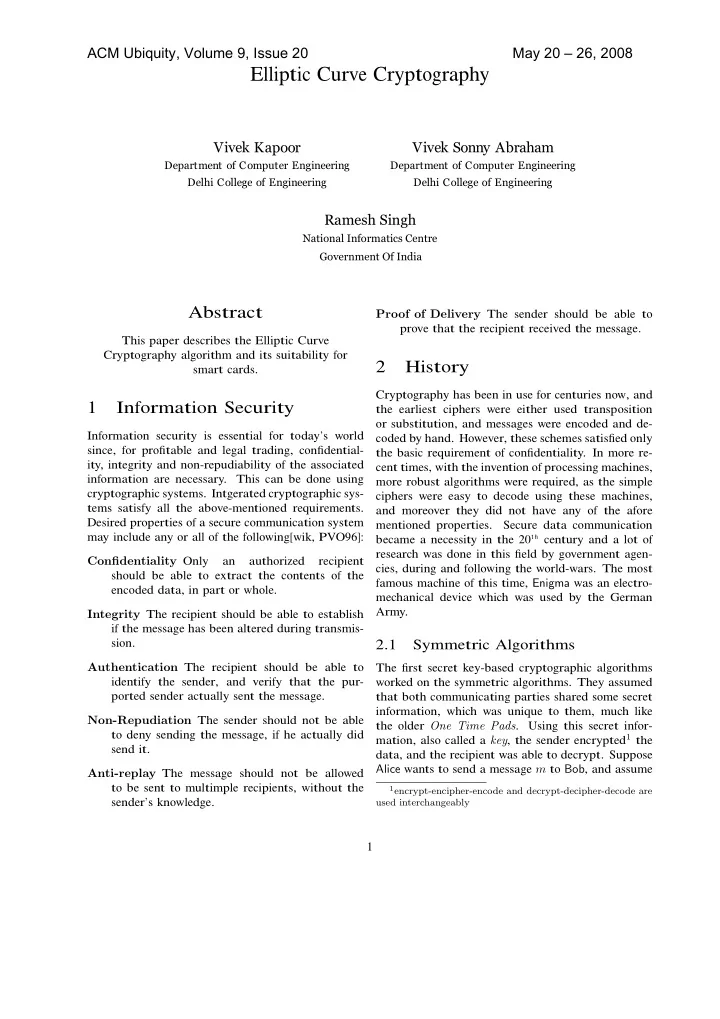
ACM Ubiquity, Volume 9, Issue 20 May 20 26, 2008 E lli p t i c C u r v e C r y p t og r a ph y Vivek Kapoor Vivek Sonny Abraham Department of Computer Engineering Department of Computer Engineering Delhi College of Engineering Delhi


slide-1
SLIDE 1

Elliptic Curve Cryptography

Vivek Kapoor

Department of Computer Engineering Delhi College of Engineering

Vivek Sonny Abraham

Department of Computer Engineering Delhi College of Engineering

Ramesh Singh

National Informatics Centre Government Of India

Abstract

This paper describes the Elliptic Curve Cryptography algorithm and its suitability for

smart cards.

1

Information Security

Information security is essential for today’s world

since, for profitable and legal trading, confidential-

ity, integrity and non-repudiability of the associated information are necessary.

This can be done using

cryptographic systems. Intgerated cryptographic sys- tems satisfy all the above-mentioned requirements.

Desired properties of a secure communication system may include any or all of the following[wik, PVO96]:

Confidentiality Only

an authorized

recipient

should be able to extract the contents of the

encoded data, in part or whole. Integrity The recipient should be able to establish if the message has been altered during transmis-

sion.

Authentication The recipient should be able to identify the sender, and verify that the pur-

ported sender actually sent the message.

Non-Repudiation The sender should not be able to deny sending the message, if he actually did

send it.

Anti-replay The message should not be allowed to be sent to multimple recipients, without the

sender’s knowledge.

Proof of Delivery The sender should be able to

prove that the recipient received the message.

2

History

Cryptography has been in use for centuries now, and

the earliest ciphers were either used transposition

  • r substitution, and messages were encoded and de-

coded by hand. However, these schemes satisfied only the basic requirement of confidentiality. In more re- cent times, with the invention of processing machines,

more robust algorithms were required, as the simple

ciphers were easy to decode using these machines,

and moreover they did not have any of the afore mentioned properties.

Secure data communication

became a necessity in the 20t h century and a lot of

research was done in this field by government agen- cies, during and following the world-wars. The most famous machine of this time, Enigma was an electro-

mechanical device which was used by the German Army.

2.1 Symmetric Algorithms

The first secret key-based cryptographic algorithms

worked on the symmetric algorithms. They assumed that both communicating parties shared some secret information, which was unique to them, much like the older One Time Pads.

Using this secret infor- mation, also called a key, the sender encrypted1 the data, and the recipient was able to decrypt. Suppose

Alice wants to send a message m to Bob, and assume

1encrypt-encipher-encode and decrypt-decipher-decode are

used interchangeably

1

ACM Ubiquity, Volume 9, Issue 20 May 20 – 26, 2008

slide-2
SLIDE 2

that they both have already shared a key k. Alice encrypts m using the shared key k to get the cipher text. C∗(k,m) = E†k(m)

(1)

Bob can then decrypt this message using his copy of the key k, and extract the original message m. D‡k(C(k,m)) = Dk(Ek(m)) = m

(2) This technique though simple and easy to implement, has obvious drawbacks, some of which are listed here:

  • A shared secret key must be agreed upon by both

parties.

  • If a user has n communicating partners, then

n secret keys must be maintained, one for each

partner.

  • Authenticity of origin or receipt cannot

be proved because the secret key is shared.

  • Management of the symmetric keys becomes

problematic.

2.2

Public Key cryptography

The concept of Public Key cryptography(PKC) was

first introduced by Di e and Hellman in 1976, in their seminal paper, New Directions in Cryptography

[DH76]. This paper also addressed the issue of key

exchange, based on the intractability of the discrete logarithm problem.

In a public key cryptosystem,

each user has a pair of keys, one published publicly,

known as the public key, and the other known as a

private key, is stored in a secure location.

Public key cryptosystems rely on the existence of a trap- door function, which makes decoding possible given

the knowledge of the private key corresponding to the

public key for encryption. Considering a case anal-

  • gous to the one described in the case of symmetric

keys, whereby Alice wishes to send a message m to

  • Bob. the following steps will accomplish the task:

∗represents the cipher text corresponding to message m and

key k

†represents the Encryption function ‡represents the Decryption function

  • 1. Alice passes the message m and Bob’s public key

B∗∗ to an appropriate encryption algorithm to construct the encrypted message. C(ΣB,m) = EΣB(m)

(3)

  • 2. Alice transmits the encoded message to Bob.
  • 3. Bob decrypts the encrypted message received by

him, using his private key ∆B§ and the appro- priate decryption algorithm.

D∆B(C(ΣB,m)) = D∆B(EΣB(m)) = m

(4)

Bob is assured that the data he recieved is not tam-

pered with or leaked, as only his private key can decrypt the data.

Similarly Bob can send data to Alice using her public key A.

The PKC scheme also satisfies the Non-Repudiation and Authentic-

ity by using innovative techniques such as Digital Signatures[Sch95].

3 Smart Cards

3.1 Basics

A smart card, chip card, or integrated circuit(s)

card (ICC), is defined as any pocket-sized card with embedded integrated circuits.

Although there is a diverse range of applications, there are two broad

categories of ICCs.

Memory cards contain only non-volatile memory storage components, and per- haps some specific security logic. Microprocessor

cards contain memory and microprocessor compo-

nents. The standard perception of a smart card

is a microprocessor card of credit-card dimensions

(or smaller, e.g.

the GSM SIM card) with various tamper-resistant properties (e.g.

a secure crypto- processor, secure file system, human-readable fea-

tures) and is capable of providing security services

(e.g. confidentiality of information in the memory).

Not all chip cards contain a microprocessor (eg. the memory cards), therefore not all chip cards are nec-

essarily also smart cards[wik].

∗∗Σχ represents the published public key of user χ §∆τ represents the secure private key of user τ

2

ACM Ubiquity, Volume 9, Issue 20 May 20 – 26, 2008

slide-3
SLIDE 3

3.2 Application Smartcards were invented and patented in early 1970’s, but the first mass use of smartcards was made in 1983, in French pay-phones.

A major boom in

Smartcard use came in 1990’s, with their introduc- tion as SIM cards in mobile phones. They are com-

monly in use now. Smartcard technology is an in- dustry standard defined and controlled by the Joint Technical Committee 1(JCT1) of the International

Standards Organization (ISO) and the International

Electronic Committee (IEC). The series of interna-

tional standards ISO/IEC 7816, introduced in 1987 with the latest update in 2003, defines various as-

pects of a smartcard, including physical characteris-

tics, physical contacts, electronic signals and trans-

mission protocols, commands, security architecture

  • etc. Smartcards don’t contain a battery, and become

active only when connected with a card reader. When

connected, after a reset sequence, the card remains

passive, waiting to receive a command request from a client(host) application. Smartcards can be con-

tactless (based on Radio Frequency ID tags), or can

have a standard 8-pin contact[Ort03]. Today smartcards are used for various applica-

tions all over the world including Banking, Medical records, GSM SIM cards, Identification and crypto- graphic services. They have storage and processing capability, and are convenient to carry around, and as the processing power and memory capacity of smart- cards improves, their range of applications is expand- ing as well.

3.3

Java Card

Java Card technology adapts the Java platform for

use on smart cards and other devices whose environ- ments are highly specialized, and whose memory and processing constraints are typically more severe than

those of J2ME devices. On a Java Card platform mul- tiple applications from di erent vendors can co-exist

  • securely. Java Cards are capable of running Java byte

codes, and upto 3 applets at once. A major advantage

  • f running downloadable applets is that in case of a

security breach, the user only need to download and

write a new applet onto his/her Java Card, instead

  • f destroying the Card and waiting for a new one to

be shipped to him/her. A typical Java Card device has an 8- or 16-bit CPU running at 5 MHz, with 2K

  • f RAM and more than 32K of non-volatile memory

(EEPROM or Flash). High performance smartcards

come with a separate processor and cryptographic chip and memory for encryption, and some come with

a 32-bit CPU.

4

Current technology - RSA

RSA stands for Rivest, Adleman and Shamir, who devised this algorithm in 1977 at MIT. RSA is the most widely used public-key encryption scheme to-

  • day. The US patent on the RSA algorithm expired

in 2000, but as the algorithm was already published

prior to patent application, it precluded patents else-

where.

The security of the RSA cryptosystem is based on

two mathematical problems: the problem of factoring

very large numbers, and the RSA problem. Both of

these problems are hard, i.e., no e cient algorithm exists for solving them.

The RSA problem is defined as the task of taking

eth roots modulo a composite n: recovering a value m such that me = c

(mod n), where (e, n) is the public key and c is the ciphertext. Currently the most promising approach to solving the RSA problem is

to factor the modulus n. With the ability to recover

prime factors, an attacker can compute the secret

exponent d from a public key (e, n), then decrypt c

using the standard procedure. To accomplish this, an attacker factors n into p and q, and computes (p−1)(q−1) which allows the determination of d from

e.

No polynomial-time method for factoring large

integers on a classical computer has yet been found,

but it has not been proven that none exists[wik].

4.1 Basic Algorithm 4.1.1 Key Generation Suppose Alice and Bob are communicating over an in-

secure (open) transmission medium, and Alice wants

Bob to send her a private (or secure) message [wik]. 3

ACM Ubiquity, Volume 9, Issue 20 May 20 – 26, 2008

slide-4
SLIDE 4

Using RSA, Alice will take the following steps to gen-

erate a public key and a private key:

  • 1. Choose two large numbers prime numbers p and

q such that p = q, randomly and independent of each other.

  • 2. Compute

n = pq

(5)

  • 3. Compute the totient

φ(n) = (p − 1)(q − 1)

(6)

  • 4. Choose an integer e such that 1 < e < φ(n)

which is coprime to φ(n).

  • 5. Compute d such that

de ≡ 1

(mod φ(n)) (7) The public key consists of:

  • n, the modulus, and
  • e, the public exponent (sometimes encrpytion

exponent)

The private key consists of:

  • n, the modulus, and
  • e, the private exponent (sometimes decryption

exponent), which must be kept secret. Alice transmits the public key to Bob, and keeps the private key secret. p and q are sensitive since they are the factors of n, and allow computation of d given e. 4.1.2 Encrypting Messages Suppose Bob wishes to send a message M to Alice.

He turns M into a number m < n, using some pre-

viously agreed-upon reversible protocol known as a padding scheme. Bob now has m, and knows n and

e, which Alice has announced. He then computes the ciphertext c corresponding to m: c = me

(mod n) (8) Bob transmits c to Alice.

4.1.3 Decrypting Messages Alice receives c from Bob, and knows her private key

  • d. She can recover m from c by the following proce-

dure:

m = cd

(mod n) (9) Given m, she can recover the original message M. The decryption procedure works because

cd ≡ (me)d ≡ med

(mod n). (10)

Now, since

ed = 1

(mod p − 1) (11) and

ed = 1

(mod q − 1), (12) Fermat’s little theorem yields

med ≡ m

(mod p) (13) and

med ≡ m

(mod q). (14)

Since p and q are distinct prime numbers, applying the Chinese remainder theorem to these two congru- ences yields med ≡ m

(mod pq). (15) Thus,

cd ≡ m

(mod n). (16)

4.2

Issues with RSA

As of 2005, the largest number factored using general purpose methods is 663-bits long, using state of the art distributed methods. Experts feel that 1024-bit

keys may become breakable in the near future(though

disputed). 256-bit length keys are breakable in a few hours using a personal computer. The current rec-

  • mmended key-length is 2048-bits[wik]. Though this

length may be insignificant for most personal com-

puters in use, it causes low processing power portable devices like smartcards to become ine cient. There are constraints on processor word length, available memory and clock speeds in these devices. As the need for portable and secure identification slowly be-

comes a necessity, and as RSA key sizes will increase 4

ACM Ubiquity, Volume 9, Issue 20 May 20 – 26, 2008

slide-5
SLIDE 5

in proportion to the processor power available, there

arises a need to devise a scheme which provies the same level of cryptographic security with smaller key

lengths.

ECC is one such scheme, described in the

following section.

5 ECC

Elliptic Curve Cryptography is an approach to public-key cryptography, based on elliptic curves over

finite fields. The technique was first proposed indi-

vidually by Neal Koblitz and Victor Miller in 1985. The ECC is based on the Elliptic Curve Discrete Log-

arithm problem, which is a known NP-Hard problem.

An elliptic curve is defined by the equation,

y2 + xy = x3 + ax + b†

(17)

A brief introduction to the mathematics required for

Figure 1: Elliptic curve showing the operation P +

Q = R. (See Appendix B)

†can also be used in the form

y2 = x3 + ax + b

elliptic curves, and their usage is given in the follow- ing section. 5.1

Basic Algorithm

5.1.1 Operations on Elliptic Curves

The crucial property of an elliptic curve is that we

can define a rule for adding two points which are on the curve, to obtain a third point which is also on the curve.

This addition rule satisfies the normal properties of addition. The points and the addition

law form a finite Abelian group.[Bar97]

For addition to be well defined for any two points,

we need to include an extra zero point 0, which does

not satisfy the elliptic curve equation. 0 is taken to be a point of the curve. The order of the curve is the number of distinct points on the curve, including the

zero point.

Having defined addition of two points, we can also

define multiplication kP where k is a positive integer and P is a point as the sum of k copies of P.

∴ 2P = P + P 5.1.2 Cryptography Alice, Bob, Cathy, David. . . agree on a (non-secret) elliptic curve and a (non-secret) fixed curve point F. Alice chooses a secret random integer Ak which is her

secret key, and publishes the curve point AP = AkF as her public key. Bob, Cathy and David do the same. Now suppose Alice wishes to send a message to Bob. One method is for Alice to simply compute AkBP and use the result as the secret key for a conventional symmetric block cipher (say DES). Bob can compute

the same number by calculating BkAP , since BkAP = Bk · (AkF) = Ak · (BkF) = AkBP .

(18) The security of the scheme is based on the assumption

that it is di cult to compute k given F and kF. 5.1.3 Choosing the Fixed Curve

A finite field is first chosen (see Appendix A). If the

field is GF(p) where p is a large prime, the xy term 5

ACM Ubiquity, Volume 9, Issue 20 May 20 – 26, 2008

slide-6
SLIDE 6

is omitted, leaving us with (see Equation 17) y2 = x3 + ax2 + b, where 4a3 + 27b2 = 0.

(19) If the field is GF(2m), then we include the xy term

to get y2 + xy = x3 + ax2 + b, where b = 0.

(20) Fields GF(pm) with both p > 2 and m > 1 are not

considered here. 5.1.4 Choosing the Fixed Point

For any point P on a elliptic curve in the GF(pm),

lim

k→∞ kP → 0.

For some a and b, b > a, we will have aP = bP. This

implies cP = 0 where c = b−a. The least c for which this is true is called the order of the point, and c must

divide the order of the curve. For good security, the curve and fixed point are

chosen so that the order of the fixed point F is a large prime number.

This is determined from the

  • rder of the curve, which is done from Schoof’s Algo-

rithm[IKNY98]. For good security, the order of the fixed point should also satisfy the MOV condition to

prevent certain possible attacks. As far as is known, with the above provisions, if

the order of the fixed point F is an n-bit prime, then computing k from kF and F takes roughly 2

n 2 oper-

ations. This is what makes the use of elliptic curves attrac-

tive – it means that public keys and signatures can be

much smaller than with RSA for the same predicted security.

5.2 Advantages over RSA 5.2.1 Security

The main advantage ECC has over RSA is that the basic operation in ECC is point addition (see Ap- pendix B), which is known to be computationally very expensive. This is one of the reasons why it

is very unlikely that a general sub-exponential attack

  • n ECC will be discovered in the near future, though

ECC has a few attacks on a few particular classes

  • f curves. These curves can be readily distinguished

and can be avoided. On the other hand, RSA already has a known sub-exponential attack which works in

  • general. Thus, to maintain the same degree of secu-

rity, in view of rising computing power, the number

  • f bits required in the RSA generated key pair will

rise much faster than in the ECC generateed key pair,

as seen in table 1. Menezes and Jurisic, in their paper [JM97], said

that to achieve reasonable security, a 1024-bit mod-

ulus would have to be used in a RSA system, while

160-bit modulus should be su cient for ECC. Time to break RSA key-size ECC key-size

(in MIPS-years) (in bits) (in bits)

104 512 106 108 768 132 1011 1024 160 1020 2048 210 1078 21000 600

Table 1: Comparison of strength of RSA and ECC Most attacks on ECC are based on attacks on sim-

ilar discrete logarithm problems, but these work out to be much slower due to the added complexity of

point addition. Also, mathods to avoid each of the attacks have already been designed.[Pie00]

5.2.2 Space Requirements

Due to increasing computation required for higher bit

encryption, more transistors are required onboard the

smart card to perform the operation. This leads to an increase in area used for processor. Using ECC,

the number of transistors can be cut back on since the numbers involved are much smaller than an RSA

system with as similar-level security. Also, the bandwidth requirements for both of the systems is the same when the messages to be signed are long, but ECC is faster when the messages are short.

This is more relevant, since PKC is used to

transmit mostly short messages, e.g. session ids. 6

ACM Ubiquity, Volume 9, Issue 20 May 20 – 26, 2008

slide-7
SLIDE 7

5.2.3 Efficiency

Both methods can be made faster – in RSA, by using smaller public exponent, though this holds a greater security risk and in ECC, some results of the calcula-

tion can be stored beforehand. Certicom, a Canadian company, has been studying and promoting the ECC

system since the early ’80s. Some of their results of

fast implementations of ECC compared to RSA are given in table 2. Function ECC 163-bit RSA 1024-bit

(in ms) (in ms) Key Generation

3.8 4708.3

Sign

2.1(ECNRA) 228.4 3.0(ECDSA)

Verify

9.9(ECNRA) 12.7 10.7(ECDSA)

Table 2: Comparison of RSA and ECC

6

Conclusions

In the discussion above, we have seen that ECC is faster, and occupies less meory space than an equiv-

alent RSA system. This means that it is suitable for

constrained environments, especially in smartcards, where fast operations are necessary. Though the in-

dustry has been excruciatingly slow in adopting the new technique, RSA Security in an article on their

website has implicitly agreed that ECC is the way to the future.

The di erence in the key-sizes between ECC and RSA will grow exponentially to maintain

the same relative strength as compared to the aver-

age computing power available. The one thing working against ECC is that though

elliptic curves has been a well-researched field, albeit

an esoteric and extremely vast one2, its cryptographic applications have been noticed only recently. This is

the only advantage that RSA has over ECC. RSA

has been well-researched and has been the topic of many seminal theses. In fact, the cryptographic use

2”It is possible to write endlessly on elliptic curves. (This

is not a threat.)”– Serge Lang

for elliptic curves was only discovered in the process

  • f finding out new attacks on the RSA system.[Len87]

A Galois Fields

The familiar examples of fields are R, C, Q and Z (mod p)∀p = prime numbers. The latter is an exam- ple of a finite field. The requirements of a field are

the operations of addition and multiplication, plus the existence of both additive and multiplicative in-

verses (except that 0 doesn’t have a multiplicative

inverse). To put it another way, a field has addition,

subtraction, multiplication and division – and these

  • perations always produce a result that is in the field,

with the exception of division by zero, which is un-

defined. Recall that complex numbers can be defined as a+

b · ι with the reduction rule ι2 + 1 = 0. To multiply complex numbers we treat ι as an unknown, collect up

powers of ι, and apply the reduction rule to simplify

the result. It turns out that this construction works for other reduction rules involving higher powers of ι.

To avoid confusion, in what follows, t is used instead

  • f ι.

The coe cients of the powers of t can be from any

field – but if we take the field to be the Z

(mod p),

we get a finite field with pm elements, where m is the

degree of the reduction rule – that is the exponent of

the highest power of t.

For example, if we set p = 2, m = 4, and use the

reduction rule t4 + t + 1 = 0, we get a field with 24 = 16 distinct elements: 0, 1, t, t + 1, t2, t2 + 1, t2 + t, t2 + t + 1, t3, t3 + 1, t3 + t, t3 + t + 1, t3 + t2, t3 + t2 + 1, t3 + t2 + t, t3 + t2 + t + 1.

This construction works for all p and m, as long as p is prime; in fact every finite field can be con-

structed in this way; moreover two finite fields with

the same number of elements are always isomorphic – that is there is a 1-1 map between them which pre-

serves the addition and multiplication rules.

This

field is called the Galois Field with pm elements, de-

noted by GF(pm).

7

ACM Ubiquity, Volume 9, Issue 20 May 20 – 26, 2008

slide-8
SLIDE 8

B Addition of Points in GF(p)

For elliptic curves, the operation P + Q = R can be carried out by drawing a chord through P and

  • Q. This chord intersects the ellipitc curve at a third
  • point. This point is −R. R is found out by reflecting

−R in the x-axis (see Figure 1).

The operation is denoted by:

P + Q = R or,

(xP, yP) + (xQ, yQ)

=

(xR, ymathbfR), where

xR = L2 − xP − xQ and, yR = L(xP − xR) − yP and, L =

(yP − yQ) (xQ − xP) If xP = xQ and yP = yQ we must use instead,

xR = L2 − 2xP yR = L(xP − xR) − yP L =

(3x2

P + a)

2yP

If xP = xQ and yP = −yP then R = 0 and if

either point is 0, then the result is the other point.

If P = Q, then the chord reduces to a tangent. It

can easily be seen that this operation is commutative,

associative and distributive.

References

[Bar97]

George Barwood. Elliptic curve cryptog-

raphy faq v1.12. 1997.

[DH76]

Whitfield Di e and Martin E. Hellman. New directions in cryptography.

IEEE Transactions on Information Theory, IT- 22(6):644–654, 1976.

[IKNY98] Tetsuya Izu, Jun Kogure, Masayuki Noro, and Kazuhiro Yokoyama. E cient imple-

mentation of schoof’s algorithm. In ASI-

ACRYPT ’98: Proceedings of the Interna- tional Conference on the Theory and Ap- plications of Cryptology and Information Security, pages 66–79, London, UK, 1998. Springer-Verlag.

[JM97]

Aleksandar Jurisic and Alfred J. Menezes. Elliptic curves and cryptography.

Dr. Dobb’s Journal, 1997.

[Len87]

  • H. W. Lenstra.

Factoring integers with

elliptic curves. Annals of Mathematics, 126:649–673, 1987.

[Ort03]

  • C. Enrique Ortiz. An Introduction to Java

Card Technology. 2003.

[Pie00] Henna Pietil¨

  • ainen. Elliptic curve cryptog-

raphy on smart cards. 30 October 2000.

[PVO96]

Scott A Vanstone P. Van Oorschot, Alfred

J Menezes. Handbook of Applied Cryptog-

  • raphy. CRC Press, 1996.

[Sch95]

Bruce Schneier. Applied cryptography (2nd

ed.): protocols, algorithms, and source code in C. John Wiley & Sons, Inc., New

York, NY, USA, 1995.

[wik]

Wikipedia.

8

ACM Ubiquity, Volume 9, Issue 20 May 20 – 26, 2008