
SLIDE 1 Darwin Chen, MD Assistant Professor Mount Sinai Medical Center Department of Orthopaedic Surgery
Achieving Leg Length Equality in THA
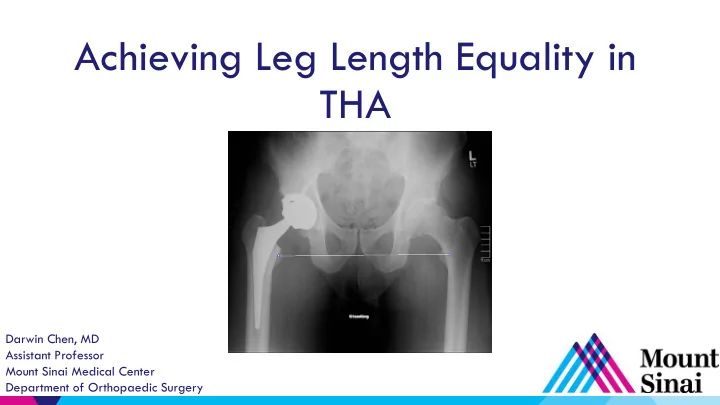
Achieving Leg Length Equality in THA Darwin Chen, MD Assistant - - PowerPoint PPT Presentation
Achieving Leg Length Equality in THA Darwin Chen, MD Assistant Professor Mount Sinai Medical Center Department of Orthopaedic Surgery Disclosures Monogram Orthopedics Consultant Conformis Medical advisory board, consultant
Achieving Leg Length Equality in THA
Disclosures
Leg Length Inequality
▶ One of the most vexing problems in THA ▶ Hard to define – Less than 1mm, 5mm,10mm? – Patient perception? ▶ Prevalence unknown ▶ 32-44% patients perceive LLD postop – Shortening < 10mm – Lengthening > 6mm Ranawat, J Arthroplasty 2001 Woolson, J Arthroplasty 1999 Hoffman, Orthpedics 2000 McGrory, JBJS 1995 Why is Leg Length Inequality Important?
▶ Abnormal gait ▶ LBP, knee pain
▶ Nerve palsy ▶ Shoe wear ▶ Dissatisfaction ▶ Most common reason for litigation after THA! Clark, JAAOS 2006 Today’s Routine, Primary THA Should Be “Perfect”
▶ “…patients very soon become adjusted to 1cm of over-lengthening.”
▶ A pain free THA isn’t good enough anymore ▶ Happy patient = – No pain Preoperative History and Physical Exam
▶ Do your legs feel equal? ▶ PMHx – Spinal deformity/fusion – Prior trauma – Neuromuscular disorder – DDH ▶ Exam – Pelvic obliquity – Flexion contracture – Shoe modification Preoperative History and Physical Exam
▶ True leg length – ASIS to medial malleolus ▶ Apparent leg length – umbilicus to medialmalleolus
*Preop* *Postop* Templating is the Key to THA Success
▶ Goal – restore hip center of rotation, recreate offset, correct LLD ▶ Determine – Neck cut level – Acetabular position – Stem size and offset Templating is the Key to THA Success
▶ Proper AP femur – 15º IR ▶ Proper marker ball placement 15º IR “Ball on ball” sign Improper marker ball placement Templating is the Key to THA Success
Intraoperative Instability
▶ Don’t let intraoperative instability make you lengthen theleg…look for other sources!
Posterior Approach – LLD Assessment
▶ Knee/heel assessment – Subjective, dependent on leg shape, pelvic position – Feel before neck cut, compare with template – Compare with trials ▶ “Shuck” test – Unreliable – Dependent on relaxation, soft tissue quality/contractures Posterior Approach – LLD Assessment
▶ “L to C” - lesser trochanter to center of femoral head Posterior Approach – LLD Assessment
▶ Bent Steinmann pin Mcgee, Scott, CORR 1985 Posterior Approach – LLD Assessment
▶ Calipers/tools Direct Anterior Approach – Improved Leg Lengths?
▶ Trans-ischial or trans-teardrop line Direct Anterior Approach – Improved Leg Lengths?
▶ Off-table, direct assessment K Berend Direct Anterior Approach – Improved Leg Lengths?
▶ Overlay method J Matta Does Advanced Technology Help?
Does Advanced Technology Help?
June 2015 “Robot-assisted posterior THA, fluoroscopy-guided anterior THA, and conventional posterior THA did not differ in obtaining minimal LLD. All three techniques are effective in achieving accuracy in LLD.” Conclusions
▶ Preoperative templating is critical to restoring leg length and offset ▶ Posterior – lesser to center, calipers, pins, knee/heel ▶ Anterior – fluoroscopy, overlay, direct supine assessment ▶ A robotic/navigation system can help but is unnecessary and addsexcessive cost
Thank You
Darwin Chen, MD Assistant Professor Mount Sinai Medical Center Department of Orthopaedic Surgery