Accommodation Plan ___________________________________ - - PDF document

accommodation plan
SMART_READER_LITE
LIVE PREVIEW

Accommodation Plan ___________________________________ - - PDF document

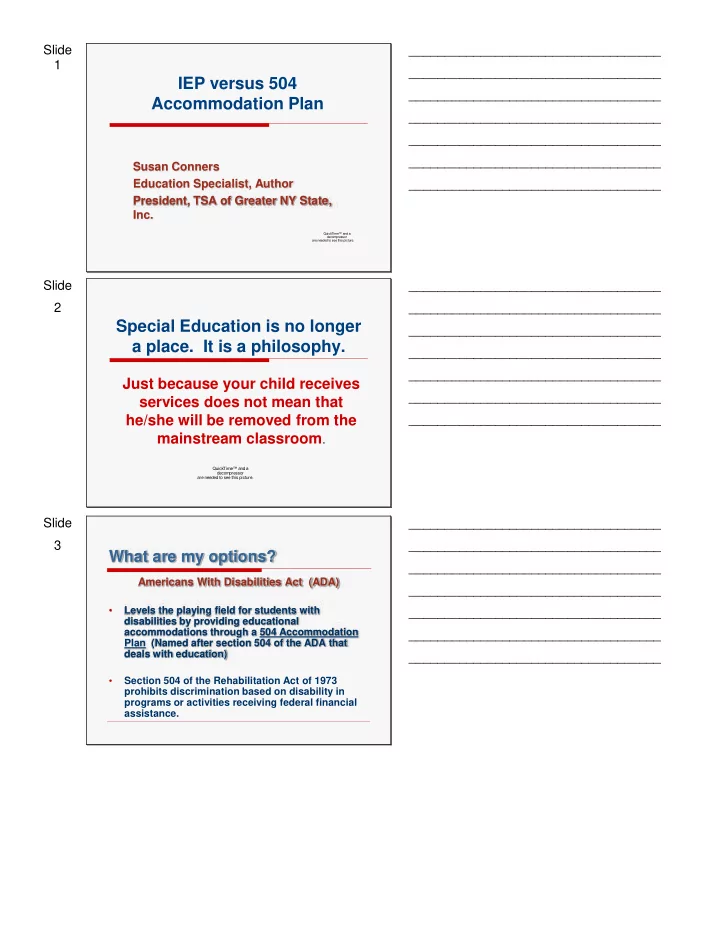
Slide ___________________________________ 1 ___________________________________ IEP versus 504 ___________________________________ Accommodation Plan ___________________________________ ___________________________________


slide-1
SLIDE 1

Slide 1

IEP versus 504 Accommodation Plan

Susan Conners Education Specialist, Author President, TSA of Greater NY State, Inc.

QuickTime™ and a decompressor are needed to see this picture.

___________________________________ ___________________________________ ___________________________________ ___________________________________ ___________________________________ ___________________________________ ___________________________________ Slide 2

Special Education is no longer a place. It is a philosophy.

Just because your child receives services does not mean that he/she will be removed from the mainstream classroom.

QuickTime™ and a decompressor are needed to see this picture.

___________________________________ ___________________________________ ___________________________________ ___________________________________ ___________________________________ ___________________________________ ___________________________________ Slide 3

What are my options?

Americans With Disabilities Act (ADA)

  • Levels the playing field for students with

disabilities by providing educational accommodations through a 504 Accommodation Plan (Named after section 504 of the ADA that deals with education)

  • Section 504 of the Rehabilitation Act of 1973

prohibits discrimination based on disability in programs or activities receiving federal financial assistance.

___________________________________ ___________________________________ ___________________________________ ___________________________________ ___________________________________ ___________________________________ ___________________________________

slide-2
SLIDE 2

Slide 4

Individuals With Disabilities Education Act (IDEA)

  • Provides an Individualized Education Plan (IEP) -

Accommodations plus direct services of a special education teacher or other service providers (OT, Speech, Counseling, etc.)

___________________________________ ___________________________________ ___________________________________ ___________________________________ ___________________________________ ___________________________________ ___________________________________ Slide 5

IDEA 2004 & FEDERAL REGULATIONS 300.8 (c ) (9)

“We believe that Tourette Syndrome is commonly misunderstood to be a behavioral or emotional condition, rather than a neurological condition. Therefore including TS in the definition of OHI (Other Health Impaired) may help correct the misconception of TS as a behavioral or conduct disorder and prevent the misdiagnosis of their needs.”

___________________________________ ___________________________________ ___________________________________ ___________________________________ ___________________________________ ___________________________________ ___________________________________ Slide 6

How Does My Child Qualify?

  • Not all children with TS will be eligible for special education

and an IEP. Some will merely require modifications or accommodations through a 504 Plan

  • Some will require a higher level of services through an IEP
  • Some schools will refuse an IEP at first request. It’s best to

accept the 504 Plan to at least get accommodations. If that doesn’t work, you have the rationale to then insist on an IEP

___________________________________ ___________________________________ ___________________________________ ___________________________________ ___________________________________ ___________________________________ ___________________________________

slide-3
SLIDE 3

Slide 7

How do I know that my child might need services?

  • A decline in grades

  • Increased frustration

  • Decrease in the child's self esteem

  • Social difficulties

  • A negative attitude about school

  • School avoidance/phobia
  • Behavioral issues at school

  • Increase in TS symptoms due to stress or anxiety

  • Difficulties at home that are a direct result of school issues

QuickTime™ and a decompressor are needed to see this picture.

___________________________________ ___________________________________ ___________________________________ ___________________________________ ___________________________________ ___________________________________ ___________________________________ Slide 8

Possible Accommodations Under a 504 Plan

  • Extended time on tests/assignments
  • Testing in a separate location
  • Extra set of textbooks at home
  • Preferential seating
  • Access to a computer for long written assignments
  • In service on TS for all staff working with the child
  • Extra locker to assist with organization
  • Use of a scribe
  • Books on tape
  • Use of technology

___________________________________ ___________________________________ ___________________________________ ___________________________________ ___________________________________ ___________________________________ ___________________________________ Slide 9

Examples of Specific Tics/Obsessions and How They May Interfere

  • Student has a head-shaking tic that happens every few

seconds that interferes with his/her ability to stay focused

  • n the exam. It is also a tic that slows down the entire

test taking process.

  • Student has an eye blinking tic and other facial tics that

make it difficult to keep his/her place and not only slows down the test taking process, but also makes it difficult to transfer answers from the test booklet to the scantron sheet with accuracy.

  • Student has a tic that makes him/her twist both wrists over

and over again several times a minute which makes it impossible for him/her to hold a pencil and write fluidly.

  • Student has an obsession to count every word in every line

that he/she reads. This makes test taking very slow and laborious. .

___________________________________ ___________________________________ ___________________________________ ___________________________________ ___________________________________ ___________________________________ ___________________________________

slide-4
SLIDE 4

Slide 10

  • Student has been diagnosed with ADHD and is therefore

very distractible in a large room setting.

  • Student needs extra time and frequent breaks because
  • f motor and vocal tics that interfere and/or ADHD that

causes him/her to be very fidgety.

  • Student has loud screeching vocal tic which will most

likely interfere with the other students’ concentration during the test.

  • Student has an obsession to make sure that the bubble
  • n the scantron sheet is filled in completely and that the

pencil mark dose not go outside of the circle causing him/her to take hours to complete the scantron sheet.

  • Student has significant handwriting deficits which make

writing slow, laborious and sloppy. He/she also has visual motor deficits which makes the transferring of answers to the scantron sheet accurately almost impossible.

___________________________________ ___________________________________ ___________________________________ ___________________________________ ___________________________________ ___________________________________ ___________________________________ Slide 11

REMEMBER

You are an equal member of the 504 or IEP team

___________________________________ ___________________________________ ___________________________________ ___________________________________ ___________________________________ ___________________________________ ___________________________________ Slide 12

What are some reasons why students with TS need services?

  • Interfering tics
  • Interfering obsessions and compulsions
  • Dysgraphia (Handwriting Difficulties)
  • Attentional Deficits
  • Short term memory deficits
  • Social skills deficits
  • Processing deficits
  • Hyperactivity
  • Behavioral issues
  • Executive Dysfunction (Organizational Difficulties)

QuickTime™ and a decompressor are needed to see this picture.

___________________________________ ___________________________________ ___________________________________ ___________________________________ ___________________________________ ___________________________________ ___________________________________

slide-5
SLIDE 5

Slide 13 2008 AMENDMENT TO THE ADA

This new amendment emphasizes that the definition of disability should be construed in favor of broad coverage of individuals to the maximum extent permitted by the terms of the ADA and generally shall not require extensive analysis. The effect of these changes is to make it easier for an individual seeking protection under the ADA to establish that he or she has a disability within the meaning of the ADA.

QuickTime™ and a decompressor are needed to see this picture.

___________________________________ ___________________________________ ___________________________________ ___________________________________ ___________________________________ ___________________________________ ___________________________________ Slide 14

Recent Changes to 504 Eligibility (2009)

Major Life Activity:

The Act restores the original definition of disability intended by Congress to the disability "substantially (actually, truly) limits a major life activity instead of prior wording "significantly" (of utmost importance) which some schools are using.

QuickTime™ and a decompressor are needed to see this picture.

___________________________________ ___________________________________ ___________________________________ ___________________________________ ___________________________________ ___________________________________ ___________________________________ Slide 15

Definition - Major Life Activity

‘Major life activities’, as defined in the Section 504 regulations at 34 C.F.R. 104.3(j)(2)(ii), include functions such as caring for one's self, performing manual tasks, walking, seeing, hearing, speaking, breathing, learning, and working. This list is not

  • exhaustive. Other functions can be major life

activities for purposes of Section 504. With these amendments, Congress provided additional examples of major life activities, including eating, sleeping, standing, lifting, bending, reading, concentrating, thinking, and communicating.

___________________________________ ___________________________________ ___________________________________ ___________________________________ ___________________________________ ___________________________________ ___________________________________

slide-6
SLIDE 6

Slide 16

Inconsistent Symptoms

The law now states that an impairment that is episodic or in remission is a disability if it would substantially limit a major life activity when active.

Quic k Tim e™ and a dec om pres s or are needed to s ee this pic t

___________________________________ ___________________________________ ___________________________________ ___________________________________ ___________________________________ ___________________________________ ___________________________________ Slide 17

Disability Can Impact Just One Major Life Activity

  • An impairment may limit only one major life activity and still be

considered a disability.

  • A student who has difficulty with written ‘communication’ may

still qualify as having a disability even if he/she does well academically and it does not impact ‘learning’.

QuickTime™ and a decompressor are needed to see this picture.

___________________________________ ___________________________________ ___________________________________ ___________________________________ ___________________________________ ___________________________________ ___________________________________ Slide 18

Symptom Management and ‘Mitigating Measures’

A student may still qualify for a 504 Plan even when the symptoms are being managed with medication, specific strategies, or undocumented supports.

QuickTime™ and a decompressor are needed to see this picture.

___________________________________ ___________________________________ ___________________________________ ___________________________________ ___________________________________ ___________________________________ ___________________________________

slide-7
SLIDE 7

Slide 19

Intelligence / Performance

Many students are mistakenly denied eligibility because of their above average grades and/or high achievement assessment

  • scores. Section 504 states that students can be found to be

eligible, "regardless of their intelligence", if the disability results in students being unable to fully demonstrate their ability.

Impact on Educational Performance, Learning, Social/Emotonal Behavior & Functioning

QuickTime™ and a decompressor are needed to see this picture.

___________________________________ ___________________________________ ___________________________________ ___________________________________ ___________________________________ ___________________________________ ___________________________________ Slide 20

IEP Process

  • Parents or school district staff can make a referral and request an

evaluation; parents agree in writing.

  • Evaluations completed. Eligibility decision made at IEP Meeting

(NOT IN ADVANCE)

  • Eligible for services
  • IEP Developed, Placement, Services , Goals and Accommodations

Determined

QuickTime™ and a decompressor are needed to see this picture.

___________________________________ ___________________________________ ___________________________________ ___________________________________ ___________________________________ ___________________________________ ___________________________________ Slide 21

Time Frame

In most states the school district has 60 school days from the receipt of the written request for evaluation to have completed all evaluations, scheduled an IEP meeting and have a program in place.

QuickTime™ and a decompressor are needed to see this picture.

___________________________________ ___________________________________ ___________________________________ ___________________________________ ___________________________________ ___________________________________ ___________________________________

slide-8
SLIDE 8

Slide 22

IDEA 2004

  • Sec. 300.304(c)(4)Sec. 300.304(c)(4)

The child is assessed in all areas related to the suspected disability, including, if appropriate, health, vision, hearing, social and emotional status, general intelligence, academic performance, communicative status, and motor abilities;

___________________________________ ___________________________________ ___________________________________ ___________________________________ ___________________________________ ___________________________________ ___________________________________ Slide 23

WHAT EVALUATIONS DO I ASK FOR?

  • Occupational Therapy Evaluation for Dysgraphia
  • Sensory Evaluation
  • Executive Function Evaluation
  • Auditory Processing
  • Full Psychological Evaluation
  • Assistive Technology **
  • Functional Behavioral Assessment ++

IDEA states: Sec. 614(b)(3)(B) The child is assessed in all areas related to the suspected disability

QuickTime™ and a decompressor are needed to see this picture.

___________________________________ ___________________________________ ___________________________________ ___________________________________ ___________________________________ ___________________________________ ___________________________________ Slide 24

  • Sec. 300.324 Development, review, and

revision of IEP.

  • General. In developing each child's IEP, the

IEP Team must consider-

  • The academic, developmental, and functional

needs of the child.

___________________________________ ___________________________________ ___________________________________ ___________________________________ ___________________________________ ___________________________________ ___________________________________

slide-9
SLIDE 9

Slide 25

RULES TO FOLLOW

  • Always put your request in writing to the director of special

education for the district and/or the school principal

  • Always try to bring someone from your local TSA or an

advocate with you to the first meeting and remember that you have the right to take the IEP/504 Plan home with you and have it reviewed before agreeing to it.

  • Obtain information available through TSA, Inc. Assume that

most of your child’s teachers know little about TS and the accompanying disorders. Do your homework and be prepared to educate school personnel about TS, related disorders and the approach that is most effective for your child.

___________________________________ ___________________________________ ___________________________________ ___________________________________ ___________________________________ ___________________________________ ___________________________________ Slide 26

SAMPLE SCHOOL LETTER

Dear ______________,
 My child, ________________, has recently been diagnosed with Tourette Syndrome by Dr.___________. Tourette Syndrome is a neurological spectrum disorder which is almost always accompanied by other neurological disorders. My child has thus also been diagnosed with (LIST RELATED DISORDERS). I have

  • bserved the impact that all of these disorders are having on

his/her academic performance and social emotional well being. I have also learned from TS literature that a very large number of children with TS also exhibit learning disabilities especially in the area of non-verbal learning. These disabilities very often include sensory issues, processing difficulties and dysgraphia (difficulty with written language).

I am therefore requesting that my child be observed and receive a complete psycho-educational evaluation by the school psychologist as the first step in seeking from the IEP Team a classification of Other Health Impaired.

___________________________________ ___________________________________ ___________________________________ ___________________________________ ___________________________________ ___________________________________ ___________________________________ Slide 27

Sample School Letter, Cont’d

I am also requesting evaluations in the following area(s) that I suspect as being areas of deficit. (LIST SPECIFIC AREAS OF DIFFICULTIES) I am including a letter of diagnosis from the treating physician and materials from the Tourette Syndrome Association to be shared with my child’s teachers and the school psychologist. In the interim, I will be more than happy to meet with school personnel working with my child to discuss what behaviors he/she may be exhibiting in the classroom as a result of this diagnosis and what educators can do to assist. Thank you for your prompt attention to this matter. I look forward to hearing from you soon and to working together with school personnel to provide an optimum learning environment for my child.
 Sincerely,

___________________________________ ___________________________________ ___________________________________ ___________________________________ ___________________________________ ___________________________________ ___________________________________

slide-10
SLIDE 10

Slide 28

Sample Physician’s Letter

To Whom it May Concern: ___________ is currently under my care and has been diagnosed with (Tourette Syndrome, ADHD, OCD, etc.). All of these disorders are having a negative impact on ________ performance in

  • school. The following tics/ obsessions (be specific) that he/she is

currently exhibiting are interfering with his ability to (read, write, complete assignments in a timely fashion). The symptomology of ADHD is also proving to impact negatively on his/her academic performance. He/She is unable to organize materials appropriately, is very distracted by external stimuli, cannot complete assignments on time, is getting into trouble because of his/her impulsiveness and is under great stress socially because of the nature of his/her tics.

QuickTime™ and a decompressor are needed to see this picture.

___________________________________ ___________________________________ ___________________________________ ___________________________________ ___________________________________ ___________________________________ ___________________________________ Slide 29

Physician’s Letter Cont’d

It is my recommendation that a full battery of psycho-educational testing be administered by the school and/or by an outside neuropsychologist to test for the following disabilities that are very common with children diagnosed with TS:

  • Fine Motor/Visual Motor Impairment (Usually administered by an

Occupational Therapist)

  • Central Auditory Processing
  • Language Processing
  • Memory Skills
  • Executive Function

__________ is also currently taking the following medications that may be affecting his ability to attend properly in the classroom. I will be available for further consultation once the testing process has been completed to assist in making specific recommendations for _________ IEP.

___________________________________ ___________________________________ ___________________________________ ___________________________________ ___________________________________ ___________________________________ ___________________________________ Slide 30

Possible IEP Services

  • Resource Room
  • Consultant Teacher Services - Direct
  • Consultant Teacher Services - Indirect
  • Co-Taught / Blended Classroom
  • Special Education Classroom
  • OT, PT, Speech, Counseling, etc.
  • Out of District Placement

___________________________________ ___________________________________ ___________________________________ ___________________________________ ___________________________________ ___________________________________ ___________________________________

slide-11
SLIDE 11

Slide 31

LEAST RESTRICTIVE ENVIRONMENT / LRE The child must be educated in the least restrictive environment that can accommodate his/her needs.

___________________________________ ___________________________________ ___________________________________ ___________________________________ ___________________________________ ___________________________________ ___________________________________ Slide 32

Accommodations

  • Accommodations under an IEP can be the same

as under a 504 Plan.

  • They must address all academic, developmental,

and functional needs of the child.

  • Be creative. Use the resources given at the end.

___________________________________ ___________________________________ ___________________________________ ___________________________________ ___________________________________ ___________________________________ ___________________________________ Slide 33

What If I Don’t Agree with the Evaluation?

  • 300.103.(b) Parent right to evaluation at public expense
  • A parent has the right to an independent educational

evaluation at public expense if the parent disagrees with an evaluation obtained by the school district

QuickTime™ and a decompressor are needed to see this picture.

___________________________________ ___________________________________ ___________________________________ ___________________________________ ___________________________________ ___________________________________ ___________________________________

slide-12
SLIDE 12

Slide 34

IEP Team

Federal Law Requires:

  • Parent / Child (where appropriate)
  • Regular Ed Teacher
  • Special Ed Teacher
  • School Representative
  • School Psychologist (Someone to interpret Evaluations)
  • At the discretion of the parent or the agency, other individuals who

have knowledge or special expertise regarding the child, including related services personnel as appropriate

QuickTime™ and a decompressor are needed to see this picture.

___________________________________ ___________________________________ ___________________________________ ___________________________________ ___________________________________ ___________________________________ ___________________________________ Slide 35

REMEMBER

You are an equal member of the IEP team

___________________________________ ___________________________________ ___________________________________ ___________________________________ ___________________________________ ___________________________________ ___________________________________ Slide 36

A Word to the Wise

Do not accept a refusal for classification based

  • n the following reasons:
  • Your child does not qualify as Learning Disabled. This doesn’t

apply because you are not seeking a classification of LD, but OHI.


  • Your child does not qualify for services because he is receiving

good grades or not failing. Federal law states that special education cannot be denied because a student is receiving passing grades and/or progressing from grade to grade. Additionally the Law states that a student’s developmental and functional progress must be taken into consideration in addition to academic performance.

___________________________________ ___________________________________ ___________________________________ ___________________________________ ___________________________________ ___________________________________ ___________________________________

slide-13
SLIDE 13

Slide 37

(RTI ) Response to Intervention

  • If a parent requests in writing that their child

be evaluated for either a 504 Plan or an IEP, the school cannot use the RTI process to delay the evaluation of that child. The process of determining whether the child qualifies for services either under the ADA or the IDEA must follow the required time frame

  • nce the referral has been made.

___________________________________ ___________________________________ ___________________________________ ___________________________________ ___________________________________ ___________________________________ ___________________________________ Slide 38

Resources

Contact me for the following brochures:

  • Getting Help at School - Where Do I Begin?
  • The ABC’s of Special Education
  • Section 504, the Americans with Disabilities Act (ADA)
vs.
The Individuals

with Disabilities Education Act (IDEA)
What is the Difference?

  • Catalog of Accommodations
  • Functional Behavioral Assessment Workbook
  • The IEP for Students with TS - A Parent’s Guide
  • The IEP for Students with TS - A Teacher’s Guide

Email me at conners@roadrunner.com for any of these resources

QuickTime™ and a decompressor are needed to see this picture.

___________________________________ ___________________________________ ___________________________________ ___________________________________ ___________________________________ ___________________________________ ___________________________________ Slide 39

Available at Amazon.com, Barnes and Noble and many other bookstores

___________________________________ ___________________________________ ___________________________________ ___________________________________ ___________________________________ ___________________________________ ___________________________________

slide-14
SLIDE 14

Slide 40

Compliance Issues

Contact the Quality Assurance Office of your state education department to file a complaint or locate the compliance officer for your school district.

QuickTime™ and a decompressor are needed to see this picture.

___________________________________ ___________________________________ ___________________________________ ___________________________________ ___________________________________ ___________________________________ ___________________________________ Slide 41

Contact Information

Susan Conners conners@roadrunner.com

___________________________________ ___________________________________ ___________________________________ ___________________________________ ___________________________________ ___________________________________ ___________________________________