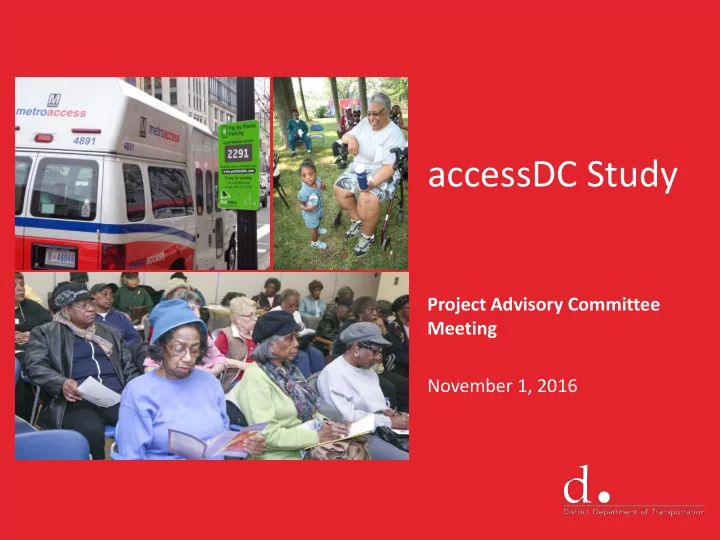
accessDC Study Project Advisory Committee Meeting November 1, 2016 - - PowerPoint PPT Presentation

accessdc study
SMART_READER_LITE
LIVE PREVIEW

accessDC Study Project Advisory Committee Meeting November 1, 2016 - - PowerPoint PPT Presentation

accessDC Study Project Advisory Committee Meeting November 1, 2016 Meeting Agenda Introduction and Study Goals 1:00 pm 1:20 pm Study Scope, Deliverables & 1:20 pm 1:50 pm Schedule Role of the PAC / Questions 1:50 pm


slide-1
SLIDE 1

accessDC Study

Project Advisory Committee Meeting November 1, 2016

slide-2
SLIDE 2

Meeting Agenda

■ Introduction and Study Goals ■ Study Scope, Deliverables & Schedule ■ Role of the PAC / Questions ■ Summary of Linkages ■ Questions from the Community ■ Next Steps

accessDC Study: November Project Advisory Committee Meeting

2

1:00 pm – 1:20 pm 1:20 pm – 1:50 pm 1:50 pm – 2:05 pm 2:05 pm – 2:35 pm 2:35 pm – 2:50 pm 2:50 pm – 3:00 pm

slide-3
SLIDE 3

Introduction and Study Goals

slide-4
SLIDE 4

Project Goals

The accessDC Study will identify ways to give people with disabilities and older adults in the District of Columbia better access to multiple transportation services, allowing for greater mobility with dignity and independence, and easier integration in the community. We also want to determine the extent to which the inclusion of older adults and people with disabilities in an advisory and decision-making capacity positively contributes to the outcome of the project.

accessDC Study: November Project Advisory Committee Meeting

4

slide-5
SLIDE 5

Study Scope, Deliverables & Schedule

slide-6
SLIDE 6

Study Schedule

accessDC Study: November Project Advisory Committee Meeting

6

slide-7
SLIDE 7

Project Kick-Off

accessDC Study: November Project Advisory Committee Meeting

7

■ Develop a detailed work plan and outreach plan ■ Establish Project Advisory Committee ■ Initial public outreach

– Stakeholder/Customer Survey(s) – Open Mic Session #1 – Project web page

www.ddot.dc.gov/page/accessdc-study

Strategies and Recommendations Project Kick-Off Identify Existing Conditions Final Report

slide-8
SLIDE 8

Stakeholder/Customer Survey

accessDC Study: November Project Advisory Committee Meeting

8

■ Provides insight into how people travel and what trips and trip purposes are currently poorly served ■ Establishes a baseline to determine the success of project recommendations ■ Administered online and in-person at Open Mic Sessions ■ Compliant with Section 508

Strategies and Recommendations Project Kick-Off Identify Existing Conditions Final Report

slide-9
SLIDE 9

Open Mic Sessions

accessDC Study: November Project Advisory Committee Meeting

9

■ Opportunity for customers and stakeholders to “voice” their opinions on unmet needs and study recommendations ■ Provides additional depth to survey results ■ Each speaker provides two minutes of commentary

Strategies and Recommendations Project Kick-Off Identify Existing Conditions Final Report

slide-10
SLIDE 10

Identify Existing Conditions

accessDC Study: November Project Advisory Committee Meeting

10

■ Collect and review existing plans, studies, and reports ■ Collect data on existing services and needs ■ Document unmet needs ■ Prepare and present existing conditions report

Strategies and Recommendations Project Kick-Off Identify Existing Conditions Final Report

slide-11
SLIDE 11

Questions We Want to Answer

accessDC Study: November Project Advisory Committee Meeting

11

■ What types of services and programs are available in the District? ■ How do customers use these available services? Where are people going? ■ What trips and trip purposes can’t be served with existing options?

Strategies and Recommendations Project Kick-Off Identify Existing Conditions Final Report

slide-12
SLIDE 12

Strategies and Recommendations

accessDC Study: November Project Advisory Committee Meeting

12

■ Identify national best practice strategies ■ Develop, screen, and evaluate alternatives ■ Prepare, present, and discuss alternative strategies ■ Reach consensus on recommendations

Strategies and Recommendations Project Kick-Off Identify Existing Conditions Final Report

slide-13
SLIDE 13

Examples of Potential Strategies

accessDC Study: November Project Advisory Committee Meeting

13

■ Small improvements or “fixes” to existing services ■ Mobility management efforts ■ Coordination of existing education/outreach efforts ■ Linkages

– Continuum of Functionality

Strategies and Recommendations Project Kick-Off Identify Existing Conditions Final Report

slide-14
SLIDE 14

Final Report

accessDC Study: November Project Advisory Committee Meeting

14

■ Final report includes:

– Operational Design and Financial Plan – Implementation Plan – Monitoring\Evaluation Plan

Strategies and Recommendations Project Kick-Off Identify Existing Conditions Final Report

slide-15
SLIDE 15

Operational Design and Financial Plan

accessDC Study: November Project Advisory Committee Meeting

15

■ Administrative cost projections ■ Operating and capital cost projections ■ Funding sources ■ Cost sharing strategies

Strategies and Recommendations Project Kick-Off Identify Existing Conditions Final Report

slide-16
SLIDE 16

Implementation Plan

accessDC Study: November Project Advisory Committee Meeting

16

■ Identifies actions steps necessary for implementing recommendations ■ Clear prioritization and timelines

– Activities occurring prior to implementation – Activities occurring during implementation – Activities occurring following implementation

Strategies and Recommendations Project Kick-Off Identify Existing Conditions Final Report

slide-17
SLIDE 17

Monitoring\Evaluation Plan

accessDC Study: November Project Advisory Committee Meeting

17

■ Guidelines for evaluating the success of study recommendations

– Specific performance measures – Data collection and tracking methods

■ Did the participatory design of this study lead to better outcomes?

Strategies and Recommendations Project Kick-Off Identify Existing Conditions Final Report

slide-18
SLIDE 18

Study Schedule

accessDC Study: November Project Advisory Committee Meeting

18

slide-19
SLIDE 19

Role of the PAC / Questions

slide-20
SLIDE 20

PAC Composition

■ 2 members who are older adults ■ 3 members who are people with disabilities ■ 1 member from the DC Office on Aging ■ 1 member from the Department of Healthcare Finance ■ 1 member from the Washington Metropolitan Area Transit Authority ■ 1 member from the Department of For Hire Vehicles

accessDC Study: November Project Advisory Committee Meeting

20

slide-21
SLIDE 21

PAC Member Responsibilities

■ Attend 4 to 6 PAC and public meetings ■ Advise staff on the public outreach process ■ Encourage diverse opinions and help increase participation in the process ■ Help interpret public input in identifying issues and developing solutions ■ Review technical memos and reports and provide feedback to staff in a timely manner

accessDC Study: November Project Advisory Committee Meeting

21

slide-22
SLIDE 22

Summary of Linkages

slide-23
SLIDE 23

There are many types of transportation customers…

accessDC Study: November Project Advisory Committee Meeting

23

Persons with Disabilities Seniors Veterans Low-Income General Population

slide-24
SLIDE 24

…traveling for many different trip purposes…

accessDC Study: November Project Advisory Committee Meeting

24

Work/Training Shopping/Recreation Dialysis Medical Appointments Human Services

slide-25
SLIDE 25

…that can be served by a wide range of transportation modes and services, each with different requirements and constraints.

accessDC Study: November Project Advisory Committee Meeting

25

Fixed Route and Flex Transit

ADA Complementary Paratransit Dial-A-Ride Services

Human Services Transportation

Senior Transportation

Veterans Transportation Taxicabs and Livery Services

Private-For-Pay Chair Car Services

Transportation Network Companies (Lyft/Uber)

Carpools/Vanpools

Voucher/Subsidy Programs

Volunteer Driver Programs

Medicaid Non- Emergency Medical Transportation

slide-26
SLIDE 26

What is a Linkage?

Linkages can assist transportation users in finding the transportation service that will best meet their current travel needs.

accessDC Study: November Project Advisory Committee Meeting

26

■ One-stop shopping via phone or internet ■ More accurate and accessible information about transportation services. ■ Many styles and functions ■ Some using mobile technologies

slide-27
SLIDE 27

Continuum of Linkage Functionality

accessDC Study: November Project Advisory Committee Meeting

27

1 5 3 4 2 Central Repository Matching Assistance Trip Planning Assistance Trip Booking Assistance Direct Trip Booking

slide-28
SLIDE 28

Continuum of Linkage Functionality

accessDC Study: November Project Advisory Committee Meeting

28

Level Name Functionality Description 1

Central Repository Creation of -- or linkage with existing -- centralized repository of transportation resources Static, hard copy listing of services and programs distributed or accessed via phone or web-site

1A

Provider Portal + provider portal Service providers can update their information at any time

2

Matching Assistance + ways to narrow down service and program

  • ptions

Customers supply search criteria or answer “triage questions” asked by mobility specialist (call-taker) or prompted by on-line system to reduce providers to viable options

3

Trip Planning Assistance + trip planning assistance Customers use on-line system or call mobility specialists (who use the on-line system) to get detailed ways to make a particular trip

4

Trip Booking Assistance + trip booking by mobility specialists Mobility specialists call provider to book trip

  • n behalf of the customer

5

Direct Trip Booking + trip booking by customer Via links to paratransit systems (One system allows provider scheduler to schedule trip onto a partners’ vehicle run)

slide-29
SLIDE 29

Central Repository

Static, hard copy listing of services and programs distributed via phone or website

accessDC Study: November Project Advisory Committee Meeting

29

1

■ Provides a centralized source of information ■ Works best in communities with limited services that remain constant over time

slide-30
SLIDE 30

Will County, IL – Residency and Eligibility

accessDC Study: November Project Advisory Committee Meeting

30

1

slide-31
SLIDE 31

Will County, IL – Client Eligibility by Provider

accessDC Study: November Project Advisory Committee Meeting

31

1

slide-32
SLIDE 32

Will County, IL – Provider Summaries

accessDC Study: November Project Advisory Committee Meeting

32

1

slide-33
SLIDE 33

Matching Assistance

Customers supply search criteria or answer “triage questions” to reduce providers to viable options

accessDC Study: November Project Advisory Committee Meeting

33

2

■ Allows customers to more easily identify services that may meet their needs ■ Not linked with schedule information, so more steps are needed to find a service that fits a specific trip ■ Often part of 211 systems

slide-34
SLIDE 34

211 LA County – Selection of Search Category

accessDC Study: November Project Advisory Committee Meeting

34

2

slide-35
SLIDE 35

211 LA County – Selection of Taxonomy Category

accessDC Study: November Project Advisory Committee Meeting

35

2

slide-36
SLIDE 36

211 LA County – Inputting Keywords

accessDC Study: November Project Advisory Committee Meeting

36

2

slide-37
SLIDE 37

211 LA County – Select from Service Options

accessDC Study: November Project Advisory Committee Meeting

37

2

slide-38
SLIDE 38

Trip Planning Assistance

Customers use online system or call mobility specialists to get detailed ways to make a particular trip

accessDC Study: November Project Advisory Committee Meeting

38

3

■ Works similarly to an online trip planner (like Google Maps) ■ Can be integrated with a wide variety of automated data sources (real-time transit, taxi databases, walk/bike directions, carpool matching) ■ Customers or mobility specialists still must contact service provider for trip booking

slide-39
SLIDE 39

211 Vetlink – Online Trip Planner

accessDC Study: November Project Advisory Committee Meeting

39

3

slide-40
SLIDE 40

211 Vetlink – Triage Questions

accessDC Study: November Project Advisory Committee Meeting

40

3

slide-41
SLIDE 41

211 Vetlink – Service Selection

accessDC Study: November Project Advisory Committee Meeting

41

3

slide-42
SLIDE 42

Trip Booking Assistance

Mobility specialists call provider to book trip on behalf

  • f the customer

accessDC Study: November Project Advisory Committee Meeting

42

4

■ Mobility specialists can both identify services and book trips for customers ■ Makes it easier for customers to make more complicated trips, such as those requiring a transfer ■ Can be linked with an online system, allowing mobility specialists to focus on most complex trips

slide-43
SLIDE 43

Direct Trip Booking

Customers directly book trips via links to paratransit systems

accessDC Study: November Project Advisory Committee Meeting

43

5

■ Customers and mobility specialists can book trips without contacting provider ■ Customers can create online user profiles, making it easier to find and book trips ■ Enhances awareness and reduces barriers to using new services and providers ■ Requires software integration amongst providers that often use different systems

slide-44
SLIDE 44

FindMyRide PA – Paratransit Booking

accessDC Study: November Project Advisory Committee Meeting

44

5

slide-45
SLIDE 45

What Linkages Exist in the District?

accessDC Study: November Project Advisory Committee Meeting

45

1 5 3 4 2 Central Repository Matching Assistance Trip Planning Assistance Trip Booking Assistance Direct Trip Booking Information and Referral Line

slide-46
SLIDE 46

What Functionality Would be Best for the District?

accessDC Study: November Project Advisory Committee Meeting

46

1 5 3 4 2 Central Repository Matching Assistance Trip Planning Assistance Trip Booking Assistance Direct Trip Booking

slide-47
SLIDE 47

Questions from the Community?

slide-48
SLIDE 48

Next Steps