Accelerating Multi- Modal and Small Project Delivery ASLA Board of - - PowerPoint PPT Presentation

accelerating multi modal and small project delivery
SMART_READER_LITE
LIVE PREVIEW

Accelerating Multi- Modal and Small Project Delivery ASLA Board of - - PowerPoint PPT Presentation

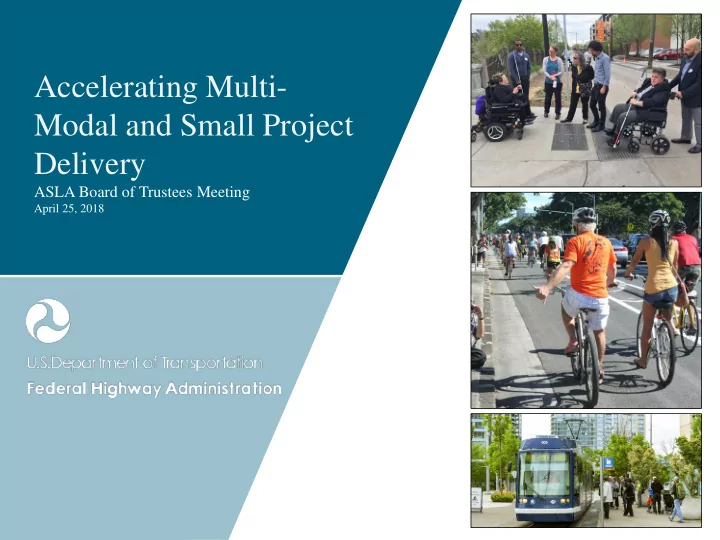
Accelerating Multi- Modal and Small Project Delivery ASLA Board of Trustees Meeting April 25, 2018 Available at www.fhwa.dot.gov/environment/bicycle_pedestrian Accelerating Multimodal and Small Project Delivery Regulatory Reform

slide-1
SLIDE 1

Accelerating Multi- Modal and Small Project Delivery

ASLA Board of Trustees Meeting

April 25, 2018

slide-2
SLIDE 2

Available at www.fhwa.dot.gov/environment/bicycle_pedestrian

slide-3
SLIDE 3

Accelerating Multimodal and Small Project Delivery

  • Regulatory Reform
  • Resources
  • Research and Work in progress
  • Partnerships
slide-4
SLIDE 4

National Context

FHWA

  • Execute transportation policies and practices

and deliver more integrated multimodal solutions.

  • Advance policies and practices that support

an integrated surface transportation system for all users that is efficient, equitable, and safe.

Background

  • Safety for all users
  • Connected pedestrian and bicycle networks
  • Design flexibility
  • Accelerated project delivery
  • Data to improve the planning process
slide-5
SLIDE 5

USDOT Strategic Plan for FY 2018-2022

GOALS Safety

  • Reduce Transportation-Related Fatalities and Serious Injuries Across

the Transportation System. Infrastructure

  • Invest in Infrastructure to Ensure Mobility and Accessibility and to

Stimulate Economic Growth, Productivity and Competitiveness for American Workers and Businesses. Innovation

  • Lead in the Development and Deployment of Innovative Practices and

Technologies that Improve the Safety and Performance of the Nation's Transportation System. Accountability

  • Serve the Nation with Reduced Regulatory Burden and Greater

Efficiency, Effectiveness and Accountability.

slide-6
SLIDE 6

Legislative Outline for Rebuilding Infrastructure in America

Proposal (pg 24):

Provide Small Highway Projects with Relief for the Same Federal Requirements as Major Projects

  • Currently, some smaller scale projects (e.g., those typically eligible for

transportation alternatives) funded under the Surface Transportation Block Grant Program must be treated as major highway projects, even if they are not located within the right-of-way of a Federal-aid highway (23 U.S.C. 133).

  • This means that smaller, simpler projects that could be implemented and open to

the public quickly often are delayed by lengthy procurement procedures and Federal requirements that are more appropriate for larger, more complex projects.

  • Amending this requirement for smaller projects that predominantly are outside

the Federal-aid highway right-of-way would eliminate Federal procurement requirements for these infrastructure projects. This would allow States to use their own procedures to implement these projects.

slide-7
SLIDE 7

Accelerating Project Delivery

Expediting Project Delivery Self-Assessment Workbook

  • Innovation
  • Regulatory flexibility
  • Risk-based Federal stewardship

and oversight

slide-8
SLIDE 8

Accelerating Project Delivery

slide-9
SLIDE 9

Real Estate Acquisition Best Practices

Excerpt BUILD Solicitation:

  • BUILD (3) all real property and right-of-way

acquisition will be completed in a timely manner in accordance with 49 CFR part 24, 23 CFR part 710, and other applicable legal requirements or a statement that no acquisition is necessary.

slide-10
SLIDE 10

Top Strategies for Accelerating Project Delivery Handbook

Key Focus of Handbook:

  • Provide effective strategies for

accelerating multimodal infrastructure delivery.

  • Highlight proven techniques.
  • Address barriers or delays in

project delivery, etc.

  • Completion date: Mid/Late June
slide-11
SLIDE 11

Center for Environmental Excellence (AASHTO)

Detailed case studies on streamlining the planning and implementation of bicycle and pedestrian projects

  • PennDOT Connects Initiative

– South Street Bridge Project – US 422 West Shore Bypass project

  • Connecticut DOT Community Connectivity Program

– Road Safety Audits – Taking Action to Improve Conditions

slide-12
SLIDE 12

Pedestrian and Bicycle Networks

  • Provide comfortable and safe

conditions walking and bicycling along and across roads.

  • Improve access to destinations such as

transit stations and schools.

  • Include seamless transitions between

different facilities.

  • Address the needs of the full range of

users.

  • Address barriers.
  • Be transportation focused.
  • Acknowledge surrounding land uses.
slide-13
SLIDE 13

Recent FHWA Pedestrian and Bicycle Resources

Available at www.fhwa.dot.gov/environment/bicycle_pedestrian

slide-14
SLIDE 14

Pedestrian and Bicycle Planning Resources

Available at www.fhwa.dot.gov/environment/bicycle_pedestrian

slide-15
SLIDE 15

Recently Released Coming Soon !

slide-16
SLIDE 16

http://pedbikesafe.org/BIKESAFE/ http://pedbikesafe.org/PEDSAFE/

Decision Support Tools and Capacity Building

slide-17
SLIDE 17

Decision Support Tools and Capacity Building

www.safety.fhwa.dot.gov/uslimits/

slide-18
SLIDE 18
slide-19
SLIDE 19

mutcd.fhwa.dot.gov

slide-20
SLIDE 20

Connecting Communities: Integrating Transportation and Recreation

  • We can connect and integrate transportation and

recreation infrastructure.

  • Trails: spines for transportation networks.
  • Transportation and Recreation isn’t either/or!
slide-21
SLIDE 21

Bridges and Tunnels: Essential Links for Networks

  • Long life spans: Plan for future demand, use, and reuse.
  • Bridges connect communities.
slide-22
SLIDE 22

Bridges and Tunnels: Essential Links for Networks

  • Reconnect communities.
  • Tunnels and underpasses.
slide-23
SLIDE 23

Community Connections is about using transportation innovations, partnerships, and technologies to bring communities together and to connect people to services and

  • pportunities.

Under the Every Day Counts program, FHWA is supporting urban, suburban, and rural communities that have been divided by past transportation investments and are currently experiencing gaps in existing transportation infrastructure and services. The Every Day Counts initiative features a toolbox with analytical tools, public involvement strategies, planning and design techniques, and operational improvements. The toolkit promotes performance management approaches for planning, project development, and design that support safety, connectivity, health, and community revitalization.

slide-24
SLIDE 24

What to expect in 2018

  • Technical assistance from SMEs with FHWA’s Headquarters Office and Resource Center
  • Peer learning through FHWA’s Transportation Planning Capacity Building Program
  • Community Connections handbook and case studies
  • New Community Connections website -

https://www.fhwa.dot.gov/planning/community_connections

  • Informational four-part webinar series (July-Oct)

For more information

  • Corbin Davis, 202-366-6072, Corbin.Davis@dot.gov
slide-25
SLIDE 25

Case Studies in Realizing Co-Benefits of Multimodal Roadway Design and Gray and Green Infrastructure

FHWA identified, evaluated, and categorized these green infrastructure case studies into several project types, including:

  • Mitigating Flood Risk
  • Public-Private Partnerships
  • Multimodal Network Connectivity
  • State and Locally Driven Projects

Johnson Street before (top) and after (bottom)

This report is intended to provide information to encourage agencies interested in making improvements to their pedestrian and bicycle networks that also provide green infrastructure and resiliency benefits. The discussion of storm water and mobility benefits will help communities better understand the variety of goals and outcomes they can achieve through their projects. https://www.fhwa.dot.gov/environment/bicycle_pedestrian/publications/multimodal_green_infrastructure/

slide-26
SLIDE 26

www.pedbikeinfo.org

slide-27
SLIDE 27
slide-28
SLIDE 28

Overview

  • 1. Introduction
  • 2. Connectivity

Analysis Process

  • 3. Fact Sheets on

Connectivity Analysis Methods and Measures

  • 4. Lessons Learned
  • 5. Bibliography

Appendix: Case Studies

Analysis Methods Case Studies

  • Atlanta Regional

Commission

  • City of Baltimore
  • CALTRANS -

District Four

  • City of Fort

Collins

  • Portland Metro
  • Network

Completeness

  • Network Density
  • Route Directness
  • Access to

Destinations

  • Network Quality
slide-29
SLIDE 29
slide-30
SLIDE 30

Filling Gaps

  • Scalable Risk Assessment

Methodology

– How to measure exposure to risk for walking and biking?

  • Bike Facility Selection Guide

– How to identify the most appropriate bike facilities?

  • Pedestrian and Bicycle

Transportation Pooled Fund

  • Safe Transportation for Every

Pedestrian (STEP-EDC-4)

  • Automation – AV/CV, SUM
slide-31
SLIDE 31

Partnering Themes

Local, Regional, State, and National Events/Outreach

  • Good Sketch Plans – considerate of ROW needs
  • State of practice - integrating new resources
  • Design Flexibility
  • Accelerating Project Delivery - emphasis areas
  • Urban vs. Rural Needs
  • Stand Alone, Bundled, or Major Project Scoping
  • Human and Natural Environment Impacts -

Benefits/Mitigation

  • Value Capture/Public-Private Financing
slide-32
SLIDE 32

2018 AASHTO Joint Policy Meeting

The 2018 AASHTO Joint Policy Meeting in Spokane,

  • Washington. The conference will take place July 17-20.
  • Committee on Data Management and Analytics
  • Committee on Environmental and Sustainability
  • Committee on Funding and Finance
  • Committee on Planning
  • Council on Active Transportation
  • Special Committee on Freight
slide-33
SLIDE 33

33

Selected Contacts

Gary Jensen Office of Planning, Environment, and Realty Gary.Jensen@dot.gov Christopher Douwes Office of Planning, Environment, and Realty Christopher.Douwes@dot.gov Gabe Rousseau Office of Safety Gabe.Rousseau@dot.gov Elizabeth Hilton Office of Infrastructure Elizabeth.Hilton@dot.gov Dave Kirschner Office of Operations David.Kirschner@dot.gov FHWA Division Office Pedestrian and Bicycle Points

  • f Contact

www.fhwa.dot.gov/environment/bicycle_pedestrian/s tate_fhwa_contacts State DOT Pedestrian and Bicycle Coordinators https://www.fhwa.dot.gov/environment/bicycle_pede strian/state_contacts For More Information: www.fhwa.dot.gov/environment/bicycle_pedestrian