About These Slides Presented at the South Atlantic Fire Rescue - - PDF document

about these slides
SMART_READER_LITE
LIVE PREVIEW

About These Slides Presented at the South Atlantic Fire Rescue - - PDF document

About These Slides Presented at the South Atlantic Fire Rescue Expo in Raleigh, in August 2011 Expanded with slides listing spoken comments. North Carolina Firefighting History Expanded with additional details and slides in


slide-1
SLIDE 1

1

North Carolina Firefighting History

Presented by Mike Legeros

About These Slides

  • Presented at the South Atlantic Fire Rescue

Expo in Raleigh, in August 2011

  • Expanded with slides listing spoken comments.
  • Expanded with additional details and slides in

Spring 2016.

  • Last updated: August 15, 2017.

Today’s Agenda

05:00 – Meet the presenter 70:00 – Presentation 15:00 – Questions, answers, discussion, something else

Presenter Information

  • Software company as day job,

web project manager

  • Former Raleigh firefighter
  • Official historian
  • Incident photographer
  • Author
  • Buff
  • mikey@legeros.com
  • www.legeros.com

Raleigh Fire Museum

www.raleighfiremuseum.org

Raleigh Fire Museum

www.raleighfiremuseum.org

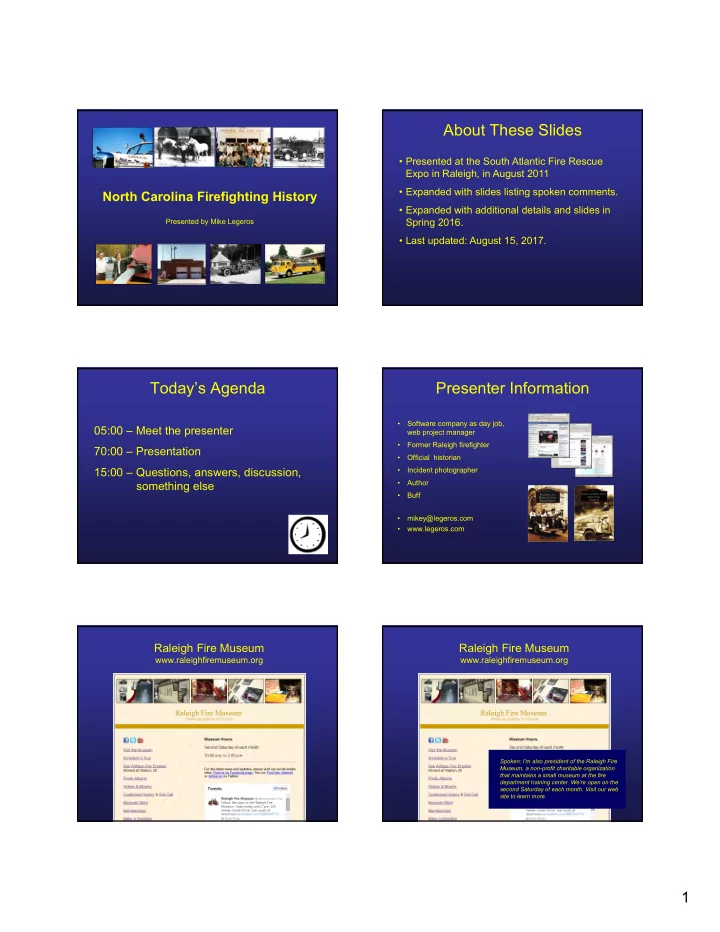
Spoken: I’m also president of the Raleigh Fire Museum, a non-profit charitable organization that maintains a small museum at the fire department training center. We’re open on the second Saturday of each month. Visit our web site to learn more.

slide-2
SLIDE 2

2

More Information

legeros.com/history

  • or-

Google “legeros fire history”

Spoken Comments #1

  • One reason for conducting this workshop is to

challenge the material.

  • Presenter is not expert in all areas. He is more

like a collector of information.

  • Audience is encouraged to edit, expand, correct,
  • r challenge the contents of these slides
  • Everybody wins as histories are rendered more

accurate

Going Back in Time

1900s 1800s 1700s

Early North Carolina

  • 1705, 1710, 1722 – First towns, Bath, New Bern, Edenton
  • 1729 – North Carolina becomes English colony
  • 1735 – Salisbury largest city in western North Carolina
  • 1766 – Construction starts on Salem
  • 1770 – First Capitol completed in New Bern, Tryon Palace
  • 1789 – North Carolina becomes 12th state
  • 1792, 1794 – Raleigh created, Capitol moved
  • 1799 – Cities and towns

– Some growing, Washington, Elizabeth City

– Some still small, Charlotte, Fayetteville, Wilmington – Some not yet created, Winston

Cities and Towns

  • 1710 – New Bern
  • 1722 – Edenton
  • 1734 – Wilmington
  • 1739 – Fayetteville
  • 1755 – Salisbury
  • 1766 – Salem
  • 1768 – Charlotte
  • 1776 – Washington
  • 1792 – Raleigh
  • 1793 – Elizabeth City
  • 1794 – Asheville
  • 1808 – Greensboro

Fires and Fire Protection

  • Why was fire such a risk?
  • Fires in every building, for light, heat, and cooking
  • Flammable building materials
  • Water supplies often minimal.
  • How did communities protect from fire?
  • Prevent fires
  • Extinguish fires.
slide-3
SLIDE 3

3

How Things Started

  • Collective responsibility for firefighting
  • Buckets, ladders, axes, hand engines
  • Laws compel prevention, participation
  • Fire companies organize
  • Fire department created

First Fire Companies

  • 1773 – New Bern (authorized to create)
  • 1785 – Salem
  • 1791 – Fayetteville (chartered)
  • 1791 – Washington
  • 1819 – Raleigh
  • 1845 – Charlotte
  • 1846 – Wilmington
  • 1849 – Greensboro

New Bern – Raleigh Charlotte

Raleigh as Example

  • 1792 – Created as planned community. Everyone

and no one responsible for firefighting.

  • 1795 – First regulations for fire prevention.
  • 1819 – Officials purchase fire engine.

First fire company formed. Fire companies form, disband, reform.

  • 1851 – Major fire renews interest in fire protection.
  • 1852 – Fire companies, fire equipment improved.

Unified fire department created.

Early Legislation

  • 1773 – Salem – Fire inspector appointed
  • 1773 – New Bern – Can create fire company, buy equipment
  • 1793 – Salisbury – Homes must have fire equipment
  • 1795 – Raleigh – Additions to building fronts prohibited
  • 1798 – New Bern – Homes must have fire equipment
  • 1803 – Raleigh – Officials granted power to fight fire,

even by demolishing buildings

  • 1813 – Salem – Fire code established

New Bern As Example

  • 1773 – Officials authorized to create fire company, buy

equipment

  • 1794 – Fire Watch established at night
  • 1798 – Citizens required to keep equipment at home

Local militia must report to fires Fire tax authorized Night watchman hired

  • 1828 – Five Fire Wardens hired
  • 1830 – Three fire companies formed
  • 1845 – Atlantic Steam Engine Co. 1 chartered

First Fire Equipment

Hooks Buckets Axes Ladders

slide-4
SLIDE 4

4

First Fire Equipment

Hooks Buckets Axes Ladders

Spoken: Fire hooks were used to pull buildings down, either before they caught fire or after they were burning. This helped control the spread of fires, but reducing the volume of material either burning

  • r that could catch fire. Explosives were used in a similar fashion,

to control major fires by blasting buildings and creating fire breaks.

First Hand Engines

  • 1785 - Salem (2) ►
  • 1817 - Salisbury
  • 1819 - Raleigh
  • 1832 - Fayetteville
  • 1845, by - Charlotte

First Hand Engines

  • 1785 - Salem (2) ►
  • 1817 - Salisbury
  • 1819 - Raleigh
  • 1832 - Fayetteville
  • 1845, by - Charlotte

Spoken: The first hand engines in our state was a pair delivered to the Moravian community of Salem in Forsyth County. They’ve remained intact and can be viewed today at Old Salem in Winston-Salem.

Salem Hand Engine

Handle for pumping Nozzle that swivels Water poured into pump using buckets

Salem Hand Engine Hand Engines

  • Beaufort
  • Belhaven
  • Charlotte (3)
  • Clayton
  • Elizabeth City
  • Enfield
  • Fayetteville
  • Graham
  • Greensboro (2)
  • Greenville
  • Henderson
  • Hickory
  • Laurinburg
  • Lenoir
  • Milton
  • Morehead City
  • Plymouth
  • Raleigh (5)
  • Salem (2)
  • Salisbury (2)
  • Smithfield
  • Tarboro
  • Warrenton
  • Washington (2)
  • Wilmington (2)
  • Winston

Smithfield

slide-5
SLIDE 5

5

Hand Engines

  • Beaufort
  • Belhaven
  • Charlotte (3)
  • Clayton
  • Elizabeth City
  • Enfield
  • Fayetteville
  • Graham
  • Greensboro (2)
  • Greenville
  • Henderson
  • Hickory
  • Laurinburg
  • Lenoir
  • Milton
  • Morehead City
  • Plymouth
  • Raleigh (5)
  • Salem (2)
  • Salisbury (2)
  • Smithfield
  • Tarboro
  • Warrenton
  • Washington (2)
  • Wilmington (2)
  • Winston

Smithfield

Spoken: Some two-dozen communities had hand engines across our state. Larger towns and cities had multiple “hand tubs,” and over decades as never and larger models replaced older and smaller ones. Very few of these have

  • survived. Just a handful.

Who Were The Volunteers?

  • Prominent citizens
  • Drafted citizens
  • Skill tradesmen
  • Multigenerational
  • Segregated before/after

Civil War

  • Day in the life, what

does it look like?

Greensboro – Wilmington

Who Were The Volunteers?

  • Prominent citizens
  • Drafted citizens
  • Skill tradesmen
  • Multigenerational
  • Segregated before/after

Civil War

  • Day in the life, what

does it look like?

Greensboro – Wilmington

Spoken: What a day in the life of a typical volunteer fireman look like? Good

  • question. To be determined.

Black Fire Companies

Greensboro Wake Forest – Warrenton

Black Fire Companies

Greensboro Wake Forest – Warrenton

Spoken: Early fire companies were typically segregated, with separate groups of white and black firemen. In some communities, the first fire companies to organize were those of black citizens. Some black-only fire companies persisted into the late 20th century, such as Wake Forest Fire Department #2 from the 1940s to the 1980s, and Warren’s municipal fire department, into the 2000s.

Black Fire Companies

  • Beaufort
  • Charlotte
  • Clinton
  • Concord
  • Durham
  • Edenton
  • East Spencer
  • Enfield
  • Elizabeth City
  • Farmville
  • Fayetteville
  • Goldsboro.
  • Greensboro
  • Greenville
  • Henderson
  • Louisburg
  • Lincolnton
  • Monroe
  • New Bern
  • Oxford
  • Princeville
  • Swansboro
  • Raleigh
  • Rocky Mount
  • Salisbury
  • Smithfield
  • Statesville
  • Tarboro
  • Wake Forest
  • Warrenton
  • Washington
  • Weldon
  • Wilmington
  • Wilson
  • Winston

Wilmington

slide-6
SLIDE 6

6

Insurance Marks Insurance Marks

  • Originated in England, after great fire
  • f 1666
  • Metal plates affixed to buildings
  • Identified that building was insured
  • Appear in America, in 1750s
  • Untrue stories develop of American

insurance marks and fire company behavior

  • Used in North Carolina?

First Steam Engines

  • 1865, by – Charlotte
  • 1868 – New Bern
  • 1868 – Wilmington
  • 1870 – Raleigh
  • 1871 – Wilmington
  • 1873 – Elizabeth City
  • 1873 – Wilmington
  • 1874 – Wilmington
  • 1879 – New Bern

Raleigh – New Bern

First Steam Engines

  • 1865, by – Charlotte
  • 1868 – New Bern
  • 1868 – Wilmington
  • 1870 – Raleigh
  • 1871 – Wilmington
  • 1873 – Elizabeth City
  • 1873 – Wilmington
  • 1874 – Wilmington
  • 1879 – New Bern

Raleigh – New Bern

Spoken: Steam power arrived in the 1860s. These coal-powered pumping engines were often initially pulled by hand, such as the Rescue Company of Raleigh, which was hand-pulled for the first seven to nine years. Steam engines greatly reduced the number of people required for fighting fires, as they could be operated with just one or two people, instead of 10 or 20 for a hand engine.

Lantern Boiler Coal Tray Intakes/Outlets Whistle Pump Smokestack Suction Hose Lantern

Steam Engines

  • Charlotte (3)
  • Durham (3)
  • Elizabeth City (2)
  • Fayetteville
  • Goldsboro
  • Greensboro (2)
  • Greenville
  • Kinston
  • Monroe
  • New Bern (4)
  • Raleigh (2)
  • Reidsville
  • Rocky Mount
  • Salem (2)
  • Salisbury
  • Washington
  • Wilmington (8)
  • Winston (3)
  • Winston-Salem

Winston – Charlotte Wilmington

slide-7
SLIDE 7

7

Steam Engines

  • Charlotte (3)
  • Durham (3)
  • Elizabeth City (2)
  • Fayetteville
  • Goldsboro
  • Greensboro (2)
  • Greenville
  • Kinston
  • Monroe
  • New Bern (4)
  • Raleigh (2)
  • Reidsville
  • Rocky Mount
  • Salem (2)
  • Salisbury
  • Washington
  • Wilmington (8)
  • Winston (3)
  • Winston-Salem

Winston – Charlotte Wilmington

Spoken: Forty-two steam engines served in our state. The earliest were hand-pulled, until a dedicated horse team was acquired. Such as Raleigh’s Rescue Company, which pulled their steamer by hand for the first seven to nine years.

What Happened To Them?

  • Sold
  • Scrapped
  • Saved
  • Restored
  • Displayed
  • 11 of 42

have survived

Salisbury Washington Rocky Mount

Later Hand Engines

1870s Rumsey Hand Engine Outlet, connects to hose. Suction hose dropped into well or cistern. Nozzle, connects to hose.

Later Hand Engines

1870s Rumsey Hand Engine Outlet, connects to hose. Suction hose dropped into well or cistern. Nozzle, connects to hose.

Spoken: Later hand engines were considerably larger than their predecessors, with greater pumping capacity and requiring more men to operating the handles, which were called brakes.

Other Fire Apparatus

Spoken: Other fire apparatus of the 1870s and 1880s and 1980s included hand hose reels, which carried the hose used by hand and steam engines. Chemical engines, single- and double-tank models, carried small amounts of chemically charged water, useful for smaller fires. Hook ‘n’ ladder trucks of varying sizes carried buckets, ladders, fire hooks, and other tools.

Other Fire Apparatus

slide-8
SLIDE 8

8

Great Fires

  • 1816 – Raleigh – 51 buildings
  • 1819 – Wilmington – Large section of town
  • 1831 – Fayetteville – 600+ structures
  • 1832 – Raleigh – 30 buildings
  • 1835, 1837, 1843 – New Bern – Several

blocks

  • 1849 – Greensboro – Business district
  • 1854 – Statesville – Half of town
  • 1864 – Washington – Half of town
  • 1864 – Wilmington – Wharf, 20+ buildings
  • 1869 – Goldsboro - 14 buildings
  • 1872 – Greensboro – Large portion of town
  • 1880 – Durham – Half of town
  • 1886 – Durham – Large portion of town
  • 1886 – Wilmington – Waterfront
  • 1887 – Clinton – 49 dwellings
  • 1890 – Thomasville – Nearly every business
  • f East Main Street
  • 1899 – Greenville – 25 stores and offices
  • 1900 – Washington – Business district
  • 1902 – Clinton – Entire southern section of

town, including 43 stores

  • 1907 – Salisbury – Five manufacturing plants
  • 1911 – Apex – Business district
  • 1912 – Black Mountain – Business district
  • 1913 – Rolesville – Business district, 10

buildings

  • 1914 – Durham – Large portion of business

district

  • 1918 – Charlotte – 48 homes
  • 1918 – Burlington - Downtown
  • 1922 – New Bern – 40 blocks, 3000

homeless

Great Fires

  • 1816 – Raleigh – 51 buildings
  • 1819 – Wilmington – Large section of town
  • 1831 – Fayetteville – 600+ structures
  • 1832 – Raleigh – 30 buildings
  • 1835, 1837, 1843 – New Bern – Several

blocks

  • 1849 – Greensboro – Business district
  • 1854 – Statesville – Half of town
  • 1864 – Washington – Half of town
  • 1864 – Wilmington – Wharf, 20+ buildings
  • 1869 – Goldsboro - 14 buildings
  • 1872 – Greensboro – Large portion of town
  • 1880 – Durham – Half of town
  • 1886 – Durham – Large portion of town
  • 1886 – Wilmington – Waterfront
  • 1887 – Clinton – 49 dwellings
  • 1890 – Thomasville – Nearly every business
  • f East Main Street
  • 1899 – Greenville – 25 stores and offices
  • 1900 – Washington – Business district
  • 1902 – Clinton – Entire southern section of

town, including 43 stores

  • 1907 – Salisbury – Five manufacturing plants
  • 1911 – Apex – Business district
  • 1912 – Black Mountain – Business district
  • 1913 – Rolesville – Business district, 10

buildings

  • 1914 – Durham – Large portion of business

district

  • 1918 – Charlotte – 48 homes
  • 1918 – Burlington - Downtown
  • 1922 – New Bern – 40 blocks, 3000

homeless

Spoken: One state historian has written that practically every city and town in North Carolina has experienced a major fire that destroyed dozens or hundreds of buildings. Some of those fires are listed here. The Great New Bern Fire was one of the last major conflagrations in our state.

Great Fire of New Bern - 1922

  • December 1, 1922
  • Many firemen out of town
  • Started first at lumberyard (8:35 a.m.)
  • Then at house on other side of town (10:00 a.m.)
  • Spread over dozens of blocks.
  • Kinston, Washington called.
  • Dynamite to blast houses to create fire break.
  • Controlled by late afternoon.
  • Forty blocks destroyed
  • Hundreds of homes,

numerous business and churches burned.

  • 3000 people homeless.

Fire Horses

Salem - Burlington

  • First horses

– 1879, Raleigh – 1883, Asheville – 1887, Charlotte – 1890, Durham

  • Usage

− Stabled at stations, other places − Some shared with other city depts − Replaced after several years − Transported by rail for mutual aid − Retired starting 1910s

Water Systems

  • Early waterworks

– 1778, Salem – 1820, Fayetteville

  • Underground cisterns

– 1848, Greensboro – 1852, Raleigh

  • Modern waterworks

– 1882, Charlotte – 1887, Raleigh – 1888, Durham – 1892, Wilson – 1893, Fayetteville – 1895, Lumberton – 1899, Statesville

Raleigh

Water Systems

  • Early waterworks

– 1778, Salem – 1820, Fayetteville

  • Underground cisterns

– 1848, Greensboro – 1852, Raleigh

Raleigh

Spoken: Wells, streams, rivers, lakes, and ocean fronts provided natural water supplies for firefighting. Early water systems in Salem and Fayetteville pumped water through wooden logs turned into

  • pipes. By the mid 19th

Century, fire cisterns were installed in such places as Greensboro and Raleigh. These were underground tanks that were filled by rainwater through gutter systems.
slide-9
SLIDE 9

9

Water Systems

  • Modern waterworks

– 1882, Charlotte – 1887, Raleigh – 1888, Durham – 1892, Wilson – 1893, Fayetteville – 1895, Lumberton – 1899, Statesville

Raleigh

Spoken: By the 1880s, “modern” water systems were developed, which greater improved a communities ability to fight

  • fire. These typically municipal

systems included fire hydrants, which provided enough pressure to fight fires using hand lines connected directly to the hydrants. Steam- and hand-powered pumping engines were no longer necessary, for fighting most fires.

Hydrants and Hose Hydrants and Hose

Spoken: Hose was also changing in the 19th

  • Century. Leather hose was replaced by canvas
  • hose. The former was stiff and hard to bend.

Leather hose had to be wound on reels. Canvas hose was flexible and was easily bent. It could be laid flat, and easily stored (and pulled from) the back of a wagon. Thus hose wagons were developed.

Carthage Carthage

Spoken: This picture shows Carthage firemen operating hose streams powered by hydrant pressure.

Carthage

Spoken: With the installation of fire hydrants, a fire department could

  • perate with minimal equipment. Just

a reel or two with hose, and a wagon with ladders and other equipment.

slide-10
SLIDE 10

10

Fire Apparatus Changes

Hose Reels Hose Wagons

Salem Greensboro

Fire Apparatus Changes

Hose Reels Hose Wagons

Salem Greensboro

Spoken: Hand reels were often replaced with horse-drawn hose wagons, which were faster and didn’t require manpower for pulling.

Horse-Drawn Aerial Ladder

Winston

Horse-Drawn Aerial Ladder

Winston

Spoken: In larger cities and towns, hand-drawn ladder wagons became horse-drawn. And at least one horse-drawn aerial ladder was operated, in the town of Winston, before they merged with the town of Salem.

Horse-Drawn Apparatus

  • 1879

Raleigh

  • 1881 ?

Statesville

  • 1883

Asheville

  • 1884, by

Wilmington

  • 1888, by

New Bern

  • 1887

Charlotte

  • 1888

Greensboro

  • 1890, c

Durham

  • 1896, by

Goldsboro

  • 1900, by

Greenville

  • 1900, by

Salem

  • 1900, by

Winston

  • 1901, by

Reidsville

  • 1901, by

Rocky Mount

  • 1902, by

Concord

  • 1902, by

Salisbury

  • 1905

Burlington

  • 1905

Gastonia

  • 1907

Oxford

  • 1908

Lenoir

Horse-Drawn Apparatus

  • 1879

Raleigh

  • 1881 ?

Statesville

  • 1883

Asheville

  • 1884, by

Wilmington

  • 1888, by

New Bern

  • 1887

Charlotte

  • 1888

Greensboro

  • 1890, c

Durham

  • 1896, by

Goldsboro

  • 1900, by

Greenville

  • 1900, by

Salem

  • 1900, by

Winston

  • 1901, by

Reidsville

  • 1901, by

Rocky Mount

  • 1902, by

Concord

  • 1902, by

Salisbury

  • 1905

Burlington

  • 1905

Gastonia

  • 1907

Oxford

  • 1908

Lenoir

Spoken: The first horse-drawn fire engines appeared in the late 1870s, and were added through the 1900s.

slide-11
SLIDE 11

11

Horse-Drawn Apparatus

  • 1879

Raleigh

  • 1881 ?

Statesville

  • 1883

Asheville

  • 1884, by

Wilmington

  • 1888, by

New Bern

  • 1887

Charlotte

  • 1888

Greensboro

  • 1890, c

Durham

  • 1896, by

Goldsboro

  • 1900, by

Greenville

  • 1900, by

Salem

  • 1900, by

Winston

  • 1901, by

Reidsville

  • 1901, by

Rocky Mount

  • 1902, by

Concord

  • 1902, by

Salisbury

  • 1905

Burlington

  • 1905

Gastonia

  • 1907

Oxford

  • 1908

Lenoir

Spoken: Thus the romantic image

  • f the fire engine pulled by a team
  • f horses—typically a steamer—

was a relatively short period in the state’s history. Only about 30 to 40 years.

Fire Alarm Systems

  • 1878 – Wilmington (telephone)
  • 1883 – New Bern
  • 1887 – Charlotte
  • 1888 – Raleigh
  • 1891 – Durham
  • 1910 – Rocky Mount
  • 1912 – Salisbury
  • 1925 – Lexington

Fire Alarm Systems

  • 1878 – Wilmington (telephone)
  • 1883 – New Bern
  • 1887 – Charlotte
  • 1888 – Raleigh
  • 1891 – Durham
  • 1910 – Rocky Mount
  • 1912 – Salisbury
  • 1925 – Lexington

Spoken: Electro-mechanical fire alarm systems appeared in the late 19th Century. The most popular with electric- telegraph systems, typically made by Gamewell. These low-voltage systems connected numbered alarm boxes to bells, gongs, or whistles. The alerting device would ring or blow in a repeating sequence that matched the alarm box

  • number. The firemen would respond to the corresponding

street address of the box number.

Fire Alarm Systems

  • 1878 – Wilmington (telephone)
  • 1883 – New Bern
  • 1887 – Charlotte
  • 1888 – Raleigh

– 10 boxes, initially locked – Inside and outside fire district – 36 boxes in 1906 – 120 boxes in 1930 – 274 boxes in 1965 – Last box alarm sent in 1973 – System dismantled in 1973

Spoken: In Raleigh, the first alarm boxes were installed in 1888. They were also locked for the first few years, so a key holder had to first be found. Typically at a store of resident nearby. The system expanded as the city grew, and was used through most of the 20th Century. Telephone boxes replaced the alarm boxes beginning in 1973.

Fire Alarm Systems

Alerting and Recording Dispatching Mechanical

Fire Alarm Systems

Alerting and Recording

Spoken: Firemen were alerted of “box alarms” with such mechanisms as bells, gongs, and whistles. The gong on the right includes a numeric indictor of the box number. “Punch recorders” were used to record the received alarm on “punch tape.”

slide-12
SLIDE 12

12

Fire Alarm Systems

Dispatching

Spoken: Alarm signals could be manually transmitted, for such circumstances as a phone alarm. The dispatcher would locate the nearest alarm box, then transmit that box number. The transmitter on the left uses “gear wheels”, the transmitter on the right has knobs for selecting number values.

Fire Alarm Systems

Dispatching

Virtual box numbers were also

  • used. Such as a number to

signal an “out of town” alarm, which brought the firemen to the station for verbal instructions.

Fire Alarm Systems

Mechanical

Spoken: Behind the scenes of electric-telegraph fire alarm systems, the equipment included repeaters as shown in the top photo, and circuit boards, shown in the bottom photo.

Conventions and Tournaments

  • 1860s – Early travels
  • 1870s – Early contests and tournaments
  • 1873

– State Convention of Colored Firemen

  • 1888

– North Carolina State Firemen’s Association (NCSFA)

  • 1889? – North Carolina Colored Volunteer Firemen’s Association

(NCCVFA)

Raleigh

Tournaments

  • NCSFA contests included

– Hand reel – Grab reel – Horse hose wagon (until 1916) – Steamer, distance (until 1912) – Steamer, time (until 1913) – Motor, water (start 1920) – Motor, chemicals (start 1920)

  • NCSFA tournaments end 1941
  • NCCVFA tournaments continue past 1957

New Bern – Wake Forest

Fire Departments in 1910

  • Asheville
  • Benson
  • Biltmore

(Asheville)

  • Burlington
  • Chapel Hill
  • Charlotte
  • Clinton
  • Chestnut Hill

(Salisbury)

  • Concord
  • Durham
  • Dunn
  • Edenton
  • Elizabeth City
  • Fayetteville
  • Freemont
  • Gastonia
  • Goldsboro
  • Graham
  • Greensboro
  • Greenville
  • Henderson
  • Hickory
  • High Point
  • Kinston
  • Lenoir
  • Lexington
  • Louisburg
  • Monroe
  • Morganton
  • Mount Airy
  • New Berne
  • Oxford
  • Raleigh
  • Red Springs
  • Reidsville
  • Rockingham
  • Rocky Mount
  • Salem
  • Salisbury
  • Sanford
  • Southern

Pines

  • Spencer
  • Statesville
  • Tarboro
  • Warrenton
  • Washington
  • Wilmington
  • Wilson
  • Winston

As recorded as members of North Carolina State’s Firemen Association

slide-13
SLIDE 13

13

Fire Departments in 1910

  • Asheville
  • Benson
  • Biltmore

(Asheville)

  • Burlington
  • Chapel Hill
  • Charlotte
  • Clinton
  • Chestnut Hill

(Salisbury)

  • Concord
  • Durham
  • Dunn
  • Edenton
  • Elizabeth City
  • Fayetteville
  • Freemont
  • Gastonia
  • Goldsboro
  • Graham
  • Greensboro
  • Greenville
  • Henderson
  • Hickory
  • High Point
  • Kinston
  • Lenoir
  • Lexington
  • Louisburg
  • Monroe
  • Morganton
  • Mount Airy
  • New Berne
  • Oxford
  • Raleigh
  • Red Springs
  • Reidsville
  • Rockingham
  • Rocky Mount
  • Salem
  • Salisbury
  • Sanford
  • Southern

Pines

  • Spencer
  • Statesville
  • Tarboro
  • Warrenton
  • Washington
  • Wilmington
  • Wilson
  • Winston

As recorded as members of North Carolina State’s Firemen Association

Spoken: By the early 20th Century, there dozens of fire departments protecting the cities and towns of North

  • Carolina. Plus institutions and private facilities. This list

from the state fireman’s association provides a good picture of the time, though incomplete. There were likely a number of additional departments either newly organized,

  • r operating but without membership to the state

association.

Career Fire Departments

  • 1887 – Charlotte, plus volunteer company until 1907
  • 1897 – Wilmington
  • 1909 – Durham
  • 1912 – Raleigh
  • 1923 – Winston-Salem
  • 1924 – Asheville
  • 1926 – Greensboro
  • 1938 – Rocky Mount
  • 1947 – Fayetteville

Charlotte

Career Fire Departments

  • 1887 – Charlotte, plus volunteer company until 1907
  • 1897 – Wilmington
  • 1909 – Durham
  • 1912 – Raleigh
  • 1923 – Winston-Salem
  • 1924 – Asheville
  • 1926 – Greensboro
  • 1938 – Rocky Mount
  • 1947 – Fayetteville

Charlotte

Spoken: Career firefighters appeared in the 1880s, beginning in Charlotte. By this time, departments also employed paid members, such as paid drivers, engineers, or fire chiefs. Others provided remuneration to volunteers who answered calls.

Raleigh as Example

  • 1910

City size 4.0 square miles, with 19,218 people. Volunteer Raleigh fire department, with five fire companies, three stations, and 127 men.

  • 1912

Paid fire department organized, with three fire companies, three stations, and 24 men.

Raleigh as Example

  • 1910

City size 4.0 square miles, with 19,218 people. Volunteer Raleigh fire department, with five fire companies, three stations, and 127 men.

  • 1912

Paid fire department organized, with three fire companies, three stations, and 24 men.

Spoken: In Raleigh, the volunteer fire department and its fire companies had been serving for 50 years, when city

  • fficials began planning for a career “fire force.” They were

compelled by the risk and resource assessments by the National Board of Fire Underwriters. The city needed a better fire department, or insurance rates would raise. Thus a career chief and career department were developed. It was placed in service in December 1912.

Spoken Comments #2

  • Most of the historical examples in these slides

refer to the larger cities

  • The presenter apologizes for this bias
  • Comprehensive historical information is difficult

to find

  • There are many smaller fire departments that

could be cited in the development of the state’s fire service

slide-14
SLIDE 14

14

Motor Apparatus

  • 1911 – Asheville
  • 1912 – Charlotte
  • 1912 – Durham
  • 1912 – Wilmington
  • 1913 – Greensboro
  • 1913 – Raleigh
  • 1913 – Winston-Salem
  • 1914, by – Fayetteville
  • 1914 – Rocky Mount

Charlotte – Raleigh

Motor Apparatus

  • 1912 – Asheville
  • 1912 – Charlotte
  • 1912 – Durham
  • 1912 – Wilmington
  • 1913 – Greensboro
  • 1913 – Raleigh
  • 1913 – Winston-Salem
  • 1914, by – Fayetteville
  • 1914 – Rocky Mount

Charlotte – Raleigh

Spoken: Motorized fire engines appeared in the early 1910s, and were quickly adopted through the state.

More Motor Apparatus

  • 1912 – Lumberton
  • 1913 – Statesville
  • 1913 – Washington
  • 1913 – Wilson
  • 1914 – Chapel Hill
  • 1914 – New Bern
  • 1915 – Morganton
  • 1916 – Lexington
  • 1918 – Kinston

Cherryville – Morehead City High Point

Motor Aerial Ladders

  • 1910s – Greensboro
  • 1910s – Winston-Salem
  • 1914 – Wilmington
  • 1916 – Raleigh
  • 1917 – Charlotte
  • 1919 – Rocky Mount
  • 1920s – Asheville
  • 1920s – Durham
  • 1920s – High Point

High Point – Asheville Wilmington

Motor Aerial Ladders

  • 1910s – Greensboro
  • 1910s – Winston-Salem
  • 1914 – Wilmington
  • 1916 – Raleigh
  • 1917 – Charlotte
  • 1919 – Rocky Mount
  • 1920s – Asheville
  • 1920s – Durham
  • 1920s – High Point

High Point – Asheville Wilmington

Spoken: That included a number of tractor-drawn aerial ladders, or “tillers.”

Motor Apparatus

  • Chemical truck
  • Hose truck
  • Chemical/hose truck
  • Chemical/hose/pump truck
  • Hose/pump truck
  • Service ladder truck
  • Aerial ladder truck
  • Chief’s car

Raleigh

slide-15
SLIDE 15

15

Motor Apparatus

  • Chemical truck
  • Hose truck
  • Chemical/hose truck
  • Chemical/hose/pump truck
  • Hose/pump truck
  • Service ladder truck
  • Aerial ladder truck
  • Chief’s car

Raleigh

Spoken: The types of motor apparatus were based on their equipment: chemical (or later water) tank, hose bed, water pump, ground ladders, and aerial ladders. Trucks with two functions were called “combinations”, trucks with three were called “triple combinations,” trucks with four were “quads,” trucks with five were “quints” or “quintuple combinations.”

American LaFrance – 1910s to 1940s

Aberdeen Ahoskie Albemarle Andrews Asheboro Asheville Ashville Ayden Azalea Beaufort Belhaven Belmont Bessemer City Biltmore Forest Black Mountain Blowing Rock Boone Brevard Broughton Hospital Bryson City Burgaw Burlington Burnsville Canton Carolina Beach Carthage Chadbourne Champaign Chapel Hill Charlotte Cherryville China Grove Clinton Concord Conover Dallas Dunn Durham Edenton Elizabeth City Enka Falson Farmville Fayetteville Fort Bragg Franklin Franklinton Gastonia Goldsboro Granite Falls Greensboro Greenville Hamlet Hawthorne Henderson Hendersonville Hertford Hickory High Point Jacksonville Kernersville Kings Mountain Kinston Landis Laurinburg Leaksville Lenoir Lexington Lillington Lincolnton Louisburg Lumberton Marion Marshall Marshville Mebane Monroe Mooresville Morehead City Morganton Mount Airy Mount Holly Mount Olive Murfreesboro Murphy Nashville New Bern Newton Norlina North Wilkesboro Oxford Pinehurst Plymouth Raleigh Red Springs Reidsville Roanoke Rapids Robbins Robersonville Rockingham Rocky Mount Roxboro Rutherfordton Salisbury Sanford Shelby Southern Pines Spruce Pine Statesville Sylva Tarboro Taylorsville Thomasville Tryon Valdese Wadesboro Washington Waynesville Weldon Whiteville Williamstown Wilmington Wilson Winston-Salem

American LaFrance – 1910s to 1940s

Aberdeen Ahoskie Albemarle Andrews Asheboro Asheville Ashville Ayden Azalea Beaufort Belhaven Belmont Bessemer City Biltmore Forest Black Mountain Blowing Rock Boone Brevard Broughton Hospital Bryson City Burgaw Burlington Burnsville Canton Carolina Beach Carthage Chadbourne Champaign Chapel Hill Charlotte Cherryville China Grove Clinton Concord Conover Dallas Dunn Durham Edenton Elizabeth City Enka Falson Farmville Fayetteville Fort Bragg Franklin Franklinton Gastonia Goldsboro Granite Falls Greensboro Greenville Hamlet Hawthorne Henderson Hendersonville Hertford Hickory High Point Jacksonville Kernersville Kings Mountain Kinston Landis Laurinburg Leaksville Lenoir Lexington Lillington Lincolnton Louisburg Lumberton Marion Marshall Marshville Mebane Monroe Mooresville Morehead City Morganton Mount Airy Mount Holly Mount Olive Murfreesboro Murphy Nashville New Bern Newton Norlina North Wilkesboro Oxford Pinehurst Plymouth Raleigh Red Springs Reidsville Roanoke Rapids Robbins Robersonville Rockingham Rocky Mount Roxboro Rutherfordton Salisbury Sanford Shelby Southern Pines Spruce Pine Statesville Sylva Tarboro Taylorsville Thomasville Tryon Valdese Wadesboro Washington Waynesville Weldon Whiteville Williamstown Wilmington Wilson Winston-Salem

Spoken: American LaFrance was the most popular of apparatus makers that delivered motor trucks in North Carolina in the early 20th century.

Fire Station Sizes

Raleigh Lumberton Raleigh Charlotte

Fire Station Sizes

Raleigh Lumberton Raleigh Charlotte

Hand reels Horse wagons Early motorized Later motorized

Spoken: Fire station sizes changed over the

  • decades. Small buildings for hand reels, larger

buildings for horse teams, then smaller buildings for early motor trucks, then larger buildings for larger motor trucks.

First Fire Marshal

  • Sherwood Brockwell
  • Former Raleigh Fire Chief
  • Appointed 1914
  • Served 39 years, until death
  • Two days after appointment,

started statewide firefighter training program

  • Led to state fire college
  • Founding director of college
slide-16
SLIDE 16

16

North Carolina Fire College

  • First college held in Asheville, 1929
  • Drills held during day; lectures at night
  • Attended by 127 firemen from North Carolina
  • Some firemen attended from other states
  • Early directors:

– 1929-1948, Sherwood Brockwell of Raleigh – 1949-1962, Charles Burkett of Salisbury – 1963-1967, Cosmo Cox of Durham – 1968-1990, R. L. Powell of Greensboro

  • Closed in late 1990s/early 2000s due to low enrollment

Early Training Towers

  • 1912 – Raleigh (Sta 1)
  • 1915 – Wilmington (Sta 1)
  • 1926 – Durham
  • 1926 – Greensboro (Sta 1)
  • 1927 – Asheville (Sta 4)
  • 1927 – Wilmington
  • 1938 – Charlotte*
  • 1939 – Goldsboro (Sta 1)
  • 1943 – Greenville
  • 1954 – Raleigh
  • 1956 – Greensboro

* Palmer Fire School also built 1940

Raleigh – Greensboro

Trivia

Memorial Auditorium, Raleigh

Trivia

Memorial Auditorium, Raleigh

Spoken: In Raleigh, a new performing arts center

  • pened in 1932. Named Memorial Auditorium, it

included a fire station in basement, and a rear section designed to function as a fire department training tower.

Industrial, Institutional

  • Private fire brigades, fire departments
  • Protected factories, mills, military bases, hospitals,

schools, prisons, orphanages, etc.

  • Helped protect unincorporated areas

Fort Bragg

Labor

  • Civil service protection

– 1933, Raleigh – 1949, after, statewide (correct?)

  • Trade unions

– 1918, Wilmington – 1932, Asheville – 1938, Raleigh – 1940, Charlotte, Durham, High Point – 1940, NC FF Association – 1947, Greensboro – 1969, Burlington, Goldsboro, Greenville, Kinston – 1970, Wilson – 1975, Gastonia – 1978, Hickory

  • Two shifts created

– 1919, Charlotte – 1924, Raleigh – 1941, Greensboro

  • Retirement systems

– 1932, Charlotte – 1949, Raleigh Raleigh

slide-17
SLIDE 17

17

World War II

  • Personnel enlisted, drafted

– Charlotte loses 63 members

  • Restrictions affect infrastructure

– New apparatus, new construction, etc.

  • Rationing of materials, such as fuel
  • Civilian defense after Pearl Harbor

– Blackout drills

  • Auxiliary firefighters trained

– Asheville, Kinston, Raleigh, Tarboro, etc.

Auxiliary Firefighters in Action!

Raleigh

  • Legislation
  • 1939, Counties can contract with municipal FDs
  • 1945, Counties can establish and maintain own FDs
  • 1947, Rural communities (Rowan county only?) can

tax for fire protection provided by: – Municipal FDs – County FDs, if established – Local FD under jurisdiction of countywide three- member commission

Rural Fire Protection

  • 1940 - Seagate (New Hanover)
  • 1942 - Bessemer (Greensboro)
  • 1943 - Wilkinson Boulevard (Charlotte)
  • 1944 - Oak Grove (Greensboro)
  • 1945, by - North Asheboro (Asheboro)
  • 1946 - Guilford College (Greensboro)
  • 1948 - Pleasant Garden (Marion/McDowell County)
  • 1949 - Newell (Charlotte)
  • 1949 - Pinoca (Charlotte)
  • 1949 - Sedge Garden (Winston-Salem)

First Rural Fire Departments

Catawba County

Fire Prevention Divisions

  • Early century fire prevention

– Inspections, education, plans review, etc. – Chief officers, fire committees, etc.

  • Fire prevention divisions

– 1929, Charlotte – 1949, Raleigh – 1950, Greensboro – 1971, Durham

  • Arson investigation

Raleigh

First Rescue Squads

  • Types of rescue squads

– First aid/transport units – Basic technical rescue – Suppression support/equipment trucks

  • Early fire department rescue squads:

– 1939, Salisbury – 1944, Greensboro – 1947, Greenville – 1950 by, Fayetteville – 1951, Washington – 1953, Raleigh – 1956, Beaufort – 1960, Durham

Salisbury – Beaufort Raleigh

slide-18
SLIDE 18

18

Independent Rescue Squads

  • Early independent rescue squads:

– 1937, Winston-Salem – 1941, Davidson County – 1947, Charlotte – 1947 by, Greensboro – 1948, Gaston County – 1951, Rowan County – 1951, Elkin – 1952, Marks Creek – 1953, Goldsboro (housed in fire station) – 1953, Granville County – 1953, Vance County – Etc.

Another Type of Squad

  • Circa 1940s
  • Squad trucks, also called

auxiliary trucks

  • Early mini-pumpers
  • Not rescue squads
  • Departments included:

– Durham – Greensboro – Raleigh – Wilmington

Durham - Raleigh

  • Apparatus gets larger
  • Fog nozzles
  • Generators, lights, fans
  • Hose gets smaller (1 ½ inch)
  • Ladders get lighter
  • Radios

– 1935, Charlotte – 1951, Greensboro – 1952, Durham – 1953, Rocky Mount – 1955, Raleigh

  • Self-contained breathing apparatus

Trucks and Tools

Raleigh

Trivia

  • First closed-cab pumper in United States
  • Designed by Charlotte Fire Chief
  • 1935 Mack Type 19
  • 750 GPM

More Changes

  • Red cross training

– 1947, Greensboro

  • Ladies auxiliaries

– 1952, Raleigh

  • Reduced working hours

– 1956, Greensboro, 84 to 72 hours – 1957, Charlotte, 84 to 72 hours

  • Cardiopulmonary resuscitation ►

– 1964, Greensboro

Rural Fire Department Growth

  • Post-war boom in population, funding,

interest

  • Funding from Civil Defense agencies
  • Legislation in 1951

– With popular vote, rural residents can

  • rganize rural districts with taxes
  • Municipal departments increasingly

aware of liability

Wake County

slide-19
SLIDE 19

19

Wake County as Example

  • 1940s

No rural FDs. Some towns have FDs

  • 1950s

Many rural and town FDs form

– Some alongside existing municipal FDs – Some with municipal and rural divisions – Some exclusively rural

  • 1960s

More rural FDs form, one reforms and relocates after annexation by Raleigh

Wake County

Small Town Fire Departments

  • Rural Hall in Forsyth County
  • Hydrants installed in town
  • Fire department formed 1939
  • First fire truck bought 1941
  • Carried hose, extinguishers,

hand equipment

  • Hydrant pressure used for

fighting fires

  • Same concept as a century

earlier.

Rural Water Supply

  • Originated by Iowa farmer
  • Cumberland, Duplin, Wayne county

fire departments first to utilize

  • Late 1960s
  • Converted tankers to start
  • Recognized by ISO
  • Nahunta FD (Wayne County) first to

receive lower ISO rating

Wake County

Changing Times

  • EMT and first responder
  • Black firefighters
  • Female firefighters
  • Public safety officers
  • Labor activities
  • Lime apparatus
  • Hurst tools

EMT and First Responder

  • North Carolina EMS system started in 1969
  • North Carolina EMS act in 1973
  • Some FDs became EMS providers
  • Some FDs added ambulances

– 1972, Parkwood (Durham County) – 1974, Wilmington – 1978, Salisbury

  • Many FDs added first responders

Parkwood (Durham County)

EMT and First Responder

  • North Carolina EMS system started in 1969
  • North Carolina EMS act in 1973
  • Some FDs became EMS providers
  • Some FDs added ambulances

– 1974, Wilmington – 1978, Salisbury

  • Many FDs added first responders

Parkwood (Durham County)

slide-20
SLIDE 20

20

First Responder Programs

  • 1974 – Wilmington
  • 1977 – Greensboro
  • 1978 – Charlotte
  • 1978 – Salisbury
  • 1979 – Winston-Salem1
  • 1980 – Raleigh
  • 1993 – Durham
  • 1999 – Winston-Salem2

Raleigh

Fire + EMS Departments Today

  • Bahama (Durham)
  • Beulaville (Duplin)
  • Bunn (Franklin)
  • Conetoe (Edgecombe)
  • Currituck County
  • Dallas (Gaston)
  • Fort Run (Greene)
  • Greenville (Pitt)
  • Hamilton District (Martin)
  • Hicksboro (Vance)
  • Lebanon (Durham)
  • Matthews (Mecklenberg)
  • Maysville (Jones)
  • Morehead City
  • Pender
  • Pine Knoll Shores (Carteret)
  • Pleasant Grove (Duplin)
  • Redwood (Durham)
  • Shine (Greene)
  • South River-Merrimon (Carteret)
  • Stem (Granville)
  • Washington
  • Western Carteret
  • Williamston
  • White Level (Franklin)

Fire + EMS Departments Today

  • Bahama (Durham)
  • Beulaville (Duplin)
  • Bunn (Franklin)
  • Conetoe (Edgecombe)
  • Currituck County
  • Dallas (Gaston)
  • Fort Run (Greene)
  • Greenville (Pitt)
  • Hamilton District (Martin)
  • Hicksboro (Vance)
  • Lebanon (Durham)
  • Matthews (Mecklenberg)
  • Maysville (Jones)
  • Morehead City
  • Pender
  • Pine Knoll Shores (Carteret)
  • Pleasant Grove (Duplin)
  • Redwood (Durham)
  • Shine (Greene)
  • South River-Merrmimon

(Carteret)

  • Stem (Granville)
  • Washington
  • Western Carteret
  • Williamston
  • White Level (Franklin)

Spoken: Today, there are numerous fire departments around our state that are also EMS providers…

Black Firefighters

  • Early career firefighters

– Wilmington, 1898 (18)

  • Later career firefighters

– 1951, Winston-Salem (8) – E4 (partial) – 1958, Durham (10) – E4 – 1961, Greensboro (28) – E4, T4 – 1963, Raleigh (6) – E2 (partial) – 1967, Charlotte (1)

  • Integration of department

– 1966, Greensboro – 1967, Winston-Salem – 1969, Durham

Winston-Salem - Durham

Female Firefighters

  • 1973 – Winston-Salem (1 PS FF) – First in nation
  • 1975 – Durham (1 PS FF)
  • 1978 – Greensboro (2)
  • 1978 – Raleigh (8)
  • 1980 – Charlotte (1)
  • 1981 – Fayetteville (1)
  • 1982 – Durham (regular FF)
  • 1982 – Rocky Mount (1)
  • 1983 – Wilmington (1)
  • 1984 – Wilmington (2 more)

Raleigh Greensboro

Female Firefighters

  • 1973 – Winston-Salem (1 PS FF) – First in nation
  • 1975 – Durham (1 PS FF)
  • 1978 – Greensboro (2)
  • 1978 – Raleigh (8)
  • 1980 – Charlotte (1)
  • 1981 – Fayetteville (1)
  • 1982 – Durham (regular FF)
  • 1982 – Rocky Mount (1)
  • 1983 – Wilmington (1)
  • 1984 – Wilmington (2 more)

Raleigh Greensboro

Spoken: Woman made inroads into the career fire service in North Carolina beginning in the 1970s. That include being hired as both Public Safety Officers who functioned as firefighters, and as “regular firefighters.” What were the role of women in volunteer fire departments in our state? Men were likely exclusive in suppression roles from the earliest era (late 1700s) through the mid-20th century. With the development of rural fire departments in 1940s, 1950s, and 1960s, women provided strong support roles, with such functions as

  • fundraising. They also joined the ranks of firefighters in the 1970s

and later. (And maybe earlier?)

slide-21
SLIDE 21

21

Widows of Living Firemen

Nickname for wives of members of the Bay Leaf Volunteer Fire Department in Wake County, beginning in the 1960s.

Labor

Laws

  • Overtime laws change, 1970
  • Work weeks reduced
  • Third platoons added

– 1969, Charlotte – 1970, Greensboro – 1970, Raleigh

Actions

  • 1967 – Walkout threat
  • 1970 – Slowdown tactics
  • 1974 – Class-action suit
  • 1976 – Sick out
  • 1981 – Sick out

Labor

Laws

  • Overtime laws change, 1970
  • Work weeks reduced
  • Third platoons added

– 1969, Charlotte – 1970, Greensboro – 1970, Raleigh

Actions

  • 1967 – Walkout threat
  • 1970 – Slowdown tactics
  • 1974 – Class-action suit
  • 1976 – Sick out
  • 1981 – Sick out

Federal overtime laws in the 1970s reduced the hours

  • f each work week, requiring fire departments to pay

more overtime, or, more typically, add a third platoon

  • f firefighters. Also during that time, some of the

largest urban fire departments used labor actions, as leverage while lobbying for higher pay or benefits.

Public Safety Officers

  • 1957 - >1967

Winston-Salem Fire Police

  • 1970 – 1985

Durham

  • 1973 – present

Butner (Granville County)

  • 1973 – 1987

Winston-Salem

  • 1976 – 1993

Chapel Hill

  • 1976 – present

Morganton

  • 1980 – 1999

Monroe

  • 1983 – present

Havelock (Carteret County)

  • 1994 – 2001

Long View (Catawba County)

  • 1995 – 2006

Holly Springs (Wake County)

  • 1996 – 1998

Washington

  • 2002 – 2015

Knightdale (Wake County)

  • 2004 – 2016

Kinston

  • 2009 – present

Bald Head Island

Knightdale

  • 1957 - >1967

Winston-Salem Fire Police

  • 1970 – 1985

Durham

  • 1973 – present

Butner (Granville County)

  • 1973 – 1987

Winston-Salem

  • 1976 – 1993

Chapel Hill

  • 1976 – present

Morganton

  • 1980 – 1999

Monroe

  • 1983 – present

Havelock (Carteret County)

  • 1994 – 2001

Long View (Catawba County)

  • 1995 – 2006

Holly Springs (Wake County)

  • 1996 – 1998

Washington

  • 2002 – 2015

Knightdale (Wake County)

  • 2004 – 2016

Kinston

  • 2009 – present

Bald Head Island

Public Safety Officers

Knightdale

Spoken: In 1957, a “fire police” program was started in Winston-Salem. Personnel at Station 8 were assigned dual duties. They were assigned a Mack pumper and a Chevrolet station wagon, and worked together as a single unit, with duties including fire suppression and police patrols.

Color Changes

▲ Greensboro, 1973–1987 Winston-Salem, 1971–1991 ▼

Lee Wilson photos

slide-22
SLIDE 22

22

Color Changes

▲ Greensboro, 1973–1987 Winston-Salem, 1971–1991 ▼

Lee Wilson photos

Spoken: Another hallmark of the fire service in the 1970s was the adoption of “lime” as a new color for fire apparatus by Ward LaFrance in 1971. The change was intended to improve the visibility of trucks. Numerous fire departments changed from red, and then reverted in a later decade. A few continued using their new colors to present day.

Color Changes

  • Bailey (green)
  • Beaver Dam (Watauga) (lime) *
  • Bethany
  • Carthage
  • Castle Hayne (chrome yellow)
  • Charlotte (lime)
  • Cumberland Road (black/lime)
  • Durham (white/lime)
  • East Rockingham *
  • Efland *
  • Fair Bluff
  • Fayetteville (lime)
  • Forbush
  • Fort Bragg (lime)
  • Frisco
  • Grover Rural
  • High Shoals
  • Icard Township (Burke)
  • Madison (chrome yellow)
  • Nags Head (white/chrome y.) *
  • Nahunta
  • Orange Grove
  • Rocky Mount (white/lime)
  • Swannanoa (white/lime) *
  • Vander (chrome yellow) *
  • Wentworth (Rockingham)
  • West Iredell
  • Wilson (white/lime)
  • Yrac (lime)

* Color still used today

Color Changes

  • Bailey (green)
  • Beaver Dam (Watauga) (lime) *
  • Bethany
  • Carthage
  • Castle Hayne (chrome yellow)
  • Charlotte (lime)
  • Cumberland Road (black/lime)
  • Durham (white/lime)
  • East Rockingham *
  • Efland *
  • Fair Bluff
  • Fayetteville (lime)
  • Forbush
  • Fort Bragg (lime)
  • Frisco
  • Grover Rural
  • High Shoals
  • Icard Township (Burke)
  • Madison (chrome yellow)
  • Nags Head (white/chrome y.) *
  • Nahunta
  • Orange Grove
  • Rocky Mount (white/lime)
  • Swannanoa (white/lime) *
  • Vander (chrome yellow) *
  • Wentworth (Rockingham)
  • West Iredell
  • Wilson (white/lime)
  • Yrac (lime)

* Color still used today Spoken: Excluding airport apparatus, departments with “lime” fire engines included these listed in this slide…

Airport Firefighters

Raleigh-Durham Airport

Airport Firefighters

Raleigh-Durham Airport

Spoken: Airport firefighters over the decades have included military personnel at Army air fields and air bases, ramp personnel at civilian airfields who cross-staffed crash-fire- rescue vehicles in later decades, and career fire department personnel at larger or busier civilian airports.

Hurst Tools

  • Hydraulic rescue tool
  • Developed by George Hurst
  • Late 1960s
  • Hurst Performance Products
  • Designed for race cars roll bars
  • Called Jaws of Life
  • Introduced to fire departments

and rescue squads in 1971

Havelock

slide-23
SLIDE 23

23

Hurst Tools

  • Hydraulic rescue tool
  • Developed by George Hurst
  • Late 1960s
  • Hurst Performance Products
  • Designed for race cars roll bars
  • Called Jaws of Life
  • Introduced to fire departments

and rescue squads in 1971

Havelock

Spoken: Another milestone for the fire service in the 1970s was the introduction of the Hurst Tool. It was invented as a better way to rescue race car drivers, without using saws or torches (which were dangerous), or pry bars or chain pullers (which were slow). The hydraulic rescue tools were faster, safer, and more efficient, and vastly improved the ability of fire departments (and rescue squads) to extricate patients from crashed cars.

Honor Guards

  • 1976, circa – Charlotte
  • 1982 – Durham
  • 1983 – Winston-Salem
  • 1984 – Raleigh
  • 1988 – Fayetteville
  • 1988 – Greensboro
  • 1992 – Southern Pines

Raleigh – Durham Charlotte

Honor Guards

  • 1976, circa – Charlotte
  • 1982 – Durham
  • 1983 – Winston-Salem
  • 1984 – Raleigh
  • 1988 – Fayetteville
  • 1988 – Greensboro
  • 1992 – Southern Pines

Raleigh – Durham Charlotte

Spoken: Fire department honor guards started appearing in the late 1970s and early 1980s. They serve at functions ranging from promotional ceremonies to firefighter funerals to civic events. Their number has grown in recent decades, and in likely response to the more frequent and more formal recognition of fallen firefighters at the state and national level.

Honor Guards

  • 1965 – Charlotte
  • 1982 – Durham
  • 1983 – Winston-Salem
  • 1984 – Raleigh
  • 1988 – Fayetteville
  • 1988 – Greensboro
  • 1992 – Southern Pines
  • 1996 – Rocky Mount
  • 1996 – Sampson County
  • 1999 – Buncombe County
  • 2001 – Goldsboro
  • 2002 – Chapel Hill
  • 2006 – Morrisville
  • 2011 – Wilkes County
  • 2014 – Davie County

Haz-Mat

Fire department teams:

  • 1982 – Charlotte
  • 1982 – Greensboro
  • 1984 – Raleigh
  • 1986 – Durham
  • 1987 – Asheville
  • 1990 – Winston-Salem

Regional response teams:

  • 1995 – Six created

− Asheville − Durham Co. (now Raleigh) − Fayetteville − Surry Co. (now Greensboro) − Williamston − Wilmington

  • 2002 - Seventh added

− Charlotte

Cary

Haz-Mat

Fire department teams:

  • 1982 – Charlotte
  • 1982 – Greensboro
  • 1984 – Raleigh
  • 1986 – Durham
  • 1987 – Asheville
  • 1990 – Winston-Salem

Regional response teams:

  • 1995 – Six created

− Asheville − Durham Co. (now Raleigh) − Fayetteville − Surry Co. (now Greensboro) − Williamston − Wilmington

  • 2002 - Seventh added

− Charlotte

Cary

Spoken: In the 1980s, hazardous materials responses programs were developed in a number of larger fire departments (and some smaller ones). For some, the impetus was a much-published chemical fire in Charlotte that forced the evacuation

  • f several neighborhoods
  • n September 13, 1982.
slide-24
SLIDE 24

24

Haz-Mat

Fire department teams:

  • 1982 – Charlotte
  • 1982 – Greensboro
  • 1984 – Raleigh
  • 1986 – Durham
  • 1987 – Asheville
  • 1990 – Winston-Salem

Regional response teams:

  • 1995 – Six created

− Asheville − Durham Co. (now Raleigh) − Fayetteville − Surry Co. (now Greensboro) − Williamston − Wilmington

  • 2002 - Seventh added

− Charlotte

Cary

Spoken: In 1995, six state- funded haz-mat regional response teams (RRT) were activated around the

  • state. These are staffed by

their host fire departments, and use equipment provided by the state. In 2002, a seventh RRT was added in Charlotte.

Trivia

  • July 9, 1959
  • Charlotte Chemical Company
  • Burning vat inside building being demolished
  • Materials exploded during suppression
  • 13 firefighters injured, several critical
  • Metallic sodium sealed in kerosene caused explosion
  • Fire Marshal J. F. Morris developed marking system
  • NFPA adopted as standard 704

Trivia

  • July 9, 1959
  • Charlotte Chemical Company
  • Burning vat inside building being demolished
  • Materials exploded during suppression
  • 13 firefighters injured, several critical
  • Metallic sodium sealed in kerosene caused explosion
  • Fire Marshal J. F. Morris developed marking system
  • NFPA adopted as standard 704

Spoken: Did you know that the national haz-mat marking system was developed by a Charlotte Fire Marshal. This followed a chemical fire in 1959 that resulted in critical injuries to several firefighters. One lost both ears and most of his face, and retired from his injuries. Another injured member later committed suicide.

Technical Rescue Teams

Greensboro as example:

  • 1989 – Technical rope & confined space
  • 1996 – Trench rescue
  • 1996 – Structural collapse
  • 2000 – Water rescue

North Carolina Urban Search & Rescue Task Forces

  • Program started after Sep. 11, 2001
  • Teams started operation in 2003

More Developments

  • Explorer posts

– Raleigh, 1985

– etc.

  • Incident command system

– Greensboro, 1986

– etc.

  • Computer-aided dispatch

– Charlotte, 1988

– Raleigh, 1993 – etc.

  • Large diameter hose

– Cumberland Co., 1980s – Durham County, 1980s – etc.

  • Closed-cab apparatus

– Raleigh, 1990

– etc.

  • EMT-D

– Raleigh, 1993

– Charlotte, 1997 – etc.

  • 800 MHz radios

– Charlotte, 1991 – Durham, 1995 – Raleigh, 2006 – etc.

  • Rapid intervention teams

– Raleigh, 1997

– etc.

  • Thermal imagers

– Raleigh, 2000

– etc.

  • Fallen Firefighters Memorial

– Dedicated 2006

Imperial Foods Fire - 1991

  • September 3, 1991
  • Hamlet, NC
  • Chicken processing plant
  • 25 workers killed, 55 injured
  • Cooking machinery ignited
  • Much of plant enveloped in under two minutes
  • No evacuation plan, one exterior door locked
  • Phones inoperable, verbal notification to fire department at 8:24 a.m.
  • Hamlet FD had two paid members on duty at all times, plus 28 volunteers.
  • Mutual aid from Rockingham, East Rockingham, Cordova, North Side.
  • All available county EMS, plus helicopters from Winston-Salem, Chapel Hill,

Durham, and Charlotte.

slide-25
SLIDE 25

25

Deadliest Fires

  • Imperial Foods – 1991

Hamlet 25 killed

  • Prison Camp – 1931

Duplin County 11 killed

  • Guthery Apartments – 1940

Charlotte 9 killed

  • Highland Hospital – 1948

Asheville 9 killed

  • Mobile home – 1989

Robeson County 9 killed

  • County Jail – 1976

McDowell County 8 killed

  • Rest Home – 1996

Scotland 8 killed

  • Corrections Facility – 2005

Mitchell County 8 killed

Deadliest Disasters

  • Air Crashes, Civilian

1967 – Henderson – 82 killed 1974 – Charlotte – 72 1994 – Charlotte – 37

  • Air Crashes, Military

1943 – Laurinburg-Maxton AAB – 25 killed 1994 – Pope AFB – 23 1967 – Camp Lejeune – 22

  • Hurricanes

1999 – Floyd – 51 killed 1996 – Fran – 24 1954 – Hazel – 19

  • Military Explosions

1864 – Bachelor Creek – 40 killed

  • Motor-Vehicle Collison

1957 – Cumberland Co. – 18 killed 1942 – Robeson Co. – 11

  • Railroad Accidents

1943 – Rennert – 74 killed 1906 – Hamlet – 29 1891 – Statesville – 25

  • Tornadoes

1984 – Nine counties – 42 killed 1884 – Two counties – 23 1936 – Guilford Co. – 14

  • Mine Explosions

1925 – Farmville – 53 killed 1895 – Cumnock – 39 1899 – Cumnock – 23

  • Ships

1838 – New Hanover Co. – 150? Killed 1878 – Dare Co. – 150? 1877 – Nags Head - 98

The End

  • Well, not really…

What’s Missing?

  • Fire museums
  • Fireboats (Wilmington, others)
  • Firefighter Memorials
  • Firemen’s Relief Fund
  • Forest service and forest firefighting
  • Insurance assessments and grading
  • Municipal expansion, rural reduction
  • Pipes and drums bands
  • Volunteers today, evolution of

combination departments

  • More history of EMS
  • More history of training
  • etc.

Photo Credits

  • Photographers

– Mike Legeros, Lee Wilson

  • Sources

– Fire departments, including Bay Leaf, Burlington, Cary, Charlotte, Cherryville, Durham, Durham Highway, Falls, Fuquay-Varina, Havelock, High Point, Morehead City, New Bern, Parkwood, Raleigh, Raleigh-Durham Airport, Rocky Mount, Salisbury, Smithfield, Stony Hill, Winston-Salem – News & Observer and Raleigh Times – North Carolina State Archives – Raleigh Public Affairs – Raleigh and Wake County Emergency Communications Center – Various birthplace societies, historical societies, and libraries

legeros.com/history

  • or-

Google “legeros fire history” mikey@legeros.com