About operator strategies and cooperation Jan Markendahl November - - PDF document

about operator strategies and cooperation
SMART_READER_LITE
LIVE PREVIEW

About operator strategies and cooperation Jan Markendahl November - - PDF document

About operator strategies and cooperation Jan Markendahl November 18, 2014 1 Cooperation: Market Actors and Relations Customer Customer Customer Company under study Supplier Supplier Supplier 2 1 Cooperation: Market Actors and


slide-1
SLIDE 1

1

1

About operator strategies and cooperation

Jan Markendahl November 18, 2014

2
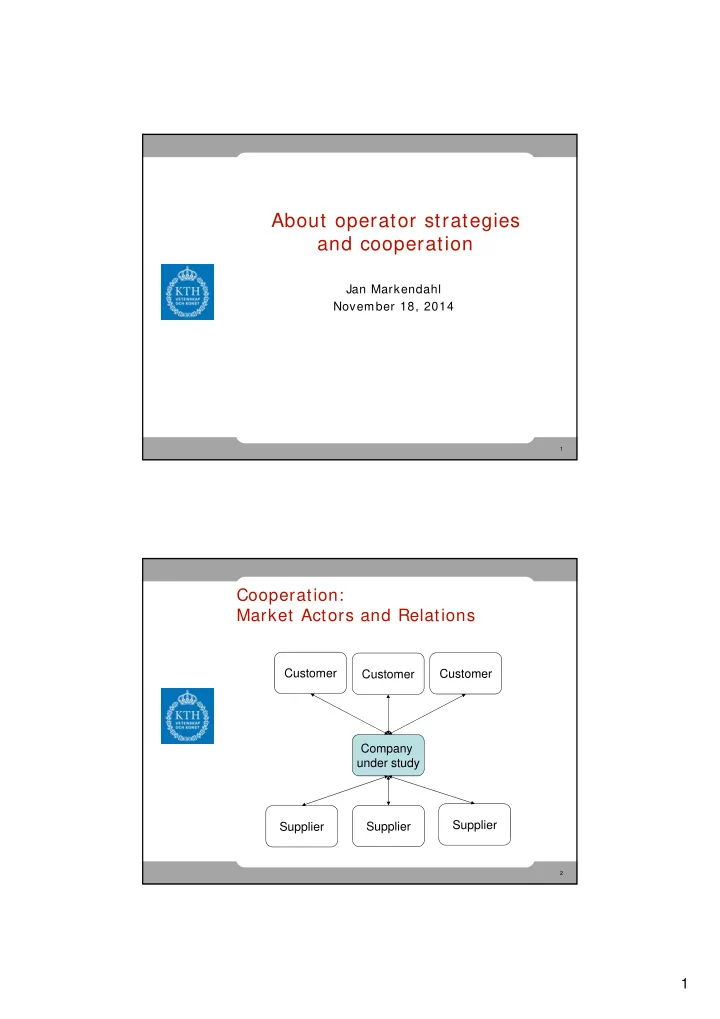
Cooperation: Market Actors and Relations

Company under study Supplier Supplier Supplier Customer Customer Customer

slide-2
SLIDE 2

2

3

Cooperation: Market Actors and Relations

Company under study Supplier Supplier Supplier Customer Customer Customer Competitor Partner

4

Agenda

  • Some examples of company strategies

– IKEA – Xerox – Kodak

  • About cooperation with

– Partners (the case mobile payments) – Customers (the case indoor systems) – Competitors (the case network sharing)

slide-3
SLIDE 3

3

5

PhD problem formulation

Tw o m ain research questions

  • What are the main drivers for a specific type of cooperation?
  • In what ways can the actors organize the cooperation?

The problem space include a num ber of aspects

  • Cooperation with

– Partners – Customers – Competitors

  • Type of business relations and services

– B2C (Business to Consumer) – B2B (Business to Business) – B2B2C (Business to Business to Consumer)

6

Shared Networks Indoor Systems Mobile Payments

Types of business relations B2C B2B B2C B2B2C B2B2C Operator cooperates with Competitor Customers Competitors Partners Customers Competitors System ”to test” Dynamic Roaming Femtocell Networks Contactless Mobile Services

Areas of contributions

slide-4
SLIDE 4

4

7

Agenda

  • Some examples of company strategies

– IKEA – Xerox – Kodak

  • About cooperation with

– Competitors (the case network sharing) – Customers (the case indoor systems) – Partners (the case mobile payments)

8

How to do things – differently ?

  • Involve customers (e.g. IKEA)
  • Focus on the offer - not the product (Xerox case)
  • Focus on added value – not technology (Kodak)
  • Focus on working processes – not connectivity
  • Focus on the local environment (WLAN access)
slide-5
SLIDE 5

5

9

  • IKEA Customers take on some tasks traditionally

done by manufacturers and retailers – Self service – Transportation – Assembly

Example – IKEA

Norman & Ramirez, 1992 “Designing interactive strategy – from value chains to value constellations”

10

Customer involvement

  • Self service in shops
  • Cash withdrawel
  • Ordering of tickets
  • Flight ”check-in” using

– ”Machine” – Internet – SMS

  • Infrastructure owned

deployed & operated by the end-users

slide-6
SLIDE 6

6

11

Example - Xerox

  • Before Xerox – the existing market and sales

– Copy machines ”cheap” ($ 300), little profit – Profit from supplies and consumables – Few copies, typically 20 per day

  • Xerox new electrophotography

– Copy machine expensive ($ 2000) – Candidate partners IBM, Kodak, GE said no – ADL consultancy study 

  • Xerox started on its own

– Offered machine for lease $ 95 per month, including service and 2000 free copies – then 4 cents per copy

12

Example - Xerox

  • Before Xerox – the existing market and sales

– Copy machines ”cheap” ($ 300), little profit – Profit from supplies and consumables – Few copies, typically 20 per day

  • Xerox new electrophotography

– Copy machine expensive ($ 2000) – Candidate partners IBM, Kodak, GE said no – ADL consultancy study 

  • Xerox started on its own

– Offered machine for lease $ 95 per month, including service and 2000 free copies – then 4 cents per copy

Result was exceeding expectation > 2000 copies per DAY

slide-7
SLIDE 7

7

13

Example – Kodak

  • The core business was based on processing of film

– a lot of chemistry

  • Introduction of Digital Cameras changed

the situation completely

  • Kodak managed to stay in business

by changing ”almost everything”

14

Example – Kodak

  • The core business was based on processing of film

– a lot of chemistry

  • Introduction of Digital Cameras changed

the situation completely

  • Kodak managed to stay in business

by changing ”almost everything”

To help people to share and manage their memories

slide-8
SLIDE 8

8

15

The customer activities are related to ”managing and sharing memories”

From Sawhney et al 2004 Creating Growth with Services

16

Agenda

  • Some examples of company strategies

– IKEA – Xerox – Kodak

  • About cooperation with

– Competitors (the case network sharing) – Customers (the case indoor systems) – Partners (the case mobile payments)

slide-9
SLIDE 9

9

17

Many partnerships and joint ventures

Telenor ”Three” Telia Tele2 SUNAB

3G joint venture

3GIS

3G joint venture

Net4Mobility

4G joint venture

Telenor ”Three” Telia Tele2 SUNAB

3G joint venture

3GIS

3G joint venture

Net4Mobility

4G joint venture

18

Network sharing

Payments and billing Customer rel mgmt Common Network, Red Operator Payments and billing Customer rel mgmt Blue Operator

slide-10
SLIDE 10

10

19

Discuss two minutes

  • How will the spectrum allocation influence the

marketing message and market position?

  • Is the spectrum allocation OK or not?
  • Is the cooperation strategy OK or not?

20

slide-11
SLIDE 11

11

21

Agenda

  • Some examples of company strategies

– IKEA – Xerox – Kodak

  • About cooperation with

– Competitors (the case network sharing) – Customers (the case indoor systems) – Partners (the case mobile payments)

22

Different solutions for indoor coverage

Base station Red MNO

DAS: Distributed Antenna System

Base station Blue MNO

Indoor base stations Repeater

Base station Red MNO

DAS: Distributed Antenna System

Base station Blue MNO

Indoor base stations Repeater

slide-12
SLIDE 12

12

23

Shared indoor infrastructure

Payments and billing Customer rel mgmt Shared indoor infrastructure Red Operator Payments and billing Customer rel mgmt Blue Operator Facility

  • wner

24

Actors and relations indoor wireless access systems

Facility Owner Equipment manufacturer Systems integrator Mobile Operator Facility Owner Equipment manufacturer Systems integrator Mobile Operator

slide-13
SLIDE 13

13

25

Actors and relations indoor wireless access systems

Facility Owner Equipment Manufacturer (Powerwave) Systems integrator (MIC nordic) Mobile Operator Network Manufacturer (Ericsson) Facility Owner Equipment Manufacturer (Powerwave) Systems integrator (MIC nordic) Mobile Operator Network Manufacturer (Ericsson)

26

Facility Owner Equipment Manufacturer (Powerwave) Systems integrator (MIC nordic) Mobile Operator Network manufacturer (Ericsson) Building construction company Enterprise Facility Owner Equipment Manufacturer (Powerwave) Systems integrator (MIC nordic) Mobile Operator Network manufacturer (Ericsson) Building construction company Enterprise

Actors and relations indoor wireless access systems

slide-14
SLIDE 14

14

27

Why wireless indoor solutions?

  • Indoor solutions are not only used in order to

compensate for wall penetration losses

  • Other reasons may be:

– Companies want ensured and dedicated capacity – Companies use mobile phones as office phone – Mobile operators want to increase customer loyalty – Mobile operators want to offload data traffic from

  • utdoor (more expensive?) macro networks

28

Willingness to pay for indoor coverage

Willingness to pay Type of end-user Traveller Visitors (public Visitor (guests) Employees ”in tunnel” users) in malls at hotels etc

  • f company

Companies & Enterprise Owners of shopping malls, railway stations, etc Owners of conference centers Hotels, fairs, Local / Road authorities Willingness to pay Type of end-user Traveller Visitors (public Visitor (guests) Employees ”in tunnel” users) in malls at hotels etc

  • f company

Companies & Enterprise Owners of shopping malls, railway stations, etc Owners of conference centers Hotels, fairs, Local / Road authorities

slide-15
SLIDE 15

15

29

Indoor wireless solutions are used in two different business settings

  • 1. To ensure public access in locations like

shopping malls, subways, sport arenas, hotels

  • The users are subscribers of the operators that visit

the shopping mall, subway, sport arena, hotel, etc

  • The operator have agreements with the owners of

the mall, the sport arena, the hotel etc

  • The service IS the ensured indoor coverage
  • 2. To provide indoor ”private” access at company
  • ffices etc as part of a complete offer etc
  • The users are the employees of the ”company”, etc
  • The indoor coverage is just one part of the offer
  • Other components can be outdoor coverage,

handsets, IT support and services, call centers

B2B2C B2B

30

How do actors organize the cooperation

  • In all these cases the mobile operators are the key

actors and organize the network of actors

  • For B2B cases the operator can establish close relations

and aquire knowledge about the customer business and offer more services

Owner of Shopping mall Public users Shop or restaurant Mobile Operators Owner of Shopping mall Public users Shop or restaurant Mobile Operators Mobile Operator Enterprise Mobile Operator Enterprise Facility Owner Enterprises Mobile Operators Facility Owner Enterprises Mobile Operators Hotel Mobile Operator Public users Hotel Mobile Operator Public users

B2B B2B2C

Owner of Shopping mall Public users Shop or restaurant Mobile Operators Owner of Shopping mall Public users Shop or restaurant Mobile Operators Mobile Operator Enterprise Mobile Operator Enterprise Facility Owner Enterprises Mobile Operators Facility Owner Enterprises Mobile Operators Hotel Mobile Operator Public users Hotel Mobile Operator Public users

B2B B2B2C

slide-16
SLIDE 16

16

31

Agenda

  • Some examples of company strategies

– IKEA – Xerox – Kodak

  • About cooperation with

– Competitors (the case network sharing) – Customers (the case indoor systems) – Partners (the case mobile payments)

32

Generic map of actors & relations

Banks and credit card companies Mobile

  • perators

User layer Intermediary layer Service provider layer

Trusted third parties End users Service providers and merchants Banks and credit card companies Mobile

  • perators

User layer Intermediary layer Service provider layer

Trusted third parties End users Service providers and merchants

slide-17
SLIDE 17

17

33

Actor maps for Parking subscriptions and ”separate charging” services

Consumers Merchant or service provider Provider of separate charging service Mobile

  • perators

Banks and credit card companies

Consumers Merchant or service provider Provider of separate charging service Mobile

  • perators

Banks and credit card companies

Consumers Parking operator Mobile parking payment provider Mobile

  • perators

Banks and credit card companies

Consumers Parking operator Mobile parking payment provider Mobile

  • perators

Banks and credit card companies 34

Actor map for SMS ticket services

Consumers Subway or bus company Mobile service provider Mobile

  • perators

Consumers Subway or bus company Mobile service provider Mobile

  • perators

Consumers Parking operator Mobile service provider Mobile

  • perators

Consumers Parking operator Mobile service provider Mobile

  • perators
slide-18
SLIDE 18

18

35

Premium SMS

Banks and credit card companies Mobile

  • perators

Trusted third parties End users Service providers and merchants

36

Bank SMS

Banks and credit card companies Mobile

  • perators

Trusted third parties End users Service providers and merchants

slide-19
SLIDE 19

19

37

Conclusions

  • Many companies think in new ways
  • Many new networking solutions imply that mobile
  • perators need to cooperate with other actors

– customers – competitors

  • Many new mobile services imply that that mobile
  • perators need to cooperate with other actors

– customers – partners – competitors

38

slide-20
SLIDE 20

20

39

Generic map of actors & relations

Banks and credit card companies Mobile

  • perators

Trusted third parties End users Service providers and merchants

40

Cooperation: Market Actors and Relations

Company under study Supplier Supplier Supplier Customer Customer Customer Competitor Partner

slide-21
SLIDE 21

21

41

Porters five market forces

42

The mobile business battle

Mobile Operator

(Wants to share revenues from content and apps and extend to enterprize market)

Integrator

(Wants to integrate also mobile services)

Equipment Vendor

(Wants to extend its business to include services)

Content/ app provider

(Wants to share traffic revenues)

slide-22
SLIDE 22

22

43

Porters generic strategies

44

Porter and the MOB game

According to Porter, there are three fundamental ways through which a company can achieve sustainable competitive advantage. Porter’s three generic strategies are as follows:

  • A cost leadership strategy
  • A differentiation strategy
  • A focus strategy

Choose ONE strategy for the MOB game Prepare activities in order to implement the strategy