About Cardea Our Mission: Improve organizations' abilities to deliver - - PDF document

about cardea
SMART_READER_LITE
LIVE PREVIEW

About Cardea Our Mission: Improve organizations' abilities to deliver - - PDF document

2/4/2014 About Cardea Our Mission: Improve organizations' abilities to deliver Revenue Cycle Management accessible, high quality, culturally proficient, and Best Practices for compassionate services to their clients. Training, organizational


slide-1
SLIDE 1

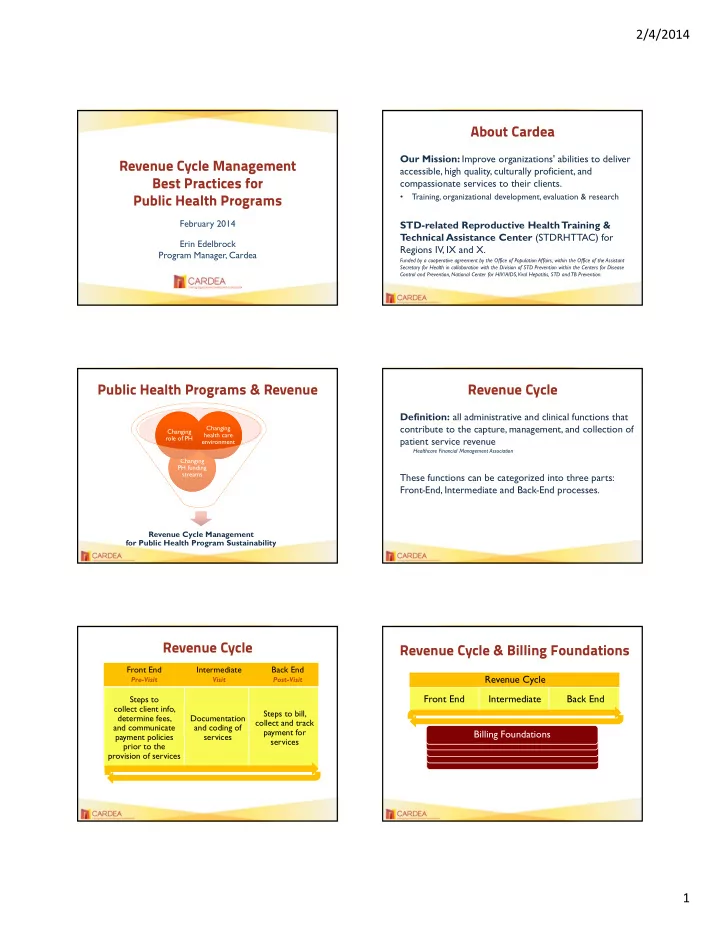
2/4/2014 1 Revenue Cycle Management Best Practices for Public Health Programs

February 2014 Erin Edelbrock Program Manager, Cardea

About Cardea

Our Mission: Improve organizations' abilities to deliver accessible, high quality, culturally proficient, and compassionate services to their clients.

  • Training, organizational development, evaluation & research

STD-related Reproductive Health Training & T echnical Assistance Center (STDRHTTAC) for Regions IV, IX and X.

Funded by a cooperative agreement by the Office of Population Affairs, within the Office of the Assistant Secretary for Health in collaboration with the Division of STD Prevention within the Centers for Disease Control and Prevention, National Center for HIV/AIDS, Viral Hepatitis, STD and TB Prevention.

Public Health Programs & Revenue

Changing PH funding streams Changing PH funding streams Changing role of PH Changing role of PH Changing health care environment Changing health care environment

Revenue Cycle Management for Public Health Program Sustainability

Definition: all administrative and clinical functions that contribute to the capture, management, and collection of patient service revenue

Healthcare Financial Management Association

These functions can be categorized into three parts: Front-End, Intermediate and Back-End processes.

Revenue Cycle Revenue Cycle

Steps to collect client info, determine fees, and communicate payment policies prior to the provision of services Documentation and coding of services Steps to bill, collect and track payment for services Back End Intermediate Front End

Pre-Visit Visit Post-Visit

Revenue Cycle & Billing Foundations

Revenue Cycle Front End Intermediate Back End Billing Foundations

slide-2
SLIDE 2

2/4/2014 2 Billing Foundation

Third Party Payer Relationships Leadership & Staff Buy-in Information System Capacity Workforce Capacity Legislative/Policy Landscape

Adapted from Elements for Successful Immunization Billing Practice, New York State Dept of Health, June 2012

Revenue Cycle Management

IS NOT… Only related to billing insurance; it includes collecting patient fees, managing program funds, etc. IS… the management of revenue cycle processes to allow for a steady stream of revenue Revenue cycle management reflects an important truth— your services have value!

Best Practices: Front End Processes

GOALS

  • Collect complete and accurate information
  • Communicate financial policies to clients
  • Collect first-party payments, as appropriate

Scheduling

COLLECT from the patient:

  • Contact and demographic info
  • Insurance info
  • Reason for visit

COMMUNICATE to the patient:

  • Agency financial policies and payment options
  • Required documents for visit

Eligibility/Pre-Authorization

Using the information captured at scheduling…

  • Contact insurance carrier to determine eligibility and seek

pre-authorization, if applicable Reduces denials due to incorrect/missing information or insufficient coverage Reduces time at check-in

Reminders & Registration

Three opportunities to collect info from and communicate info to the patient:

  • Initial scheduling
  • Reminder call
  • Registration/Check-in
slide-3
SLIDE 3

2/4/2014 3 Registration/Check-in

COMMUNICATE to the patient:

  • Agency financial policies and payment options

COLLECT from the patient:

  • Any updated contact, demographic, insurance info
  • Copy of insurance card, as applicable
  • Signed release forms (address confidentiality)
  • Co-pays or other fees?

Front End – Final Steps

  • Verify insurance eligibility
  • Pre-populate encounter form/superbill

Best Practices: Intermediate Processes

GOALS

  • Correctly and completely document all clinical care /

capture all billable services

  • Capture corresponding charges and codes

Documentation & Coding

Clinical Care Documentation Charge Capture Coding Services

Paper Encounter Form/Superbill + Manual Charge Entry Electronic Encounter Form/Superbill (EHR, Practice Management)

Documentation & Coding

Paper or electronic, either way…

  • Documentation, charge capture and coding is a

partnership between providers and billing staff

  • Charges and codes must be supported by medical

documentation

Best Practices: Back End Processes

GOALS

  • Submit claims/send bills in an accurate and timely fashion
  • Pursue all available avenues for reimbursement
  • Minimize errors
slide-4
SLIDE 4

2/4/2014 4

COMMUNICATE to the patient:

  • Charges and account details, including the patient’s
  • bligation

COLLECT from the patient:

  • Payment, as appropriate (enter immediately)
  • Commitment to a payment plan, as appropriate

Check Out Claims Submission

Review and correct claims

  • Codes and charges, patient and provider info
  • In-house v. Clearinghouse

Timely submission (know your payer’s guidelines)

Remittance Advice and Payment Posting

Remittance advice: information sent to a provider explaining how payments, adjustments or denials were applied Paid? Congratulations! Post payment to the appropriate account as soon as possible Partially paid or denied? Don’t give up – follow-up!

Denials Management

  • Denials for claim errors; often easily corrected 

modify and resubmit

  • Denials due to payer error  appeal
  • Denials due to lack of coverage for the patient or the

service, unpaid deductible/co-ins, etc.  bill secondary payers or patient, as appropriate

Patient Billing

Check payer and program rules (including Medicare, Medicaid, Title X) around balance billing to patients If balance billing allowed…

  • Have written policies and procedures and train staff on

how to discuss charges and balances

  • Send initial statement as close to visit as possible; follow up

with regular, detailed statements

  • Provide multiple payment options

Quality Improvement

Quality Improvement

  • A philosophy/approach
  • Driven by staff & clients
  • Focuses on systems and

processes; builds on strengths

  • Assumes that the system,

NOT the individual is the root cause of most problems

Quality Assurance

  • A specific activity
  • Driven by management
  • Focus on policies &

procedures; tasks & compliance checks

  • Includes performance

evaluations

  • Seeks to identify problems

and make corrections

slide-5
SLIDE 5

2/4/2014 5 A Quality Improvement Plan

  • Leadership Involvement — Mission, Goals, Resources
  • T

eam Empowerment—Responsibilities, Timeline

  • Customer Focus
  • Data Collection—tools; defined indicators,

benchmarks

  • Process—Plan, Do, Check, Act; continuous
  • Celebrate success!

William J. Riley, et al. Realizing Transformational Change Through Quality Improvement in Public

  • Health. J Public Health Management Practice, 2010.

What are your agency’s strengths and areas for improvement?

Front End Intermediate Back End

Scheduling Registration Eligibility Verification Fee Determination Patient communication Claims Submission Claims Follow-up Denials management Payment posting Balance billing Clinical Care Documentation Charge Capture Coding Services Quality Improvement

Resources from Cardea

  • Case studies of public health programs that are

currently billing

  • Webinars and other online learning tools
  • An online learning community to help you connect

with peers and access resources

  • Customized training and technical assistance

Contact Information

Erin Edelbrock Program Manager erin@cardeaservices.org 206.447.9538 www.cardeaservices.org @CardeaServices