
SLIDE 1
Esta foto de Autor desconocido está bajo licencia CC BY-SA
ABAC, APEC and Exporters: New
- pportunities for Businesses
Loreto Leyton Executive Director Chile Pacific Foundation and ABAC 2019
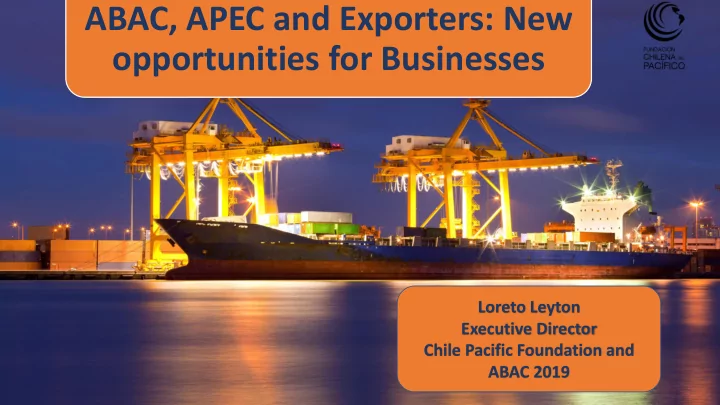
ABAC, APEC and Exporters: New opportunities for Businesses Loreto - - PowerPoint PPT Presentation
ABAC, APEC and Exporters: New opportunities for Businesses Loreto Leyton Executive Director Chile Pacific Foundation and ABAC 2019 Esta foto de Autor desconocido est bajo licencia CC BY-SA I. ABAC What does ABAC do? Funcin de ABAC
Esta foto de Autor desconocido está bajo licencia CC BY-SA
Loreto Leyton Executive Director Chile Pacific Foundation and ABAC 2019
as cr crea eated in in 1995, , si six yea ears aft fter r th the fou
in 1989
It mak akes rec ecommendations fr from priv rivate sec sector r rep epresentatives to
the e lea leaders of
the 21 APEC ec economies.
Over r th the yea ears, ABAC´s ag agenda has as in incl cluded new top
elated to
rn-day prio riorities (e (e.g., dig igital economy, SME’s and sustainability)
tween ABAC members an and Le Lead aders ar are e regular ar th throughout th the year ar by y usin sing in institutional ch chan annels.
Regional Economic Integration Sustainable Development MSME & Entrepreneurship Finance and Economics Digital & Innovation
access
economic integration
communities through social innovation and green growth
inclusion through innovation
regulations, security and skills for the future
Digital and Innovation
Facilitating human capital digitalization Guidelines for a regulatory framework that facilitates business Enhancing cyber security and resilience
Finance and Economics
Enabling technology to drive increased economic and financial inclusion Promoting MSME access to finance Advancing financial integration within APEC
MSME &
Entrepreneurship
Promoting MSME success in GVCs Strengthening the participation of women in the economy Best practices for MSMEEs and regulations that foster their business
Sustainable Development
Fostering sustainable food systems Energy, innovation and circular economy Ensuring sustainability of, and cohesion around, extractive industries
Regional Economic Integration
Further promotion, liberalization and facilitation of trade and investment Advancing towards the Free Trade of the Asia Pacific (FTAAP)
Strengthening the services agenda and progress in the implementation of the APEC Services Competitiveness Roadmap
Digital and Innovation
Facilitating human capital digitalization Guidelines for a regulatory framework that facilitates business Enhancing cyber security and resilience
Finance and Economics
Enabling technology to drive increased economic and financial inclusion Promoting MSME access to finance Advancing financial integration within APEC
MSME &
Entrepreneurship
Promoting MSME success in GVCs Strengthening the participation of women in the economy Best practices for MSMEEs and regulations that foster their business
Sustainable Development
Fostering sustainable food systems Energy, innovation and circular economy Ensuring sustainability of, and cohesion around, extractive industries
Regional Economic Integration
Further promotion, liberalization and facilitation of trade and investment Advancing towards the Free Trade of the Asia Pacific (FTAAP)
Strengthening the services agenda and progress in the implementation of the APEC Services Competitiveness Roadmap
Digital and Innovation
Facilitating human capital digitalization Guidelines for a regulatory framework that facilitates business Enhancing cyber security and resilience
Finance and Economics
Enabling technology to drive increased economic and financial inclusion Promoting MSME access to finance Advancing financial integration within APEC
MSME &
Entrepreneurship
Promoting MSME success in GVCs Strengthening the participation of women in the economy Best practices for MSMEEs and regulations that foster their business
Sustainable Development
Fostering sustainable food systems Energy, innovation and circular economy Ensuring sustainability of, and cohesion around, extractive industries
Regional Economic Integration
Further promotion, liberalization and facilitation of trade and investment Advancing towards the Free Trade of the Asia Pacific (FTAAP)
Strengthening the services agenda and progress in the implementation of the APEC Services Competitiveness Roadmap
Digital and Innovation
Facilitating human capital digitalization Guidelines for a regulatory framework that facilitates business Enhancing cyber security and resilience
Finance and Economics
Enabling technology to drive increased economic and financial inclusion Promoting MSME access to finance Advancing financial integration within APEC
MSME &
Entrepreneurship
Promoting MSME success in GVCs Strengthening the participation of women in the economy Best practices for MSMEEs and regulations that foster their business
Sustainable Development
Fostering sustainable food systems Energy, innovation and circular economy Ensuring sustainability of, and cohesion around, extractive industries
Regional Economic Integration
Further promotion, liberalization and facilitation of trade and investment Advancing towards the Free Trade of the Asia Pacific (FTAAP)
Strengthening the services agenda and progress in the implementation of the APEC Services Competitiveness Roadmap
11-13: ABAC 4 14: SME's and Entrepreneurs Summit 15-16: CEO's Summit 16: APEC Leaders - ABAC Dialogue 17: Leaders Summit
✓ Number of Attendees: 800 high level attendees, representing APEC members equitably ✓ Assistant Profile: Chairmen, CEOs and APEC Leaders of the 21 APEC economies, renowned speakers and thought leaders
For more details and regular updates, visit www.apecceosummit.cl
For more details and regular updates, you may download: Cumbre Pymes y emprendedores
Support Producers with Technology to export their products to different parts of the
world, which without a Global B2B Marketplace would be much harder to achieve.
Companies are still using outdated methods to communicate, negotiate and buy, making it hard to manage relationships around the world. Since many online e- commerce platforms have not focused on security, many companies have been part of fraudulent
business online.
NO TRUST INEFFICIENT
It takes many companies to work together to successfully export products around the world and without technology exporting products is very difficult. Only a small percentage
export, actually do! And it’s because they don’t know what economy they could sell their products to, they have no visibility!
FRAGMENTED NO VISIBILITY
EXPORTERs VALIDATED BUSINESS PARTNERs VALIDATED IMPORTERs VALIDATED
Each economy must validate their Exporters, Importers and Business Partners By validating each company, we’ll ensure TRUST inside the Marketplace!
Phase 1: BIMP (Brunei – Indonesia- Malaysia – Philippines) Phase 3: BIMP + Pacific Alliance + ASEAN (Singapore,
Tailand, Vietnam, Cambodia, Laos and Myanmar)
Phase 2: BIMP + Pacific Alliance (México – Colombia – Perú
and Chile)
Phase 4: BIMP + Pacific Alliance + ASEAN + others APEC
(EE.UU., Canada, China, South Korea, Australia, New Zealand, Japan, PNG)
Inventing the Future 2019
OBJECTIVES
Call and selec t the best startups from America and Asia-Pacific, through an attractive application
process with the capacities and expertise to detect the best initiatives.
Invest and ac c eler ate the most promissory startups through a unique financing system in the Chilean
ecosystem, able to support startups at early and advanced stages (accelerator, angels network and CLIN fund).
Put on the agenda those promissory technologies that are going to change the world, and show
them to the people in charge of the society´s future.
Br ing together the best entrepreneurs and world experts in forefront technologies on a exclusive
event in Chile to think about new bets of Venture capital industries.
DIGITALIZATION
L
Waste management Sustainable c onsumer Shar e ec onomy Mac hine lear ning A.I
R esour c es management R educ e New mater ials R e-use r epair Plastic management Monitor ing systems T r ac eability R ec yc le mater ials Platfor ms E duc ation IoT R enewable ener gy Cr
c ing New sustainable business models New c ir c ular business models Optimization Up c yc ling E co design Big data Pr
innovation Digitalization Consumer infor mation
CIRCULAR ECONOMY
4.0 Industr y 5G Biomater ials
As of today, there are 21 member APEC economies
Century free trade development
global middle class by 2040 (ECLA)
the most dynamic
region of 21st Century
value chains
an acute understanding of businesses concerns among government officials
Source: APEC in Charts, 2018 (www.apec.org)
4,4 1,6 2,4 3,4 4,4 4,2 4,3 4,4 2,0
5,1 3,7 3,7 3,6 3,7 3,8 3,2 3,7 3,9 3,7 3,5 3,5 3,3 3,3
0,0 2,0 4,0 6,0 8,0 10,0 12,0 2000 2001 2002 2003 2004 2005 2006 2007 2008 2009 2010 2011 2012 2013 2014 2015 2016 2017 2018 2019 2020 2021 2022 2023 Asia-Pacific Emerging Advanced
Source: data from IMF WEO April 2018 database, analysis by PECC International Secretariat
APEC economies invigorates exports by opening up new markets
APEC facilitates free trade negotiations and a regular best-practices sharing process
Source: APEC in Charts, 2018 (www.apec.org)
Source: APEC in Charts, 2018 (www.apec.org)
Source: APEC in Charts, 2018 (www.apec.org)
Source: Research Outcomes. Summary of Research Projects 2018. Policy Support Unit, APEC.
Agreements) and FTA (Free Trade Agreements) has steadily increased :
least one APEC economy (Dec, 2017)
bilateral trade was under the umbrella
2017)
Source: Research Outcomes. Summary of Research Projects 2018. Policy Support Unit, APEC.
agriculture products)
71,4% 60,5% 60,9% 66,7% 60,6%
0% 20% 40% 60% 80% 100%
North America Northeast Asia Oceania Pacific South America Southeast Asia Disagree Agree
45,9% 48,2% 41,8% 40,3% 36,1% 35,0% 61,4% 64,9% 67,7% 66,9% 63,4%
0% 20% 40% 60% 80% 100% 2006 2007 2008 2010 2011 2013 2014 2015 2016 2017 2018
Negative Positive
Perception Usefulness
Source: State of the Region 2018-2019 Survey, Pacific Economic Cooperation Council
28,7% 42,2% 24,6% 24,1% 49,1% 17,3% 42,9% 22,1% 26,3%
0% 20% 40% 60%
China India Japan Russia Southeast Asia Oceania USA EU World Weaker Stronger
Source: Pacific Economic Cooperation Council State of the Region Survey 2018
Sustainable growth and prosperity
Liberalization of trade and investment Business promotion Economic and technical cooperation
Markets openness Increasing trade and investment More economic and social development Lower export and import costs Lower production costs (Gloval Value Chains) Strengthening of institutional capacities
formal negotiations in April, during APEC meeting
(more opportunities for MSMEs)
support digital trade policy in the digital era, such as:
equipment
A new digital bridge connecting Asia and South America
Missing link between Asia and South America
Digital Ga Gate from Asia to South America Curie (Google gle)
USD 300 Mill* (P) (2019)
PPP: Public Private Partnership P: Private Investment (*) Estimates (**) Devices and apps are not included (***) In coverage zones
USD 500-600 Mill (PPP) (2021)
25 fold increment in Chile’s International connectivity Capacity: from 6 to 160 Tbps
Enhanced International connectivity
38
Fiber Optic System
Capacity
Investment
possibilities in the Pacific Area.
minimum delays.
and the countries in the South American region, through an extensive network of fiber optic cables (AMX1, MONET, ELLA, PCCS, SACS).
generated in Chile (the country hosts nearly 60% of the world’s
astronomical infrastructure).
40
Origin China, Japan, Korea & Singapore Intermediate New Zealand, Australia & Hawaii Branches Landing point Rapa Nui, J. Fernández & French Polynesia Valparaíso, Arica, Punta Arenas, branch to Lima
Route Alternatives (preliminary):
adding demand for data transport with South American countries, with the confirmation of Brazil and Argentina.
New Zealand and Singapore.
class datacenter deployment and transit to other countries in the Southern Cone.
redundancy for routes through the South Pacific
ECONOMIES
GLOBAL POPULATION
GLOBAL GDP
OF THE COUNTRY’S GDP IS EXPLAINED BY TRADE
FREE TRADE AGREEMENTS
COMPANIES EXPORTED DURING 2018, INCLUDING 3.378 SME’s
OF JOBS CREATED BY EXPORT COMPANIES
OF EXPORTS GO TO COUNTRIES WITH WHICH CHILE HAS AN FTA (2018) CHINA (35%) UNITES STATES (14%) JAPAN (10%) SOUTH KOREA (6%) BRAZIL (5%)
GLOBAL EXPORTER
2018
I Fresh Cherries I Fresh Grapes I Fresh Blueberries I Salmon Fillet I
149 2.518 11.093 38.975
1960 1980 2000 2018
Record of non-copper exports
USD Millions
| THE NUM B E RS B E HIND CHILE ’ S F R E E TR A DE PO LICY
1% 8% 8% 8% 8% 8% 13% 14% 15% 16% 16% 17% 17% 17% 18% 18% 18% 18% 19% 20% 22% 23% 24% 27% 33% 34% 43% 50% 61%
Source: Chile’s General Directorate of International Economic Relations
Fuente: DIRECON, sobre la base de Banco Central de Chile, Aduana y Cámara de Comercio de Santiago.
0% 5% 10% 15% 20% 25% 30% 35% 10.000 20.000 30.000 40.000 50.000 60.000 70.000 80.000 90.000
1970 1972 1974 1976 1978 1980 1982 1984 1986 1988 1990 1992 1994 1996 1998 2000 2002 2004 2006 2008 2010 2012 2014 2016
EXPORTACIONES* EXPORTACIONES EXPORTACIONES NO COBRE ARANCEL DE IMPORTACIÓN**
0,89%
(MFN 6%)
ACE MERCOSUR AAE UE TLC KOREA TLC EEUU TLC CHINA
32,6%
(NMF 220%)
6,2%
(NMF 10%)
10.000 20.000 30.000 40.000 50.000 60.000 70.000 80.000 90.000 Total Exportado Total Importado
Source: Chile’s General Directorate of International Economic Relations
Exported Imported
Source: Chile’s General Directorate of International Economic Relations
1% 4% 5% 5% 16% 17% 21% 20% 21% 21% 19% 45% 66% 65% 77% 91% 91% 92% 92% 93% 93% 93% 94% 93% 95% 95%
0% 10% 20% 30% 40% 50% 60% 70% 80% 90% 100%
% Chile´s commercial partners Rest of the world
Port of Valparaiso, Chile
go to the APEC region
come from APEC
Chile come from the APEC region
Source: Chile at a Glance (www.apecchile2019.cl)
Source: Chile’s General Directorate of International Economic Relations
10.000.000 20.000.000 30.000.000 40.000.000 50.000.000 60.000.000 70.000.000 80.000.000 90.000.000
1990 1991 1992 1993 1994 1995 1996 1997 1998 1999 2000 2001 2002 2003 2004 2005 2006 2007 2008 2009 2010 2011 2012 2013 2014 2015 2016 2017
Mundo Mundo sin APEC
World World without APEC