A New Theory, Techniques and Alternatives for Direction-of-Arrival - - PowerPoint PPT Presentation

a new theory techniques and alternatives for direction of
SMART_READER_LITE
LIVE PREVIEW

A New Theory, Techniques and Alternatives for Direction-of-Arrival - - PowerPoint PPT Presentation

A New Theory, Techniques and Alternatives for Direction-of-Arrival Estimation in Acoustic Signal Processing Bandhit Suksiri Fukumoto Research Laboratory, Kochi University of Technology August 22, 2019 Bandhit Suksiri (KUT) Public Defense


slide-1
SLIDE 1

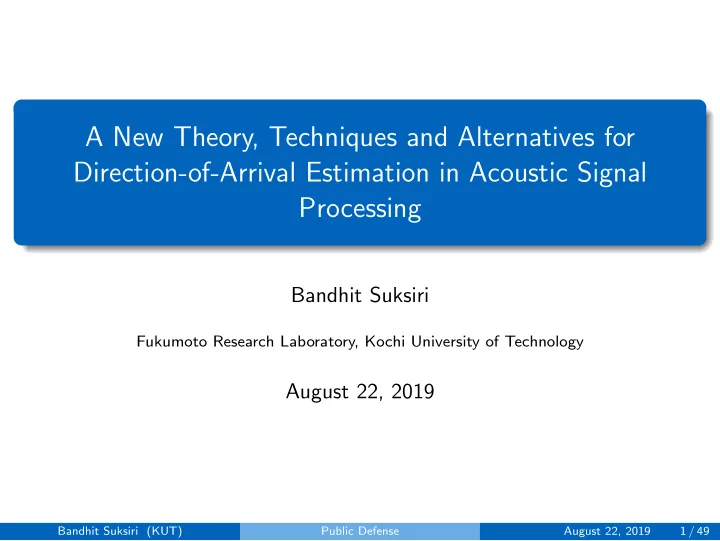
A New Theory, Techniques and Alternatives for Direction-of-Arrival Estimation in Acoustic Signal Processing

Bandhit Suksiri

Fukumoto Research Laboratory, Kochi University of Technology

August 22, 2019

Bandhit Suksiri (KUT) Public Defense August 22, 2019 1 / 49

slide-2
SLIDE 2

Presentation Outline

1 Introduction: Preliminary Assessment, Objective, and New Approaches 2 Research #1: Acoustic DOA Estimation by using Theory of Orthogonal

Procrustes Analysis

3 Research #2: Extension Theory of Orthogonal Procrustes Analysis for

Acoustic DOA Estimation

4 Research #3: Acoustic DOA and Variance Estimation via

Complex-Valued Tensor Factorization

5 Summary: Conclusions

Bandhit Suksiri (KUT) Public Defense August 22, 2019 2 / 49

slide-3
SLIDE 3

Presentation Outline

1 Introduction: Preliminary Assessment, Objective, and New Approaches 2 Research #1: Acoustic DOA Estimation by using Theory of Orthogonal

Procrustes Analysis

3 Research #2: Extension Theory of Orthogonal Procrustes Analysis for

Acoustic DOA Estimation

4 Research #3: Acoustic DOA and Variance Estimation via

Complex-Valued Tensor Factorization

5 Summary: Conclusions

Bandhit Suksiri (KUT) Public Defense August 22, 2019 3 / 49

slide-4
SLIDE 4

Introduction: Direction-of-Arrival in the Field of Acoustics

θ1 θ2 θ3

φ1 φ2 φ3

x z

Reference point

Microphone arrays

Source #1 Source #2 Source #3

θ is a x-subarray DOA, φ is a z-subarray DOA.

Usages of acoustic Direction-of-Arrival (DOA) estimation

◮ Speech enhancement, source separation, human computer interaction ◮ Other applications; surveillance, automatic camera management

Bandhit Suksiri (KUT) Public Defense August 22, 2019 4 / 49

slide-5
SLIDE 5

Introduction: Examples of the Applications

Reference: Satoshi Tadokoro. (2017, December 25) Impulsing Paradigm Change through Disruptive Technologies Program (ImPACT): Tough Robotics Challenge. Retrieved from http://www.jst.go.jp/impact/en/program/07.html. Reference: Liu, Huawei; Li, Baoqing; Yuan, Xiaobing; Zhou, Qianwei; Huang,

  • Jingchang. 2018. "A Robust Real Time Direction-of-Arrival Estimation

Method for Sequential Movement Events of Vehicles." Sensors 18, no. 4: 992.

Microphone Array Target Location #2 Target Location #1 Target Location #1 Target Location #2 Drone Target Location Bandhit Suksiri (KUT) Public Defense August 22, 2019 5 / 49

slide-6
SLIDE 6

Introduction: Preliminary Assessment

◮ Discussion: The existing framework of acoustic DOA estimation

Acoustic DOA Estimation

DOA Estimation for Wireless Communication

Wideband Method Narrowband Method

Classic & Simplest

Level of Robustness

High Efficiency

◮ Problem: Lack of high efficient techniques and suitable theory

when it comes to the acoustic DOA estimation gg ez

Bandhit Suksiri (KUT) Public Defense August 22, 2019 6 / 49

slide-7
SLIDE 7

Introduction: Preliminary Assessment

◮ Discussion: The existing framework of acoustic DOA estimation

Acoustic DOA Estimation

DOA Estimation for Wireless Communication

Wideband Method Narrowband Method

Classic & Simplest

Level of Robustness

High Efficiency Extension of framework, theory, techniques

◮ Solution: Propose a new theory to extend the existing framework

form wireless communication field to acoustic signal processing

Bandhit Suksiri (KUT) Public Defense August 22, 2019 7 / 49

slide-8
SLIDE 8

Introduction: Research Objective and Contribution

◮ To propose an alternative theory for acoustic DOA estimation;

this theory enables some useful techniques in wireless communication field to implement an acoustic DOA estimation for reducing a computational complexity and facilitating the estimation algorithm.

Bandhit Suksiri (KUT) Public Defense August 22, 2019 8 / 49

slide-9
SLIDE 9

Introduction: Research Objective and Contribution

◮ To propose an alternative theory for acoustic DOA estimation;

this theory enables some useful techniques in wireless communication field to implement an acoustic DOA estimation for reducing a computational complexity and facilitating the estimation algorithm.

◮ Keywords:

Bandhit Suksiri (KUT) Public Defense August 22, 2019 8 / 49

slide-10
SLIDE 10

Introduction: Research Objective and Contribution

◮ To propose an alternative theory for acoustic DOA estimation;

this theory enables some useful techniques in wireless communication field to implement an acoustic DOA estimation for reducing a computational complexity and facilitating the estimation algorithm.

◮ Keywords:

◮ Theory of Orthogonal Procrustes Analysis and its Extension Bandhit Suksiri (KUT) Public Defense August 22, 2019 8 / 49

slide-11
SLIDE 11

Introduction: Research Objective and Contribution

◮ To propose an alternative theory for acoustic DOA estimation;

this theory enables some useful techniques in wireless communication field to implement an acoustic DOA estimation for reducing a computational complexity and facilitating the estimation algorithm.

◮ Keywords:

◮ Theory of Orthogonal Procrustes Analysis and its Extension ◮ DOA via High-Order Generalized Singular Value Decomposition Bandhit Suksiri (KUT) Public Defense August 22, 2019 8 / 49

slide-12
SLIDE 12

Introduction: Research Objective and Contribution

◮ To propose an alternative theory for acoustic DOA estimation;

this theory enables some useful techniques in wireless communication field to implement an acoustic DOA estimation for reducing a computational complexity and facilitating the estimation algorithm.

◮ Keywords:

◮ Theory of Orthogonal Procrustes Analysis and its Extension ◮ DOA via High-Order Generalized Singular Value Decomposition ◮ DOA via Complex-Valued Tensor Factorization Bandhit Suksiri (KUT) Public Defense August 22, 2019 8 / 49

slide-13
SLIDE 13

Presentation Outline

1 Introduction: Preliminary Assessment, Objective, and New Approaches 2 Research #1: Acoustic DOA Estimation by using Theory of Orthogonal

Procrustes Analysis

3 Research #2: Extension Theory of Orthogonal Procrustes Analysis for

Acoustic DOA Estimation

4 Research #3: Acoustic DOA and Variance Estimation via

Complex-Valued Tensor Factorization

5 Summary: Conclusions

Bandhit Suksiri (KUT) Public Defense August 22, 2019 9 / 49

slide-14
SLIDE 14

Research #1: System Overviews

STFT

Time Frequency Amplitude

STFT

Time Frequency Amplitude

θ1 θ2 θ3

φ1 φ2 φ3

x z

Reference Point Source #1 Source #2 Source #3

STFT

Time Frequency Amplitude

Ax (φ, f)

x-subarray angle

Az (θ , f)

z-subarray angle sources

s (t , f)

sources at t,f

s (t , f) Ax (φ, f)

x-subarray angle

x(t , f)

received signal at t,f sources at t,f

s (t , f) Az (θ , f)

x-subarray angle

z (t , f)

received signal at t,f

Unknown Parameters

z x

Observable Parameters

Bandhit Suksiri (KUT) Public Defense August 22, 2019 10 / 49

slide-15
SLIDE 15

Research #1: Microphone Structure

Cramer-Rao bound (CRB) Structure Figure CRB Octagon Array (Circle Array)

4,12,16,20,...

57 δM3 L-Shaped Array

3,5,...,15,17,19,...

60 δM3 Cross Array

5,9,...,17,21,....

96 δM3 Triangle Array

3,6,9,12,18,21,...

108 δM3 δ = 2SNR 2πd

λ

2, CRB represents the lowest error bound of DOA.

M 2 1

Z X Y

1 2 M

ϕk θk

sk

Microphone Placement Area d Bandhit Suksiri (KUT) Public Defense August 22, 2019 11 / 49

slide-16
SLIDE 16

Research #1: Microphone Structure

Cramer-Rao bound (CRB) Structure Figure CRB Octagon Array (Circle Array)

4,12,16,20,...

57 δM3 L-Shaped Array

3,5,...,15,17,19,...

60 δM3 Cross Array

5,9,...,17,21,....

96 δM3 Triangle Array

3,6,9,12,18,21,...

108 δM3 δ = 2SNR 2πd

λ

2, CRB represents the lowest error bound of DOA.

M 2 1

Z X Y

1 2 M

ϕk θk

sk

Microphone Placement Area d

◮ Octagon CRB has only 5%

smaller than L-Shaped CRB.

◮ DOA for L-Shaped array is

widely proposed recently. (more DOA technique)

  • Y. Hua et al., “L-shaped for estimating 2D DOA,” IEEE, 1991.

Bandhit Suksiri (KUT) Public Defense August 22, 2019 11 / 49

slide-17
SLIDE 17

Research #1: General Model via Cross-Correlation

s (t , f) Ax (φ, f) x(t , f) s (t , f) Az (θ , f) z (t , f)

Signal Model at X-axis :

signals received by the microphone array

Signal Model at Z-axis :

signals received by the microphone array

General Model for Estimating DOA :

source's variance each frequency

Bandhit Suksiri (KUT) Public Defense August 22, 2019 12 / 49

slide-18
SLIDE 18

Research #1: General Model via Cross-Correlation

s (t , f) Ax (φ, f) x(t , f) s (t , f) Az (θ , f) z (t , f)

Signal Model at X-axis :

signals received by the microphone array

Signal Model at Z-axis :

signals received by the microphone array

x(t , f) z (t , f)

H

s (t , f) s (t , f)

H

Ax (φ, f) Az (θ, f )

H

{ , }

S ff

{ , }

R

ff xz

General Model for Estimating DOA :

source's variance each frequency

Bandhit Suksiri (KUT) Public Defense August 22, 2019 12 / 49

slide-19
SLIDE 19

Research #1: Well-known Direction-of-Arrival Methods

x(t , f) z (t , f)

H

s (t , f) s (t , f)

H

Ax (φ, f) Az (θ, f )

H

{ , }

S ff

{ , }

R

ff xz

General Model for Estimating DOA : Singular Value Decomposition & Estimating Left (and Right) Matrices

source's variance each frequency

Well-known methods for estimating subarray angles:

◮ Multiple Signal Classification (MUSIC) [R.Schmidt, 1986] ◮ Estimation of Signal Parameters via Rotational Invariance Techniques

(ESPRIT) [R.Roy et al., 1989]

◮ 2-dimensional MUSIC [M.G.Porozantzidou et al., 2010]

Bandhit Suksiri (KUT) Public Defense August 22, 2019 13 / 49

slide-20
SLIDE 20

Research #1: Well-known Direction-of-Arrival Methods

x(t , f) z (t , f)

H

s (t , f) s (t , f)

H

Ax (φ, f) Az (θ, f )

H

{ , }

S ff

{ , }

R

ff xz

General Model for Estimating DOA : Singular Value Decomposition & Estimating Left (and Right) Matrices

source's variance each frequency

Well-known methods for estimating subarray angles:

◮ Multiple Signal Classification (MUSIC) [R.Schmidt, 1986] ◮ Estimation of Signal Parameters via Rotational Invariance Techniques

(ESPRIT) [R.Roy et al., 1989]

◮ 2-dimensional MUSIC [M.G.Porozantzidou et al., 2010] ◮ These methods hold great promise in high efficient DOA method ◮ It is impossible to directly apply in human voice (multiple frequency)

Bandhit Suksiri (KUT) Public Defense August 22, 2019 13 / 49

slide-21
SLIDE 21

Research #1: Angle Matrices on Wide Frequency Range

Share identical angles for all frequency bins x(t , f) z (t , f)

H

s (t , f) s (t , f)

H

Ax (φ, f) Az (θ, f )

H

{ , }

S ff

{ , }

R

ff xz

1 1 1 1 1 1

1 1 1 1

f1

At frequency : x(t , f) z (t , f)

H

s (t , f) s (t , f)

H

Ax (φ, f) Az (θ, f )

H

{ , }

S ff

{ , }

R

ff xz

2 2 2 2 2 2

2 2 2 2

At frequency :

f2

Ax(φ, f)

1

Ax(φ, f)

2

≠ Az(θ , f)

1

Az(θ , f)

2

Share identical angles for all frequency bins ◮ Sources always have various frequency ranges; music, human voice

Bandhit Suksiri (KUT) Public Defense August 22, 2019 14 / 49

slide-22
SLIDE 22

Research #1: Angle Matrices on Wide Frequency Range

Share identical angles for all frequency bins x(t , f) z (t , f)

H

s (t , f) s (t , f)

H

Ax (φ, f) Az (θ, f )

H

{ , }

S ff

{ , }

R

ff xz

1 1 1 1 1 1

1 1 1 1

f1

At frequency : x(t , f) z (t , f)

H

s (t , f) s (t , f)

H

Ax (φ, f) Az (θ, f )

H

{ , }

S ff

{ , }

R

ff xz

2 2 2 2 2 2

2 2 2 2

At frequency :

f2

Ax(φ, f)

1

Ax(φ, f)

2

≠ Az(θ , f)

1

Az(θ , f)

2

Share identical angles for all frequency bins ◮ Sources always have various frequency ranges; music, human voice ◮ The left & right matrices are differences for all frequency bins ◮ However, they share same angles for all frequency bins

Bandhit Suksiri (KUT) Public Defense August 22, 2019 14 / 49

slide-23
SLIDE 23

Research #1: Problem of Multiple Subspace

f1

Subspace At frequency :

Geometric portrayal of 3 sensor case at f1

x1 x2 x3

Signal Subspace (Possible DOAs)

f2

Subspace At frequency :

Geometric portrayal of 3 sensor case at f2

x1 x2 x3

Signal Subspace (Possible DOAs)

Subspace Intersection :

Geometric portrayal of 3 sensor case

x1 x2 x3

Intersection Area = True DOAs

f1 f2

variance variance intersect

◮ Signal subspace area represent the possibility of true DOAs

Bandhit Suksiri (KUT) Public Defense August 22, 2019 15 / 49

slide-24
SLIDE 24

Research #1: Problem of Multiple Subspace

f1

Subspace At frequency :

Geometric portrayal of 3 sensor case at f1

x1 x2 x3

Signal Subspace (Possible DOAs)

f2

Subspace At frequency :

Geometric portrayal of 3 sensor case at f2

x1 x2 x3

Signal Subspace (Possible DOAs)

Subspace Intersection :

Geometric portrayal of 3 sensor case

x1 x2 x3

Intersection Area = True DOAs

f1 f2

variance variance intersect

◮ Signal subspace area represent the possibility of true DOAs ◮ DOAs can be determined by intersecting the area between f1 and f2 ◮ When there is no intersection area, it is impossible to detect DOAs

Bandhit Suksiri (KUT) Public Defense August 22, 2019 15 / 49

slide-25
SLIDE 25

Research #1: Problem of Multiple Subspace

f1

Subspace At frequency :

Geometric portrayal of 3 sensor case at f1

x1 x2 x3

Signal Subspace (Possible DOAs)

f2

Subspace At frequency :

Geometric portrayal of 3 sensor case at f2

x1 x2 x3

Signal Subspace (Possible DOAs)

Subspace Intersection :

Geometric portrayal of 3 sensor case

x1 x2 x3

Intersection Area = True DOAs

f1 f2

variance variance intersect

◮ Signal subspace area represent the possibility of true DOAs ◮ DOAs can be determined by intersecting the area between f1 and f2 ◮ When there is no intersection area, it is impossible to detect DOAs ◮ Employing conventional DOA estimation in each frequency bins

cannot obtain this intersection area

Bandhit Suksiri (KUT) Public Defense August 22, 2019 15 / 49

slide-26
SLIDE 26

Research #1: Problem of Multiple Subspace

Subspace Intersection :

Geometric portrayal of 3 sensor case

x1 x2 x3 f1 f2 f3 Subspace Transformation (all frequency bins) :

transform Geometric portrayal of 3 sensor case

x1 x2 x3 f1 f2 f3

Arrows represent signal subspace vector

(obtained by conventional DOA method in each frequency bins)

fo

◮ Problem: How to get the center of intersection area (or signal

subspace vector at fo) without employing the intersection area?

Bandhit Suksiri (KUT) Public Defense August 22, 2019 16 / 49

slide-27
SLIDE 27

Research #1: Problem of Multiple Subspace

Subspace Intersection :

Geometric portrayal of 3 sensor case

x1 x2 x3 f1 f2 f3 Subspace Transformation (all frequency bins) :

transform Geometric portrayal of 3 sensor case

x1 x2 x3 f1 f2 f3

Arrows represent signal subspace vector

(obtained by conventional DOA method in each frequency bins)

fo

◮ Problem: How to get the center of intersection area (or signal

subspace vector at fo) without employing the intersection area?

◮ Solution: Subspace transformation for all frequency bins

Bandhit Suksiri (KUT) Public Defense August 22, 2019 16 / 49

slide-28
SLIDE 28

Research #1: Subspace Transformation Process

Ax (φ, f) Az (θ, f )

H

Ax (φ, f)

×

Az (θ, f )

  • H

×

Ax (φ, f)

  • Az (θ , f)
  • H
  • 1

× ×

T x{f} T z{f}

H

S{ , }

f f

× ×

Ax (φ, f)

  • Az (θ , f)
  • H

S{ , }

f f uncorrelated sources

{ , }

Rx

f

z

f

Dxz{f} ◮ Ax (φ, fo) = T x{f }Ax (φ, f ) ,

Az (θ, fo) = T z{f }Az (θ, f ) , ∀f .

Bandhit Suksiri (KUT) Public Defense August 22, 2019 17 / 49

slide-29
SLIDE 29

Research #1: Subspace Transformation Process

Ax (φ, f) Az (θ, f )

H

Ax (φ, f)

×

Az (θ, f )

  • H

×

Ax (φ, f)

  • Az (θ , f)
  • H
  • 1

× ×

T x{f} T z{f}

H

S{ , }

f f

× ×

Ax (φ, f)

  • Az (θ , f)
  • H

S{ , }

f f uncorrelated sources

{ , }

Rx

f

z

f

Dxz{f} ◮ Ax (φ, fo) = T x{f }Ax (φ, f ) ,

Az (θ, fo) = T z{f }Az (θ, f ) , ∀f .

Optimization Problem for Estimating T x{f }, T z{f } (impracticable!)

minimize

T x{f }

  • Ax (φ, fo) − T x{f }Ax (φ, f )
  • 2

F ,

minimize

T z{f }

  • Az (θ, fo) − T z{f }Az (θ, f )
  • 2

F .

Bandhit Suksiri (KUT) Public Defense August 22, 2019 17 / 49

slide-30
SLIDE 30

Research #1: Possible Solution for Estimating T x{f }

x(t , f) z (t , f)

  • H

s (t , f) s (t , f)

  • H

Ax (φ, f) Az (θ, f )

  • H

{ , }

S ff

  • { , }

R

ff

  • xz

New Model for Estimating :

f { }

T

x

x(t , f) x (t , f)

  • s (t , f) s (t , f)
  • Ax (φ, f)

Ax (φ, f )

  • { , }

S ff

  • { , }

R

ff

  • xx

H H H

◮ Matrices above are valid iff x (t, f ) , z (t, f ) are not a stationary signal

Bandhit Suksiri (KUT) Public Defense August 22, 2019 18 / 49

slide-31
SLIDE 31

Research #1: Possible Solution for Estimating T x{f }

x(t , f) z (t , f)

  • H

s (t , f) s (t , f)

  • H

Ax (φ, f) Az (θ, f )

  • H

{ , }

S ff

  • { , }

R

ff

  • xz

New Model for Estimating :

f { }

T

x

x(t , f) x (t , f)

  • s (t , f) s (t , f)
  • Ax (φ, f)

Ax (φ, f )

  • { , }

S ff

  • { , }

R

ff

  • xx

H H H

◮ Matrices above are valid iff x (t, f ) , z (t, f ) are not a stationary signal

Practical Optimization Problem for Estimating T x{f }

minimize

T x{f }

  • Rxz{fo,fo} − T x{f }Rxz{f ,fo}
  • 2

F ,

minimize

T x{f }

  • Rxx{fo,fo} − T x{f }Rxx{f ,fo}
  • 2

F .

Bandhit Suksiri (KUT) Public Defense August 22, 2019 18 / 49

slide-32
SLIDE 32

Research #1: Solution for Estimating T x{f }, T z{f }

Given a temporal frequency f , the solution matrices are defined as: Ψ x{f } = Rxz{f ,fo}RH

xz{fo,fo},

Ψ z{f } = Rzx{f ,fo}RH

zx{fo,fo},

  • r

Ψ x{f } = Rxx{f ,fo}RH

xx{fo,fo},

Ψ z{f } = Rzz{f ,fo}RH

zz{fo,fo}.

Bandhit Suksiri (KUT) Public Defense August 22, 2019 19 / 49

slide-33
SLIDE 33

Research #1: Solution for Estimating T x{f }, T z{f }

Given a temporal frequency f , the solution matrices are defined as: Ψ x{f } = Rxz{f ,fo}RH

xz{fo,fo},

Ψ z{f } = Rzx{f ,fo}RH

zx{fo,fo},

  • r

Ψ x{f } = Rxx{f ,fo}RH

xx{fo,fo},

Ψ z{f } = Rzz{f ,fo}RH

zz{fo,fo}.

Theorem: Orthogonal Procrustes Analysis

The one possible solution of the optimization problems are given as: T x{f } = V xs{f }UH

xs{f },

T z{f } = V zs{f }UH

zs{f },

where Ψ x{f }, Ψ z{f } are factorized via Singular-Value Decomposition; Ψ x{f } = Uxs{f }Σxs{f }V H

xs{f } + Uxw{f }Σxw{f }V H xw{f },

Ψ z{f } = Uzs{f }Σzs{f }V H

zs{f } + Uzw{f }Σzw{f }V H zw{f }.

Bandhit Suksiri (KUT) Public Defense August 22, 2019 19 / 49

slide-34
SLIDE 34

Research #1: Solution for Estimating T x{f }, T z{f }

S{ , }

f f

1 1

S{ , }

f f

2 2

Ax (φ, f) Az (θ, f )

H

1 1

{ , }

R

f f

xz

1 1

S{ , }

f f

1 1

f :

1

Ax (φ, f) Az (θ, f )

H

2 2

{ , }

R

f f

xz

2 2

S{ , }

f f

2 2

f :

2

Ax (φ, f) Az (θ, f )

H

N N

{ , }

R

f f

xz

N N

S{ , }

f f

N N

f :

N

S{ , }

f f

N N

Ax (φ, f)

  • Az (θ, f )

H

  • f :

Transformation Process Transformation Process

f

1 f 2

fN , ,...

From: To: f

  • f

1 f 2

fN , ,...

From: To: f

  • The above components can be referred to as singular values

Σ

Sum of Sound Sources

Bandhit Suksiri (KUT) Public Defense August 22, 2019 20 / 49

slide-35
SLIDE 35

Research #1: New Framework for Estimating DOA

S{ , }

f f

1 1

S{ , }

f f

2 2

S{ , }

f f

N N

Ax (φ, f)

  • Az (θ, f )

H

  • Sum of Sound Sources

Rxz

◮ Employ SVD in each frequency bins ◮ Transform all f into fo space ◮ Rxz is now able to perform SVD; it is

compatible with recent subspace methods.

Bandhit Suksiri (KUT) Public Defense August 22, 2019 21 / 49

slide-36
SLIDE 36

Research #1: New Framework for Estimating DOA

S{ , }

f f

1 1

S{ , }

f f

2 2

S{ , }

f f

N N

Ax (φ, f)

  • Az (θ, f )

H

  • Sum of Sound Sources

Rxz

◮ Employ SVD in each frequency bins ◮ Transform all f into fo space ◮ Rxz is now able to perform SVD; it is

compatible with recent subspace methods.

DOA Estimation Steps:

  • 1. Obtain T x{f }, T z{f }
  • 2. Calculate Rxz
  • 3. Performing SVD of

Rxz = UΣV H

  • 4. Estimate DOA angles

U ≡ Ax (φ, fo) V ≡ Az (θ, fo) (X. Nie et al., 2015)

◮ Possible to change

another method

  • X. Nie et al., “Array aperture extension algorithm for 2-d doa estimation with

l-shaped array,” 2015.

Bandhit Suksiri (KUT) Public Defense August 22, 2019 21 / 49

slide-37
SLIDE 37

Research #1: Experimentation

◮ Experiment Setup : ◮ Number of Microphone : 8 ◮ Capture time : 5 second ◮ Reverberation time : 0.3 second ◮ SNR value : 22.78 dB ◮ Focus only front direction ◮ Room Dimensions :

X Z Y 1×1×1 meter scale

Noise from Air Conditioners Noise from Wall Reflection Microphones

◮ KUT meeting room (A511) ◮ 2 - 3 People speak to the

microphones simultaneity

Bandhit Suksiri (KUT) Public Defense August 22, 2019 22 / 49

slide-38
SLIDE 38

Research #1: Experimental Result

◮ Performance under the real environment ◮ Azimuth (ψ) and elevation (or zenith, θ) angles are considered ◮ cos φk = sin θk cos ψk

Bandhit Suksiri (KUT) Public Defense August 22, 2019 23 / 49

slide-39
SLIDE 39

Research #1: References

[IMUSIC] G. Su et al., “The signal subspace approach for multiple wide-band emitter location,” 1983. [TOFS] H. Yu et al., “A new method for wideband doa estimation,” 2007. [CSS-PGAM] B. Suksiri et al., “A computationally efficient wideband direction-of-arrival estimation method for l-shaped microphone arrays,” 2018.

Bandhit Suksiri (KUT) Public Defense August 22, 2019 24 / 49

slide-40
SLIDE 40

Presentation Outline

1 Introduction: Preliminary Assessment, Objective, and New Approaches 2 Research #1: Acoustic DOA Estimation by using Theory of Orthogonal

Procrustes Analysis

3 Research #2: Extension Theory of Orthogonal Procrustes Analysis for

Acoustic DOA Estimation

4 Research #3: Acoustic DOA and Variance Estimation via

Complex-Valued Tensor Factorization

5 Summary: Conclusions

Bandhit Suksiri (KUT) Public Defense August 22, 2019 25 / 49

slide-41
SLIDE 41

Research #2: Problem with Previously Version

s (t , f) s (t , f)

H

Ax (φ, f) Az (θ, f )

H

{ , }

S ff

  • 1

1

  • 1
1

s (t , f) s (t , f)

H

Ax (φ, f) Az (θ, f )

H

{ , }

S ff

  • 2

2

  • 2
2

At frequency :

f

2

x(t , f) z (t , f)

H

s (t , f) s (t , f)

H

Ax (φ, f) Az (θ, f )

H

{ , }

S ff

{ , }

R

ff

1 1 1 1 1

f

1

At frequency : x(t , f) z (t , f)

H

s (t , f) s (t , f)

H

Ax (φ, f) Az (θ, f )

H

{ , }

S ff

{ , }

R

ff xz

2 2 2 2 2

2 2 2 2

Subspace Transformation Process Subspace Transformation Process

1 2 3 4 5 2 1 4 5 3

Source Index of Source Index of

f

2

f

1

1 2 3 4 5 1 2 3 4 5

Pair Matching Pair matching technique between the temporal space is required Index have to be arranged correctly

Bandhit Suksiri (KUT) Public Defense August 22, 2019 26 / 49

slide-42
SLIDE 42

Research #2: Problem with Previously Version

Geometric portrayal of 3 sensor case at f1

x1 x2 x3

Signal Subspace (Possible DOAs) Geometric portrayal of 3 sensor case at f2

x2 x3 x1

Signal Subspace (Possible DOAs) Geometric portrayal of 3 sensor case No Intersection Area, no DOAs result!

f1 f2

variance variance intersect

f1

Subspace At frequency :

Geometric portrayal of 3 sensor case at f1

x1 x2 x3

Signal Subspace (Possible DOAs)

f2

Subspace At frequency :

Geometric portrayal of 3 sensor case at f2

x1 x2 x3

Signal Subspace (Possible DOAs)

Subspace Intersection :

Geometric portrayal of 3 sensor case

x1 x2 x3

Intersection Area = True DOAs

f1 f2

variance variance intersect

Un-pair matching axis

Bandhit Suksiri (KUT) Public Defense August 22, 2019 27 / 49
slide-43
SLIDE 43

Research #2: Possible Solution

◮ Discussion: Why Did This Happen?

Bandhit Suksiri (KUT) Public Defense August 22, 2019 28 / 49

slide-44
SLIDE 44

Research #2: Possible Solution

◮ Discussion: Why Did This Happen? ◮ Answer: Because T x{f1}, T x{f2}, · · · are estimated separately

Bandhit Suksiri (KUT) Public Defense August 22, 2019 28 / 49

slide-45
SLIDE 45

Research #2: Possible Solution

◮ Discussion: Why Did This Happen? ◮ Answer: Because T x{f1}, T x{f2}, · · · are estimated separately Ax (φ, f)

1

Az (θ, f )

1

H

Ax (φ, f)

1

×

Az (θ, f )

1

  • H

×

Ax (φ, f)

  • Az (θ , f)
  • H
  • 1

× ×

T x{f }

1

T z{f }

1 H

S{ , }

f f

1 1

× ×

{ , }

Rx

f

z

f

1 1

Ax (φ, f)

2

Az (θ, f )

2

H

Ax (φ, f)

2

×

Az (θ, f )

2

  • H

×

Ax (φ, f)

  • Az (θ , f)
  • H
  • 1

× ×

T x{f }

2

T z{f }

2 H

S{ , }

f f

2 2

× ×

{ , }

Rx

f

z

f

2 2

Bandhit Suksiri (KUT) Public Defense August 22, 2019 28 / 49

slide-46
SLIDE 46

Research #2: Possible Solution

◮ Discussion: Why Did This Happen? ◮ Answer: Because T x{f1}, T x{f2}, · · · are estimated separately Ax (φ, f)

1

Az (θ, f )

1

H

Ax (φ, f)

1

×

Az (θ, f )

1

  • H

×

Ax (φ, f)

  • Az (θ , f)
  • H
  • 1

× ×

T x{f }

1

T z{f }

1 H

S{ , }

f f

1 1

× ×

{ , }

Rx

f

z

f

1 1

Ax (φ, f)

2

Az (θ, f )

2

H

Ax (φ, f)

2

×

Az (θ, f )

2

  • H

×

Ax (φ, f)

  • Az (θ , f)
  • H
  • 1

× ×

T x{f }

2

T z{f }

2 H

S{ , }

f f

2 2

× ×

{ , }

Rx

f

z

f

2 2

◮ Solution: T x{f1}, T x{f2}, · · · have to be estimated simultaneously

Bandhit Suksiri (KUT) Public Defense August 22, 2019 28 / 49

slide-47
SLIDE 47

Research #2: New Solution for Estimating T x{f } via Rxz

New Optimization Problem for Estimating T x{f } via Rxz

minimize

T x{f }

  • Rxz{fo,fo} − T x{f }Rxz{f ,fo}
  • 2

F

subject to

K

  • k=1

σ2

k

  • T {f }Rxz{f ,fo}
  • =

K

  • k=1

σ2

k

  • Rxz{f ,fo}
  • ,

M

  • m=K+1

σ2

m

  • Rxz{f ,fo}
  • = 0,

where K

k=1 σ2 k (A) is the sum-of-squares K largest singular values of A.

Bandhit Suksiri (KUT) Public Defense August 22, 2019 29 / 49

slide-48
SLIDE 48

Research #2: New Solution for Estimating T x{f } via Rxz

Given a temporal frequency f , the solution matrices are defined as: E x{f } = Rxz{f ,fo}RH

xz{fo,fo}.

Bandhit Suksiri (KUT) Public Defense August 22, 2019 30 / 49

slide-49
SLIDE 49

Research #2: New Solution for Estimating T x{f } via Rxz

Given a temporal frequency f , the solution matrices are defined as: E x{f } = Rxz{f ,fo}RH

xz{fo,fo}.

Proposed Theorem: Extension Theory of Orthogonal Procrustes

The one possible solution of the optimization problems are given as: T x{f } = V e{f }s U†

e{f }s ,

where E x{f } is factorized via Generalized Singular-Value Decomposition; E x{f } = Ue{f }s Σe{f }s V H

e{f }s + Ue{f }nΣe{f }nV H e{f }n.

Bandhit Suksiri (KUT) Public Defense August 22, 2019 30 / 49

slide-50
SLIDE 50

Research #2: New Solution for Estimating T x{f } via Rxz

Given a temporal frequency f , the solution matrices are defined as: E x{f } = Rxz{f ,fo}RH

xz{fo,fo}.

Proposed Theorem: Extension Theory of Orthogonal Procrustes

The one possible solution of the optimization problems are given as: T x{f } = V e{f }s U†

e{f }s ,

where E x{f } is factorized via Generalized Singular-Value Decomposition; E x{f } = Ue{f }s Σe{f }s V H

e{f }s + Ue{f }nΣe{f }nV H e{f }n.

Note that

  • Ue{f }s

Ue{f }n

  • is not unitary, V e{f }s does not depend on f ;

V es = V e{f1}s = V e{f2}s = · · · = V e{fP}s .

Bandhit Suksiri (KUT) Public Defense August 22, 2019 30 / 49

slide-51
SLIDE 51

Research #2: New Solution for Estimating T x{f } via Rxz

Suppose we have a set of E x{fi} ∈ CM×M and all of them have a full rank; E x{f1} = Rxz{f1,fo}RH

xz{fo,fo},

E x{f2} = Rxz{f2,fo}RH

xz{fo,fo},

. . . E x{fP} = Rxz{fP,fo}RH

xz{fo,fo}.

Bandhit Suksiri (KUT) Public Defense August 22, 2019 31 / 49

slide-52
SLIDE 52

Research #2: New Solution for Estimating T x{f } via Rxz

Suppose we have a set of E x{fi} ∈ CM×M and all of them have a full rank; E x{f1} = Rxz{f1,fo}RH

xz{fo,fo},

E x{f2} = Rxz{f2,fo}RH

xz{fo,fo},

. . . E x{fP} = Rxz{fP,fo}RH

xz{fo,fo}.

Employing Generalized Singular-Value Decomposition, we have: E x{f1} = Ue{f1}s Σe{f1}s V H

e{f1}s + Ue{f1}nΣe{f1}nV H e{f1}n,

E x{f2} = Ue{f2}s Σe{f2}s V H

e{f2}s + Ue{f2}nΣe{f2}nV H e{f2}n,

. . . E x{fP} = Ue{f3}s Σe{f3}s V H

e{f3}s + Ue{f3}nΣe{f3}nV H e{f3}n.

Bandhit Suksiri (KUT) Public Defense August 22, 2019 31 / 49

slide-53
SLIDE 53

Research #2: New Solution for Estimating T x{f } via Rxz

Suppose we have a set of E x{fi} ∈ CM×M and all of them have a full rank; E x{f1} = Rxz{f1,fo}RH

xz{fo,fo},

E x{f2} = Rxz{f2,fo}RH

xz{fo,fo},

. . . E x{fP} = Rxz{fP,fo}RH

xz{fo,fo}.

Employing Generalized Singular-Value Decomposition, we have: E x{f1} = Ue{f1}s Σe{f1}s V H

e{f1}s + Ue{f1}nΣe{f1}nV H e{f1}n,

E x{f2} = Ue{f2}s Σe{f2}s V H

e{f2}s + Ue{f2}nΣe{f2}nV H e{f2}n,

. . . E x{fP} = Ue{f3}s Σe{f3}s V H

e{f3}s + Ue{f3}nΣe{f3}nV H e{f3}n. ◮ Question: How to factorize it simultaneously (not separately)?

Bandhit Suksiri (KUT) Public Defense August 22, 2019 31 / 49

slide-54
SLIDE 54

Research #2: New Solution for Estimating T x{f } via Rxz

Suppose we have a set of E x{fi} ∈ CM×M and all of them have a full rank; E x{f1} = Rxz{f1,fo}RH

xz{fo,fo},

E x{f2} = Rxz{f2,fo}RH

xz{fo,fo},

. . . E x{fP} = Rxz{fP,fo}RH

xz{fo,fo}.

Employing Generalized Singular-Value Decomposition, we have: E x{f1} = Ue{f1}s Σe{f1}s V H

e{f1}s + Ue{f1}nΣe{f1}nV H e{f1}n,

E x{f2} = Ue{f2}s Σe{f2}s V H

e{f2}s + Ue{f2}nΣe{f2}nV H e{f2}n,

. . . E x{fP} = Ue{f3}s Σe{f3}s V H

e{f3}s + Ue{f3}nΣe{f3}nV H e{f3}n. ◮ Question: How to factorize it simultaneously (not separately)? ◮ Answer: High-Order Generalized Singular-Value Decomposition

Bandhit Suksiri (KUT) Public Defense August 22, 2019 31 / 49

slide-55
SLIDE 55

Research #2: New Solution for Estimating T x{f } via Rxz

Definition of High-Order Generalized Singular-Value Decomposition

     E x{f1} E x{f2} . . . E x{fP}      =      Ue{f1}sΣe{f1}s Ue{f2}sΣe{f2}s . . . Ue{fP}sΣe{fP}s      V H

es +

     Ue{f1}nΣe{f1}n Ue{f2}nΣe{f2}n . . . Ue{fP}nΣe{fP}n      V H

en.

Bandhit Suksiri (KUT) Public Defense August 22, 2019 32 / 49

slide-56
SLIDE 56

Research #2: New Solution for Estimating T x{f } via Rxz

Definition of High-Order Generalized Singular-Value Decomposition

     E x{f1} E x{f2} . . . E x{fP}      =      Ue{f1}sΣe{f1}s Ue{f2}sΣe{f2}s . . . Ue{fP}sΣe{fP}s      V H

es +

     Ue{f1}nΣe{f1}n Ue{f2}nΣe{f2}n . . . Ue{fP}nΣe{fP}n      V H

en.

Important Criteria: V es = V e{f1}s = V e{f2}s = · · · = V e{fP}s

Bandhit Suksiri (KUT) Public Defense August 22, 2019 32 / 49

slide-57
SLIDE 57

Research #2: New Solution for Estimating T x{f } via Rxz

Definition of High-Order Generalized Singular-Value Decomposition

     E x{f1} E x{f2} . . . E x{fP}      =      Ue{f1}sΣe{f1}s Ue{f2}sΣe{f2}s . . . Ue{fP}sΣe{fP}s      V H

es +

     Ue{f1}nΣe{f1}n Ue{f2}nΣe{f2}n . . . Ue{fP}nΣe{fP}n      V H

en.

Important Criteria: V es = V e{f1}s = V e{f2}s = · · · = V e{fP}s (valid!)

Bandhit Suksiri (KUT) Public Defense August 22, 2019 32 / 49

slide-58
SLIDE 58

Research #2: New Solution for Estimating T x{f } via Rxz

Definition of High-Order Generalized Singular-Value Decomposition

     E x{f1} E x{f2} . . . E x{fP}      =      Ue{f1}sΣe{f1}s Ue{f2}sΣe{f2}s . . . Ue{fP}sΣe{fP}s      V H

es +

     Ue{f1}nΣe{f1}n Ue{f2}nΣe{f2}n . . . Ue{fP}nΣe{fP}n      V H

en.

Important Criteria: V es = V e{f1}s = V e{f2}s = · · · = V e{fP}s (valid!) New Solution of T x{f }:      T x{f1} T x{f2} . . . T x{fP}      = V es        U†

e{f1}s

U†

e{f2}s

. . . U†

e{fP}s

      

S.P. Ponnapalli et al., “Higher-Order Generalized Singular Value Decomposition for Comparison of Global mRNA Expression from Multi-organisms,” PLOS ONE, 2011.

Bandhit Suksiri (KUT) Public Defense August 22, 2019 32 / 49

slide-59
SLIDE 59

Research #2: Performance Evaluation

◮ Performance under the reverberation environment (RT60) ◮

θDOA

k

, φDOA

k

  • are placed at (41.41◦, 60◦), (60◦, 45◦), (75.52◦, 30◦)

Bandhit Suksiri (KUT) Public Defense August 22, 2019 33 / 49

slide-60
SLIDE 60

Research #2: Performance Evaluation

◮ Performance under the reverberation environment (RT60) ◮

θDOA

k

, φDOA

k

  • are placed at (41.41◦, 60◦), (60◦, 45◦), (75.52◦, 30◦)
  • 10

10 20 30 40 0.2 0.4 0.6 0.8 1

IMUSIC RT60, Second

  • 10

10 20 30 40 0.2 0.4 0.6 0.8 1

TOFS RT60, Second

  • 10

10 20 30 40 0.2 0.4 0.6 0.8 1

TOPS RT60, Second

  • 10

10 20 30 40 0.2 0.4 0.6 0.8 1

Squared TOPS RT60, Second

  • 10

10 20 30 40 0.2 0.4 0.6 0.8 1

Proposed Method with MUSIC RT60, Second

  • 10

10 20 30 40

SNR, dB

0.2 0.4 0.6 0.8 1

Proposed Method with ESPRIT RT60, Second

100 101 102

RMSE

100 101 102

RMSE SNR, dB

Achivement SNR Region Achivement SNR Region Bandhit Suksiri (KUT) Public Defense August 22, 2019 33 / 49

slide-61
SLIDE 61

Research #2: Experimentation

◮ Experiment Setup : ◮ Number of Microphone : 8 ◮ Capture time : 5 second ◮ Reverberation time : 0.3 second ◮ SNR value : 22.78 dB ◮ Focus only front direction ◮ Room Dimensions :

X Z Y 1×1×1 meter scale

Noise from Air Conditioners Noise from Wall Reflection Microphones

◮ KUT meeting room (A511) ◮ 2 - 3 People speak to the

microphones simultaneity

Bandhit Suksiri (KUT) Public Defense August 22, 2019 34 / 49

slide-62
SLIDE 62

Research #2: Experimental Result

◮ Performance under the real environment

Bandhit Suksiri (KUT) Public Defense August 22, 2019 35 / 49

slide-63
SLIDE 63

Research #2: Experimental Result

◮ Performance under the real environment

Bandhit Suksiri (KUT) Public Defense August 22, 2019 35 / 49

slide-64
SLIDE 64

Research #2: References

[IMUSIC] G. Su et al., “The signal subspace approach for multiple wide-band emitter location,” 1983. [TOPS] Y. S. Yoon et al., “Tops: new doa estimator for wideband signals,” 2006. [TOFS] H. Yu et al., “A new method for wideband doa estimation,” 2007. [Squared-TOPS] K. Okane et al., “Resolution improvement of wideband direction-of-arrival estimation ”squared-tops”,” 2010. [MUSIC] R. Schmidt, “Multiple emitter location and signal parameter estimation ,” 1986. [ESPRIT] R. Roy et al., “ ESPRIT-estimation of signal parameters via rotational invariance techniques,” 1989.

Bandhit Suksiri (KUT) Public Defense August 22, 2019 36 / 49

slide-65
SLIDE 65

Presentation Outline

1 Introduction: Preliminary Assessment, Objective, and New Approaches 2 Research #1: Acoustic DOA Estimation by using Theory of Orthogonal

Procrustes Analysis

3 Research #2: Extension Theory of Orthogonal Procrustes Analysis for

Acoustic DOA Estimation

4 Research #3: Acoustic DOA and Variance Estimation via

Complex-Valued Tensor Factorization

5 Summary: Conclusions

Bandhit Suksiri (KUT) Public Defense August 22, 2019 37 / 49

slide-66
SLIDE 66

Research #3: Problem with Previously Version

◮ In research #1, accuracy performance of acoustic DOA estimation is

improved, but information of frequency bins are compressed and lost

◮ In research #2, the accuracy performance is further improved, but we

didn’t address how to obtain information of frequency bins

Bandhit Suksiri (KUT) Public Defense August 22, 2019 38 / 49

slide-67
SLIDE 67

Research #3: Problem with Previously Version

◮ In research #1, accuracy performance of acoustic DOA estimation is

improved, but information of frequency bins are compressed and lost

◮ In research #2, the accuracy performance is further improved, but we

didn’t address how to obtain information of frequency bins

... fo fmin f K×K K×K K×K K×K

fmin f fo

...

=

fo fmin

Rsf sf d f

?

Compressed Diagonal Matrix

K×K K

...

2 1

Fourier transform

  • f sources

Bandhit Suksiri (KUT) Public Defense August 22, 2019 38 / 49

slide-68
SLIDE 68

Research #3: Problem with Previously Version

Ax (φ, f)

  • Az (θ , f)
  • H

S{ , }

f f

Dxz{f}

{ } { } { }

Bandhit Suksiri (KUT) Public Defense August 22, 2019 39 / 49

slide-69
SLIDE 69

Research #3: Problem with Previously Version

Ax (φ, f)

  • Az (θ , f)
  • H

S{ , }

f f

Dxz{f}

◮ Given an 3rd-order tensor Q ∈ CM×F×M and the inner index K ◮ Dxz{f } are rearranged by lateral slices of Q

...

column depth row

Ax (φ, f)

  • Az (θ, f )
  • P

{ , }

S ff diag( ) diag( ) diag( )

{ , }

S f

f

min min

{ , }

S f f

  • Dxz{f }

min

M×F ×M

Lateral Slices

Q

x-subarray angle variance-of-frequency z-subarray angle Tensor

Dxz{f }

  • Dxz{f }

Bandhit Suksiri (KUT) Public Defense August 22, 2019 39 / 49

slide-70
SLIDE 70

Research #3: New Sample Cross-correlation

Tensor Representation

Q =

  • Ax (φ, fo) , P, ¯

Az (θ, fo)

  • ,

Q:,f ,: = Dxz{f }, (lateral slice represent.) Dxz{f } = T x{f }Rxz{f ,f }T H

z{f }. ◮ Rxz{f ,f } ∈ CM×M is the sample cross-correlation matrix ◮ T x{f }, T z{f } ∈ CM×M are the transformation matrices ◮ Ax (φ, f ) , Az (θ, f ) ∈ CM×K is the array manifold matrices ◮ ¯

Az (θ, fo) ∈ CM×K is complex conjugate of the elements of Az (θ, fo)

◮ P ∈ RF×K ≥0

is the sample variance matrix for all frequency

Bandhit Suksiri (KUT) Public Defense August 22, 2019 40 / 49

slide-71
SLIDE 71

Research #3: DOA Estimation via Tensor Factorization

◮ To isolate Ax, P, Az from Q, tensor factorization is employed ◮ Employing Complex-valued Parallel Factor Analysis model; 1

P =          σ2

s1{fmin}

σ2

s2{fmin}

· · · σ2

sK {fmin}

. . . . . . ... . . . σ2

s1{f }

σ2

s2{f }

· · · σ2

sK {f }

. . . . . . ... . . . σ2

s1{fo}

σ2

s2{fo}

· · · σ2

sK {fo}

        

◮ σ2 sk{f } is a variance of the signal source sk (t, f ) or singular values ◮ Estimate DOA angles 2 : U ≡ Ax (φ, fo), V ≡ Az (θ, fo)

1N.D.Sidiropoulos et al., “Blind PARAFAC Receivers for DS-CDMA System,” 2000. 2B.Suksiri et al., “A Highly Efficient Wideband Two-Dimensional Direction

Estimation Method with L-Shaped Microphone Array,” IEICE-EA, 2019.

Bandhit Suksiri (KUT) Public Defense August 22, 2019 41 / 49

slide-72
SLIDE 72

Research #3: Variance Estimation Performance

The three sources were the following piano notes; (a, d) G5 - 783.99 Hz, (b, e) C5 or Tenor C (523.25 Hz), (c, f) A4 or A440 (440 Hz).

Bandhit Suksiri (KUT) Public Defense August 22, 2019 42 / 49

slide-73
SLIDE 73

Research #3: Variance Estimation Performance

The three sources were the following piano notes; (a, d) G5 - 783.99 Hz, (b, e) C5 or Tenor C (523.25 Hz), (c, f) A4 or A440 (440 Hz).

400 600 800

(a)

0.5 1 1.5

Calculated Variance

10 -5 400 600 800

Frequency, Hz (d)

0.005 0.01

Measured Variance

400 600 800

(b)

2 4 6

Singular Value

10 -5 400 600 800

Frequency, Hz (e)

0.005 0.01

Variance

400 600 800

(c)

0.5 1 1.5 2

Singular Value

10 -5 400 600 800

Frequency, Hz (f)

2 4 6 8

Variance

10 -3

Frequency, Hz Frequency, Hz Frequency, Hz

false alarm

Bandhit Suksiri (KUT) Public Defense August 22, 2019 42 / 49

slide-74
SLIDE 74

Research #3: Angle Estimation Performance

  • θDOA

k

, φDOA

k

  • are placed at (41.41◦, 60◦), (60◦, 45◦), and (75.53◦, 30◦)

Bandhit Suksiri (KUT) Public Defense August 22, 2019 43 / 49

slide-75
SLIDE 75

Research #3: Angle Estimation Performance

  • θDOA

k

, φDOA

k

  • are placed at (41.41◦, 60◦), (60◦, 45◦), and (75.53◦, 30◦)
  • 10

10 20 30 40 SNR, dB (a) 10-1 100 101 102 RMSE, Degree

  • 10

10 20 30 40 SNR, dB (b) 10-1 100 101 102 RMSE, Degree

  • 10

10 20 30 40 SNR, dB (c) 10-1 100 101 102 RMSE, Degree

IMUSIC TOPS TOFS WS-TOPS CSS-DOP Proposed Method

Number of microphone each subarray on (a) = 6, (b) = 8, and (c) = 10

Bandhit Suksiri (KUT) Public Defense August 22, 2019 43 / 49

slide-76
SLIDE 76

Research #3: Angle Estimation Performance

[IMUSIC] G.Su et al., “The signal subspace approach for multiple wide-band emitter location,” 1983. [TOPS] Y.S.Yoon et al., “Tops: new doa estimator for wideband signals,” 2006. [TOFS] H.Yu et al., “A new method for wideband doa estimation,” 2007. [WS-TOPS] H.Hirotaka et al., “Doa estimation for wideband signals based on weighted squared tops,” 2016. [CSS-DOP] B.Suksiri et al., “A Highly Efficient Wideband Two-Dimensional Direction Estimation Method with L-Shaped Microphone Array,” IEICE-EA, 2019.

Bandhit Suksiri (KUT) Public Defense August 22, 2019 44 / 49

slide-77
SLIDE 77

Presentation Outline

1 Introduction: Preliminary Assessment, Objective, and New Approaches 2 Research #1: Acoustic DOA Estimation by using Theory of Orthogonal

Procrustes Analysis

3 Research #2: Extension Theory of Orthogonal Procrustes Analysis for

Acoustic DOA Estimation

4 Research #3: Acoustic DOA and Variance Estimation via

Complex-Valued Tensor Factorization

5 Summary: Conclusions

Bandhit Suksiri (KUT) Public Defense August 22, 2019 45 / 49

slide-78
SLIDE 78

Summary: Conclusions, Contribution

Conclusions:

◮ An extension of techniques, new framework and suitable theory for

estimating acoustic DOAs are presented.

Bandhit Suksiri (KUT) Public Defense August 22, 2019 46 / 49

slide-79
SLIDE 79

Summary: Conclusions, Contribution

Conclusions:

◮ An extension of techniques, new framework and suitable theory for

estimating acoustic DOAs are presented.

◮ These alternative provide a new framework for recent narrowband

subspace methods to estimating acoustic DOA; for reducing the computational complexity and facilitating the algorithm.

Bandhit Suksiri (KUT) Public Defense August 22, 2019 46 / 49

slide-80
SLIDE 80

Summary: Conclusions, Contribution

Conclusions:

◮ An extension of techniques, new framework and suitable theory for

estimating acoustic DOAs are presented.

◮ These alternative provide a new framework for recent narrowband

subspace methods to estimating acoustic DOA; for reducing the computational complexity and facilitating the algorithm. Contribution:

◮ This work bridge a research gap of acoustic source compatibility on

the recent narrowband and wideband subspace methods to estimate DOA of the acoustic sources directly and effectively.

Bandhit Suksiri (KUT) Public Defense August 22, 2019 46 / 49

slide-81
SLIDE 81

Summary: Publications

◮ Authors: Bandhit Suksiri, Masahiro Fukumoto ◮ Journal papers:

#1. Submitted to: J-STAGE Journal of Signal Processing Tittle: Multiple Frequency and Source Angle Estimation by Gaussian Mixture Model with Modified Microphone Array Data Model Status: published on July 20, 2017 #2. Submitted to: IEICE Transactions on Fundamentals of Electronics, Communications and Computer Sciences (IEICE-EA) Tittle: A Highly Efficient Wideband Two-Dimensional Direction Estimation Method with L-Shaped Microphone Array Status: accepted on July 31, 2019, publication in November 2019 Rank: Q4 (JCR 2018) #3. Submitted to: Sensors Tittle: An Efficient Framework for Estimating Direction of Multiple Sound Sources using Higher-Order Generalized Singular Value Decomposition Status: published on July 5, 2019 Rank: Q1 (JCR 2018)

Bandhit Suksiri (KUT) Public Defense August 22, 2019 47 / 49

slide-82
SLIDE 82

Summary: Publications

◮ Peer-reviewed international conference:

#1. Conference: 14th RISP International Workshop on Nonlinear Circuits, Communications and Signal Processing (RISP NCSP’17) Tittle: Multiple Frequency and Source Angle Estimation by Gaussian Mixture Model with Modified Microphone Array Data Model Award: Student Paper Award #2. Conference: 9th Asia-Pacific Signal and Information Processing Association Annual Summit and Conference (APSIPA ASC 2017) Tittle: Enhanced Array Manifold Matrices for L-Shaped Microphone Array-based 2-D DOA Estimation #3. Conference: 50th IEEE International Symposium on Circuits and Systems (ISCAS 2018) Tittle: A Computationally Efficient Wideband Direction-of-Arrival Estimation Method for L-Shaped Microphone Arrays Award: IEEE CAS Student Travel Grant Award #4. Conference: 16th International Conference on Electrical Engineering/Electronics, Computer, Telecommunications and Information Technology (ECTI-CON 2019) Tittle: Wideband Direction-of-Arrival Estimation with Cross-Sample Matching Technique on L-Shaped Microphone Arrays

Bandhit Suksiri (KUT) Public Defense August 22, 2019 48 / 49

slide-83
SLIDE 83

Summary: Publications

◮ Domestic conference:

#1. Conference: 31st Signal Processing Symposium (31st SIP SYMPOSIUM) Tittle: Wavelet Analysis for Multiple Frequency and Signal Classification in Linear Phased Array Model (presenting in English) #2. Conference: 32nd Signal Processing Symposium (32nd SIP SYMPOSIUM) Tittle: A Novel L-Shaped Microphone Array-based Wideband Direction of Arrival Estimation Method using the Special Cross-correlation Matrix (presenting in English) #3. Conference: 33rd Signal Processing Symposium (33rd SIP SYMPOSIUM) Tittle: Complex-valued Tensor Factorization on Wideband Two-dimensional Direction Estimation Method with L-Shaped Microphone Array (presenting in Japanese)

Bandhit Suksiri (KUT) Public Defense August 22, 2019 49 / 49