
SLIDE 1
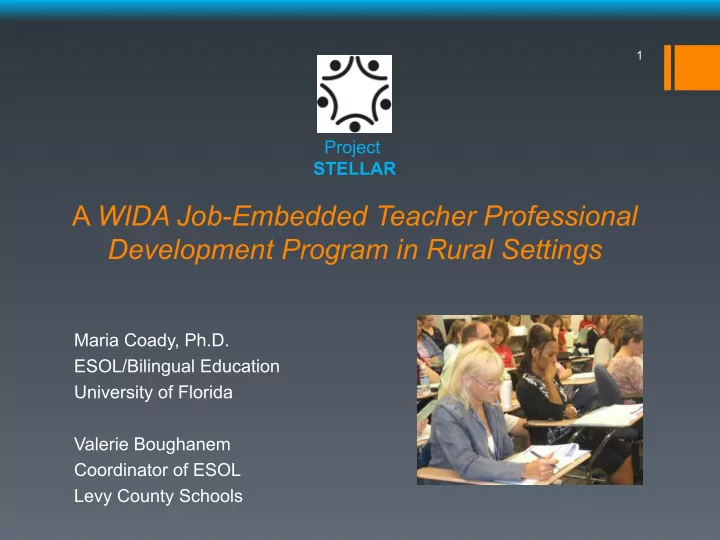
A WIDA Job-Embedded Teacher Professional Development Program in Rural Settings
Maria Coady, Ph.D. ESOL/Bilingual Education University of Florida Valerie Boughanem Coordinator of ESOL Levy County Schools
1
Project STELLAR
A WIDA Job-Embedded Teacher Professional Development Program in - - PowerPoint PPT Presentation
1 Project STELLAR A WIDA Job-Embedded Teacher Professional Development Program in Rural Settings Maria Coady, Ph.D. ESOL/Bilingual Education University of Florida Valerie Boughanem Coordinator of ESOL Levy County Schools 2 Goals of this
Maria Coady, Ph.D. ESOL/Bilingual Education University of Florida Valerie Boughanem Coordinator of ESOL Levy County Schools
1
Project STELLAR
2
3
4
5
6
7
8
9
population
11
§ ENGLISH LANGUAGE LEARNERS / ELLs
in their educational career
to achievement levels of ELLs
ELL Data Point Scores EL Graduation Rate 42.9% Civics and US History (3 or higher) 33.3% Science/Biology 18.2% Mathematics 29.1% ELA 20.6% ACCESS 2.0 (proficient, 2017) 27%
12
UNDER THE FLORIDA CONSENT DECREE
13
Levy County ELL ACCESS 2.0 English language proficiency data (2016-2017) [students of teachers in Project STELLAR]
14 STUDENT Listen Speak Read Write A 6 4.8 2.4 3.3 B 5 2.8 3.6 2.8 C 6 5.8 3 3.9 D 4 2.5 2.8 3.7 E 5.8 3.5 3.8 F 4.5 6 3.7 3.9 G 5 3 3.9 4.3 H 2.7 1 1.9 1.7 I 5.9 5.7 4.5 3.5 J 2.3 2.4 2.1 2.6 K 3.5 4.6 3.9 4.1 L 2.8 2.4 2.1 3.1 M 5 5.4 5 3.9 N 4 4.3 4 3.6 O 4.9 4.8 4.6 4.1 P 5 4.8 3.9 3.9 Q 3 2.1 2.5 2.8 R 2.5 1.9 2.8 2.1 S 1.9 1.9 1.9 2.3 T 3.6 4.3 2.2 1.9 U 6 4.9 5.3 3.5 V 6 4.3 3.6 3.5 W 5 2.3 1.9 3.7
15
16
18
§ Guided Inquiry (Sum 2017) § ESOL Methods (Fall 2017)* WIDA § Transforming the Curriculum* § Teaching in High Poverty Rural Settings § Instructional Coaching for Enhanced Student Learning* § Teacher Leadership and School Change
19
§ Phase II (2019-20) includes 74 additional teachers and leaders (three for each Phase I participant) who will receive coaching support. § All participants receive stipends and academic credit from UF towards a Master’s or advanced degree program. § Additionally, ELL families participate in talleres en español around issues of: § Safety (food) and immigration* § Social services § English language learning § Parent engagement (learning about school, resources, roles of personnel) § Participants in STELLAR rotate in evening programs to work with families.
20
21
22
23
§ Making them [multilingual parents and caregivers] not be fearful of coming to school for conferences or school events § Fear of school reporting them as illegal or undocumented § Families are constantly changing contact information; difficulty maintaining contact with them § Language and culture barriers. We struggle to get families that trust us. § Fear of the school environment and a sense of inability to help their offspring § Fear of deportation [for undocumented families] § How to make connections § Predetermined misconceptions of one another and language barriers § Lack of interpreters § Locating previous health and educational records § Communication barriers § Getting to know families and their backgrounds § Communication § Educational expectations § Reading out to parents § Threat of being deported is affecting students in the classroom § Fear of being different, not being accepted, and fear of their immigrant status § Socio-political context § If the parents don’t speak English, I can’t communicate concerns I have for their child
24
§ Challenges that multilingual families say they face: § Difficulty supporting my child’s education § Feeling safe § Not being able to communicate with people in my new community § Trust § Anxiety § Fear of deportation and child left abandoned. Also, not being prepared
§ Providing for family on substandard or intermittent pay § Not knowing whom to trust § Lack of knowledge about transportation § Financial concerns § Having consistent employment § Providing essentials (food, clothes, and medical) § Lack of transportation, stable jobs, money § Lack of education ourselves § Lack of transportation [repeated by another adult] § Inability to find resources that are friendly to our needs § Having to have kids translate at the store, doctor, school § Income § Exclusion § Economic difficulties § Language
25
Quasi experimental study that investigates the effectiveness of a job-embedded teacher preparation program. Our participants are intervention group; 17 teachers are comparison group. Data include: vComparison group is 17 teachers and colleagues with similar demographic backgrounds (years of teaching, grade teaching, preparation [degree]) vELL student data include WIDA ACCESS 2.0 ELP data, FSA data (grades 3 and higher), classroom observations vModified ELL-Danielson Observation Rubric, currently in validation (ELL teacher instructional effectiveness) / Domains 2 and 3 only vYears 1-2 benchmark data (2016-2018)
26
27
28 Component Unsatisfactory “ELL” Developing/NI “ELL” Effective “ELL” Highly Effective “ELL”
3a: Communicating with students Teacher does not communicate with ELLs. Examples include unclear communication or no communication of expectations for ELL learning; directions and procedures are unclear, confusing or nonexistent for ELLs; teacher language contains errors and/or is inappropriate or not adapted for ELLs’ culture or linguistic background; does not seek out language support so that miscommunication and student misconceptions occur Teacher infrequently or sometimes communicates/sometimes communicates effectively with
inconsistent and/or ineffective communication of expectations for ELL learning; directions and procedures are limited and/or sometimes unclear; explanations
confusion; typically does not seek
miscommunication and student misconceptions occur. Teacher generally and effectively communicates with ELLs. Examples include clear expectations for ELL learning, including clear directions, and procedures; explanations are generally clear to ELLs and reflect students’ cultures and linguistic development; teacher seeks out language support, which is generally responsive to learner needs/abilities, to ensure smooth communication; r generally seeks to reduce student miscommunication and misconceptions after problems
Teacher consistently and effectively communicates with
expectations for ELL learning; including clear directions, and procedures for ELLs and the use
seeks out language support to ensure smooth communication and proactively seeks to reduce student miscommunication and misconceptions. 3b: Using questioning and discussion techniques Teacher does not use appropriate questioning and/or discussion techniques appropriate to ELLs’ linguistic and cultural backgrounds. Examples include little to no use
frames or starters, visual aids or grouping strategies Teacher infrequently or sometimes uses limited questioning and/or discussion techniques appropriate to ELLs’ linguistic and cultural
yes/no questions, known answers, one- word answers for all ELLs without considering linguistic proficiency; some/limited use of wait time, sentence frames/starters, visual aids and grouping strategies Teacher generally and effectively uses questioning and/or discussion techniques appropriate to ELLs’ linguistic and cultural
general use of questions across the stages of proficiency, wait time, sentence frames, visual aids, grouping. Techniques may align with WIDA (Can Do Descriptors, ELD levels). Teacher consistently and effectively uses questioning and/or discussion strategies for
consistent use of questions across proficiency levels, wait time, modeling, sentence frames, visual aids, grouping, meta- linguistic and/or meta-cognitive techniques; techniques are aligned with WIDA (Can Do Descriptors, ELD levels).
Communica- ting with students Using questioning and discussion techniques Engaging students in learning Using Assessment in Instruction Demonstrating flexibility and responsiveness Total Domain 3
n 10 10 10 9 8 8 Mean 1.30 1.20 1.30 1.11 1.13 6.63
29
30
31
32
33
Your feedback is valuable! Please complete a brief survey about this session on the WIDA conference mobile app.