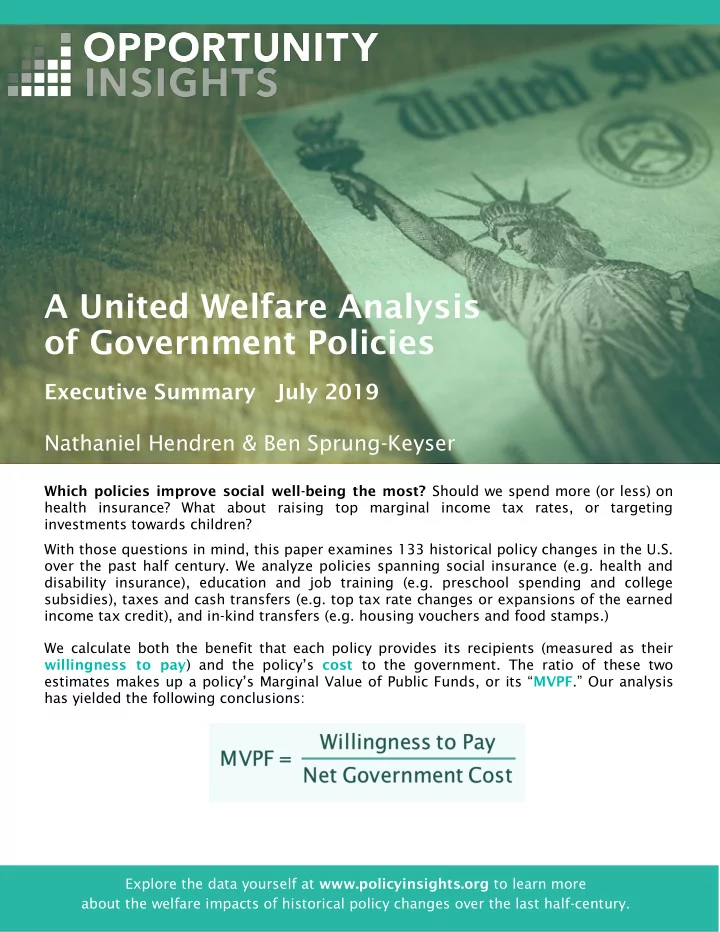
SLIDE 6 What does it mean for a policy to have an MVPF of infinity? A policy with an infinite MVPF provides benefits to its recipients without costing the government money in the long run. We often refer to this as the policy “paying for itself” because the government recoups its initial investment through increased tax revenue and reductions in transfers. In the context of tax policy, this effect is often referred to a “Laffer” effect. What does it mean for a policy to have an MVPF of 1? Policies have MVPFs equal to one if the beneficiaries value the government expenditure at its cost. In the simplest case, if the government gave a single individual a single dollar, and this policy did not change their behavior, that policy would have an MVPF of 1. It would cost the government one dollar and the person would value the policy at one dollar. The MVPF diverges from this benchmark if a policy causes indirect impacts on the government’s budget. For example, if a policy causes an individual to work less, then government tax revenues fall. This raises the net cost of the policy above $1. By contrast, if a policy causes an individual to get more schooling and consequently increases their income, government tax revenues would rise. The net cost of the policy would fall below $1. The MVPF may also deviate from that benchmark value of 1 if willingness to pay for the policy differs from the government cost. For example, when the government provides insurance, individuals may place additional value on the insurance benefit beyond its cost, just as individuals buy insurance from private companies at a price above its cost. By contrast, if individuals change their earnings in order to be eligible to receive an in-kind transfer such as food stamps or housing vouchers, willingness to pay may fall below government costs. (The logic of this final example relies on an application of the “envelope theorem.” We discuss these methods in more detail in the paper.) How do you measure the net cost of a policy? Net costs incorporate both initial spending on a policy and any future impacts of the policy on government revenue. We use existing literature to measure initial policy costs and to capture how the causal effects of the policy impact the government’s budget. How do you measure willingness to pay for a policy? In some cases, willingness to pay (WTP) is straightforward. For example, a non-distortionary tax cut
- ffering $1 additional after-tax income will have a WTP of $1. In other cases, measuring WTP is
conceptually more difficult, and, as noted above, relies on more nuanced applications of the “envelope theorem.” We discuss the assumptions of these methods in detail in the paper. We also illustrate that our primary conclusions are robust to a range of different approaches to measuring WTP.
Methods FAQs