
SLIDE 1
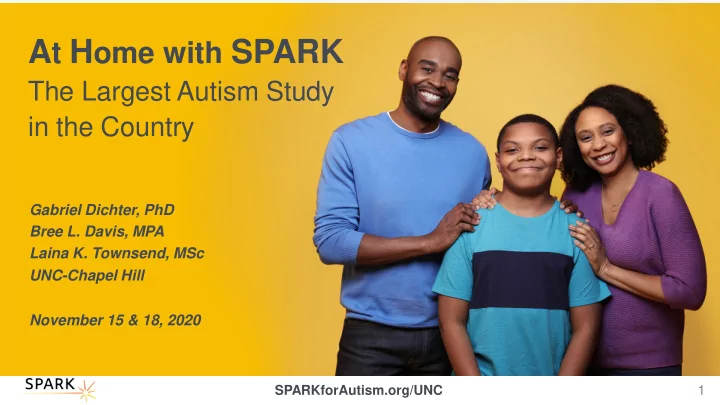
At Home with SPARK
The Largest Autism Study in the Country
Gabriel Dichter, PhD Bree L. Davis, MPA Laina K. Townsend, MSc UNC-Chapel Hill November 15 & 18, 2020
SPARKforAutism.org/UNC 1
A t H ome with SPARK The Largest Autism Study in the Country - - PowerPoint PPT Presentation
A t H ome with SPARK The Largest Autism Study in the Country Gabriel Dichter, PhD Bree L. Davis, MPA Laina K. Townsend, MSc UNC-Chapel Hill November 15 & 18, 2020 SPARKforAutism.org/UNC 1 Who Are We? Bree Davis Elena Lamarche Dr.
Gabriel Dichter, PhD Bree L. Davis, MPA Laina K. Townsend, MSc UNC-Chapel Hill November 15 & 18, 2020
SPARKforAutism.org/UNC 1
SPARKforAutism.org/UNC
Bree Davis Elena Lamarche
Laina Townsend Renée Clark
2
For more information and to register, please visit:
SPARKforAutism.org/UNC 3
P A G E 4
SPARKforAutism.org/UNC 4
SPARKforAutism.org/UNC 5
SPARKforAutism.org/UNC 6
Join a National Community of >47,000 individuals! Enhance Knowledge & Forward Autism Research New Discoveries & Information $50 Amazon Gift Card Personalized Reports SPARKforAutism.org/UNC 7
SPARKforAutism.org/UNC
8
SPARKforAutism.org/UNC 9
~24,330 individuals with autism and ~47,000 family members
to as many as 10% of families
increased the number of genes that we know are linked to autism
SPARKforAutism.org/UNC 10
P A G E 1 1
SPARKforAutism.org/UNC 11
Individuals with a professional diagnosis of ASD (i.e. from a Clinical Psychologist, Team of Healthcare Professionals, or Developmental Pediatrician) Parents and biological siblings of an individual with ASD Participants must live in the USA, and speak English (Spanish SPARK coming soon)
12
SPARKforAutism.org/UNC 13
SPARKforAutism.org/UNC 14
SPARKforAutism.org/UNC 15
P A G E 1 6
SPARKforAutism.org/UNC 16
P A G E 1 7
SPARKforAutism.org/UNC 17
SPARKforAutism.org/UNC 18 If you or your child CAN spit If you or your child CANNOT spit
After collecting a sample
2ml 1ml
Do all the tubes have the bar code sticker on them? Did the saliva reach the 1ml line with no bubbles? Was the tube shook for 5 seconds? Is the small cap screwed on tightly?
SPARKforAutism.org/UNC 19
SPARKforAutism.org/UNC 20 SPARKforAutism.org/Discover
P A G E 2 1
SPARKforAutism.org/UNC 21
SPARKforAutism.org/UNC 22
SPARKforAutism.org/UNC 23
SPARKforAutism.org/UNC 24
P A G E 2 5
SPARKforAutism.org/UNC 25
P A G E 2 6
Hear about other research studies Decide if you want to participate Study data leads to new findings Receive summary report of study results
SPARKforAutism.org/UNC 26
“Treatment Patterns in Children with Autism in the United States” Over 5,000 SPARK families participated in this study!
SPARKforAutism.org/UNC 27
P A G E 2 8
SPARKforAutism.org/UNC 28
SPARK Data are always encrypted in a secure database SPARK has legal protections to keep participant data confidential SPARK Data that is shared with
To use SPARK deidentified data researchers must go through an approval process SPARKforAutism.org/UNC 29
SPARKforAutism.org/UNC 30
P A G E 3 1
SPARKforAutism.org/UNC 31
P A G E 3 2
32
1 Welcome to today’s webinar, which is called, “At Home with SPARK, The Largest Autism Study in the Country” Our goal today is to tell you about SPARK, including: A) what it is B) what its goals are C) why we believe it’s so important, and D) how you can get involved and participate in SPARK if you haven’t already 2 Introductions: My name is Gabriel Dichter. I’m one of the PIs of the SPARK site at UNC-Chapel Hill. Our team also includes Bree Davis & Laina Townsend who will be answering any questions you ask in the “Q&A” area during this webinar; the rest of
helped to put this webinar together. 3 At the bottom of each slide, you see today, you will see a link for more information and to register: www.SPARKforAutism.org/UNC 4 Now I’d like to start by providing some more information about what SPARK is and why it's so important. 5 Let’s start with, what SPARK is. SPARK is a study about autism genetics and is the largest study of autism in the country. Participation in SPARK can be a 100% online process, which is really important given the restrictions around COVID. And it costs nothing to participate. 6 The goal of SPARK is to recruit, engage, and retain a group of 50,000 trios (individuals with autism and their biological parents) to help us discover the genes that cause autism. The overarching mission of SPARK is to speed up research and advance our understanding of autism to help improve the lives of those with autism and their families. SPARK is aiming to enroll 50,000 families with a family member with autism. We are asking individuals with autism and their biological parents to participate; other family members may participate as well, but it is really important for individuals with autism and their biological parents to participate, if possible. SPARK began in 2015 and we are about halfway to our goal – almost 25,000 families have already participated. To get to our goal, we need families like yours to join SPARK to help us accelerate autism research. SPARK is funded by the Simons Foundation and involves 31 clinical sites around the country, including us here at UNC-Chapel Hill. 7 We believe that families who participate in SPARK get a large return for their time and effort and investment in autism research.
First, they get the satisfaction that they are accelerating autism research, and that they are ultimately helping us to improve the lives of families with a family member on the autism spectrum. Second, they join a national community of families who have participated in SPARK, and they have the sense of accomplishment that they are part of one of the largest efforts ever to improve our understanding of autism. Third, we work hard to stay connected with SPARK families by sharing newsletters with information about new scientific discoveries that SPARK has contributed to, as well as educational resources that we send to our SPARK community. Fourth, families receive up to $50 in the form of an Amazon Gift Card for their time. Finally, some families will receive personalized reports about the genetic testing results and surveys they complete as part of SPARK. We’ll talk more about this later on. 8 Why is it so important to learn about the genetic causes of autism? Well, we know that genes play a strong role in autism risk. We know that as siblings share more genes with each other, the chance that one sibling has autism if the other has autism increases. This is called the concordance rate. So, the concordance rate of autism for regular siblings is about 20%, meaning that if an individual has autism, the chance that their brother or sister has autism is about 20%. However, for fraternal twins, who share more genetic information with each other than regular siblings, that concordance risk is a little higher, about 31%. But for identical twins, that is, twins who share all their genetic information, the concordance rate is 77%. This tells us that autism risk is strongly, though not entirely, determined by genetic factors. 9 So, although we don’t fully understand what causes autism, we know that genetics play an important role. Incidentally, we also know that the environment plays an important role. We also know that many types of genetic changes could occur in any of hundreds
which genes these are, and what their functions are. By participating in SPARK, you are helping us to unravel these mysteries surrounding autism, and you may be able to find out if you (or your family member) has a genetic cause for autism in a known autism risk gene.
10 This map illustrates where in the US families with a family member with autism have participated in SPARK, and as you can see, it’s across the entire country. So far, we have collected DNA samples from ~24,000 individuals with autism and ~47,000 family members. Of these families, we have returned reports about their genetic results to about 10% of families who have participated in SPARK (I’ll say more about this in a bit). From these DNA samples, genetic analyses have already doubled the number of genes that we know are linked to autism, but we hope to discover many more. Now I am going to turn the slides over to Bree and Laina who will tell us more about what is involved in SPARK participation. 11 What's Involved in SPARK Participation Hi everyone, my name is Laina Townsend and I am one of the UNC SPARK project
Neuroscience at the University of London in England, with a focus on neurodevelopmental disorders, specifically autism. I’m excited to be back in the US, and involved in SPARK. My primary role is to help people with the registration process, and guide participants through the process of SPARK. My favorite thing about SPARK is knowing this project is contributing new knowledge that forwards
And I’m Bree L. Davis. I am also a project coordinator at UNC SPARK. Although I have worked in public health research at UNC and RTI in the past, --SPARK is my first autism experience. Over a decade ago, I started my career in public health promotion & social marketing and several years ago completed my Masters degree in Public Administration. -- My role at SPARK is to help people with registration and manage community outreach for the study. My favorite thing about SPARK is knowing that my outreach efforts are creating awareness while moving autism research forward. So now we’re going to go through the process of registering and participating in
general overview of the participation timeline, and then reviewing specifically how to register and provide saliva samples. 12 Who is Eligible to Participate? Those who have a diagnosis of ASD or are a direct family member such as a biological parent or sibling, may participate.
The individual diagnosed with ASD must have received a professional diagnosis, such as from a Pediatrician or Psychologist. Participants must live in the USA and speak English. We are expecting a Spanish version of SPARK to launch later in 2021. 13 (Overview of Registration Process) Enrollment is quick and usually takes between 15 to 30 minutes. Participants can start and stop the process at any time, and information will be saved along the way.
will first create an account with their email and password.
share deidentified information with researchers, and if affiliated with UNC, for UNC and SPARK to share information with each other.
sample for analysis.
It’s important to note that if both biological parents are intending to participate, that they must each complete their own registration and consent forms. The same concept applies to adults with autism wanting to invite their parents. During registration there is an option to invite family members. Participants can enter a first name and email, which will then generate a link to the invited family member’s email for them to register. 14 So just to show everyone: This is a picture of the home screen, and this is where someone will go to begin the registration process. 15 What Information Will SPARK be Asking for during Registration? Individuals will be asked to provide some basic information during the registration
immediate family members, ASD diagnosis, and educational and treatment services used.
As mentioned previously, data and genetic consent will have to be completed to provide this information to SPARK. 16 Participation after Registration After completing registration, there will be a short survey available for participants to complete. Participants will then receive thier saliva collection kits usually within 3 weeks of registering -- and provide the samples to us. SPARK sends saliva samples for sequencing at the lab in large batches, usually once per year. The genetic experts at SPARK review all of the findings. If a participant has a gene that is on the list of high confidence autism genes, --SPARK will make contact with the participant or parent. Dr. Dichter will go over this process in more detail -- in some slides coming up shortly 17 How to Provide Saliva Samples to SPARK But first, we’re going to go over HOW to collect the saliva samples. 18 How to Collect a Saliva Sample When a participant receives kits in the mail the package will include the following: illustrated instructions, the saliva kits, personalized labels with each family member’s name, date of birth and unique bar code, specimen bags for when the kits are done. It can be helpful to become familiar with the contents of this box before beginning the collection process. Providing a saliva sample can take anywhere from 15 minutes to an hour, depending on the method of collection. There are two different methods for collection that we are going to go over today. It’s very important for participants to not eat, drink, smoke or chew gum for at least 30 minutes before providing a sample. The two types of saliva collections are dependent on whether the individual providing the sample can spit themselves or not. For example, toddlers may have trouble spitting into the tube. Individuals who are able can spit directly into the tube - or we are happy to provide further information on the assisted saliva collection demonstrated on this slide. Bree and I are available to help and troubleshoot with all saliva collection questions and concerns! 19 How to Send Back Saliva Samples There’s a helpful checklist included on the instructions that we suggest participants also look over before sending back samples. Once all the samples are collected, each tube should be placed in its own specimen bag.
The kits will then go right into the postage paid box to be sent back to SPARK 20 WHAT'S NEXT After finishing registration, as Bree mentioned earlier, there are a few additional steps – like completing the post registration survey to provide a bit more information about the individual with ASD. There is also the opportunity for additional studies and of course, a possible return
up here. Before we turn it back to him however, we want to mention a few other things. First, on the right side of this slide, is the participant login page. On this login page, called Your Dashboard, participants are able to resend invitations to their invited family members, check the status of their kits, update their contact information, and download consent forms and reports from behavioral surveys. Second, you can visit the discover page at SPARKforAutism.org/Discover to learn about SPARK’s recent findings, hear personal stories from the SPARK community, and watch educational webinars and videos. SPARK also hosts a monthly webinar around topics suggested by participants. Experts from around the country lead each webinar on a range of topics including managing behavior, transitioning to adulthood, mental health and autism, and
The last thing we want to mention is that when individuals with autism who are enrolled in SPARK turn 18, they will have to provide their own consent to continue in SPARK if they are not under legal guardianship. SPARK will send an email reminding parents of this, and they can go to their Dashboard to confirm their young adult’s legal status. Now we’re going to turn it back to Dr. Dichter to talk to you about the process of returning genetic results, and how SPARK is advancing autism research. 21 Genetic Results 22 When saliva samples are received by SPARK, they verify that the sample has enough DNA to be used. If it cannot, participants will be asked to try again and submit another sample. SPARK sends saliva samples for sequencing at the lab in large batches, usually once per year. Due to the volume of samples, this is the most efficient way to process them for research. Results from sequencing are then analyzed for changes in genes that may be related to autism.
I want to emphasize that SPARK genetic analysis uses Whole Exome Sequencing which provides detailed information for gene discovery. However, it is not intended as a clinical genetics evaluation. For example, testing for Fragile X is best done using a different technique. Therefore, if a family has specific diagnostic concerns, they should seek a referral from their doctor for clinical genetic testing. As we mentioned before, if the genetic sample that we receive reveals a change in a high confidence gene known to be linked to autism, SPARK will send the sample to a certified clinical lab for confirmation. If the result is confirmed the participant will receive a report with results. SPARK provides access to a genetic counselor to explain what this report means. 23 At this time, only about 10% of families receive a report of results. However, the list of high confidence genes has and will continue to grow due to the large number of participants in SPARK. Because new information is continuously being learned about the genetics of autism, the data are reanalyzed yearly to ensure that families receive the most up-to-date information possible. If a match for a newly discovered autism risk gene is identified, participants will receive a return of results. This underscores an important point - SPARK is an
future findings. 24 SPARK is a research study, so it is important to remember the following things: 1) Even if someone does not receive a genetic report, this does not necessarily rule
already identified autism risk gene. 2) The genetic evaluation that we do does not evaluate all possible genetic causes
3) Participation in SPARK does not and should not replace a consultation with a genetic counselor 4) A participant may be contacted in the future to let them know we have identified a genetic change linked to autism risk in the genetic sample provided. 25 How is SPARK advancing Autism Research? 26 An important component of SPARK is what we call “Research Match”. After participation in SPARK, folks may be contacted about other research studies taking place that may be of interest. Participants may opt in or out of these studies, and families will receive summaries of the results of these studies when they are complete. SPARK also shares study results on the SPARK Discover page, in newsletters, and on social media. 27 For example, one study that was part of the Research Match process was called “Treatment Patterns in Children with Autism in the United States”. This online study compared the rates of use of different kinds of treatments in Metro vs non- Metro areas, as well as barriers to access to treatment. Over 5,000 SPARK families participated in this study, making it one of the largest such studies ever conducted.
Since its launch in July 2017, over 90 studies have used Research Match. More than 32,000 families have responded to study invitations. These studies have covered a wide range of topics including: Sleep, Diet, Early diagnosis, Parenting stress, Communication skills, Challenging Behaviors, Teen & Adult experiences, as well as brain imaging studies. 28 A few words now about how SPARK protects information and privacy 29 SPARK Works Hard to Protect the Privacy of our participants! 1) SPARK data are always encrypted in a secure database using the latest encryption protocols. 2) SPARK genetic data that are shared with other researchers are deidentified, which means that all identifying information is removed. 3) SPARK has legal protections to keep participant data confidential. To protect your privacy, we have a “Certificate of Confidentiality” from the National Institute
information that may identify participants in any legal proceedings—for example, even if there is a court subpoena, there are protections in place to maintain data privacy. 4) Finally, if a researcher wants to analyze SPARK deidentified genetic data, they must first go through an approval process to ensure that they are protecting participant data thoroughly. We would like to point out that it has been shown that sharing data with a research institution is less risky than sharing data with healthcare providers or with many commercial genetic-testing companies. Research databases have more safeguards in place, including data encryption and restricting data access only to trusted researchers. 30 Finally, we would like to address a couple of possible misconceptions about SPARK. First, we want to be clear that SPARK is NOT aiming to find a cure for autism. Rather, this research will help to explain the genetic changes that contribute to autism. Second, SPARK is NOT developing a genetic test or a blood test for autism. SPARK is trying to learn as much about the genetics of autism as possible to unravel the genetic mysteries of autism risk. 31 Thank you for taking the time to be part of this webinar. We will be posting these slides online for you. For more information and to register for SPARK, please visit SPARKforAutism.org/UNC. It’s important to register with this UNC link for SPARK to make sure you are connected with our SPARK clinical site. 32 And here is our contact information in case you have any questions at all about
hand off to Laina again.