A Sundaram type bijection for SO (2 k + 1): vacillating tableaux and - - PowerPoint PPT Presentation

a sundaram type bijection for so 2 k 1
SMART_READER_LITE
LIVE PREVIEW

A Sundaram type bijection for SO (2 k + 1): vacillating tableaux and - - PowerPoint PPT Presentation

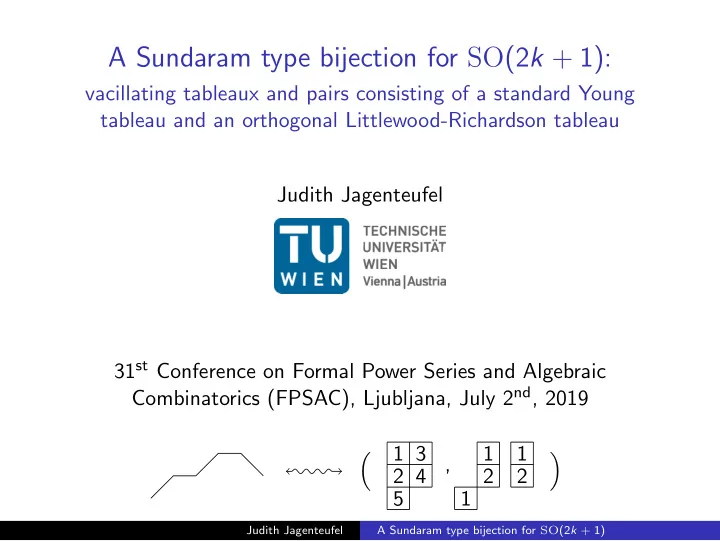
A Sundaram type bijection for SO (2 k + 1): vacillating tableaux and pairs consisting of a standard Young tableau and an orthogonal Littlewood-Richardson tableau Judith Jagenteufel 31 st Conference on Formal Power Series and Algebraic


slide-1
SLIDE 1

A Sundaram type bijection for SO(2k + 1):

vacillating tableaux and pairs consisting of a standard Young tableau and an orthogonal Littlewood-Richardson tableau Judith Jagenteufel 31st Conference on Formal Power Series and Algebraic Combinatorics (FPSAC), Ljubljana, July 2nd, 2019

  • 1

2 3 4 5 , 1 1 2 1 2

  • Judith Jagenteufel

A Sundaram type bijection for SO(2k + 1)

slide-2
SLIDE 2

Classical Schur-Weyl duality

V ⊗r ∼ =

  • λ⊢r

ℓ(λ)≤n

V GL(λ) ⊗ S(λ) as GL(V ) × Sr representations, V = Cn.

◮ GL(V ) acts diagonally and Sr permutes tensor positions ◮ V GL(λ), S(λ) . . . irreducible representation of GL(V ), Sr

Robinson-Schensted

{1, . . . , n}r ↔

  • λ
  • SSYT(λ), SYT(λ)
  • ◮ SSYT(λ), SYT(λ) . . . (semi)standard Young tableaux

Judith Jagenteufel A Sundaram type bijection for SO(2k + 1)

slide-3
SLIDE 3

Special orthogonal group

branching rule

V GL(λ)↓GL(V )

SO(V )∼

=

  • µ

λV SO(µ)

where cµ

λ are multiplicities counted by orthogonal LR tableaux

leads to

V ⊗r ∼ =

  • µ a partition

l(µ)≤n µ′

1+µ′ 2≤n

V SO(µ)⊗

  • λ⊢r

l(λ)≤n

λ S(λ) =

  • µ a partition

l(µ)≤n µ′

1+µ′ 2≤n

V SO(µ)⊗U(r, µ) as SO(n) × Sr representations. n = 2k + 1 thus n odd

◮ V = Cn . . . vector representation of SO(n) ◮ V SO(µ), S(λ) . . . irreducible representations of SO(n) and Sr

Judith Jagenteufel A Sundaram type bijection for SO(2k + 1)

slide-4
SLIDE 4

Our setting

U(r, µ) =

λ

λ S(λ)

  • Our main result: a bijection between

vacillating tableaux ↔

  • rthogonal LRT, SYT
  • that preserves descents.

Judith Jagenteufel A Sundaram type bijection for SO(2k + 1)

slide-5
SLIDE 5

Standard Young tableaux

Standard Young tableaux of shape λ (SYT(λ)):

fillings of a Young diagram of shape λ with entries {1, 2, . . . , |λ|}, increasing in rows and columns

Descents

d is a descent if d + 1 is in a row below d 1 2 5 6 9 3 4 7 8 12 1013 1116 14 15 17 1 2 5 6 9 3 4 7 8 12 1013 1116 14 15 17 descent set {2, 6, 9, 10, 12, 13, 14, 16}

Judith Jagenteufel A Sundaram type bijection for SO(2k + 1)

slide-6
SLIDE 6

Vacillating tableaux - highest weight words

◮ Vacillating tableau: a sequence of partitions / Young

diagrams ∅ = λ0, λ1, . . . , λr, at most k rows, shape λr

◮ λi and λi+1 differ in at most one cell ◮ λi = λi+1 only if kth row is non-empty

◮ Highest weight word: word w with letters in {0, ±1, . . . , ±k},

length r, weight (#1 − #(−1), . . . , #k − #(−k)), such that for every prefix w1, . . . , wj:

◮ #i − #(−i) ≥ 0 ◮ #i − #(−i) ≥ #(i + 1) − #(−i − 1) ◮ If the last position, wj = 0 then #k − #(−k) > 0.

Example (k = 3)

( 1, 1, 2, −2, 1, 1, 2, 2, 1, 3, 0, 2, 3, −3, −1, −2, −1) ∅

Judith Jagenteufel A Sundaram type bijection for SO(2k + 1)

slide-7
SLIDE 7

Descents of vacillating tableaux

Vacillating tableaux

a position i of w is a descent if there exists a path from wi to wi+1 in the crystal graph: 1 → 2 → · · · → k → 0 → −k → · · · → −1 and wiwi+1 = j(−j) if #j − #(−j) = 0 in w1, . . . , wi−1.

Example

1 2 3 4 5 6 7 8 9 1011121314151617 3 4 7 8 1011121314 16 1011 1314

descent set {2, 6, 9, 10, 12, 13, 14, 16}

Judith Jagenteufel A Sundaram type bijection for SO(2k + 1)

slide-8
SLIDE 8

Quasi symmetric expansion

Recall the Frobenius character: ch ρ = 1 r!

  • π∈Sr

Tr ρ(π)pλ(π) where pλ is a power sum symmetric function. We have: ch S(λ) = sλ =

  • Q∈SYT(λ)

FDes(Q) where sλ is a Schur function and FD is a fundamental quasi-symmetric function: FD =

  • i1≤i2≤···≤ir

j∈D⇒ij<ij+1

xi1xi2 . . . xir . Therefore, as our bijection is descent preserving, we obtain: ch

λ⊢r l(λ)≤n

λ S(λ)

  • =
  • w vacillating tableau
  • f length r and shape µ

FDes(w).

Judith Jagenteufel A Sundaram type bijection for SO(2k + 1)

slide-9
SLIDE 9

Main result: a bijection between

vacillating tableaux ↔

  • rthogonal LRT, SYT
  • that preserves descents.

Judith Jagenteufel A Sundaram type bijection for SO(2k + 1)

slide-10
SLIDE 10

Strategy

1 2 5 6 9 3 4 7 812 1013 1116 14 15 17 1 2 1 4 5 1 2 1 5 1 2 3 4 1 1 2 3

(SYT, oLRT)

1 2 5 6 9 3 4 7 812 1013 1116 14 15 17 1 1 1 2 2 3

(SYT, aoLRT)

1 2 5 6 9 3 4 7 812 1013 1116 14 15 17 18 19 20 2122 23

(SYT odd, µ)

µ = (3, 2, 1)

Judith Jagenteufel A Sundaram type bijection for SO(2k + 1)

slide-11
SLIDE 11

Orthogonal Littlewood-Richardson tableaux

n = 2k + 1, ℓ(λ) ≤ n, ℓ(µ) ≤ k, µ ≤ λ e.g. n = 7, k = 3, λ = (5, 5, 2, 2, 1, 1, 1), µ = (3, 2, 1)

Kwon’s LR tableaux

◮ k twocolumn skew-shape

semistandard tableau with tail µi; one single column

◮ λ′ determines the filling ◮ several conditions on size

and filling

1 2 1 4 5 1 2 1 5 1 2 3 4 1 1 2 3

alternative LR tableaux

◮ reverse skew-shape

semistandard tableaux, inner shape λ

◮ µ determines the filling,

reading word is Yamanouchi

◮ technical condition

1 1 1 2 2 3

Judith Jagenteufel A Sundaram type bijection for SO(2k + 1)

slide-12
SLIDE 12

First part: manipulate the orthogonal LR tableaux

1 2 1 4 5 1 2 1 5 1 2 3 4 1 1 2 3

→ 3 → 3 → 3 2 2 → 3 2 2 → 3 2 2 → 3 2 2 1 1 1 → 3 2 2 1 1 1 → 3 2 2 1 1 1 → 1 1 1 2 2 3

Judith Jagenteufel A Sundaram type bijection for SO(2k + 1)

slide-13
SLIDE 13

Strategy

1 2 5 6 9 3 4 7 812 1013 1116 14 15 17 1 2 1 4 5 1 2 1 5 1 2 3 4 1 1 2 3

(SYT, oLRT)

1 2 5 6 9 3 4 7 812 1013 1116 14 15 17 1 1 1 2 2 3

(SYT, aoLRT)

1 2 5 6 9 3 4 7 812 1013 1116 14 15 17 18 19 20 2122 23

(SYT odd, µ)

µ = (3, 2, 1) 1 2 3 4 5 6 7 8 9121316 1011141519 1720 1823 21 22 24 25 26 27 2829 30

(SYT even, µ)

µ = (3, 2, 1)

(vac. tab. even, shape ∅, partition)

µ = (3, 2, 1)

(vac. tab. odd, shape ∅, µ)

µ = (3, 2, 1)

vacillating tableau

Judith Jagenteufel A Sundaram type bijection for SO(2k + 1)

slide-14
SLIDE 14

1 2 3 4 5 6 7 8 9121316 1011141519 1720 1823 21 22 24 25 26 27 2829 30

1 8 912 13 16 1 2 8 910 11 12 13 14 15 16 19 1 2 3 8 910 11 12 13 14 15 16 17 19 20 25 27 30 2 10 11 14 15 19 1 2 3 4 8 910 11 12 13 14 15 16 17 18 19 20 23 25 26 27 30 2 3 10 12 14 15 17 19 20 25 1 2 3 4 5 8 910 11 12 13 14 15 16 17 18 19 20 21 23 25 26 27 28 29 30 2 3 4 10 12 14 15 17 18 19 20 25 26 27 3 17 20 25 1 2 3 4 5 6 8 910 11 12 13 14 15 16 17 18 19 20 21 22 23 25 26 27 28 29 30 2 3 4 5 10 11 14 15 17 18 19 20 21 25 26 27 3 4 17 18 20 25 1 2 3 4 5 6 7 8 910 11 12 13 14 15 16 17 18 19 20 21 22 23 24 25 26 27 28 29 30 2 3 4 5 6 10 11 14 15 17 18 19 20 21 23 25 26 27 3 4 5 18 19 20 21 25

Judith Jagenteufel A Sundaram type bijection for SO(2k + 1)

slide-15
SLIDE 15

let w be word (1, −1, . . . , 1, −1) labeled by first row elements of Q; /* insert row 1 */ for i = 2, 3, . . . , n do /* insert row i */ j := ⌊i/2⌋; unmark everything if i even then change 0-entries of w into j, −j, . . . , j, −j; /* init. j */ for pairs of elements a, b in row i, start with the rightmost, go to left do a1 := a, b1 := b, al := bl := 0 for l = 2, 3, . . . , j + 1, if b is largest pos. then insert b1 with −1; let p be rightmost pos. so far, ˜ p be next pos. left of p with w(˜ p) ∈ {0, ±j}; /* b */ while aj+1 < p or w(p) / ∈ {0, ±j} do if p < bl , p = al , w(p) = −l for an l < j, al+1 = 0 then if p not marked, bl+1 = 0 then w(p) := −l − 1, bl+1 := p; /* bl+1 */ else if p < al , p < bl+1 then w(p) := −l − 1, al+1 := p; /* al+1 */ if i is even, w(p) ∈ {0, ±j} then /* i even */ if bj < p, w(˜ p), w(p) = j, −j then for l < j change ±l on l-level 0 between p and ˜ p into ±(l + 1), if p < bl , bl+1 = 0 ignore bl , if p < al , al+1 = 0 ignore al ; mark changed pos.; change −j, j between p and ˜ p into 0, 0 ; /* adj. SP */ else if aj < p, w(˜ p), w(p) = j, −j then w(˜ p), w(p) := 0, 0; for l < j mark ±l on l-level 0 between p and ˜ p, if p < al , al+1 = 0 ignore al ; /* mark it + connect */ else if p = aj , w(˜ p) = 0 on j-level 1 then w(˜ p), w(p) := j, 0, aj+1 := ˜ p; /* aj+11 */ else if p < aj , w(p) = −j, aj+1 = 0 then w(p) := j, aj+1 := p; /* aj+12 */ if p < bj , bj+1 = 0 then bj+1 := p; /* bj+1 */ if i is odd, w(p) ∈ {0, ±j} then /* i odd */ if bj+1 < p, w(p), w(˜ p) = 0, 0, p j-even position on j-level 1 if bj < p or 2 if p < bj then for l < j change ±l on l-level 0 between p and ˜ p into ±(l + 1), if p < bl , bl+1 = 0 ignore bl , if p < al , al+1 = 0 ignore al ; mark changed pos.; /* adj. SP */ else if aj+1 < p < bj+1, w(p) = j on j-level 1 for p < aj or 0 for aj < p then w(˜ p), w(p) := 0, 0; /* connect */ else if aj+1 < p < bj+1, w(˜ p), w(p) = 0, 0, p j-even position on j-level 2 if p < aj or 1 if aj < p then w(˜ p), w(p) := −j, j; for l < j mark ±l on l-level 0 between p and ˜ p, if p < al , al+1 = 0 ignore al ; /* mark it + separate */ else if p < bj , p = aj , w(p) = −j, aj+1 = 0 then if p not marked, bj+1 = 0 then w(p) := 0, bj+1 := p; /* bj+1 */ else if p < aj , p < bj+1 then w(p) := 0, aj+1 := p; /* aj+1 */ if p = al on l-level 0, for an l < j, the l to the right is marked then mark al ; if p height V. in l for an l < j, (p < al or p not marked), if p < al , al+1 = 0 ignore al then w(p) := l + 1 if al+1 = 0 then bl+1 := 0 else al+1 := 0; /* height V. */ if i is even, aj+1 = 0 then w(aj+1), w(p) := 0, 0, aj+1 := 0; if i is odd, w(˜ p) = 0 on j-level 0 then w(˜ p) := −j, bj+1 := 0; if b is between p and the position to the left then insert b1 with −1; /* b */ else if a is between those then insert a1 with −1; /* a */ let p be one position to the left in w, change ˜ p according to it; do one additional iteration of the inner for-loop with a = b = 0; forget the labels of w, set V = w and return V ; Judith Jagenteufel A Sundaram type bijection for SO(2k + 1)
slide-16
SLIDE 16

Strategy

1 2 5 6 9 3 4 7 812 1013 1116 14 15 17 1 2 1 4 5 1 2 1 5 1 2 3 4 1 1 2 3

(SYT, oLRT)

1 2 5 6 9 3 4 7 812 1013 1116 14 15 17 1 1 1 2 2 3

(SYT, aoLRT)

1 2 5 6 9 3 4 7 812 1013 1116 14 15 17 18 19 20 2122 23

(SYT odd, µ)

µ = (3, 2, 1) 1 2 3 4 5 6 7 8 9121316 1011141519 1720 1823 21 22 24 25 26 27 2829 30

(SYT even, µ)

µ = (3, 2, 1)

(vac. tab. even, shape ∅, partition)

µ = (3, 2, 1)

(vac. tab. odd, shape ∅, µ)

µ = (3, 2, 1)

vacillating tableau

Judith Jagenteufel A Sundaram type bijection for SO(2k + 1)

slide-17
SLIDE 17

An alternative algorithm for n = 3

1 2 3 4 5 6 7 8 9 1011 12 1 2 3 4 5 6 7 8 9 10 11 12

Provides further properties, only conjectured for general odd n

◮ Concatenation ◮ Insertion algorithm

Judith Jagenteufel A Sundaram type bijection for SO(2k + 1)

slide-18
SLIDE 18

Conjectures

Conjecture (proven for n = 3, tableaux of even length)

Concatenation of two standard Young tableaux with same-parity row lengths corresponds to concatenation of the associated paths. Concatenating 1 2 3 4 with 1 2 3 yields 1 3 7 2 5 4 6 . Concatenating with yields .

Conjecture

Reversal of the vacillating tableau corresponds to evacuation of the standard Young tableau. Reversal of yields . Evacuation of 1 3 7 2 5 4 6 yields 1 2 3 4 5 6 7 .

Judith Jagenteufel A Sundaram type bijection for SO(2k + 1)

slide-19
SLIDE 19

Thank you!

1 2 5 6 9 3 4 7 812 1013 1116 14 15 17 1 2 1 4 5 1 2 1 5 1 2 3 4 1 1 2 3 1 2 5 6 9 3 4 7 812 1013 1116 14 15 17 1 1 1 2 2 3 1 2 5 6 9 3 4 7 812 1013 1116 14 15 17 18 19 20 2122 23 µ = (3, 2, 1) 1 2 3 4 5 6 7 8 9121316 1011141519 1720 1823 21 22 24 25 26 27 2829 30 µ = (3, 2, 1) µ = (3, 2, 1) µ = (3, 2, 1)

Judith Jagenteufel A Sundaram type bijection for SO(2k + 1)