A Study on Pedestrian Decks in Tokyo Metropolitan District. Katsuya - - PDF document

a study on pedestrian decks in tokyo metropolitan district
SMART_READER_LITE
LIVE PREVIEW

A Study on Pedestrian Decks in Tokyo Metropolitan District. Katsuya - - PDF document

A Study on Pedestrian Decks in Tokyo Metropolitan District. Katsuya Matsunami 1 and Naomi Ando 2 1 Graduate Student, Architecture Course, Department of Construction Engineering, Hosei University, Japan 2 Professor, Department of Architecture, Hosei


slide-1
SLIDE 1

A Study on Pedestrian Decks in Tokyo Metropolitan District.

Katsuya Matsunami1 and Naomi Ando2

1 Graduate Student, Architecture Course, Department of Construction Engineering, Hosei University, Japan 2Professor, Department of Architecture, Hosei University, Japan

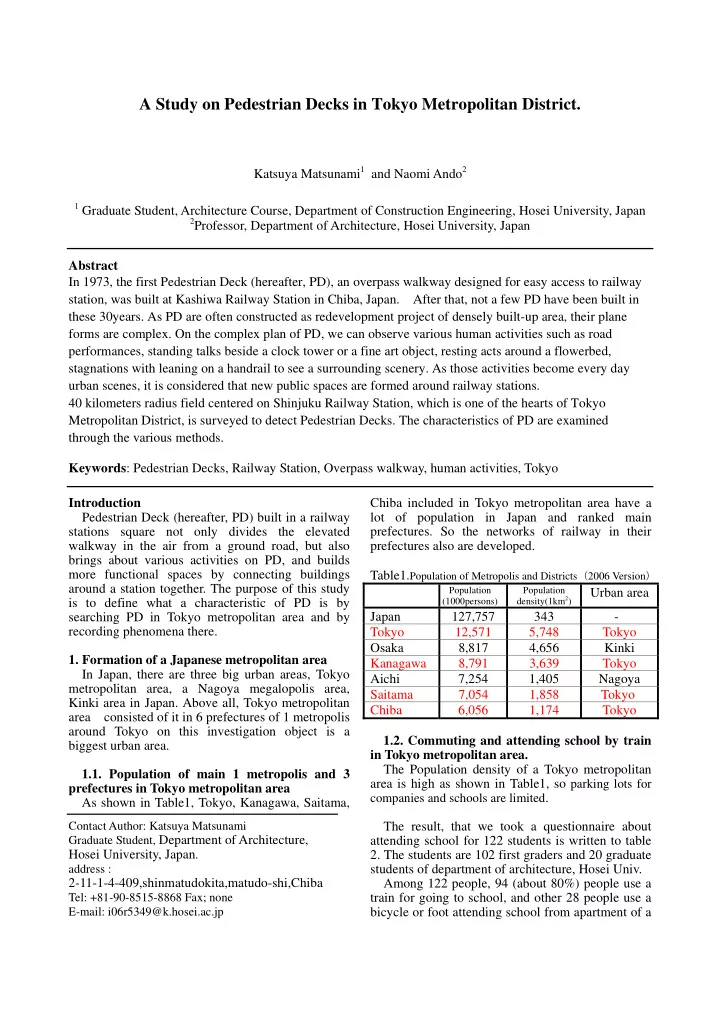
Abstract In 1973, the first Pedestrian Deck (hereafter, PD), an overpass walkway designed for easy access to railway station, was built at Kashiwa Railway Station in Chiba, Japan. After that, not a few PD have been built in these 30years. As PD are often constructed as redevelopment project of densely built-up area, their plane forms are complex. On the complex plan of PD, we can observe various human activities such as road performances, standing talks beside a clock tower or a fine art object, resting acts around a flowerbed, stagnations with leaning on a handrail to see a surrounding scenery. As those activities become every day urban scenes, it is considered that new public spaces are formed around railway stations. 40 kilometers radius field centered on Shinjuku Railway Station, which is one of the hearts of Tokyo Metropolitan District, is surveyed to detect Pedestrian Decks. The characteristics of PD are examined through the various methods. Keywords: Pedestrian Decks, Railway Station, Overpass walkway, human activities, Tokyo Introduction Pedestrian Deck (hereafter, PD) built in a railway stations square not only divides the elevated walkway in the air from a ground road, but also brings about various activities on PD, and builds more functional spaces by connecting buildings around a station together. The purpose of this study is to define what a characteristic of PD is by searching PD in Tokyo metropolitan area and by recording phenomena there.

  • 1. Formation of a Japanese metropolitan area

In Japan, there are three big urban areas, Tokyo metropolitan area, a Nagoya megalopolis area, Kinki area in Japan. Above all, Tokyo metropolitan area consisted of it in 6 prefectures of 1 metropolis around Tokyo on this investigation object is a biggest urban area. 1.1. Population of main 1 metropolis and 3 prefectures in Tokyo metropolitan area As shown in Table1, Tokyo, Kanagawa, Saitama, Chiba included in Tokyo metropolitan area have a lot of population in Japan and ranked main

  • prefectures. So the networks of railway in their

prefectures also are developed. Table1.Population of Metropolis and Districts(2006 Version)

Population (1000persons) Population density(1km2)

Urban area Japan 127,757 343

  • Tokyo

12,571 5,748 Tokyo Osaka 8,817 4,656 Kinki Kanagawa 8,791 3,639 Tokyo Aichi 7,254 1,405 Nagoya Saitama 7,054 1,858 Tokyo Chiba 6,056 1,174 Tokyo 1.2. Commuting and attending school by train in Tokyo metropolitan area. The Population density of a Tokyo metropolitan area is high as shown in Table1, so parking lots for companies and schools are limited.

Contact Author: Katsuya Matsunami Graduate Student, Department of Architecture,

Hosei University, Japan.

address :

2-11-1-4-409,shinmatudokita,matudo-shi,Chiba

Tel: +81-90-8515-8868 Fax; none E-mail: i06r5349@k.hosei.ac.jp

The result, that we took a questionnaire about attending school for 122 students is written to table

  • 2. The students are 102 first graders and 20 graduate

students of department of architecture, Hosei Univ. Among 122 people, 94 (about 80%) people use a train for going to school, and other 28 people use a bicycle or foot attending school from apartment of a

slide-2
SLIDE 2

single life or the parents' house. Table.2. shows the 94 students attend school changing an average of 2 trains, taking about 1 hour, by way of 19 stations. In distribution of seat-load time, there are many people of 50-70 minutes seat-load time. In other words, it is common in a Tokyo metropolitan area to take 1 hour by a train to attend school.

  • Table2. Questionnaire About Attending School

Average Max Way Station number 18.98 65 Route number 2.44 4 Distance in a straight line from Shinjuku(km) 24.74 69.71 Course distance by train(km) 38.73 99.6 Seat-load time(minutes) 56.59 130

  • 2. Preliminary Search for Pedestrian Decks

As mentioned above, commuting by train is quite common in Tokyo metropolitan area and towns tend to be formed around a core of railway stations. Thus, there is a high possibility that PD become major public space of the towns. However, little discussion about “How PD are distributed” or “What is PD?” has been given. In this chapter, our investigation of PD in Tokyo metropolitan area is explained. We have searched PD within the area of 40km distance from Shinjuku railway station. Shinjuku is one of the centers of Tokyo metropolis. It is the terminal of four JR1) lines, two Private railway lines and three Municipal (subway) lines. It has the highest number of embarking and disembarking passengers2) in Japan. There are 28 JR lines, numerous lines of 27 Private railway companies and 4 Municipal (subways and a street car) organizations in the searched area. The total number of railway stations in this area counts up to 1239 (355 JR, 686 Private, 198 Municipal3)). While literally, PD is a elevated overpass walkway, the actual forms of PD are various. In this chapter, at first, we will explain our investigation to find the provisional PD in the Tokyo metropolitan area, and will discuss the definition and the characteristics of PD in the following

1) Japan Railway Co.Former national railway. 2) The number of embarking passengers of JR

lines in one day is reported 747,930 in the year

  • 2005. This number excludes disembarking

passengers and private/municipal lines.

3) The number of JR-Private or JR-Municipal

transfer station is counted in JR station. The number of Private-Municipal transfer station is counted in Private station. chapter. Our methods of the investigation were as follows: (1) On spot investigation. (2) Inquiry to the private and the municipal railway companies. (3) Questionnaire. (4) Internet and other information search. (1) was carried out for all of the JR stations and a part of private and municipal stations in 2002-2003. In this on spot investigation, we found 42 PD at JR stations and 18 PD at Private stations. By the answer of (2) from 14 Private companies, 26 PD were found. (3) was the questionnaires to the people close to us, especially graduate students at Hosei University. By these questionnaires, 27 PD were pointed out. By (4), 52 PD were found. At this search, not only the existence of PD, we could feel various first-hand impressions of the people. Totally, excluding the overlapped PD, the existence

  • f 94 PD was verified inside the area of 40km

distance from Shinjuku railway station. Fig.1. shows the distribution of PD. Fig.1. Distribution Map of Pedestrian Decks

50km

Shinjuku

  • 3. Definition and characteristic of PD

PD is an overpass walkway, bus terminals and cabstands, etc. are often arranged under the pedestrian decks. On PD, rest spaces, telephone boxes, benches and plants are arranged. Some have void spaces or roofs. Various activities are

  • bserved, such as taking rest, waiting for friends,

using cellular phone and so on. By paying attention to these activities, we considered that we could define PD as “An elevated walkway that is designed for three-dimensional use of its site and it has certain elements to occur human activities”. In this chapter, we will examine this definition and clarify the spatial characteristics of PD. We visited 94 PD and described the actual activities that happened there in Fig.2 to Fig.25.

slide-3
SLIDE 3

3.1 Explanation of activities on PD Fig.2. PD is a plaza that a couple sits down on flower bed and can make love in public. Fig.3. When she lean against PD and look at the scenery, PD heals her broken heart. Fig.4. A street vender is hard work. Because it is very hot on PD in the summer, Fig.5. Art object such as the big hive which gave us gooseflesh skin was put there. Fig.6. A signboard written “Subway” was on elevated PD, fast food shop name though. Fig.7. Family waits till the clock tower sounds. Fig.2. Plaza for Lovers Fig.3.A Broken-hearted Girl Fig.4. Do You Have Mind to Sell it? Fig.8. A dog carried by the owner takes a walk on elevated PD. This is an aerial walk. Fig.9. Art object on PD is considered to be a mark to make it rather than art object. Fig.10. This is a scene like a boy broke an iron column as Hercules. Fig.11. Exhibition charges of a gallery are free on PD, but the permission is necessary. Fig.12. Live on PD is prohibited, but depends on power of singer. Fig.13. Children looked at the train which arrived next which their mom got on. Fig.5. A Huge Hive on PD Fig.6. Elevated Subway??? Fig.7.Against the Clock Tower Fig.8.An Aerial Walk Fig.9. These aren’t Art Objects Fig.10. He is Hercules Fig.11. Exhibition Charges are Free Fig.12. Singers of the Next Generation Fig.13. What Do You Look at?

slide-4
SLIDE 4

Fig.14. A Dove is a Symbol of Peace Fig.15.Plaza for Lovers 2 Fig.4 Fig.17.A Different Way of Enjoying PD Fig.6 Fig.7 Fig.20.Shall We Dance? Fig.21.Leave Me Alone PC Fig.23. Observation Point Fig.24.Family Plaza Fig.13 Fig.16. Business of FTTH on PD Fig.22.Plaza for Lovers 3 ? Fig.25. PD Connects Dreamland Fig.19. Relaxation Space for Businessman Fig.18. Here is Best Position Fig.20. A girl was dancing innocently on PD lighted up. Fig.14. A dove is a symbol of peace, but drops a lot of feces on PD. Fig.21. A businessman was sitting down on flower

  • bed. PD is a place to muse.

Fig.15. PD is a plaza that a couple leans against a fence of PD and can make love in public. Fig.16. There is no PD where business of FTTH is not performed in Japan. Fig.22. PD is a plaza that a sister sits down on flower bed and chat there. Fig.17. We can watch a flow of people on PD from neighboring building. Fig.23. It is a father's pleasure to take his son out to watch trains. Fig.18. A festival in a town is hold around PD and PD changes to a seat. Fig.24. Empty PD becomes space such as a small park. Fig.19. PD in a business area is a relaxation space for businessman. Fig.25, PD connects dreamland as Disneyland with people. That is, PD connects dream.

slide-5
SLIDE 5

Table.3. About PD Rank PD Rank Explanation about PD Rank Rank A PD has elements that people can sit down and rest there as Fig.26. Rank B PD has elements that people stop there. Like monument, sign, smoking space, public telephone, clock tower, etc as Fig.27. Rank C PD has elements letting you stop momentarily, as vending machine on Fig 28. Rank D A simple pedestrian bridge, no stay element Rank S Large-scale PD which connects neighboring buildings rather than PD of the station square, as Fig.29. (We named it Super PD) Fig.26. PD Rank A Fig.27. PD Rank B Fig.28. PD Rank C Fig.29. PD Rank S Table.4. Plane Form of PD Form type Explanation of type Plaza type Form of PD is a open space like a plaza, as Fig.30. Passage type Form of PD is narrow as a passage, as Fig.31. Fig.30. Plaza Type Fig.31.Passage Type 3.2 Classification of 94 PD We classified characteristics of various 94 PD as table 3 to 5, PD Rank, Plane form of PD, Vertical plane form of PD. Then PD of Rank S (Super PD) were found besides A, B, C. Super PD is elevated and large-scaled passage connecting dotted buildings rather than an elevated

  • pen space of the station square.

It seems that Super PD are decks which are seen in big cities in world, but Rank A, B, C, PD except Rank S are small plaza of the station square, and it is thought that it is a special thing in the Tokyo metropolitan area where a railroad is main means of facilities of travel.. 3.3 Result of classification and analysis As shown in table 6, among 94 PD, 51 PD belonged to Rank A and there are 66 PD of Rank A, B, C which had a stagnation element. In addition, about 75% of PD in Rank A belongs to Plaza type. Table.5.Vertical Plane Form of PD Form type Explanation of type Aerial type Elevated PD as Fig.32. GL connection type Connected PD with ground directly as Fig.33. Fig.32.Aerial Type Fig.33.GL Connection Type Table.6. Result of Classification of 94 PD A B C D S Total PD Rank 51 9 6 17 11 94 Plaza type 38 3 1 1 4 47 Passage type 13 6 5 16 7 47 Aerial type 42 9 3 15 11 80 GL connection type 9 3 2 14 In other words, if there is Plaza type PD at the station square, in the case of most, the PD has elements causing the activity like sitting down flower bed or bench and rest there as plaza. The stagnation element which Rank A, B, C, PD have causes various activities as shown in Chap.3.1. Furthermore, about 80% of PD in Rank A, B, C, belongs to Aerial type as table.5. Therefore, in this chapter, we could point out appropriate PD as we defined "An elevated walkway that is designed for three-dimensional use

  • f its site and it has certain elements to occur

human activities".

slide-6
SLIDE 6

human activities". Fig.34. Connecting to Large-sized Department Store Fig.36. Connecting to Hotel

  • 4. PD builds functional space around a station

A space around a railway station becomes more functional by PD connecting neighboring buildings. We call the space Station Space in this chapter that was consisted of buildings connected by PD Among 94 PD that we found in this investigation, 58 PD are connecting to a large-sized department store, 22 PD are connecting to big apartment to be seen as a recent tendency, and 17 PD are connecting to hotel, as shown in Fig.34 to Fig.36. In other words the Station Space which consisted

  • f PD has extreme function to stay and to live in

Station Space not only using a department store. In addition to this, PD which connected to various buildings was seen on this study, like a library, university, city hall, amusement building, etc. It may be said that the times will come we can do everything only walking on PD in Station Space.

  • 5. Conclusion

Through these investigation and analysis for PD we found by various methods and through the understanding about the railway for Japanese life, the conclusion of this study as follows were clarified. (1) Showing definition PD as “An elevated walkway that is designed for three-dimensional use

  • f its site and it has certain elements to occur

human activities”. (2) By investigating throughout Tokyo metropolitan area, types of PD are examined. The space constitution with elements which make various activities there and the characteristics

  • f

independent small and aerial space are pointed

  • ut.
  • Fig. 35.Connecting to

Big Apartment (3) Tendency that PD combines the various functions, such as inhabiting or accommodating activities, with railway stations is verified. Acknowledgement The authors are grateful to Mr. Hiroki Takahashi, and Mr. Atsushi Funaoka, who are students of Naomi Ando’s studio at Hosei University for their collaboration with the field survey. And also grateful to the private and the municipal railway companies for their collaborations with our

  • inquiries. And also grateful to first graders students

and 20 graduate students of department of architecture, Hosei University, for informing us about station with PD. References

1) Naomi, A., Nobuhiro, Y., Satoshi, I., Masahiro,

Y., Yasuyuki, S., Masahiro, C.,(2003), Characteristics of Conformations of Pedestrian Decks in Japan

2) Masahiro, Y.,(2001),A Study on characteristics

  • f an open space of PD,- The formation of an
  • pen space by causing various activities –

3) Masayuki, S., Naomi, A.,(2002),A study about

characteristics of an open space of PD.- Form comparison with an Italian plaza-

4) Takahiro, S., Naomi, A., Masahiro, Y., Masaki,

Y., Yasuyuki, S.,(2003), A study about the geographical convenience of PD.

5) Yasuyuki, S., Naomi, A., Masahiro, Y., Masaki,

Y., (2003), A study about a plane form of PD.

6) Naomi, A., (2004), A Study of PD about a

surrounding feeling -space evaluation of Europe plaza of PD-.

7) Statistics Bureau, Director-General for policy

planning (Statistical standard) and Statistical Research and Training Institute, population data.