5/1/2011
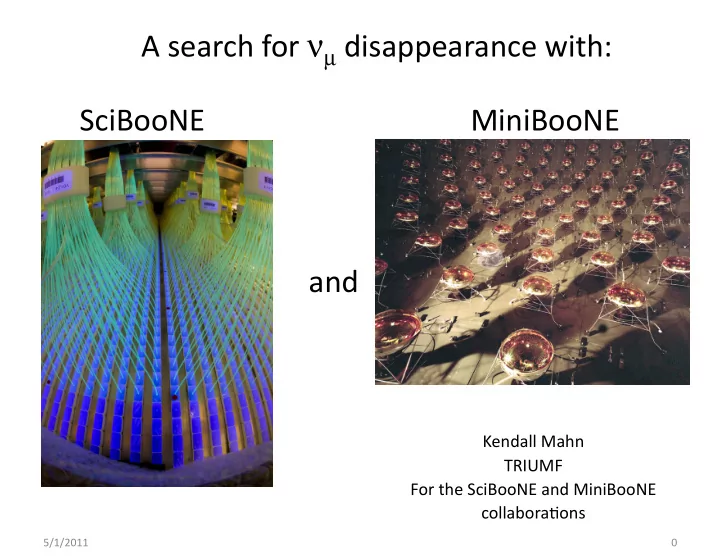
A search for disappearance with: SciBooNE MiniBooNE and Kendall - - PowerPoint PPT Presentation
A search for disappearance with: SciBooNE MiniBooNE and Kendall Mahn TRIUMF For the SciBooNE and MiniBooNE collabora>ons 5/1/2011 0 Neutrino oscillations in 2011 Neutrino oscillations thus far are consistent with three flavors of
Neutrino oscillations in 2011
5/1/2011 1
Neutrino oscillations thus far are consistent with three flavors of neutrinos which mix with the mass states according to a unitary matrix Lack of νµ νe appearance but observation of νµ νe appearance at Δm2~1 eV2 by the MiniBooNE numubar -> nuebar oscillations Phys.Rev.LeJ.105:181801,2010 Phys.Rev.LeJ.98:231801,2007
→ →
νe νe
νµ disappearance at Δm2 ~1 eV2
5/1/2011 2
Exotic physics is required to explain a difference between neutrinos and antineutrinos and the presence of an additional, large, mass splitting Sterile neutrinos (with or without CPT violation)
- G. Karagiorgi et al, Phys.Rev.D75:013011,2007. hep-ph/0609177
Barger, Marfatia, & Whisnant, Phys. Lett. B576 (2003) 303
Neutrino decay:
Palomares-Ruiz, Pascoli, Schwetz, JHEP 0509:048,2005. hep-ph/0505216
Extra dimensions: Pas, Pakvasa, Weiler, Phys.Rev.D72:095017,2005. hep-ph/0504096 New, light gauge boson:
Nelson, Walsh Phys .Rev. D77 033001 (2008) hep-ph/0711.1363
Searches for νµ νs disappearance test the same physics as νµ νs νe appearance An observation of νµ disappearance at 0.1< Δm2 < 100 eV2 would clarify the nature of any new physics A lack of disappearance in the region would constrain new physics models
→ → →
Existing measurements of νµ disappearance
MiniBooNE, CDHS, CCFR experiments observe no νµ disappearance (90%CL) MiniBooNE, CCFR experiments
- bserve no νµ disappearance
(90%CL) MiniBooNE-only results limited by neutrino flux and neutrino interaction uncertainties Constrain these with a set of near detectors: SciBooNE Same beamline, same neutrino target
- 1
1 10
2
10
90%CL excluded, CDHS 90%CL excluded, CCFR
- 1
1 10
2
10
90%CL excluded, CDHS 90%CL excluded, CCFR
- 1
1 10
2
10
90%CL excluded, CDHS 90%CL excluded, CCFR
- 1
1 10
2
10
90%CL excluded, CDHS 90%CL excluded, CCFR 90% CL sensitivity
!
! MiniBooNE 90% CL limit
!
! MiniBooNE (null) of 17.78
2
"
- f 12.72,
2
" best fit: (17.50, 0.16) with
2
eV
2
m #
- 2
10
- 1
10 1
- 1
10 1 10 10
90%CL excluded, CCFR __ __ ) $ (2
2
sin
2
eV
2
m #
- 2
10
- 1
10 1
- 1
10 1 10 10
90%CL excluded, CCFR __ __ ) $ (2
2
sin
2
eV
2
m #
- 2
10
- 1
10 1
- 1
10 1 10 10
90%CL excluded, CCFR __ __ ) $ (2
2
sin
2
eV
2
m #
- 2
10
- 1
10 1
- 1
10 1 10 10
90%CL excluded, CCFR __ __ ) $ (2
2
sin
2
eV
2
m # 90% CL sensitivity
!
! MiniBooNE 90% CL limit
!
! MiniBooNE (null) of 10.29
2
"
- f 5.43,
2
" best fit: (31.30, 0.96) with
3
Phys.Rev.LeJ.103:061802,2009
5/1/2011
The Booster Neutrino Experiments (BooNEs)
8 GeV/c protons from the Fermilab Booster strike a Be target Pions and kaons are produced which decay to produce a neutrino beam 100m from the target are the SciBooNE detectors:
- 14,336 scintillator bar detector read out with WLS fibers attached to
64 channel MA-PMTs (SciBar)
- Lead and scintillator fiber electromagnetic calorimeter (EC)
- Iron and scintillator counter muon range detector (MRD)
541m from the target is the MiniBooNE detector
- 1kton mineral oil Cherenkov detector
- 1240 inner PMTs, 240 veto PMTs
4
Booster target horn decay volume SciBooNE 100m MiniBooNE 541m
4 5/1/2011
Selecting CC νµ interactions in SciBooNE
5/1/2011 5
- Select events with the highest
momentum track with a vertex in SciBar fiducial volume which pass data quality, beam timing cuts
- Events which also end in SciBar:
“SciBar contained” Use energy loss in scintilator to select muon-like tracks pµ>250 MeV/c reduces NC events
- Events which stop in the MRD:
“MRD Stopped”
- Events which exit the end of the MRD:
“MRD Penetrated” Angular information only
µ µ‐ e-
W+
CC νµ
µ‐ νµ νµ νµ
10/31/08 W&C
µ
Real neutrino candidates
µ
MRD SciBar SciBar EC
p p
νµ νµ
SciBar EC MRD
νµ µ‐
Selecting CCQE νµ interactions in MiniBooNE
5/1/2011 6
e µ νµ
12C
p n
Tag single muon events and their decay electron
- Events produce Cherenkov light recorded by
PMTs as hits (charge, time)
- Two sets of hits separated in time (µ, e)
- Minimal hits in the veto
- Require 1st set of hits above decay electron
energy endpoint, 2nd set of hits below
- Endpoint of 1st track consistent with vertex of 2nd
track
- Also require events within fiducial volume, beam
timing and data quality selections electron candidate muon candidate
μ‐
νµ
Disappearance analysis strategy
5/1/2011 7
Use the CC νµ rate measured at SciBooNE to constrain the MiniBooNE νµ rate and test for disappearance Two analysis methods: Simultaneous fit 1) Fit SciBooNE and MiniBooNE data simultaneously for oscillation 2) Constraint applied within fit, effectively removes systematic uncertainties shared by both detectors Spectrum fit 1) Extract neutrino energy spectrum from SciBooNE data
Phys.Rev.D83:012005,2011
2) Apply correction to MiniBooNE energy spectrum 3) Fit for oscillation at MiniBooNE 4) Systematics reduced by extraction process
SciBooNE CC νµ data set
5/1/2011 8
First, test agreement of SciBooNE datasets Above Δm2 > 2 eV2 , oscillation is possible at SciBooNE No evidence for oscillation at SciBooNE Uncertainties include neutrino flux, cross section and detector uncertainties
Events 500 1000 1500 2000 2500 3000 3500 4000 4500 Data Null oscillation Non-CCQE events
(GeV)
!
Reconstructed E 0.4 0.6 0.8 1 1.2 1.4 1.6 1.8 Ratio 0.5 0.6 0.7 0.8 0.9 1 1.1 1.2 1.3 1.4 1.5 Best fit = 0.5 " 2
2
, sin
2
= 1.0 eV
2
m # = 0.5 " 2
2
, sin
2
= 10 eV
2
m #
Events 500 1000 1500 2000 2500 3000 Data Null oscillation Non-CCQE events
(GeV)
!
Reconstructed E 0.4 0.6 0.8 1 1.2 1.4 1.6 1.8 Ratio 0.5 0.6 0.7 0.8 0.9 1 1.1 1.2 1.3 1.4 1.5 Best fit = 0.5 " 2
2
, sin
2
= 1.0 eV
2
m # = 0.5 " 2
2
, sin
2
= 10 eV
2
m #
SciBar stopped MRD stopped
Events 5000 10000 15000 20000 25000 30000 Data Null oscillation Non-CCQE events
(GeV)
!
Reconstructed E 0.2 0.4 0.6 0.8 1 1.2 1.4 1.6 1.8 Ratio 0.5 0.6 0.7 0.8 0.9 1 1.1 1.2 1.3 1.4 1.5 Best fit = 0.5 " 2
2
, sin
2
= 1.0 eV
2
m # = 0.5 " 2
2
, sin
2
= 10.0 eV
2
m #
MiniBooNE CCQE νµ data set
5/1/2011 9
MiniBooNE CCQE νµ data set + prediction (no oscillation) Fit 16+16+16 bins in total = 48 χ2 (null) = 45.1/ 48 (DOF) χ2 (best) = 39.5/ 46 (DOF) At Δm2 = 43.7 eV2, sin22θ = 0.60 Δχ2 = χ2(null) – χ2 (best) = 5.6 Δχ2 (90% CL, null) = 9.3 Feldman Cousins frequentist technique used to determine Δχ2 statistic
Results of νµ disappearance fit
5/1/2011 10
Limits for simultaneous fit (black) and spectrum fit (blue) Green hatched region indicates 68% of 90%CL limits to fake data with no underlying
- scillation
Average of these limits is sensitivity, comperable for both analysis methods Largest uncertainty is MiniBooNE detector systematics
! 2
2
sin 0.1 0.2 0.3 0.4 0.5 0.6 0.7 0.8 0.9 1 ]
2
[eV
2
m "
- 1
10 1 10
90% CL limits from previous exp’s. 90% CL sensitivity (Sim. fit) 90% CL observed (Sim. fit) 90% CL observed (Spec. fit)
No disappearance at 90% CL observed for either method
Conclusion
5/1/2011 11
First joint venture of the SciBooNE and MiniBooNE experiments A fit to SciBooNE and MiniBooNE data is consistent with no muon neutrino disappearance at 90%CL
- Two complementary methods have consistent results
- New exclusion region between 10 < Δm2 < 30 eV2
- Provides additional constraints on exotic physics models, such as sterile
neutrinos SciBooNE took antineutrino data which will be used for a joint SciBooNE-MiniBooNE νµ disappearance analysis
Backup slides
5/1/2011 12
Sensitivity
5/1/2011 13
Improvement over previous MiniBooNE-only analysis sensitivity Two methods have similar sensitivities Slightly better sensitivity for simultaneous fit
Oscillation probability
5/1/2011 14
MiniBooNE CCQE νµ SciBooNE MRD stopped SciBooNE SciBar stopped Oscillation at sin22θ = 0.10 Includes range in L present at each detector
0.86 0.88 0.9 0.92 0.94 0.96 0.98 1 1.02 1.04 0.5 1 1.5 reconstructed E! (GeV) "m2=1eV2 reconstructed E! (GeV) "m2=3eV2 0.86 0.88 0.9 0.92 0.94 0.96 0.98 1 1.02 1.04 0.5 1 1.5 0.86 0.88 0.9 0.92 0.94 0.96 0.98 1 1.02 1.04 0.5 1 1.5 (GeV) reconstructed E! (GeV) "m2=9eV2 0.86 0.88 0.9 0.92 0.94 0.96 0.98 1 1.02 1.04 0.5 1 1.5 reconstructed E! (GeV) "m2=6eV2
Events 5000 10000 15000 20000 25000 30000 Data Null oscillation Non-CCQE events
(GeV)
!
Reconstructed E 0.2 0.4 0.6 0.8 1 1.2 1.4 1.6 1.8 Ratio 0.5 0.6 0.7 0.8 0.9 1 1.1 1.2 1.3 1.4 1.5 Best fit = 0.5 " 2
2
, sin
2
= 1.0 eV
2
m # = 0.5 " 2
2
, sin
2
= 10.0 eV
2
m #
Spectrum fit method
5/1/2011 15
MiniBooNE CCQE νµ dataset + prediction corrected from SciBooNE datasets (spectrum fit, reduced errors) Best fit: Δm2 =41.5 eV2
sin22θ = 0.51