
SLIDE 1
A Review on Stress Corrosion Cracking of Stainless Steel 316L in Oxygenated and Chlorinated Primary Water Chemistry
Dong-Jun Lee a, You-Jin Kang a, Yong-Soo Kim a
aDepartment of Nuclear Engineering, Hanyang University,
222 Wangsimni-ro, Seongdong-gu, Seoul, 04763, Korea
*Corresponding author: yongskim@hanyang.co.kr
- 1. Introduction
STS 316L austenitic stainless steel has been used widely as structural material under primary water reactor environment in PWR due to high resistance of general corrosion and mechanical strength. However, there are many localized corrosion failures in nuclear reactor, and stress corrosion cracking (SCC) is occurred. SCC is classified as either intergranular stress corrosion cracking (IGSCC) or transgranular stress corrosion cracking (TGSCC), depending upon the primary crack
- morphology. Since 1980s, stress corrosion cracking
became an important degradation mechanism to deteriorate reliability of components in nuclear power
- plants. SCC has been studied extensively over the last
thirty years, the cracking process is still a matter of debate [1, 2]. To prevent SCC, it is necessary to know boundary condition that SCC occurs. In this study, previous studies of boundary condition generating SCC related to austenitic STS 316L in water chemistry are analyzed.
- 2. Methods and Results
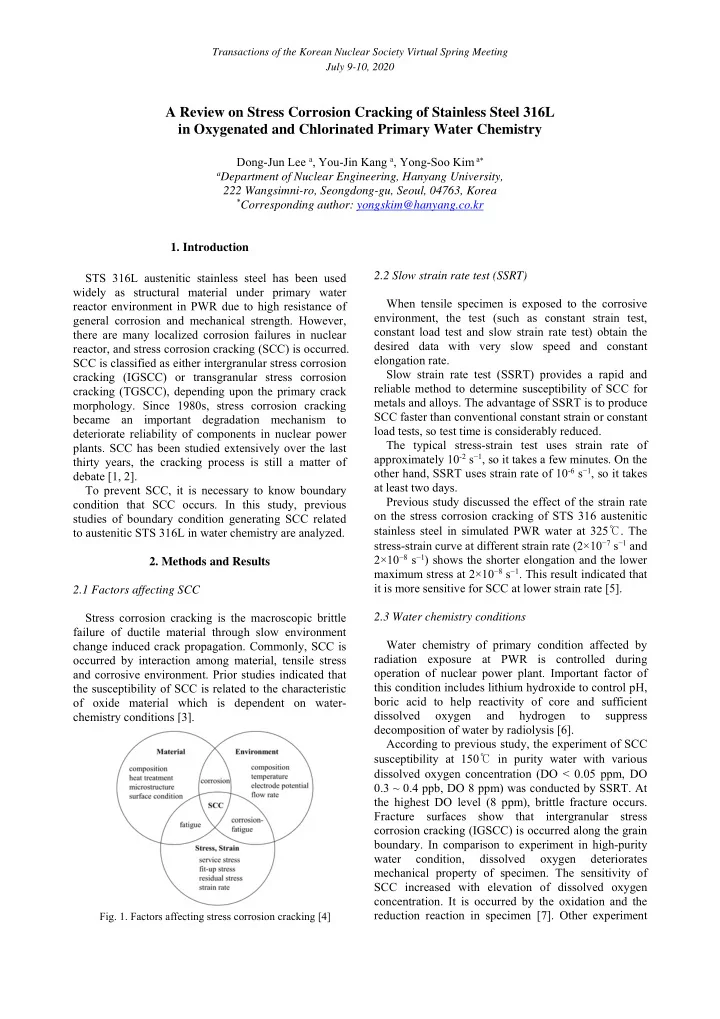
2.1 Factors affecting SCC Stress corrosion cracking is the macroscopic brittle failure of ductile material through slow environment change induced crack propagation. Commonly, SCC is
- ccurred by interaction among material, tensile stress
and corrosive environment. Prior studies indicated that the susceptibility of SCC is related to the characteristic
- f oxide material which is dependent on water-
chemistry conditions [3].
- Fig. 1. Factors affecting stress corrosion cracking [4]
2.2 Slow strain rate test (SSRT) When tensile specimen is exposed to the corrosive environment, the test (such as constant strain test, constant load test and slow strain rate test) obtain the desired data with very slow speed and constant elongation rate. Slow strain rate test (SSRT) provides a rapid and reliable method to determine susceptibility of SCC for metals and alloys. The advantage of SSRT is to produce SCC faster than conventional constant strain or constant load tests, so test time is considerably reduced. The typical stress-strain test uses strain rate of approximately 10-2 s−1, so it takes a few minutes. On the
- ther hand, SSRT uses strain rate of 10-6 s−1, so it takes
at least two days. Previous study discussed the effect of the strain rate
- n the stress corrosion cracking of STS 316 austenitic
stainless steel in simulated PWR water at 325℃. The stress-strain curve at different strain rate (2×10⁻⁷ s−1 and 2×10⁻⁸ s−1) shows the shorter elongation and the lower maximum stress at 2×10⁻⁸ s−1. This result indicated that it is more sensitive for SCC at lower strain rate [5]. 2.3 Water chemistry conditions Water chemistry of primary condition affected by radiation exposure at PWR is controlled during
- peration of nuclear power plant. Important factor of
this condition includes lithium hydroxide to control pH, boric acid to help reactivity of core and sufficient dissolved
- xygen
and hydrogen to suppress decomposition of water by radiolysis [6]. According to previous study, the experiment of SCC susceptibility at 150℃ in purity water with various dissolved oxygen concentration (DO < 0.05 ppm, DO 0.3 ~ 0.4 ppb, DO 8 ppm) was conducted by SSRT. At the highest DO level (8 ppm), brittle fracture occurs. Fracture surfaces show that intergranular stress corrosion cracking (IGSCC) is occurred along the grain
- boundary. In comparison to experiment in high-purity
water condition, dissolved
- xygen
deteriorates mechanical property of specimen. The sensitivity of SCC increased with elevation of dissolved oxygen
- concentration. It is occurred by the oxidation and the