A Question Topic 14 p public class WordList { bli l W dLi t { - - PowerPoint PPT Presentation

a question topic 14 p
SMART_READER_LITE
LIVE PREVIEW

A Question Topic 14 p public class WordList { bli l W dLi t { - - PowerPoint PPT Presentation

A Question Topic 14 p public class WordList { bli l W dLi t { Iterators private ArrayList<String> myList; // pre: none "First things first, but not necessarily // post: all words that are exactly len // characters long have


slide-1
SLIDE 1

Topic 14 p Iterators

"First things first, but not necessarily i th t d " in that order "

  • Dr Who
  • Dr. Who

CS 307 Fundamentals of Computer Science Iterators

1

A Question

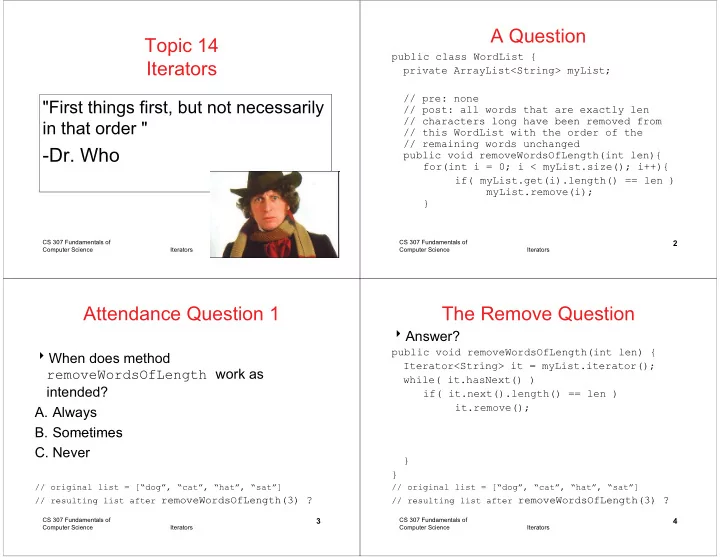
bli l W dLi t { public class WordList { private ArrayList<String> myList; // pre: none // post: all words that are exactly len // characters long have been removed from // characters long have been removed from // this WordList with the order of the // remaining words unchanged public void removeWordsOfLength(int len){ public void removeWordsOfLength(int len){ for(int i = 0; i < myList.size(); i++){ if( myList.get(i).length() == len ) Li t (i) myList.remove(i); }

CS 307 Fundamentals of Computer Science Iterators

2

Attendance Question 1

When does method removeWordsOfLength work as intended?

  • A. Always

B Sometimes

  • B. Sometimes
  • C. Never

// original list = [“dog”, “cat”, “hat”, “sat”] // resulting list after removeWordsOfLength(3) ? // resulting list after removeWordsOfLength(3) ?

CS 307 Fundamentals of Computer Science Iterators

3

The Remove Question

A ? Answer?

public void removeWordsOfLength(int len) { Iterator<String> it = myList iterator(); Iterator<String> it = myList.iterator(); while( it.hasNext() ) if( it.next().length() == len ) it.remove(); } }

// original list = [“dog”, “cat”, “hat”, “sat”] // resulting list after removeWordsOfLength(3) ?

CS 307 Fundamentals of Computer Science Iterators

4

// resulting list after removeWordsOfLength(3) ?

slide-2
SLIDE 2

Iterators

ArrayList is part of the Java Collections framework Collection is an interface that specifies the basic operations every collection (data structure) should have Some Collections don’t have a definite order So e Co ec o s do a e a de e o de

– Sets, Maps, Graphs

How to access all the items in a Collection How to access all the items in a Collection with no specified order?

CS 307 Fundamentals of Computer Science Iterators

5

Access All Elements - ArrayList

i i i i i public void printAll(ArrayList list){ for(int i = 0; i < list.size(); i++) System.out.println(list.get(i)); } How do I access all the elements of a Set? The elements don’t have an index. Iterator objects provide a way to go through all the elements of a Collection, one at a time

CS 307 Fundamentals of Computer Science Iterators

6

Iterator Interface

A it t bj t i “ h t” bj t An iterator object is a “one shot” object

– it is designed to go through all the elements of a Collection once elements of a Collection once – if you want to go through the elements of a Collection again you elements of a Collection again you have to get another iterator object

Iterators are obtained by calling y g a method from the Collection

CS 307 Fundamentals of Computer Science Iterators

7

Iterator Methods

The Iterator interface specifies 3 methods: The Iterator interface specifies 3 methods:

boolean hasNext() //returns true if this iteration has more elements Object next() //returns the next element in this iteration //returns the next element in this iteration //pre: hastNext() id () void remove() /*Removes from the underlying collection the last element returned by the iterator. Thi th d b ll d l ll t t pre: This method can be called only once per call to next. After calling, must call next again before calling remove again. */

CS 307 Fundamentals of Computer Science Iterators

8

*/

slide-3
SLIDE 3

Attendance Question 2

Which of the following produces a syntax error?

ArrayList list = new ArrayList(); Iterator it1 = new Iterator(); // I Iterator it2 new Iterator(list); // II Iterator it2 = new Iterator(list); // II Iterator it3 = list.iterator(); // III

A I

  • A. I
  • B. II

C III

  • C. III
  • D. I and II
  • E. II and III

CS 307 Fundamentals of Computer Science Iterators

9

Typical Iterator Pattern

i i i i i public void printAll(ArrayList list){ Iterator it = list.iterator(); Obj t t Object temp; while( it.hasNext() ) { i temp = it.next(); System.out.println( temp ); } }

CS 307 Fundamentals of Computer Science Iterators

10

Typical Iterator Pattern 2

public void printAll(ArrayList list){ public void printAll(ArrayList list){ Iterator it = list.iterator(); while( it.hasNext() ) S t t i tl ( it t() ) System.out.println( it.next() ); } // i // go through twice? public void printAllTwice(ArrayList list){ Iterator it = list.iterator(); while( it.hasNext() ) System.out.println( it.next() ); it = list.iterator(); while( it.hasNext() ) System.out.println( it.next() ); }

CS 307 Fundamentals of Computer Science Iterators

11

A Picture of an Iterator

Imagine a fence made up of fence posts and rail sections

rails rails fenceposts

CS 307 Fundamentals of Computer Science Iterators

12

slide-4
SLIDE 4

Fence Analogy

The iterator lives on the fence posts The data in the collection are the rails Iterator created at the far left post As long as a rail exists to the right of the As long as a rail exists to the right of the Iterator, hasNext() is true

iterator object j

CS 307 Fundamentals of Computer Science Iterators

13

Fence Analogy

A Li t St i ArrayList<String> names = new ArrayList<String>(); names.add(“Jan”); names.add(“Levi”); names.add(“Tom”); names add(“Jose”); names.add( Jose ); Iterator<String> it = names.iterator(); int i = 0;

“Jan” “Levi” “Tom” “Jose”

CS 307 Fundamentals of Computer Science Iterators

14

Fence Analogy

i i while( it.hasNext() ) { i++; System.out.println( it.next() ); } // when i == 1, prints out Jan first call to next moves iterator to next post and returns “Jan”

“Jan” “Levi” “Tom” “Jose”

next post and returns “Jan”

CS 307 Fundamentals of Computer Science Iterators

15

Fence Analogy

i i while( it.hasNext() ) { i++; System.out.println( it.next() ); } // when i == 2, prints out Levi

“Jan” “Levi” “Tom” “Jose”

CS 307 Fundamentals of Computer Science Iterators

16

slide-5
SLIDE 5

Fence Analogy

i i while( it.hasNext() ) { i++; System.out.println( it.next() ); } // when i == 3, prints out Tom

“Jan” “Levi” “Tom” “Jose”

CS 307 Fundamentals of Computer Science Iterators

17

Fence Analogy

i i while( it.hasNext() ) { i++; System.out.println( it.next() ); } // when i == 4, prints out Jose

“Jan” “Levi” “Tom” “Jose”

CS 307 Fundamentals of Computer Science Iterators

18

Fence Analogy

i i while( it.hasNext() ) { i++; System.out.println( it.next() ); } // call to hasNext returns false // while loop stops

“Jan” “Levi” “Tom” “Jose”

CS 307 Fundamentals of Computer Science Iterators

19

Attendance Question 3

What is output by the following code?

ArrayList<Integer> list; List = new ArrayList<Integer>(); list.add(3); list add(3); list.add(3); list.add(5); Iterator<Integer> it = list.iterator(); g (); System.out.println(it.next()); System.out.println(it.next());

A.3

  • B. 5
  • C. 3 3 5

D 3 3 E 3 5

  • D. 3 3
  • E. 3 5

CS 307 Fundamentals of Computer Science Iterators

20

slide-6
SLIDE 6

Comodification

If ( ) i h d If a Collection (ArrayList) is changed while an iteration via an iterator is in progress an Exception will be thrown the next time the next() or remove() methods are called via the iterator

ArrayList<String> names = i i () new ArrayList<String>(); names.add(“Jan”); Iterator<String> it = names iterator(); Iterator<String> it = names.iterator(); names.add(“Andy”); it.next(); // exception will occur here

CS 307 Fundamentals of Computer Science Iterators

21

(); // p

remove method

C th t thi f th Can use the Iterator to remove things from the Collection Can onl be called once per call to t() Can only be called once per call to next()

public void removeWordsOfLength(int len) { String temp; g p Iterator it = myList.iterator while( it.hasNext() ) { temp = (String)it.next(); temp (String)it.next(); if( temp.length() == len ) it.remove(); } }

// original list = [“dog”, “cat”, “hat”, “sat”]

3

CS 307 Fundamentals of Computer Science Iterators

22 // resulting list after removeWordsOfLength(3) ?

Common Iterator Error

bli id i tAllOfL th(A Li t<St i > public void printAllOfLength(ArrayList<String> names, int len) { //pre: names != null, names only contains Strings //post: print out all elements of names equal in // length to len Iterator<String> it = names.iterator(); te ato St g t a es. te ato (); while( it.hasNext() ){ if( it.next().length() == len ) S t t i tl ( it t() ) System.out.println( it.next() ); } } // given names = [“Jan”, “Ivan”, “Tom”, “George”] // and len = 3 what is output?

CS 307 Fundamentals of Computer Science Iterators

23

The Iterable Interface

A l t d i t f i bl A related interface is Iterable One method in the interface:

public Iterator<T> iterator()

Why? Anything that implements the Iterable interface can be used in the for each loop.

ArrayList<Integer> list; //code to create and fill list int total = 0; int total = 0; for( int x : list ) total += x;

CS 307 Fundamentals of Computer Science Iterators

24

slide-7
SLIDE 7

Iterable

If i l t t th h ll th If you simply want to go through all the elements of a Collection (or Iterable thing) use the for each loop use the for each loop

– hides creation of the Iterator

public void printAllOfLength(ArrayList<String> names, p p g y g int len){ //pre: names != null, names only contains Strings //post: print out all elements of names equal in // length to len for(String s : names){ if( s.length() == len ) S t t i tl ( ) System.out.println( s ); } }

CS 307 Fundamentals of Computer Science Iterators

25

Implementing an Iterator

Implement an Iterator for our GenericList class

– Nested Classes – Inner Classes – Example of encapsulation – checking precondition on remove – does our GenricList need an Iterator?

CS 307 Fundamentals of Computer Science Iterators

26