A; Strategy Background - - PDF document

a
SMART_READER_LITE
LIVE PREVIEW

A; Strategy Background - - PDF document

C REATIVE E NERGY NES NEFC CPCN E XHIBIT C1-10 CI .; 10 9/16/2015 zyxwvutsrqponmlkjihgfedcbaZYXWVUTSRQPONMLKJIHGFEDCBA A; compass zyxwvutsrqponmlkjihgfedcbaZYXWVUTSRQPONMLKJIHGFEDCBA VANCOUVER zyxwvutsrqponmlkjihgfedcbaZYXWVUTSRQPONMLKJIHGFEDCBA


slide-1
SLIDE 1

~TYOF

VANCOUVER

A; compass zyxwvutsrqponmlkjihgfedcbaZYXWVUTSRQPONMLKJIHGFEDCBA

:.'

" zyxwvutsrqponmlkjihgfedcbaZYXWVUTSRQPONMLKJIHGFEDCBA

VANCOUVER zyxwvutsrqponmlkjihgfedcbaZYXWVUTSRQPONMLKJIHGFEDCBA

,Iit'f" (".""~ zyxwvutsrqponmlkjihgfedcbaZYXWVUTSRQPONMLKJIHGFEDCBA

CI .; 10

9/16/2015 zyxwvutsrqponmlkjihgfedcbaZYXWVUTSRQPONMLKJIHGFEDCBA

BChydro m

FOR GENERATIONS

Compass Resource Management Ltd. 200 - 1260 Hamilton St. Vancouver, B.C. V6B 258 Cansda Phone: 604-641-2875 Fax: 604-641-2878 www.compassrm.com

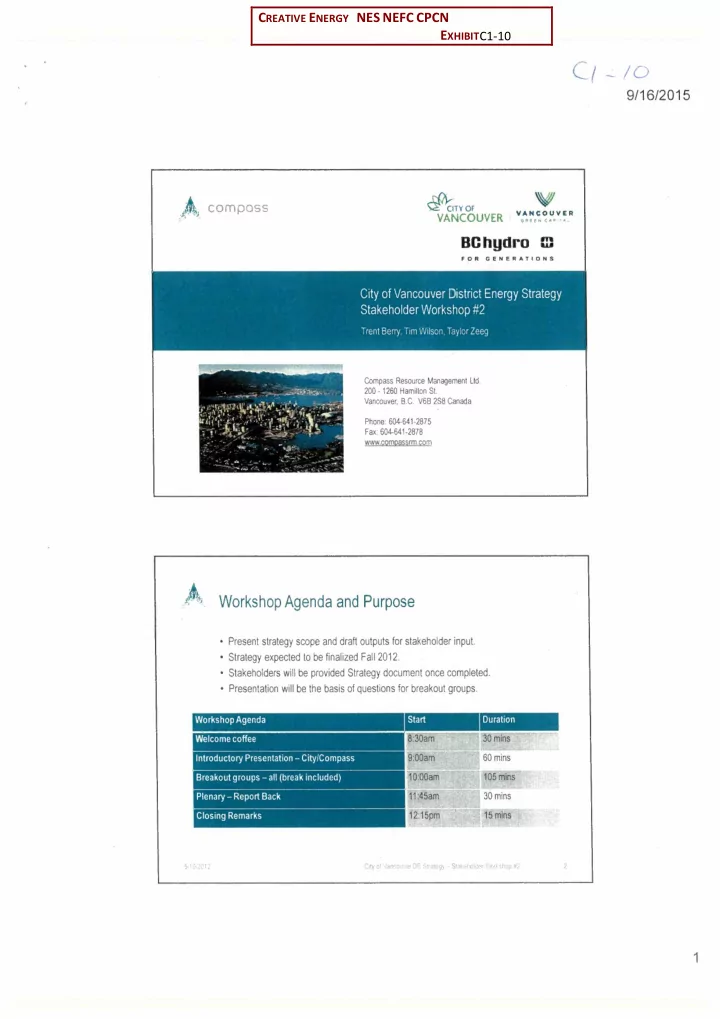
:A;.. Workshop Agenda and Purpose

  • Present strategy scope and draft outputs for stakeholder input.
  • Strategy expected to be finalized Fall 2012.
  • Stakeholders will be provided Strategy document once completed.
  • Presentation will be the basis of questions for breakout groups,

Workshop Agenda Start Duration Welcome coffee

.U~T"".T'·\":lml1l:1.lIl.""1I.11~11t-r.

Breakout groups - all (break included) 10:00am Plenary - Report Back 11:45am Closing Remarks 12:15pm

City of "JanCOI! .er DE S\l atelJ~ - Sta~ erclcer V'.'m~ shop ::2

1

C1-10

CREATIVE ENERGY NES NEFC CPCN

EXHIBIT

slide-2
SLIDE 2

9/16/2015 zyxwvutsrqponmlkjihgfedcbaZYXWVUTSRQPONMLKJIHGFEDCBA

District Energy - Overview zyxwvutsrqponmlkjihgfedcbaZYXWVUTSRQPONMLKJIHGFEDCBA

510·2012 zyxwvutsrqponmlkjihgfedcbaZYXWVUTSRQPONMLKJIHGFEDCBA

Distribution System Building Hydronic HVAC Energy Transfer Stations zyxwvutsrqponmlkjihgfedcbaZYXWVUTSRQPONMLKJIHGFEDCBA

Cit) of 'JanCQU'Jer DE Strategy - Sta~ eholder

Vlcr~.shop .1:2

Regional District Energy Activity

51('1 "C1

2

slide-3
SLIDE 3

9/16/2015 zyxwvutsrqponmlkjihgfedcbaZYXWVUTSRQPONMLKJIHGFEDCBA

,:.A;. Existing zyxwvutsrqponmlkjihgfedcbaZYXWVUTSRQPONMLKJIHGFEDCBA

DE Systems in Vancouver zyxwvutsrqponmlkjihgfedcbaZYXWVUTSRQPONMLKJIHGFEDCBA

0_<11 __

City of vancouver DE Strategy - Staker-,older Vlorkshop ::.2

A;

';' "

Strategy Background zyxwvutsrqponmlkjihgfedcbaZYXWVUTSRQPONMLKJIHGFEDCBA

5.10·2012

Low Carbon District Energy (HLCDE"1 Strategy Objective:

To accelerate the establishment and expansion of cost

competitive LCDE systems in Vancouver. Greenest City Action Plan: Avoid 120,000 tonnes CO2 by 2020,

City of VanrClJ'ler DE Str a!egy Star eholde 1':'O:r 5"OP ~2

3

slide-4
SLIDE 4

9/16/2015 zyxwvutsrqponmlkjihgfedcbaZYXWVUTSRQPONMLKJIHGFEDCBA

.A;,

Source of Vancouver GHGs

Heavy Trucks

5%

51Q 2012 City of vancouver DE Strategy - StakeMlder Vlcr~shop::2

A,

'.' J
  • .

District Solution vs Building Scale Solution

  • SE False Creek NEU: demonstrates

that renewable energy can be cost effective at scale in dense urban settings - and delivers significant GHG reduction

  • High upfront capital costs, but low operating costs + long

amortization create opportunities for cost competitiveness

  • Economies of scale and other options for low carbon

technologies

  • Systems can serve existing buildings
  • Avoid 'island of green in sea of brown'

t

  • Use of local energy sources zyxwvutsrqponmlkjihgfedcbaZYXWVUTSRQPONMLKJIHGFEDCBA

= resilience

CHi cf /ar:;OU~;8( DE S;' zyxwvutsrqponmlkjihgfedcbaZYXWVUTSRQPONMLKJIHGFEDCBA d!~J'i - .::": i~ .;rol)';f v: 'orl ;rq' :::"

4

slide-5
SLIDE 5

9/16/2015 zyxwvutsrqponmlkjihgfedcbaZYXWVUTSRQPONMLKJIHGFEDCBA

CoV Low Carbon District Energy Strategy Components zyxwvutsrqponmlkjihgfedcbaZYXWVUTSRQPONMLKJIHGFEDCBA

1, Mapping opportunities 2, Clarifying ownership and operations roles 3, Implementation guidelines to address public concerns 4, Priority supporting policy/actions

  • Tools to reduce risks (including load development)
  • Tools to support lower rates
  • Tools to reduce connectivity costs zyxwvutsrqponmlkjihgfedcbaZYXWVUTSRQPONMLKJIHGFEDCBA

5102012 City ot vancoover DE Strategy - Stakeholder liJorkshop::2

A;

::'

"

Workshop #1: Feedback from Developers / Landowners

10

  • Confused about implementation roles and impacts on timelines
  • Concerned about cost premiums: hydronic heat and client rates
  • Unclear of the benefits of district solutions - more familiar with building scale

solutions

  • If there are benefits to DE - question consumer willingness to pay any

premium

  • Concerns over LEED standard and credit for district energy

510·21"2

5

slide-6
SLIDE 6

9/16/2015 zyxwvutsrqponmlkjihgfedcbaZYXWVUTSRQPONMLKJIHGFEDCBA

510'2012 zyxwvutsrqponmlkjihgfedcbaZYXWVUTSRQPONMLKJIHGFEDCBA

Workshop #1 : Feedback from Utilities

  • Prefer multiple franchise/ service areas vs. single city-wide service provider.

Competition / diversity is healthy,

  • Utilities perceived the current BCUC regulatory requirements as a barrier to

entry,

  • Unanimously recognise important role of City in DE development.

City ,'Jf '.'an';ou'.'er DE Str3'egy - Stake~olcer ~":or~ st'lcp::.2

II

Workshop #1: Feedback from Government / Institutions

  • DE a key strategy for lowering GHG, where it can lower capital/lifecycle costs
  • Access to capital/lack
  • f experience are key barriers for communities
  • Not In My Backyard (NIMBY) - public concern over supply impacts
  • Some institutions / agencies_do not see DE as a core function
  • Transition from existing campus energy systems will need to mitigate impacts
  • n existing labour force
  • City should consider supportive policies e.q. rezoning and bylaws that improve

DE business case; increased density; tax instruments; allow siting on municipal land; P3s.

  • Greater coordination between local governments required (within region)

5.1

2'J1 ..

6

slide-7
SLIDE 7

9/16/2015 zyxwvutsrqponmlkjihgfedcbaZYXWVUTSRQPONMLKJIHGFEDCBA

.. A;, zyxwvutsrqponmlkjihgfedcbaZYXWVUTSRQPONMLKJIHGFEDCBA

Geospatial Vision Can Assist Implementation

  • Guide area-based planning zyxwvutsrqponmlkjihgfedcbaZYXWVUTSRQPONMLKJIHGFEDCBA

I

feasibility (replace city-wide 2 acre DE policy?)

  • Target growth to leverage

benefits of DE (part of long- term growth planning initiative)

  • Target DE policies I strategies
  • Consider large-scale supply

and transmission issues

  • Identify logical system I

franchise boundaries

City of Vancouver DE Strategy - Staf eholder I;;orf.shop =2 zyxwvutsrqponmlkjihgfedcbaZYXWVUTSRQPONMLKJIHGFEDCBA 13 zyxwvutsrqponmlkjihgfedcbaZYXWVUTSRQPONMLKJIHGFEDCBA

A

.'

. .

Geospatial Data Sets

  • Existing and projected fioor area
  • Current and projected energy consumption (heating and cooling)

I'

  • Existing DE systems
  • Major infrastructure (sewer infrastructure, transit stations, parks, etc.)
  • Existing planning units (comprehensive development districts, industrial

zones, etc.)

  • Areas of interest for distributed electricity generation
  • Large anchor loads zyxwvutsrqponmlkjihgfedcbaZYXWVUTSRQPONMLKJIHGFEDCBA

2(12

7

slide-8
SLIDE 8

9/16/2015 zyxwvutsrqponmlkjihgfedcbaZYXWVUTSRQPONMLKJIHGFEDCBA

Geospatial Approach zyxwvutsrqponmlkjihgfedcbaZYXWVUTSRQPONMLKJIHGFEDCBA

DE Low Priority Zone

DE Priority Zones: High growth/energy density, anchor loeds, candidate infrastructure Proactive, area-based DE franchise, ownership, plans and policies DE Opportunity Zones: Moderate growth/energy density, anchor loads, candidate infrastructure Ooportunistic extension via 2-acre study requirement and site rezoning conditions zyxwvutsrqponmlkjihgfedcbaZYXWVUTSRQPONMLKJIHGFEDCBA

15

DE Low Priority Zones: Low growth/energy density, no anchor loads, poor infrastructure candidate Emphasis on green building / site-oriented strategies

City of Vanccu,,~r DE Strategy - Sla~ eGolder I icrk::;;rcp

:::2

Geospatial Vision - Priority/Opportunity Areas (draft)

5 'n,

'>1

~.

L

~~-~~-

zyxwvutsrqponmlkjihgfedcbaZYXWVUTSRQPONMLKJIHGFEDCBA

r

'.

I

:0

8

slide-9
SLIDE 9

Projected Growth

Existing Floorspace New Floorspace

  • - zyxwvutsrqponmlkjihgfedcbaZYXWVUTSRQPONMLKJIHGFEDCBA
.. __ ..3 ... _

thousands m2 DE Priority Areas 17,000 9,000

  • - .. 'r-" -
''';_~
  • '.
; t'

DE Opportunity Areas

I,

7,600

": ~

1,700

,.

~.! 11 e
  • .

Subtotal 24,400 10,900 Existing / Committed DE

n ,

Connecfions

  • 4,400
  • 1,800

Vancouver- Total Floor Area 45,800 13,000

~~

t •

DE Areas as % Vancouver Total 53% ,.ll 84% (anticipated)

51012012 City of Vancouver DE Stralegy

  • Stakeholder

Ii/orkshop =2

.A;,

Ownership / Franchising Current Status

  • Ownership:
  • City developed, owns and operates SEFC, Considering expansion of system,
  • SEFC ownership will be reviewed in 2013,
  • Rest of systems are privately owned,
  • No commitment or formal policy to develop, own or operate any other systems,
  • No option toacquire systems
  • Franchising:
  • No overarching policy/strategy with regards to franchising,

CIty of janCOUVE! DE SIr ate'J~ Sta~ eholde. zyxwvutsrqponmlkjihgfedcbaZYXWVUTSRQPONMLKJIHGFEDCBA

\;'Jo~~ ~no~, =)

9/16/2015

17 18

9

slide-10
SLIDE 10

9/16/2015 zyxwvutsrqponmlkjihgfedcbaZYXWVUTSRQPONMLKJIHGFEDCBA

Ownership I Franchise Scenarios

Scenario Description

1) City-led

" ,~'-'

,'-'

City develops and owns bulk of new DE intrastruclure. (Possible partnership in conversion of existing systems).

2) Formal P3 Partial role for City in DE ownership (individual assets

and/or joint ventures) and proactive service area / franchising strategy. 3) Strategic Partnership No City role in ownership but proactive service area and franchise strategy with joint cooperation

  • agreements. zyxwvutsrqponmlkjihgfedcbaZYXWVUTSRQPONMLKJIHGFEDCBA

19

5,10'2012 City of lJanCQu';er DE Strategy - Stal.er.clcer I/Jcrkshop:;2

A;

.'

"

Example of City Led - SEFC

SOlllheuthlsrCrtekNEVEntrgyCtntre

Cit, of \/ar~ou','H DE Strategy SId eholoG-! zyxwvutsrqponmlkjihgfedcbaZYXWVUTSRQPONMLKJIHGFEDCBA ,io;- .iMp;;.2

  • Initially developed, owned and operated by City
  • Service area bylaw
  • Utility located in municipal engineering department
  • Transparent, fully allocated costing
  • Emulates private sector financing model (City can

make profit)

  • Independent rate review panel (advisory)
  • Commitment to ownership review within 3 years
  • Other examples: Lonsdale Energy; Revelstoke;

Markham; Copenhagen; bulk of Swedish systems (at start-up)

10

slide-11
SLIDE 11

9/16/2015 zyxwvutsrqponmlkjihgfedcbaZYXWVUTSRQPONMLKJIHGFEDCBA

;A\ zyxwvutsrqponmlkjihgfedcbaZYXWVUTSRQPONMLKJIHGFEDCBA

Example of P3 Model - Enwave

CIty 01 TOlonlo (topJ, Deep Willer lak. cooling piping zyxwvutsrqponmlkjihgfedcbaZYXWVUTSRQPONMLKJIHGFEDCBA (below)

Jointly by City of Toronto and the Ontario Municipal Employees Retirement System's Borealis Penco infrastructure fund (Borealis). Originally established as a Co-op between City, Hospitals, Queens Park, Terminal Railways

In 1998 Toronto entered into a joint venture with Borealis to fund

expansion, Financial return to City, Governance features:

  • The shareholders established a board of directors
  • City and Borealis equally represented on board

In December 2011, the Toronto and Borealis announced sale of

Enwave through an auction process, Other examples: Regent Park (Toronto); Windsor; Richmond (under development)

CII't of Vancouver DE Strategy - Stakeholder VJor~ shop

£1:2

21

Example of Strategic Partnership Model - Southhampton, UK

5102012

Central heating and cooling scheme started in 1986 with competitive selection process to secure Cofely (DBFOO). About 40 customers with 70,000 MW,h/year sales today. Energy sources include geothermal (open loop), gas/oil-fired CHP, conventional gas-fired boilers, and chillers.

  • 11 km of distribution piping,

Owned and operated by Cofely, subsidiary of GDF Suez. Joint Co-operation Agreement (JCA) between City and Cofely.

  • Model under consideration in Seattle

..

22

11

slide-12
SLIDE 12

9/16/2015 zyxwvutsrqponmlkjihgfedcbaZYXWVUTSRQPONMLKJIHGFEDCBA

A;. zyxwvutsrqponmlkjihgfedcbaZYXWVUTSRQPONMLKJIHGFEDCBA

City's Ownership Model Evaluation Criteria

  • Advance City policy objectives
  • Financial and risk exposure for City
  • Competitive customer service, pricing and transparency
  • Consistency, predictability, and affordability for developers
  • Enabling environment for utility industry

CIt'/ zyxwvutsrqponmlkjihgfedcbaZYXWVUTSRQPONMLKJIHGFEDCBA

  • i Vanco\f/er DE SIr a:egy - 5!a~eholrjer 1,-/OIi;Shcp :;2 zyxwvutsrqponmlkjihgfedcbaZYXWVUTSRQPONMLKJIHGFEDCBA

23

Ownership Feedback

  • Three ownership models
  • Five evaluation criteria
  • Opportunity to review and comment on criteria and models
  • And to provide feedback on the model the City is considering

2,1 ';',1,

11',1)

12

slide-13
SLIDE 13

Current City Supporting Policies / Actions zyxwvutsrqponmlkjihgfedcbaZYXWVUTSRQPONMLKJIHGFEDCBA

  • Large site rezoning policy requires screening of DE for rezoning applications (EcoDensity

Action 2),

  • Official Development Plan policies and rezoning conditions:
  • Hydronic heating zyxwvutsrqponmlkjihgfedcbaZYXWVUTSRQPONMLKJIHGFEDCBA

I connection requirements for Northeast False Creek, Cambie

Corridor, parts of Chinatown, and River District

  • Service Area Bylaw in South East False Creek Neighbourhood:
  • All buildings must connect to system
  • Voluntary connections to SEFC outside neighbourhood boundaries

5,102012

City of 'Jancou'.er DE Strategy - 5ta~ ebctder \'/or~shop 1;:2

Supporting Policies / Actions Under Consideration

1, Land use I building policies

  • Additional service area bylaws - for immediate connection to low-carbon DE systems
  • DE connectivity and connection requirements - for future connection to low-carbon

DE system

  • Green building standards (reconcile LCDE Strategy with zyxwvutsrqponmlkjihgfedcbaZYXWVUTSRQPONMLKJIHGFEDCBA

LEED requirements) 2, Cost competitiveness policies

  • Property taxation of new LCDE utilities
  • Processes to reduce DE infrastructure costs through coordination with municipal

infrastructure planning

  • Lobbying senior levels of government for supporting policies and funding commitments
5 zyxwvutsrqponmlkjihgfedcbaZYXWVUTSRQPONMLKJIHGFEDCBA

rc ~,''\.1? zyxwvutsrqponmlkjihgfedcbaZYXWVUTSRQPONMLKJIHGFEDCBA

9/16/2015

25

13

slide-14
SLIDE 14

9/16/2015 zyxwvutsrqponmlkjihgfedcbaZYXWVUTSRQPONMLKJIHGFEDCBA

Supporting Policies / Actions Under Consideration zyxwvutsrqponmlkjihgfedcbaZYXWVUTSRQPONMLKJIHGFEDCBA

  • 3. DE development standards and processes
  • Streamlined approval processes for DE infrastructure
  • Regional coordination
  • Technical standards to ensure heat source flexibility, system scalability, and system

compatibility with building design

4, Engagement

  • Co-marketing DE (consumer education, etc.)
  • Gathering and disseminating market information (energy use, cost benchmarks, etc.) zyxwvutsrqponmlkjihgfedcbaZYXWVUTSRQPONMLKJIHGFEDCBA

510'2012 City of Vanccuver DE Strategy - Stakeholder I;'/orkshop =2 27

Stakeholder Input

  • Stakeholder feedback on Introductory Presentation (15 mins)
  • Questions?
  • Key issues to address?
  • Breakout group (1 hr 45 mins)
  • Purpose: provide feedback, cross pollinate ideas, promote shared learning
  • Ownership models and criteria
  • Key supporting policies / actions and elicit feedback
  • Engagement and advocacy priorities

5·1,}'2012 25

14