
IEEE TRANSACTIONS ON VEHICULAR TECHNOLOGY, VOL. 48, NO. 6, NOVEMBER 1999 1751
ADVISOR 2.1: A User-Friendly Advanced Powertrain Simulation Using a Combined Backward/Forward Approach
Keith B. Wipke, Matthew R. Cuddy, and Steven D. Burch
Abstract—ADVISOR 2.1 is the latest version of the National Renewable Energy Laboratory’s advanced vehicle simulator. It was first developed in 1994 to support the U.S. Department
- f Energy hybrid propulsion system program and is designed
to be accurate, fast, flexible, easily sharable, and easy to use. This paper presents the model, focusing on its combination
- f forward- and backward-facing simulation approaches, and
evaluates the model in terms of its design goals. ADVISOR predicts acceleration time to within 0.7% and energy use on the demanding US06 to within 0.6% for an underpowered series hybrid vehicle (0–100 km/h in 20 s). ADVISOR simulates vehicle performance on standard driving cycles between 2.6 and 8.0 times faster than a representative forward-facing vehicle model. Due in large part to ADVISOR’s powerful graphical user interface and Web presence, over 800 users have downloaded ADVISOR from 45 different countries. Many of these users have contributed their
- wn component data to the ADVISOR library.
Index Terms— Backward-facing simulator, component sizing, forward-facing simulator, fuel economy, hybrid electric vehicle (HEV), optimization, simulation algorithms, vehicle simulation.
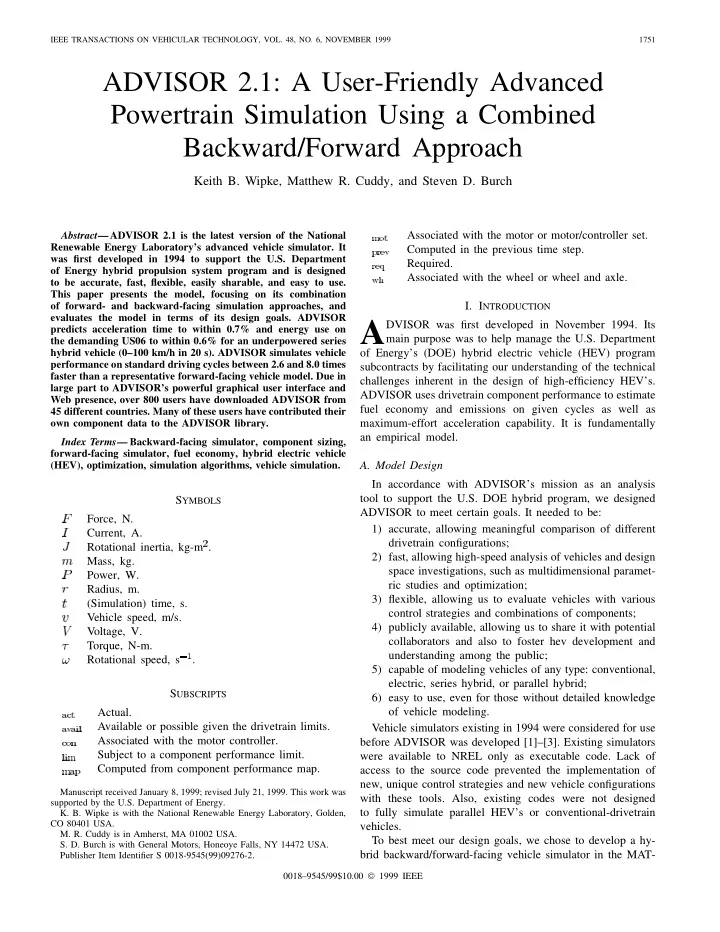
SYMBOLS Force, N. Current, A. Rotational inertia, kg-m . Mass, kg. Power, W. Radius, m. (Simulation) time, s. Vehicle speed, m/s. Voltage, V. Torque, N-m. Rotational speed, s . SUBSCRIPTS Actual. Available or possible given the drivetrain limits. Associated with the motor controller. Subject to a component performance limit. Computed from component performance map.
Manuscript received January 8, 1999; revised July 21, 1999. This work was supported by the U.S. Department of Energy.
- K. B. Wipke is with the National Renewable Energy Laboratory, Golden,
CO 80401 USA.
- M. R. Cuddy is in Amherst, MA 01002 USA.
- S. D. Burch is with General Motors, Honeoye Falls, NY 14472 USA.
Publisher Item Identifier S 0018-9545(99)09276-2.
Associated with the motor or motor/controller set. Computed in the previous time step. Required. Associated with the wheel or wheel and axle.
- I. INTRODUCTION
A
DVISOR was first developed in November 1994. Its main purpose was to help manage the U.S. Department
- f Energy’s (DOE) hybrid electric vehicle (HEV) program
subcontracts by facilitating our understanding of the technical challenges inherent in the design of high-efficiency HEV’s. ADVISOR uses drivetrain component performance to estimate fuel economy and emissions on given cycles as well as maximum-effort acceleration capability. It is fundamentally an empirical model.
- A. Model Design
In accordance with ADVISOR’s mission as an analysis tool to support the U.S. DOE hybrid program, we designed ADVISOR to meet certain goals. It needed to be: 1) accurate, allowing meaningful comparison of different drivetrain configurations; 2) fast, allowing high-speed analysis of vehicles and design space investigations, such as multidimensional paramet- ric studies and optimization; 3) flexible, allowing us to evaluate vehicles with various control strategies and combinations of components; 4) publicly available, allowing us to share it with potential collaborators and also to foster hev development and understanding among the public; 5) capable of modeling vehicles of any type: conventional, electric, series hybrid, or parallel hybrid; 6) easy to use, even for those without detailed knowledge
- f vehicle modeling.
Vehicle simulators existing in 1994 were considered for use before ADVISOR was developed [1]–[3]. Existing simulators were available to NREL only as executable code. Lack of access to the source code prevented the implementation of new, unique control strategies and new vehicle configurations with these tools. Also, existing codes were not designed to fully simulate parallel HEV’s or conventional-drivetrain vehicles. To best meet our design goals, we chose to develop a hy- brid backward/forward-facing vehicle simulator in the MAT-
0018–9545/99$10.00 1999 IEEE