
36
COMMERCE • www.commercemagnj.com
continued on page 38
A
CCORDING TO THE CONFERENCE
- f Mayors, the business case
for brownfield redevelopment includes increasing city tax bases, creat- ing new employment, revitalizing neigh- borhoods and protecting the environ-
- ment. COMMERCE asked some of New
Jersey’s top environmental lawyers to highlight some of the key legal issues relating to Licensed Site Remediation Professionals (LSRPs) and brownfields. Cole Schotz P.C. By Richard J. Ericsson, Esq., Member Every day, our environ- mental attorneys work hand in hand with LSRPs and environ- mental consultants to solve issues that arise in every environmental project, regardless of size, saving time and project costs. This dynamic has become much more important as LSRPs have taken on the responsibility of acting more as regulator than consultant, but without the support of their own in- house counsel to help them interpret the often vague statutes, complex regu- lations and ever-changing guidance doc- uments issued by the NJDEP. We recently strategized with an LSRP to interpret the state’s complex remedial financial assurance obligations and convince NJDEP of our client’s position, resulting in significant savings to the project. Our environmental lawyers also just worked with the LSRPs for both our client (the seller) and the buyer to develop success- ful arguments regarding the NJDEP’s ambiguous guidance for remediation of petroleum hydrocarbons, saving a trans- action and significantly reducing our client’s costs. Every project warrants some type of knowledgeable advocacy
- n behalf of the client, which is wel-
comed by LSRPs who are still navigating through the unfamiliar seas of New Jersey’s new site remediation program. Connell Foley LLP By Steve Barnett, Esq., Partner We represented the buyer of an industrial property who objected to an NJDEP application form. Specifically, the appli- cation for an Industrial Site Recovery Act (ISRA) Remediation in Progress Waiver (RIPW) asks the applicant to certify that it will take over the lead case and post financial assurance if the lead case “falls
- ut of compliance with the remediation
schedule or is unable to maintain the required remediation funding source.” This could cause repercussions, includ- ing additional requirements to satisfy investors, lenders, insurers and others involved in this and related transactions. Interestingly, neither ISRA nor NJDEP regulations contain this requirement. Additionally, the applicant/buyer has no way to know the lead case schedule, and the certification does not allow the lead case to cure any issue before the buyer must take over. ISRA sets forth four requirements: submission of a General Information Notice; certification that there has been no discharge during the applicant’s ownership or operation
- r that any has been remediated; certifi-
cation that a remediation funding source exists; and certification that any transferee has been notified of remedia-
- tion. ISRA provides that the NJDEP shall
grant the RIPW when these four requirements are satisfied. We held dis- cussions with NJDEP officials who ulti- mately granted our client’s RIPW with-
- ut this portion of the certification.
Day Pitney LLP By Joshua J. VandenHengel, Esq., Environmental Associate Day Pitney recently helped a client and its LSRP obtain access to several neighboring properties to perform off-site vapor intrusion and groundwater sampling activities within the timeframes required by NJDEP regu-
- lations. The site under investigation
was a former manufacturing facility surrounded by other commercial and industrial business establishments. In the past, the NJDEP would often issue coop- eration orders to neighboring property
- wners if an off-site investigation was
necessary to delineate the extent of contamination or its potential impact on surrounding properties. However, under the Site Remediation Reform Act, the supervision of a site’s remediation has been delegated to the LSRP and the NJDEP is no longer in the business of compelling property owners to grant access to their properties. Essentially, the LSRP has stepped into the shoes of the NJDEP, but without the authority to compel access to off-site properties, which is often a critical component in a timely investigation of a site. After sev- eral unsuccessful attempts to negotiate
COMPILED BY MILES Z. EPSTEIN
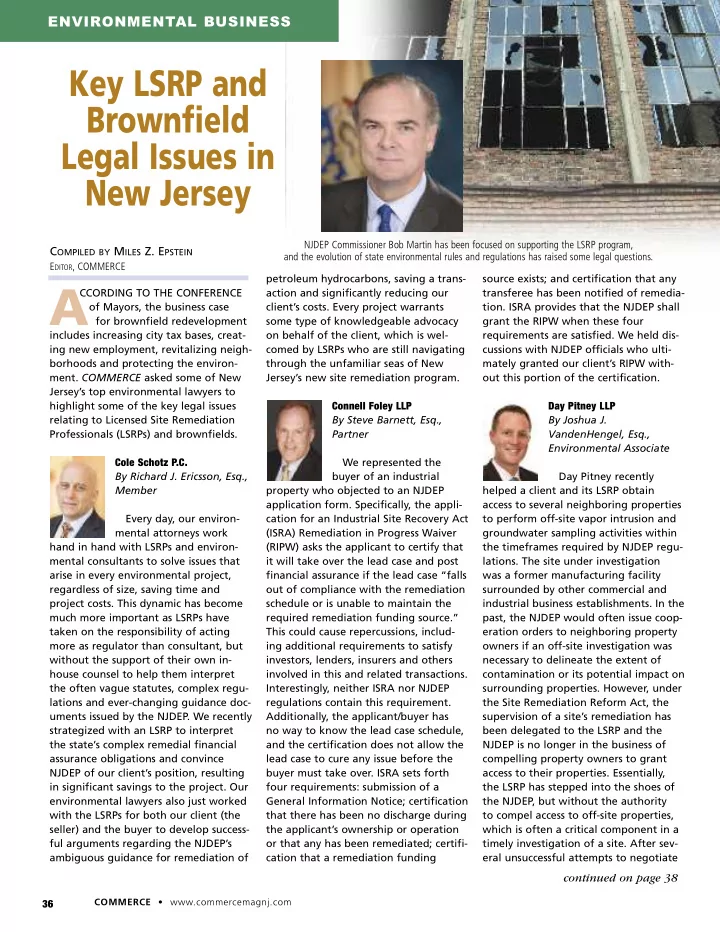
EDITOR, COMMERCE NJDEP Commissioner Bob Martin has been focused on supporting the LSRP program, and the evolution of state environmental rules and regulations has raised some legal questions.
Key LSRP and Brownfield Legal Issues in New Jersey
ENVIRONMENTAL BUSINESS