2017 City of 2020 Round Pittsburgh Capital Budget Information - - PowerPoint PPT Presentation

2017 city of
SMART_READER_LITE
LIVE PREVIEW

2017 City of 2020 Round Pittsburgh Capital Budget Information - - PowerPoint PPT Presentation

Neighborhood Initiatives Fund 2017 City of 2020 Round Pittsburgh Capital Budget Information Session Webinar April 8, 2020 Agenda 1. Introduction 2. Program Overview 3. Eligible Projects and Activities 4. Program Schedule 5. Program


slide-1
SLIDE 1

2017 City of Pittsburgh Capital Budget

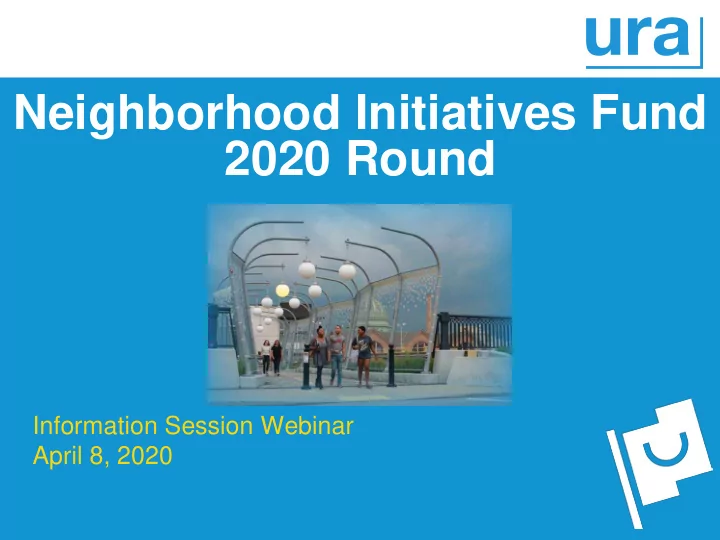
Neighborhood Initiatives Fund 2020 Round

Information Session Webinar April 8, 2020
slide-2
SLIDE 2

Agenda

  • 1. Introduction
  • 2. Program Overview
  • 3. Eligible Projects and Activities
  • 4. Program Schedule
  • 5. Program Details and Requirements
  • 6. Q&A
slide-3
SLIDE 3

Mission

The Urban Redevelopment Authority of Pittsburgh (URA) is the City of Pittsburgh's economic development agency, supporting the City’s economic development goals, which are designed to create a city of inclusive opportunity for residents, stakeholders and communities. The URA is committed to creating more housing that is affordable to the average Pittsburgher; encouraging more entrepreneurship and small business development; promoting inclusive growth and quality job creation; expanding neighborhood and main streets revitalization efforts; and developing a talented workforce that is equipped with the skills of the future.

slide-4
SLIDE 4

The Neighborhood Development Department supports the URA mission by developing public- private partnerships to advance place-based strategies to build an equitable Pittsburgh. We do this by collaborating with community groups, developers, and city agencies on neighborhood initiatives and

  • projects. From vision-to-action

we assist with community planning, project financing, and bringing resources to communities.

slide-5
SLIDE 5

Program Overview

  • What is the Neighborhood Initiatives Fund?
  • Program for neighborhood-scale projects
  • Grants up to $100,000 for non-housing neighborhood projects
  • Who is eligible to apply?
  • Non-profit entities, including government agencies
  • Non-profit organizations with for-profit development partners

Photo courtesy of Mt. Washington Community Development Corporation

slide-6
SLIDE 6

Program Overview

  • What are the goals of the program?
  • Help unlock the economic and placemaking potential within

neighborhoods;

  • Support vision-to-action community investment strategies that build

an equitable Pittsburgh; and

  • Formalize collaborative partnerships across the City.
  • Grants fund non-housing neighborhood projects that

benefit the community and catalyze economic development

  • Hard and soft costs are eligible

Photo courtesy of Grow Pittsburgh

slide-7
SLIDE 7

Eligible Projects and Activities

  • Eligible categories are:
  • Vacant property reclamation and stewardship;
  • Historic preservation;
  • Brownfield redevelopment;
  • Construction of public space and neighborhood infrastructure

improvements, including, but not limited to:

  • Streetscape improvements;
  • Transit and transportation-related improvements;
  • Parks and open space improvements;
  • Green infrastructure; and or
  • Public art.
  • Up to twenty-five (25) percent of total grant funds can be utilized for
  • perations or administrative costs for those organizations that have

faced hardships due to COVID-19

slide-8
SLIDE 8

Eligible Projects and Activities

  • COVID-19 Hardship
  • Up to 25 percent of total grant funds can be utilized for
  • perations or administrative costs for organizations that have

faced hardships due to COVID-19

  • Proof of hardship is required
  • Determination of eligibility is at the URA’s discretion

Photo courtesy of ACH Clear Pathways

slide-9
SLIDE 9

Eligible Projects and Activities

  • Grant funds may not be used for the following activities
  • Projects outside of the City of Pittsburgh;
  • Residential dwellings or the residential portions of mixed-use

buildings;

  • Improvements proposed in the City right-of-way that have not been

approved and/or coordinated with the City;

  • Improvements proposed on properties without site control;
  • Marketing and promotional expenses;
  • Travel expenses or any lodging/hotel expenses; and/or
  • Development fees.
slide-10
SLIDE 10

Program Schedule

  • April 2, 2020

Funding round opens

  • April 8 – 22, 2020

Information Sessions

  • June 1, 2020

Applications are due!

  • August 2020

Funding awards

  • November 2020

Enter into grant agreement

  • Funds must be expended within one year of executed grant

agreements

slide-11
SLIDE 11

Program Details and Requirements

  • Two tiers of available grants:
  • Tier 1 – Under $15,000
  • No matching requirements
  • Tier 1 activities are limited to soft

costs, technical assistance and training, or public art opportunities

  • Tier 2 - $15,000 to $100,000
  • For every two dollars ($2) of

Program funds invested into a project, there must be at least one- dollar ($1) match invested in the project.

  • Matching funds must come from

non-URA and non-city sources.

  • Proposals must meet the following

criteria to be eligible for grants:

  • Located in a CDBG-eligible census

tract or block group

  • Demonstrated public support
  • Financially feasible
  • Committed and documented match
  • Contributes to neighborhood stability
  • r revitalization
  • In compliance with a neighborhood

plan, if applicable

  • Includes a maintenance plan, if

applicable

slide-12
SLIDE 12

Program Details and Requirements

  • Proposals are evaluated according to the eligibility criteria
  • Because funds may be insufficient to fund all eligible

proposals, additional criteria may be used for evaluation, including:

  • Degree of distress of the neighborhood in which the initiative/project will

be located;

  • Impact of initiative/project to be undertaken;
  • Priority will be given to applications which identify workforce development opportunities
  • Response to the COVID-19 crisis;
  • Priority will be given to applications that address consequences of the COVID-19

pandemic

  • The amount of match; and
  • Capacity of the organization and the amount of technical assistance

required.

  • Registered Community Organizations (RCOs) are preferred but not required
slide-13
SLIDE 13

Program Details and Requirements

  • General Requirements
  • All 2020 projects will be funded using CDBG funds
  • Projects must be located in CDBG-eligible census tracts or block groups
  • All projects must undergo environmental review, which in some cases may take

up to 6 months

  • The project must meet all State and Federal statutory mandates
  • Davis-Bacon prevailing wage requirements apply to most projects
  • All successful applicants are required to demonstrate and

document a good faith effort to obtain MWBE participation for projects or activities that meet or exceed the below thresholds.

  • The City of Pittsburgh’s goal is 18 percent minority and 7 percent women

business enterprise participation

  • MWBE goals apply to professional service contracts of $75,000 or greater.
  • All properties rehabilitated under NIF are subject to inspections by

the URA.

slide-14
SLIDE 14

Program Details and Requirements

  • Design Standards
  • Projects that propose work in the public right-of-way must comply

with standards established by the City of Pittsburgh

  • URA and City staff will review all designs to ensure that they are consistent with

the approved City standards

  • Projects that propose public art on City-owned property or in the

City’s right-of-way must have the project reviewed by the City’s Art Commission

  • NIF grants are reimbursement grants
  • If a match is required, the payment request must document the

matching payment

  • Final payments will not be released until all required permits or

relevant approvals have been documented, if applicable, and until a final grant report is submitted

slide-15
SLIDE 15

Here is the

Questions and Discussion

For more information, please visit the program website at https://www.ura.org/pages/neighborhood-initiatives-fund or contact: Matt Reitzell at 412-255-6560 or mreitzell@ura.org Nick Fedorek at 412-255-6616 or nfedorek@ura.org