A Northern Perspective on Northern University Initiatives Sarah - - PowerPoint PPT Presentation

a northern perspective on northern university initiatives
SMART_READER_LITE
LIVE PREVIEW

A Northern Perspective on Northern University Initiatives Sarah - - PowerPoint PPT Presentation

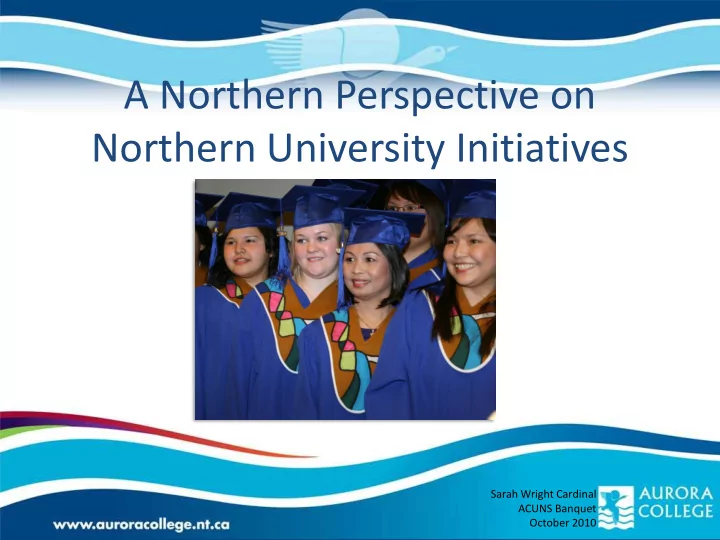
A Northern Perspective on Northern University Initiatives Sarah Wright Cardinal ACUNS Banquet October 2010 Purpose To provide: Background on Aurora College & Aurora Research Institute Background on desire for northern university

slide-1
SLIDE 1

A Northern Perspective on Northern University Initiatives

Sarah Wright Cardinal ACUNS Banquet October 2010

slide-2
SLIDE 2

Purpose

To provide:

  • Background on Aurora College & Aurora Research

Institute

  • Background on desire for northern university
  • Current developments
  • Opportunities
  • Challenges
  • Key questions
slide-3
SLIDE 3

Demographics of the NWT

  • The NWT includes 33 communities
  • 4 settled land claim regions: Inuvialuit,

Gwich’in, Sahtu Dene & Metis, Tlicho

  • Claims in process: Deh Cho, Akaitcho,

Northwest Territory Metis Nation

  • Two reserves: Katlod’eeche & Salt River
  • 11 Official Languages
  • Yellowknife has citizens of over 100

countries of origin

  • Aurora College has 3 campuses, 25

community learning centres, and a research institute

slide-4
SLIDE 4

AC Programs by enrolment

  • School of Education
  • School of Health & Human

Services

  • School of Trades,

Apprenticeship & Industrial Training

  • Business Programs
  • Environmental Sciences

Programs

  • Developmental Programs

School of Education, 105, 14% School of Health, 161, 22% School of Trades, 59, 8% Business Programs, 90, 12% Environemntal Programs, 26, 4% Developmental Studies, 295, 40%

2010 Fall Enrollments

(Full and Part-time Students)

slide-5
SLIDE 5
slide-6
SLIDE 6

Aurora Research Institute

Initiatives 2009-2011:

  • World class research facilities
  • Research Advisory Council to
  • ur Legislative Assembly
  • Community participation
  • NSERC & SHERC accreditation
  • Intellectual Property &

Traditional Knowledge policy

  • Faculty & Staff research
slide-7
SLIDE 7

University in the North?

  • Education transferred from federal to territorial government in 1968/69
  • Every province of Canada has universities
  • Arctic Sovereignty (John Raulston Saul)
  • Researchers doing research in/about the North seek northern host
  • Northern researchers seek northern host
  • Circumpolar universities seek partnerships
slide-8
SLIDE 8

Current Developments

Who are the stakeholders? Residents of the three territories seeking northern opportunities for university level programming and/or research. Proponents/Interested parties University of the Arctic (UArctic) UArctic Canada Walter Duncan Gordon Foundation Dechinta Institute University North Society Federal Government Three Territorial governments Yukon College, Aurora College & Nunavut Arctic College

slide-9
SLIDE 9

University of the Arctic

  • Officially launched in 2001
  • A cooperative network of 121

universities, colleges, and indigenous

  • rganizations committed to higher

education and research in the North.

  • Bachelor of Circumpolar Studies:

Delivered by distance with circumpolar co-hort OR by member institution within program of study

  • Graduate Studies (UAlaska and

ULapland)

  • PHd Field Schools
  • Faculty & Student Exchanges
slide-10
SLIDE 10

UArctic Dialogue

Example: University of the Arctic – Institute for Applied Circumpolar Policy, Considering a Roadmap Forward: The Arctic Marine Shipping Assessment, Workshop Report 2009

  • Enhancing Arctic Marine Safety: knowing who is and is

not represented at the international organizations

  • Uniformity of Arctic Shipping Governance: Key examples
  • f state regulations for possible integration and

harmonization

  • Arctic Search and Rescue: Evaluation of adequacy of

cooperative SAR agreements

  • Survey of Arctic Indigenous Marine Use: Identify who to

communicate with – organizations, community leaders and spokespersons.

  • Engagement with Arctic communities: Fostering conflict

avoidance and communicating importance of building trust

Aurora Research Institute: A researcher tests the thickness of Arctic ice as part of a study being carried

  • ut for the International Polar Year.
slide-11
SLIDE 11

UArctic Canada

  • 30 universities, colleges and
  • ther research and Aboriginal
  • rganizations
  • Currently Dean resides at U of S
  • Bachelor Circumpolar Studies: 3rd

and 4th year courses by distance and member institution delivery

  • Student Mobility Fund: exchange

programs with circumpolar universities

  • Federal funding

Position of the three Northern colleges:

  • With continued federal funding and

possibly territorial funding, there is

  • pportunity to create Circumpolar

Studies Centres at each college to host the UArctic BCS, UArctic Mobility Program, create links to our college research institutes, and future graduate programs.

  • This is not a “university solution” in

and of itself. This expands university degree offerings and research

  • pportunities with northern

relevance.

slide-12
SLIDE 12

Walter Duncan Gordon Foundation

  • Notable Canadian Philanthropic
  • rganization: health,

environment, education, the arts, and public policy research

  • Environmental Scan “Dialogue

Towards a University in the North”

  • Seed money: Dechinta Institute,

an NWT field school, piloted 4 courses in Summer 2010, seeking accreditation

Dechinta: Bush University Centre for Research and Learning is a northern- led initiative to deliver land-based, university credited educational experiences led by northern leaders, experts, elders and professors to engage northern and southern youth in a transformative curricula based

  • n the cutting-edge needs of

Canada’s North.

slide-13
SLIDE 13

Local Interest Groups

  • University North Society: Seeking

a university in Yellowknife

  • Iqaluit has a local group seeking a

university

  • Forums and blogs on the

need/desire for universities in Nunavut, NWT and Yukon

Aurora College Distributed campus model: Yellowknife campus (top), Inuvik’s Aurora campus (middle) and Fort Smith’s Thebacha campus (bottom). The Challenge: Do not have strong physical presence in the captial city. The Opportunity: A doorstep in almost every community of the NWT.

slide-14
SLIDE 14

Governments

  • Federal government: UArctic (INAC,

DFAIT, HRSDC); the Northern Strategy

  • Territorial Premiers Communique,

September 5, 2009: Recognizing importance of research and innovation in building healthy and sustainable northern communities; committed to examining options for development of a Northern university

  • Aboriginal governments: Requests for

capacity-building, governance, land claims initiated and self-government roles

slide-15
SLIDE 15

The three Northern Colleges

  • Legislated degree granting status
  • Tri-college MOU 1999, Reaffirmed

2009

  • Yukon College: independent from

government, Education Council established 2008

  • Aurora College: dual reporting to

Board of Governors and Minister, Education Council in process, requires legislative change

  • Nunavut Arctic College: President

is a Deputy Minister

The three Northern Colleges submitted a working paper in February 2010 to the territorial Ministers responsible for education supporting the commitment of the Territorial Premiers and offering a vision for a pan- territorial university anchored in the territorial colleges with a front door in every northern community.

slide-16
SLIDE 16

Working Paper: Key Principles

The vision of a pan-territorial university is built on the following principles:

  • Northern leadership and governance;
  • Indigenous perspectives embedded throughout programs,

services, and research;

  • Pan-territorial partnership building on existing resources

and programs;

  • Shared funding and fundraising for future growth;
  • Community access through enhanced information

Communication Technology;

  • Delivery structure and systems appropriate to Northern

needs;

  • National and international higher learning and research

affiliations;

  • Maintenance of each college’s unique identity.
slide-17
SLIDE 17

Working Paper: Key Objectives

The vision of a pan-territorial university honours Northern knowledge and experience by supporting and promoting:

  • Northern knowledge and worldview;
  • Northern human and societal capacity;
  • Research relevant and beneficial to Northern

researchers and communities;

  • Northern dialogue and inquiry;
  • Expanded post-secondary opportunities in the North;
  • Sustainable communities, cultures and economies;
  • Northern degrees responsive to northern needs and

recognized across Canada.

slide-18
SLIDE 18

Opportunities

  • Northern control and participation in Northern

research

  • Increased opportunities for university level

programming

  • Increased opportunities for northern research

by northerners

  • Increased opportunity for visiting expert

professors and researchers

  • Economic benefits
  • Societal benefits
slide-19
SLIDE 19

Embed Aboriginal Perspectives In Aurora College Business

Opportunities:

  • Governance: Elder Rep
  • Faculty & Staff development
  • Succession planning
  • Student activities
  • Course content
  • Research opportunities
  • Approaches to doing

business

slide-20
SLIDE 20

ACCC Fall 2010 Symposium “Serving Aboriginal Learners in Rural & Remote Communities”

  • Athabasca University
  • Northern Lakes College
  • University College of the North
  • Nunavut Arctic College
  • De Beers Canada
  • Fleming College
  • Yukon College
  • Red Crow College
  • Assiniboine Community College
  • Grande Prairie Regional College
  • Tlicho Government
  • George Brown College
  • Government of the Northwest Territories
  • ECO Canada
  • Dehcho First Nation
  • George Brown College
  • Liidlii Kue First Nation
  • McGill University
  • Red River College
  • New Brunswick Community College
  • Yellowhead Tribal College
  • Aurora College
  • Yellowknives Dene First Nation
  • Cambrian College of Applied Arts & Technology
  • Sault College
  • Vancouver Island College
  • Cameco Corporation
  • Oshki-Pimache-O-Win Education & Training Inst.
  • Mine Training Society
  • Cegep John Abbott College
  • Human Resources and Skills Development Canada
  • College of the North Atlantic
  • Saskatchewan Indian Institute of Technologies
  • Canadian Construction Association
  • College of the Rockies
  • Gwich’in Tribal Council
  • Northern College of Applied Arts & Technology
  • INAC
  • Association of Canadian Community Colleges
  • Native Women’s Association of the NWT
  • Northwest Territory Metis Nation
  • CanNor
  • Lakeland College
  • Canadore College
  • Dehcho Futures Society
slide-21
SLIDE 21

Promote Transformative Education

Opportunities:

  • A paradigm shift = student success
  • PLAR and student learning plans
  • Build our leaders of tomorrow
  • Create viable economies
  • Culture that supports education
  • Walk in two worlds: From bush to

boardroom

  • Research of relevance
slide-22
SLIDE 22

Challenges

  • Funding
  • Geography
  • Population (volume)
  • Population (dispersion)
  • Languages (number of)
  • Academic readiness
  • Pan-territorial (east/west)
  • r north/south

partnerships?

Aurora College degree partnerships

slide-23
SLIDE 23

Current Challenges for Aurora College

1. Distance: 1.34 million square kilometres 2. Vast mandate of the college 3. Costs & fiscal restraint 4. Use of technology 5. Attrition & relocation 6. History of education in the north

slide-24
SLIDE 24

Challenge: Bandwidth

Opportunities:

  • Increase Distance & Web based

learning

  • Maximize existing MOUs with

partner colleges & universities

  • Virtual meetings
  • Yukon College has web

capability in almost every learning centre

  • Nunavut Arctic College cyber

infrastructure project

  • Aurora College: 13 of 33

communities synchronous

slide-25
SLIDE 25
  • NWT: Most of our

communities are accessible by air and seasonal winter ice roads.

  • Nunavut: No roads
  • Malls & Starbucks
  • Nature vs. Man

Challenge: Transportation & Infrastructure

slide-26
SLIDE 26

Costs of doing business

+

x

/

slide-27
SLIDE 27

Education gaps in the North

5 10 15 20 25 30 35 All Persons All Aboriginals All Non-Aboriginals Percentage Ethnicity

Highest Level of Schooling by Ethnicity (NWT)

Source: NWT Bureau of Statistics, 2004

Less than Grade 9 High School, No Diploma High School Diploma Other Certificate or Diploma University Degree Not Stated

slide-28
SLIDE 28

Interesting Facts about Alaska

  • Over 200 communities;
  • Alaska was purchased from Russia in 1867

for 7.2 million dollars;

  • Approx. 600,000 people: half in Anchorage;

80,000 in Fairbanks; and 20,000 in Juneau;

  • Alaska Native Claims Settlement Act (ANCSA)

signed by President Nixon on December 18, 1971;

  • Largest land claims settlement in United

states history;

  • The settlement extinguished Alaska Native

claims by transferring titles to twelve Alaska Native regional corporations and over 200 local village corporations.

  • A thirteenth regional corporation was later

created for Alaska Natives living outside Alaska

  • “The Lower 48”
slide-29
SLIDE 29

Key Questions

What should it look like? Real or Virtual Linked with existing Colleges or not Networked or single location Physical (one location, or three) Led by one territory, or led by three What role should cultures and languages play? What role should Aboriginal governments play? What would legislation need to look like? Funding How would it be funded?

Aurora College Environmental Sciences Winter Camp

slide-30
SLIDE 30

Kinanaskomitin; Mahsi; Ma’hsi; Masi; Marsi; Merci; Quyanainni; Quyanaq; Quana; Thank you