
SLIDE 1
1
A new method of production and study of the most exotic neutron rich nuclei
J.N. Wilson, IPN Orsay
A new method of production and study of the most exotic neutron rich - - PowerPoint PPT Presentation
A new method of production and study of the most exotic neutron rich nuclei J.N. Wilson, IPN Orsay 1 2 Exoticity 3 Spontaneous Fission 252 Cf(SF), 248 Cm(SF) (Gammasphere, Euroball) Exoticity 4 Spontaneous Fission 252 Cf(SF), 248 Cm(SF)
1
J.N. Wilson, IPN Orsay
2
3
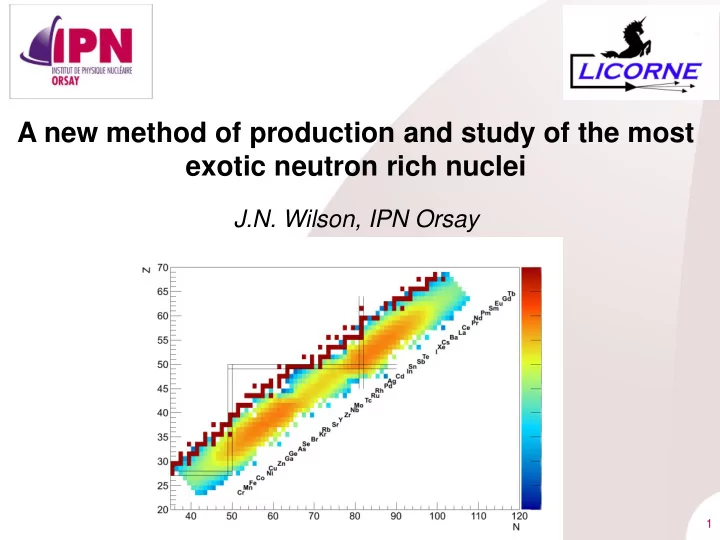
Exoticity
4
Exoticity Spontaneous Fission
252Cf(SF), 248Cm(SF)
(Gammasphere, Euroball)
5
Exoticity Spontaneous Fission
252Cf(SF), 248Cm(SF)
(Gammasphere, Euroball) Fission induced by thermal neutrons
235U(nth,f) 241Pu(nth,f)
(EXILL Exogam@ILL)
6
Exoticity Spontaneous Fission
252Cf(SF), 248Cm(SF)
(Gammasphere, Euroball) Fission induced by thermal neutrons
235U(nth,f) 241Pu(nth,f)
(EXILL Exogam@ILL) Fission induced by fast 1.5 MeV neutrons
238U(n,f), 232Th(n,f)
(LICORNE @ IPN Orsay)
7
5-10 cm 1-3 cm Sample Fluxes typically 106 n/cm2/s 109 n/s
7Li(p,n)
d(d,n) d(9Be,n)
8
5-10 cm 1-3 cm Sample Fluxes typically 106 n/cm2/s 109 n/s Typically over 99% of neutrons ‘’wasted’’
7Li(p,n)
d(d,n) d(9Be,n)
9
5-10 cm 1-3 cm Sample Fluxes typically 106 n/cm2/s 109 n/s Typically over 99% of neutrons ‘’wasted’’ Wasted neutrons contribute to the room background
7Li(p,n)
d(d,n) d(9Be,n)
10
5-10 cm 1-3 cm Sample Fluxes typically 106 n/cm2/s 109 n/s Typically over 99% of neutrons ‘’wasted’’ Wasted neutrons contribute to the room background Placement of gamma detectors impossible without heavy shielding
7Li(p,n)
d(d,n) d(9Be,n)
11
n n n n H target 100nA 7Li 13-17 MeV
Lithium Inverse Cinematiques ORsay NEutron source
12
n n n n H target 100nA 7Li 13-17 MeV
Lithium Inverse Cinematiques ORsay NEutron source
Sample
13
n n n n H target 100nA 7Li 13-17 MeV
Lithium Inverse Cinematiques ORsay NEutron source
Sample
14
n n n n H target 100nA 7Li 13-17 MeV
Lithium Inverse Cinematiques ORsay NEutron source
γ γ
Sample
15
Hydrogen gas cells H2 pressure and flow control system
16
“Comparative measurement of prompt fission gamma-ray emission from fast neutron induced fission of 235U and 238U”
In press (2015) “Development of a kinematically focused neutron source with the p(7Li,n)7Be inverse reaction” M.Lebois, J.N. Wilson et al., Nucl. Instrum. Meth. A 735 145 (2014) “Experimental studies of prompt fission neutron spectra” Alix Sardet, CEA/DAM/DIF Bruyeres-le-chatel, Ph.D thesis, 2 Oct. (2015)
17
Precision spectroscopy of fast neutron induced reactions
18
mercredi 16 septembre 2015
Evolution and collectivity development in the vicinity of 78Ni Shape coexistence and collectivity around N=60 Neutron-rich nuclei around and beyond 132Sn Spectroscopy of neutron-rich fragments of 40<Z<50
Physics Cases
19
Total Fission Rate > 150 kHz at 100nA 7Li Uranium metal target (ITU Karlsruhe) 3cm
20
21
3 weeks of beam time: ~ 3 × 10⁹ events with Mγ >= 3 Ge singles rates ~ 8kHz
22
Time (ns) Energy (keV)
23
Time (ns) Energy (keV)
Prompt fission gamma rays
24
25
gate
26
27
28
mercredi 16 septembre 2015
Fission Fragment Isomers (10ns - 10µs)
29 mercredi 16 septembre 2015
30 mercredi 16 septembre 2015
99mMo 139Sn*
31
Time (ns) Energy (keV)
32
Time (ns) Energy (keV) 400 ns
33
34
T1/2 ~ 170 ns
35
134Te: 6+ isomer 164 ns
2+ → 0+
36 134Te 164 ns 133I 170ns 132Te 145 ns 135Te 0.5 µs 136Xe 2.9 µs 138Ba 0.8 μs
37
134Te 164 ns
2+ → 0+
133I 170ns 132Te 145 ns 135Te 0.5 µs 136Xe 2.9 µs 138Ba 0.8 μs
38
39
40
41
rich fission fragments for the first time (LICORNE@IPNO)
via isomer tagging from ~50 ns – few μs (TIPS)
Conclusions
Perspectives
42
A hybrid LaBr3-Ge array for fast timing spectroscopic studies at the IPN Orsay
43
and M. Zielinska10
1Institut de Physique Nucléaire d’Orsay, 91406 Orsay Cedex, France 2Department of Physics, University of Surrey, Guildford, GU2 7XH, UK 3National Physical Laboratory, Teddington, Middlesex, TW11 0LW, UK 4Institute for Reference Materials and Measurements, 2440 Geel, Belgium 5Fundamental Physics, Chalmers University of Technology, 41296 Goteborg, Sweden 6CEA/DAM Ile-de-France, 91297 Arpajon Cedex, France 7Institute for Transuranium Elements (ITU), Postfach 2340, 76125 Karlsruhe, Germany 8Lawrence Livermore National Laboratory, Livermore, California 94551, USA 9Subatech, CNRS/IN2P3, University Nantes, EMN, Nantes, France 10IRFU, CEA Saclay, 91191 Gif-sur-Yvette, France 11CSNSM Orsay, 91405 Orsay, France 12Department of Physics, University of Oslo, Blindern, N-0316 Oslo, Norway 13Institut Pluridisciplinaire Hubert Curien, Université de Strasbourg, 23 rue du Loess F-67037 Strasbourg, France 14CENBG, Université de Bordeaux, CNRS/IN2P3,Chemin du Solarium, B.P. 120, 33175 Gradignan, France 15 IRFU, CEA Saclay, 91191 Gif-sur-Yvette, France 16 Department of Physics and Astronomy, The University of Manchester, Manchester M13 9PL, UK 17 IKP, University of Koln, Koln,Germany
Collaborators
44
mercredi 16 septembre 2015
101Sn 99In 100In 98Cd
(190 ns)
102Sn
(720 ns)
101In 99Cd 100Cd
(60 ns)
hole spectrum in 100Sn”, Phys. Rev. Lett. 79 2415 (1997)
charge in 102Sn”. Phys. Lett B 440, 246 (1998) R.M. Clark and J.N. Wilson et al. “Yrast and near yrast excitations up to high spin in 100Cd”,
N=50
Z=50
100Sn
45
46
FISSION events (n,n’) Intrisic activity
47
48
LICORNE
49
Fission becomes more symmetric with increasing En LICORNE NFS
50
51
mercredi 16 septembre 2015
7Li p n 7Be
Maximum fluxes ~108 n/s/steradian 28µm
52
56Fe Neutron Capture and Scattering Cross Sections
Thermal Energies Fast Energies
53
mercredi 16 septembre 2015
Eγ log10 t (ns)
Delayed γ’s Prompt γ’s
10 ns – 10 μs
54
2ns 400 ns
fission event
…. Event time structure
LICORNE pulsed neutron beam
delayed gamma delayed gamma
55
mercredi 16 septembre 2015
56
Total Fission Rate > 150 kHz at 100nA 7Li UO2 bar
57
mercredi 16 septembre 2015
58
mercredi 16 septembre 2015
Ebeam=13.5 MeV
59
Liquang Geometry simulation Gas target fluxes EDEN detector
7Li
60
Liquang Geometry simulation Gas target fluxes EDEN detector E=15 MeV
7Li
61
Liquang Geometry simulation Gas target fluxes EDEN detector
7Li
E=14.5 MeV
62
Liquang Geometry simulation Gas target fluxes EDEN detector
7Li
E=14 MeV
63
Liquang Geometry simulation Gas target fluxes EDEN detector
7Li
E=13.5 MeV
64
Liquang Geometry simulation Gas target fluxes EDEN detector
7Li
E=13 MeV