
SLIDE 1
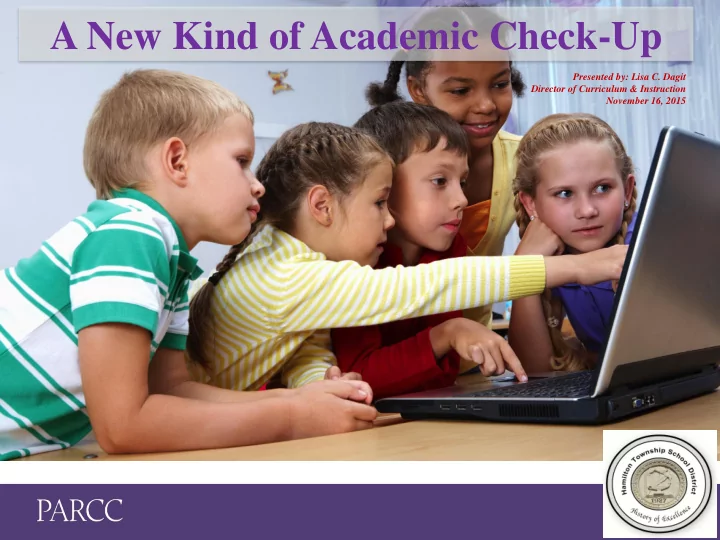
A New Kind of Academic Check-Up
Presented by: Lisa C. Dagit Director of Curriculum & Instruction November 16, 2015
A New Kind of Academic Check-Up Presented by: Lisa C. Dagit - - PowerPoint PPT Presentation
A New Kind of Academic Check-Up Presented by: Lisa C. Dagit Director of Curriculum & Instruction November 16, 2015 0 New Academic Standards in New Jersey In 2010 New Jersey adopted new, college and career-ready academic standards to
Presented by: Lisa C. Dagit Director of Curriculum & Instruction November 16, 2015
1
New Academic Standards in New Jersey
In 2010 New Jersey adopted new, college and career-ready academic standards to better prepare our children for the next steps in their education and in life. Why?
Students are graduating high school unprepared for college. More than 50 percent of first-year community college students must take remedial courses in English or math because they are not prepared for postsecondary studies. The jobs of today — and tomorrow — require students to attain a postsecondary credential or degree. Labor economists predict that by the end of this decade, more than 65 percent of all jobs in the United States will require education and training beyond high school. Many of today’s students lack the skills and preparation needed to enter the
they cannot find qualified candidates.
2
Implementing New Standards in New Jersey
School districts developed curriculum to meet the new standards and teachers are providing instruction of the curriculum. New Jersey joined Partnership for Assessment of Readiness for College and Careers (PARCC) —a group of states that collaboratively developed a new assessment that measures student progress towards meeting the common core standards. New Jersey educators contributed many hours over a four year period to develop an assessment that measures students’ knowledge and progress toward the common core standards.
3
Determine whether students are college- and career-ready or “on track” Provide tools to assess student learning and support instruction during the school year Report growth in performance, as well as absolute achievement Report comparable results across schools, districts and member states Generate valid and reliable information to inform instruction and accountability decisions
What are the objectives of PARCC?
Use technology for a range of
purposes including increasing student access, providing accommodations, engaging students and creating efficiencies in administration, scoring and reporting
4
How are these tests different?
They are taken on a computer so they are more interactive for students, allow for greater accommodations and make it more efficient for schools to use results to improve instruction. In schools that are not yet ready, students take the tests on paper. They allow students to show their work. On the new tests, students are required to show their work and explain their reasoning so teachers can better understand what they know and where there are gaps in learning that need to be addressed. They are more than multiple choice tests. Rather than focusing on what a child has memorized through multiple choice questions, the new tests ask students to apply skills like thinking, reasoning and justifying answers – showing what they know and can do. The tests do not lend themselves to “teaching to the test.” Since they focus on applying skills, it is the daily practice of these skills in the classroom that will serve as the best preparation for the tests.
5
How are these tests different?
Other tests PARCC assessments Primarily use multiple-choice format that emphasizes memorization, “test prep” and guessing. Allow students to submit answers and detailed responses, eliminating guesswork and allowing students to show their thinking and knowledge. Test students’ rote learning. Assess students’ abilities to read carefully, communicate clearly and problem solve. Offer basic, one-step problems. Present challenging, multi-tiered problems. Are too vague to offer detailed insight to gauge students’ readiness for the next step toward success. Provide students, parents and educators detailed information so they can understand how students are progressing, where they need assistance and where they can be encouraged to do more.
6
Sample Questions
To take a practice PARCC test: http://www.parcconline.org/take-the-test
ELA, Grade 5
7
Sample Questions
Math, Grade 4
To take a practice PARCC test: http://www.parcconline.org/take-the-test
8
This year, students will spend less time testing. Rather than two test windows, there will be one. The NJDOE testing window for ELA & Math for grades 3-8 is from April 4, 2016 through May 13, 2016 HTSD is still developing the exact dates and times for each grade level
PARCC in New Jersey
9
Technology
At the Hess and Davies Schools students take the PARCC assessments on the computer. The technology is engaging, as it includes videos and interactive tools. PARCC is using Universal Design principles to make the new tests as accessible as possible to all students, including English learners and students with disabilities. Paper-and-pencil assessments will be available for those students who require them.
10
The Road to the First Parent Score Report
Spring 2015
Administration of PARCC assessments
July/August 2015
Performance level setting for high school and grades 3-8
August/ September 2015
State K-12 and higher-ed chiefs review/vote on recommended cut scores
November 2015
School districts receive high school score reports
December 2015
School districts receive 3-8 score reports
11
Five Performance Levels
Place a purple frame around images PARCC uses five performance levels that delineate the knowledge, skills, and practices students are able to demonstrate:
Level 1: Did Not Yet Meet Expectations Level 2: Partially Met Expectations Level 3: Approached Expectations Level 4: Met Expectations Level 5: Exceeded Expectations
12
What Parents Should Know About PARCC
The PARCC tests replace the old state tests. They measure how well students are performing against the common core standards that guide math and English language arts instruction. The PARCC tests move away from multiple choice questions to ones that allow students to demonstrate a real understanding of what they know and can do by writing essays, solving real world problems, and reading and analyzing complex text—all critical skills in the real-world. The PARCC tests are only one of several measures, including report card grades and in-class performance, that are used to determine a student's academic
The score reports are a valuable tool for parents and teachers. The report provides a deeper level of information that can be used to better understand where students are doing well and where they need additional support.
13
Your child’s score may look lower this year because the tests measured more complex skills. A low score does not mean your child did not improve or learned less; instead, it means that the expectations have been raised for students. The first year’s scores are a new baseline from which to progress from and measure against moving forward. It will take time. While teachers have been gearing up for the new standards for almost four years, the tests are new and they ask questions in different ways and require students to show their work. Just as what happens with new standardized tests, scores will start to improve as teachers and students become more familiar with the standards and acquire the skills and knowledge to meet them.
What Parents Should Know About PARCC
14
Sample English Language Arts Report
15
Sample English Language Arts Report
16
Sample English Language Arts Report
17
Sample Math Report
18
Sample Math Report
1919
Sample Math Report
20
How You Can Support Your Child
Read both fiction and non-fiction aloud or with your child. Look for subjects of interest – from sports heroes to dinosaurs. Discuss and “do” real life math with your child. Discuss the new tests with your child. Make sure he/she is not scared or anxious going into the new tests. Explain to your child that the tests will initially be more challenging. Tell your child to do his/her best on the test and that you are there to help every step of the way. After the test, review the results with your child. Bring the teacher into the discussion as needed. Provide a quiet, comfortable place for studying at home and make sure your child gets a good night’s sleep and a nutritious breakfast before a test.
Check out UnderstandTheScore.org for free tools and resources to support your child’s success Check out prc.parcconline.org for released test items to support your child’s success
21
Understand The Score
http://understandthescore.org/
Score.org
22
Released Test Items
https://prc.parcconline.org/assessments/parcc-released-items
Score.org
23
Skill Builder
24
GreatKids State Test Guide For Parents
25
Understanding The PARCC Score Report
26
Contact Information
For more information about the PARCC assessments, contact:
– Presenter/District contact: Lisa Dagit dagitl@hamiltonschools.org – Hess School contact: Melanie Lamanteer lamanteerm@hamiltonschools.org – Davies School contact: Steve Santilli santillis@hamiltonschools.org – PARCC contact: http://parcconline.org/contact