A Neuromuscular Model of Human Locomotion and its Applications to - - PowerPoint PPT Presentation

a neuromuscular model of human locomotion and its
SMART_READER_LITE
LIVE PREVIEW

A Neuromuscular Model of Human Locomotion and its Applications to - - PowerPoint PPT Presentation

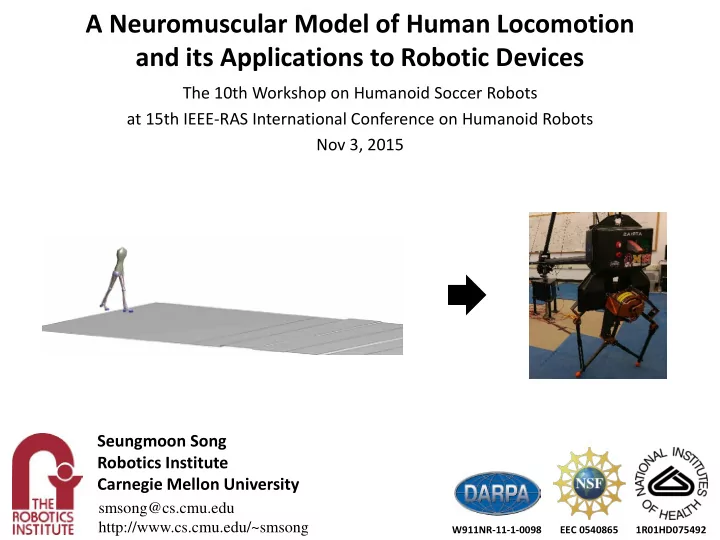
A Neuromuscular Model of Human Locomotion and its Applications to Robotic Devices The 10th Workshop on Humanoid Soccer Robots at 15th IEEE-RAS International Conference on Humanoid Robots Nov 3, 2015 Seungmoon Song Robotics Institute Carnegie


slide-1
SLIDE 1

A Neuromuscular Model of Human Locomotion and its Applications to Robotic Devices

The 10th Workshop on Humanoid Soccer Robots at 15th IEEE-RAS International Conference on Humanoid Robots Nov 3, 2015 Seungmoon Song Robotics Institute Carnegie Mellon University

EEC 0540865 1R01HD075492 W911NR-11-1-0098

smsong@cs.cmu.edu http://www.cs.cmu.edu/~smsong

slide-2
SLIDE 2

S Song, Y Ryoo, and D Hong, Development of an omnidirectional walking engine for full-sized lightweight humanoid robots, ASME IDETC, 2011.

How does human walk?

slide-3
SLIDE 3

Geyer Group

Hartmut Geyer

slide-4
SLIDE 4

Content

Background Neuromuscular model of human locomotion Using the model to control bipedal robots

1/19

slide-5
SLIDE 5

Current understanding of human locomotion control

Not much is understood at the neural circuit level Human locomotion is well described at the behavioral level

Spinal and supraspinal control layers Central pattern generators (CPGs), reflexes, … Kinematics, dynamics, muscle activations, …

2/19

slide-6
SLIDE 6

pros cons

Simulation studies may provide better understanding

+ robust 3D locomotion + predictive model + diverse locomotion behaviors

3/19

slide-7
SLIDE 7

S Song and H Geyer, A neural circuitry that emphasizes spinal feedback generates diverse behaviors of human locomotion, The Journal of Physiology, 2015.

Background Neuromuscular model of human locomotion Using the model to control bipedal robots

4/19

slide-8
SLIDE 8

7 segments 8 DOFs 22 MTUs

CE: contractile element SE: series elasticity PE: parallel elasticity

Musculoskeletal system

5/19

slide-9
SLIDE 9

Neural transmission delay Other sources of system delay

excitation-contraction coupling (ECC): ~35 ms muscle dynamics 10 + 15 + 15 + 10 = 50 ms

Neurophysiological transmission delays are modeled

6/19

slide-10
SLIDE 10

Stance

[Geyer EA, 2003]

Compliant leg behavior realizes walking and running Positive force feedback generates compliant leg behavior

Swing

[Desai EA, 2012&2013; Song EA 2013]

Stance Swing

Fcntr Fipsi

Spinal control consists of reflex modules that embed key functions essential for legged locomotion

LIPM [Kajita EA, 2001] SIMBICON [Yin EA, 2007] 7/19 [Geyer EA, 2006]

slide-11
SLIDE 11

The neural control is plausible The neural control predicts normal human locomotion

Energy optimal control parameters generates human-like walking

8/19

slide-12
SLIDE 12

Human Model

Energy optimal walking shows human-like muscle activation

The differences come from …

  • simplified musculoskeletal model
  • energy optimal control parameters

9/19

slide-13
SLIDE 13

Robust walking (±10 cm) Slope ascend and descend

The model can generate diverse locomotion behaviors

10/19

slide-14
SLIDE 14

Speed change

0.8 ms-1 1.8 ms-1 1.8 ms-1 0.8 ms-1

The model can generate diverse locomotion behaviors

Direction change Obstacle avoidance

10/19

slide-15
SLIDE 15

S Song and H Geyer, A neural circuitry that emphasizes spinal feedback generates diverse behaviors of human locomotion, The Journal of Physiology, 2015.

The model can be downloaded from: http://www.cs.cmu.edu/~smsong/nmsModel/nmsModel.html

The model is implemented in MATLAB Simulink

The proposed model can generate human-like robust walking and diverse locomotion behaviors The motor patterns of many human locomotion behaviors can be generated by chains of reflexes in the lower layer controller

11/19

slide-16
SLIDE 16

BionX (BiOM) [Eilenberg EA, 2010] EPFL (COMAN) [van der Noot EA, 2015] Delft Univ. [van Dijk EA, 2013] Samsung [Seo EA, 2015] Stanford Univ. [Wang EA, 2012]

Controllers for prosthetic legs and bipedal robots Simulation testbeds for assistive devices Controllers for graphical characters

GeyerGroup [Schepelmann EA, 2015] GeyerGroup [Thatte EA, 2015] GeyerGroup [Thatte EA, 2015] Utrecht Univ. [Geijtenbeek EA, 2013]

Our neuromuscular model has been used in different studies

12/19

slide-17
SLIDE 17

Z Batts, S Song, and H Geyer, Toward a virtual neuromuscular control for robust walking in bipedal robots, IEEE IROS, 2015.

Background Neuromuscular model of human locomotion Using the model to control bipedal robots

13/19

slide-18
SLIDE 18

Centralized controllers Heuristic policy-based controllers

[Nelson EA, 2012] [Raibert EA, 2008] [Urata EA, 2012] [Feng EA, 2014]

Current robot walking controllers have not yet reached the robustness of human locomotion control

14/19

slide-19
SLIDE 19

The reflex-based neuromuscular control may provide an alternative controller

15/19

Virtual neuromuscular control (VNMC) ATRIAS robot

  • human size
  • trunk mass: 58 kg, leg mass: 2 kg (x 2)
  • no foot
  • series elastic actuators (SEA)
slide-20
SLIDE 20

With VNMC, ATRIAS can walk on a terrain with height changes of ±20 cm in a 2D simulation environment

16/19

slide-21
SLIDE 21

The stance leg control is tested on hardware

17/19

slide-22
SLIDE 22

N Thatte and H Geyer, Toward balance recovery with leg prostheses using neuromuscular model control, IEEE Transactions on Biomedical Engineering, 2015.

Other Applications

– Controller and simulation testbed for prosthetic legs

Nitish Thatte

18/19

  • vs. impedance control [Sup EA 2008]
slide-23
SLIDE 23

S Song and H Geyer, The energetic cost of adaptive feet in walking, IEEE ROBIO, 2011. S Song, C LaMontagna, SH Collins, and H Geyer, The effect of foot compliance encoded in the windlass mechanism on the energetics of human walking, IEEE EMBC, 2013.

18/19

Other Applications

– Simulation testbed for studying foot biomechanics

slide-24
SLIDE 24

Simulation testbed for locomotion studies Controller for robotic platforms

The model can be downloaded from: http://www.cs.cmu.edu/~smsong/nmsModel/nmsModel.html smsong@cs.cmu.edu