A Nationwide Database of Retail Food Safety Inspections Ginger Jin - - PowerPoint PPT Presentation

a nationwide database of retail food safety inspections
SMART_READER_LITE
LIVE PREVIEW

A Nationwide Database of Retail Food Safety Inspections Ginger Jin - - PowerPoint PPT Presentation

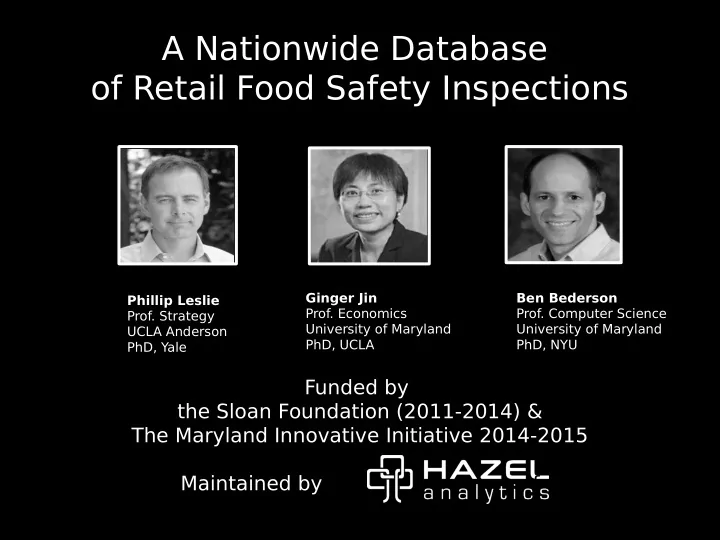
A Nationwide Database of Retail Food Safety Inspections Ginger Jin Ben Bederson Phillip Leslie Prof. Economics Prof. Computer Science Prof. Strategy University of Maryland University of Maryland UCLA Anderson PhD, UCLA PhD, NYU PhD,


slide-1
SLIDE 1

A Nationwide Database

  • f Retail Food Safety Inspections

Ben Bederson

  • Prof. Computer Science

University of Maryland PhD, NYU Phillip Leslie

  • Prof. Strategy

UCLA Anderson PhD, Yale Ginger Jin

  • Prof. Economics

University of Maryland PhD, UCLA

Funded by the Sloan Foundation (2011-2014) & The Maryland Innovative Initiative 2014-2015 Maintained by f

slide-2
SLIDE 2

Our Data Warehouse Coverage (2015)

  • 87 local health

departments

  • 34 States
  • 895K unique

establishments

  • 6.8M inspection

records

  • 18.5M violations

Data posted online by local jurisdictions (as of 2012)

slide-3
SLIDE 3

Heterogeneity and Fragmentation

  • Out of 87 jurisdictions with online posting of data:
  • 12 provide no numerical count of violations (due to

pdf publishing and other non-numerical formats)

  • 23 provide explicit grading in either letter grades or

numerical points

  • Number of inspection records per establishment

ranges from 1 to 38

  • Number of violations per inspection ranges from

0.066 in San Diego County to 9.35 in Fort Worth City, TX

slide-4
SLIDE 4

Example insights from our database

  • Of NYC inspections 41% report at least one violation whose

description contains the words rodent, vermin, fmies, mice, pests, rats, or insects.

  • Compared to 11% in DC, 8% in LA (County), and 6% in

Seattle (King County).

  • From lowest to highest violations (on average), restaurants with

the following words in their establishment names: sandwich, salad, burger, pizza, pasta, japan/sushi, china/chinese.

  • Half of our covered jurisdictions indicate whether an inspection

is a re-inspection. Among these jurisdictions,

  • on average 10.6% of routine inspections led to a re-

inspection

  • 15.1% of the violations found in the routine inspection

recurred in the re-inspection.

  • Both numbers range greatly across jurisdictions.
slide-5
SLIDE 5

Consistency

0.000 1.000 2.000 3.000 4.000 5.000 6.000

Number of violations per inspection

Chain A Chain B Chain C

slide-6
SLIDE 6

Further evidence for consistency

(11 jurisdictions in NY, WA, AK, AZ, OH and FL, 2010-2011)

Poisson Model Dependent Variable = # of hospitalizations due to intestinal infection per zip code per year (1) (2) (3) # of violations per inspection (standardized) 0.066*** 0.076*** 0.075*** (0.022) (0.021) (0.022) ZIP pop x x x # of inpatients due to other digestive illnesses x x # of inpatients due to all other illnesses x Year FE x x x Jurisdiction FE x x x Standard error robust robust robust N 2678 2678 2678

slide-7
SLIDE 7

T

  • summarize
  • Online posting of government-collected

data is only the fjrst step

– Signifjcant efgort is needed in centralization, cleaning, documentation, archive, and continuation

  • Large potential to utilize the “big data”

– For research – For government policy evaluation – For enhanced compliance

  • We welcome data request!