London 27-09-2013
A national agencys views Sabine Straus Sabine Straus MD PhD - - PowerPoint PPT Presentation
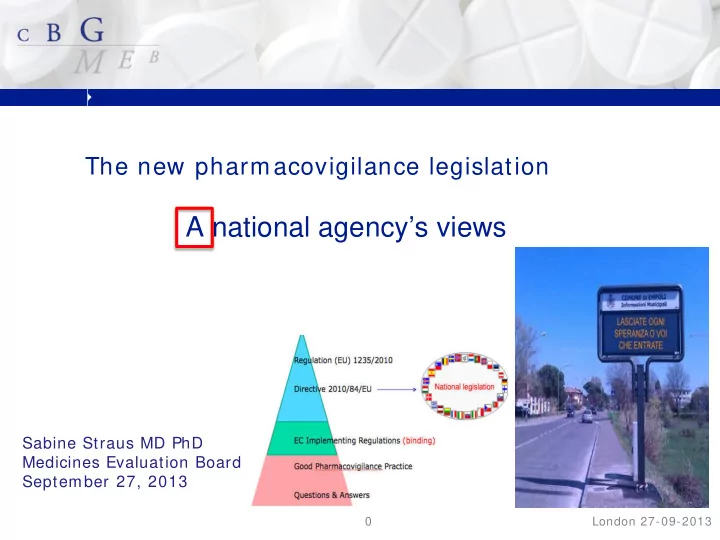
The new pharmacovigilance legislation A national agencys views Sabine Straus Sabine Straus MD PhD Medicines Evaluation Board September 27, 2013 0 London 27-09-2013 Introduction Challenges for a NCA Some lessons learned
London 27-09-2013 1
- Introduction
- Challenges for a NCA
- Some lessons learned
- Closing remarks
Firstly, public health activities Secondly, transparency and com m unication activities Thirdly, sim plification and efficiency activities
London 27-09-2013 * agreed by EMA Management Board
Prioritised implementation*
London 27-09-2013 3
Dr Peter Arlett, nov 12, 2012
Actions taken at national level
- I nternal
– Steering group – Working groups – Review/ update SOPs – Training
London 27-09-2013 4
- External
– Stakeholder meetings – Patient/ HCP organisations meetings
- Support
– dedicated website
London 27-09-2013 5
London 27-09-2013 6
London 27-09-2013 7
- Introduction
- Challenges for a NCA
- Some lessons learned
- Closing remarks
Signal detection Referrals Risk Management Plans
Implementing Regulation No 520/ 2012 CHAPTER III provides details on operational aspects for minimum requirements for the monitoring of data in the EV:
8
Art 18 General Requirements ⇒ EV monitoring Art 19 Identification of changed risks and new risks ⇒ Signals Art 20 Methodology for determining the evidentiary value of a signal ⇒ Validation Art 21 Signal Management ⇒ Stakeholders Art 22 Work-sharing for signal management ⇒ Public list of substances Art 23 Signal detection support ⇒ eRMR Art 24 Signal detection audit trail ⇒ EPITT & locally
London 27-09-2013 8
Signal detection Validation Confirm atio n Analysis, prioritizatio n Assessm ent Recom m endation for action
MAH MSs Agency MSs Agency
Signal Management Process IR art 21
PRAC
London 27-09-2013 9
London 27-09-2013 10
Signal detection Referrals Risk Management Plans Transparancy
In practice
London 27-09-2013 11
Tracking & audittrail non-validated signals IR Art 24(1)]
I n practice at MEB
London 27-09-2013 12
Excel based summary data
- Contain all Drug Event Combinations for a substance
- Counts against different criteria, eg
- literature
- parent-child
- fatal
- source (Patient, Health Care Professional, Study..)
- route of administration
- pediatric, geriatric
- abuse, medication error
- PRR based disproportionality
- Highlighted Signals of Disproportionate Reporting
Electronic Reaction Monitoring Report (eRMR)
13
London 27-09-2013 13
Periodicity EudraVigilance monitoring
14
Frequency proportionate to:
- identified risk
- potential risks
- need for additional information
Baseline periodicity: once monthly 2 week frequency:
- products under additional monitoring
- products with need for additional information
More frequent in specific situations e.g. Pandemic situation, targeted safety issues
London 27-09-2013
validation meeting
Week 1 Week 2 consult NL-PRAC delegates
e-RMR
? ?
EV Monitoring at Medicines Evaluation Board
meeting
15
consistent, timely, traceable
London 27-09-2013 15
16
Signal confirm ation I X.C.1 . Roles and responsibilities E-mail: “Signal from … to …”
London 27-09-2013
Signals: Data and PRAC Outcomes
17
- Period: September 2012 - August 2013
- 1 54 for CAPs (59% ), 29 for NAPs (31% ), 9 for both (10% )
- 2 6 referrals ongoing, 2 concluded: restriction of use (codeine) and suspension of MA (HES)
Data source 51 EudraVigilance 19 national review 9 literature 4 FDA/ PMDA 4 historical (PhVWP) 5 studies Outcom e 44 labelling changes 12 no regulatory action 8 referral evaluation2 1 update RMP 27 assessment ongoing
Num ber of signals 921
London 27-09-2013 18
- Introduction
- Challenges for a NCA
- Some lessons learned
- Closing remarks
Signal detection Referrals Risk Management Plans Referral Procedures: Art 2 0 , Art 3 1 and Urgent Union Procedure ( 1 0 7 i) ,
London 27-09-2013 19
Time (hours)
Activity EU referral National actions Management 22 60 Case management 124,75 72,5 Assessment 564 58,5 PRAC 113 9 CMD-h 18,5 Policy advise 25,75 Public relations 48,5 416,5 Total 8 9 0 ,7 5 6 4 2 ,2 5
London 27-09-2013 20
London 27-09-2013 21
London 27-09-2013 22
- Introduction
- Challenges for a NCA
- Some lessons learned
- Closing remarks
Signal detection Referrals Risk Management Plans
London 27-09-2013 23
PRAC rapporteur PRAC Co- rapporteur PRAC Concerned CHMP rapporteur CHMP Co- rapporteur CHMP Peer CHMP Concerned
DUAL Rapporteurship
London 27-09-2013 24
RMP assessment principles (1/ 2)
- Both CHMP and PRAC Rapporteurs start
assessing the dossier at Day 0
- CHMP Rapporteur’s draft AR circulated first
- PRAC Rapporteur considers CHMP draft AR
and circulates the draft RMP AR
- Peer review and MS comments (PRAC +
CHMP)
- PRAC RMP AR updated (AR template
designed for the process; one single document concept)
25 London 27-09-2013
26
PRAC – CHMP interaction timeline Opinion
D181: MAH sends responses to LOI
D181
D210 Opinion CHMP week PRAC week
D182-3: PRAC Rapporteur circulates the RMP AR D196: PRAC adopts the final PRAC Assessment Overview and Advice D210: CHMP adopts the CHMP AR and Opinion
<1 week
Member States comments D189: CHMP Rapporteur circulates the draft CHMP AR+
+7 +14 +21
2 weeks
RMP PRAC TC*
<1 week
* I f there is disagreement between PRAC and CHMP on the RMP assessment and recommendations
London 27-09-2013
London 27-09-2013 27
- Introduction
- Challenges for a NCA
- Some lessons learned
- Closing remarks
London 27-09-2013 28
Science/Quality – Procedures Transparancy -communication Workload
London 27-09-2013 29
The new EU PV Legislation: Finding the right balance between procedures and contents
London 27-09-2013 30
Transparancy -communication
DIA Amsterdam 2013: Transparancy is there , but has communication improved
- W orkload
Challenges for the MEB
London 27-09-2013 31
London 27-09-2013 32
- Introduction
- Challenges for a NCA
- Some lessons learned
- Closing remarks
London 27-09-2013 33
The ultim ate test for pharm acovigilance system s is the dem onstration of public health benefit
w ith the em erging pharm acovigilance tools and new legislative provisions, w e should be able not
- nly to refine benefit– risk assessm ents, but also
to m axim ize the public health benefit of new m edical treatm ents.
Closing rem arks
London 27-09-2013 34