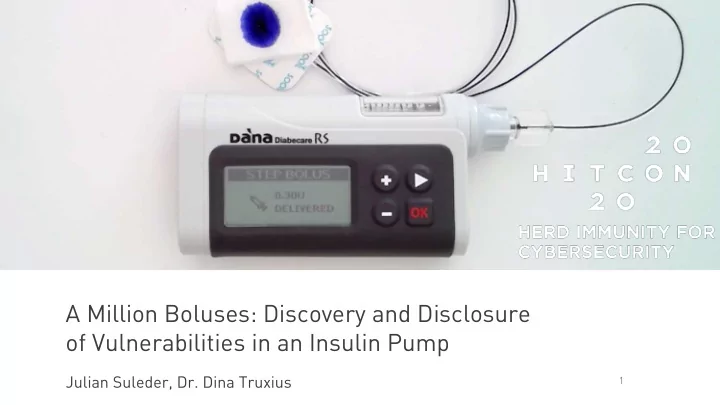
A Million Boluses: Discovery and Disclosure of Vulnerabilities in an - - PowerPoint PPT Presentation

a million boluses discovery and disclosure of
SMART_READER_LITE
LIVE PREVIEW

A Million Boluses: Discovery and Disclosure of Vulnerabilities in an - - PowerPoint PPT Presentation

A Million Boluses: Discovery and Disclosure of Vulnerabilities in an Insulin Pump Julian Suleder, Dr. Dina Truxius 1 About Us Julian Suleder o Security Analyst & Researcher o ERNW Research GmbH o jsuleder@ernw.de o Twitter:


slide-1
SLIDE 1

1

A Million Boluses: Discovery and Disclosure

  • f Vulnerabilities in an Insulin Pump

Julian Suleder, Dr. Dina Truxius

slide-2
SLIDE 2

2

About Us

  • Julian Suleder
  • Security Analyst & Researcher
  • ERNW Research GmbH
  • jsuleder@ernw.de
  • Twitter: @jsuleder
  • Dr. Dina C. Truxius
  • Section DI 24 - Cyber Security in

the Public Health and Financial Services Sectors

  • Federal Office for Information

Security (BSI)

  • dina.truxius@bsi.bund.de
slide-3
SLIDE 3

3

Agenda

  • Medical Device Security
  • Testing Setup
  • Technical Analysis
  • Communication Protocol
  • Vulnerabilities
  • Impact & Temporary Measures
  • Disclosure
slide-4
SLIDE 4

4

Disclaimer

  • This talk focuses on security vulnerabilities identified in the DANA

Diabecare RS insulin pump.

  • The exemplifying vulnerabilities affected the pump's proprietary,

Bluetooth Low Energy (BLE)-based communication and affected patient safety.

  • Opinions expressed belong solely to the authors and not necessarily

to the authors’ employers or organizations.

  • We want to thank SOOIL for participating in the project.
slide-5
SLIDE 5

5

Part I: Medical Device Security

  • What is a Medical Device?
  • The Environment – Medical Devices
  • The State of IT Security in Germany 2019
  • Project ManiMed
slide-6
SLIDE 6

6

Medical Device Classification

  • In the European Economic Area directives and

legal regulations classify medical products

  • Depending on their use (primarily)
  • Possible harms to patients (secondary)
  • Depending on the classification vendors must:
  • Implement processes for quality/risk

management, SDL and usability for products including software

  • Get a needed certification
slide-7
SLIDE 7

7

What is a medical device?

  • Basically everything intended by the manufacturer to be used for

human beings for the purpose of:

  • diagnosis, prevention, monitoring, treatment or alleviation of disease,
  • diagnosis, monitoring, treatment, alleviation of or compensation for

an injury or handicap,

  • investigation, replacement or modification of the anatomy or of a

physiological process,

  • control of conception

See: Council Directive 93/42/EEC of 14 June 1993 concerning medical devices

Applies to the EU!

slide-8
SLIDE 8

8

The Environment – Medical Devices

  • Not stationary
  • Expensive à Lifetime++
  • Use Proprietary data exchange formats
  • Various audiences with individual

backgrounds, expectations and needs

  • Disrupt IT management processes
  • Operations is key: Essential for a patient’s life

Photo by Jair Lázaro on Unsplash

slide-9
SLIDE 9

9

The State of IT Security in Germany 2019

  • The increasing degree of networking and distribution, coupled with

society's rising acceptance of mobile applications, is now associated with an elevated level of risk of cyber attacks

  • More smart products in the health sector
  • Range of medical applications covered by mobile solutions is rising
  • Many applications are already classified as medical devices
  • Cybersecurity is often not given any particular priority
  • New legislation, Medical Device Regulation (MDR): Medical devices will

be required to have certain cyber security properties

  • Operation is key: Medical functionality vs. security

[https://www.bsi.bund.de/SharedDocs/Downloads/DE/BSI/Publikationen/Lageberichte/Lagebericht2019.pdf?__blob=publicationFile&v=7, July 28, 2020]

slide-10
SLIDE 10

10

Project ManiMed - Manipulation of Medical Devices

  • Initiated by the German Federal Institute for Information Security (BSI)
  • The project aims to:
  • Carry out a security analysis of selected products by security assessments
  • Assess the current state: No finger-pointing
  • Increase awareness, communicate transparently, facilitate a trustful communication

and cooperation between manufacturers, security researchers, and authorities

  • Illustrate questions medical device vendors are facing by making devices smart
slide-11
SLIDE 11

11

ManiMed: Finalization

  • A final report for the German population will be prepared and

published in German and English

  • Purpose:
  • Establish active cooperation and collaboration between all stakeholders
  • Increase awareness, communicate transparently, enhance/built/keep

trust, get a “feeling” for vulnerabilities

  • Contents:
  • Abstract description of the different device categories and vulnerabilities
  • Lessons learned and current state of disclosure processes
  • Manufactures can decide on naming their product
  • Show their cooperation and lessons learned
  • No finger-pointing
slide-12
SLIDE 12

12

ManiMed: Product Categories

Implantable Pacemakers, Programmers, Home Monitoring Units Insulin Pumps Ventilators and Anesthesia Devices Infusion and Syringe Pumps Patient monitors

slide-13
SLIDE 13

13 13

Part II: Testing Setup

  • The Medical Device: Intended Use
  • Where do I get Medical Devices?
  • Security Assessment Methodology
slide-14
SLIDE 14

14

The Medical Device

  • Intended use by the manufacturer:
  • The insulin pump is the central component of the therapy system
  • Can be controlled with Android and iOS apps via BLE

SOOIL DANA Diabecare RS insulin pump

  • Other uses:
  • Artificial Pancreas System (APS)
  • #WeAreNotWaiting
  • There are mobile applications

compatible with this pump on GitHub

  • Patients need to build the

system for themselves

slide-15
SLIDE 15

15

Where do I get medical devices?

  • Insulin pumps and their accessories are listed as application aids

in the aid register of the German Statutory Health Insurance (GKV)

  • Regarded as prescriptible at the expense of the GKV
  • Insulin pumps are not publicly sold in Germany
  • The manufacturer provided us with two insulin pumps J
  • Other common procurement problems:
  • Direct sales:
  • Vendors do not provide private persons with medical devices
  • Public tenders à Heterogeneous environmental requirements
  • Lab setup requires complex medical information systems
  • Do not perform device assessments in production!
slide-16
SLIDE 16

16

Methods: Security Assessment

  • Highly specialized and individual in the device's medical use case,

interfaces, technologies, and assumptions to its environment

  • Scope:
  • Proprietary Communication Protocol on top of Bluetooth Low Energy (BLE)
  • Assessment Modules: Cryptography, Authentication & Pairing Process
  • Methodology:
  • Black-box approach without source code insight
  • Reverse Engineering of the communication protocol using the

manufacturer's Android and iOS applications as well as communication captures

slide-17
SLIDE 17

17 17

Part III: Technical Analysis

  • Communication Protocol
  • Pairing Process
  • Authentication Process
slide-18
SLIDE 18

18

Application-Layer Pairing

  • Every communication starts with the

signaling bytes \x01\x00 followed by the insulin pump’s serial number

  • The pump’s response indicates that the

serial number is matching

  • The second message initiated by the

mobile application (\x01\xD1) requests the pairing

  • This is confirmed by the insulin pump

with the response \x02\xD1\x00

  • After this, the user needs to manually

confirm the pairing request shown on the pump’s display

Conrm Pairing on Pmp Ii P Mbie A Aderiemen \01\00<edaced> \02\00OK \01\D1 \02\D1\00 Encrp Meage ih D_KEY Calclae D_KEY from Local_Name Reqe Pairing

slide-19
SLIDE 19

19

Application-Layer Pairing

  • Every communication starts with the

signaling bytes \x01\x00 followed by the insulin pump’s serial number

  • The pump’s response indicates that the

serial number is matching

  • The second message initiated by the

mobile application (\x01\xD1) requests the pairing

  • This is confirmed by the insulin pump

with the response \x02\xD1\x00

  • After this, the user needs to manually

confirm the pairing request shown on the pump’s display

Pairing Prompt

slide-20
SLIDE 20

20

Application-Layer Pairing

  • With the manual confirmation, a

\x02\xD2\x38\x37 message is sent to the mobile application

  • The two bytes after the signaling bytes

represent the pairing key (P_KEY)

  • \x01\x01 requests a session key

(S_KEY)

  • With all three keys:

à Initiate higher-privileged requests

Conrm Pairing on Pmp I

  • A

\01\01 \02\01130816152125861D Erac P_KEY Erac S_KEY + PIN Encrp Messages ih D_KEY, P_KEY, S_KEY \002\0D23837 \A1\02 \B2\0200F21C1027E4...

slide-21
SLIDE 21

21

Paired Communication

  • After the pairing and

exchange of the pairing key:

  • The P_KEY is appended to

\x01\xD0 signaling bytes à \x01\xD0\x38\x37

  • The session key (S_KEY) is

requested to finish the handshake

Inlin Pm Mbile A Adeiemen \01\00<edaced> \02\00OK \01\D0\38\37 \02\D0\00 \01\01 \02\01\13\08\16\15\21\25\86\1D Enc Meage ih D_KEY Eac S_KEY + PIN Enc Meage ih D_KEY, P_KEY, S_KEY Calclae D_KEY fm Lcal_Name \A1\02 \B2\02\00\F2\1C\10\27\E4... Send P_KEY

slide-22
SLIDE 22

22 22

Part IV: Technical Analysis

  • Vulnerabilities
slide-23
SLIDE 23

23

Weak PINs

Default Device Keypad Lock PIN: 1234 Recommending Weak Device Keypad Lock PINs: Use device PINs near 0000 such as 1000 to easily disable the device lock „The PIN 0000 can be used to unlock the device easily“ Default Physician Menu PIN: 3022 Manufacturer: The PINs’ Purpose is to prevent erroneous operation of the keypad An attacker needs physical access

slide-24
SLIDE 24

24

Client-Side Controls

  • Mobile applications ask users for the keypad lock PIN
  • The pump does not require this PIN to establish a connection
  • The client-side check implies the disclosure of the PIN
  • An attacker can omit the check when communicating with the pump
  • The AnyDANA application denies the connection to the insulin

pump when the pump is configured with the PIN 1234

slide-25
SLIDE 25

25

Keypad Lock PIN Disclosure

  • The PIN is transmitted without

establishing a privileged connection via BLE

  • The request is intended to be sent

after successful pairing or after the pairing key has been provided

  • An attacker can calculate the

device keypad lock PIN with a magic number à Extract the keypad lock PIN

[*] Device [Name=<red> BD=<red>] [*] Request 0x0100 [DEBUG] C >>: 0100<SN-REDACTED> [DEBUG] C <<: 02004F4B [*] Request 0x0101 [DEBUG] C >>: 0101 [DEBUG] C <<: 020113081B0D2214861D [+] PIN: 0x1001

slide-26
SLIDE 26

26

Weak Generation of Encryption Keys

  • Device Key (D_KEY)
  • Derived from the pump‘s serial number
  • Calculation does not contain any randomizing element
  • The device serial number can be obtained from the BLE

advertisements

  • à Key will never change
  • Session Key (S_KEY)
  • Derived from the device keypad lock PIN and the pump’s time
  • à Attackers can extract information needed to calculate the S_KEY

from captures

slide-27
SLIDE 27

27

  • Pairing Key (P_KEY)
  • Derived from the insulin

pump’s time

  • Calculation does not contain

any randomizing element

  • à Attackers can extract the

key and hijack the pump

Weak Generation of Encryption Keys

[*] Device [Name=<red> BD=<red>] [+] P_Key: 424B 2019-08-26 15:50:56.025675 [+] P_Key: 424B 2019-08-26 15:50:56.378260 [+] P_Key: 424B 2019-08-26 15:50:56.741305

slide-28
SLIDE 28

28

Further Vulnerabilities

  • Spoofing the Pump’s Identity
  • No active verification of the pump’s identity

à An attacker sending BLE advertisement messages may spoof the pump and perform Man-in-the-Middle (MitM) attacks on the communication system

  • Missing Replay Protection
  • The protocol has no replay protection measures

à An attacker hijacking a BLE session between an application and the pump

  • r in a MitM position may be able to replay messages
  • Insecure Transmission of Cryptographic Keys
  • All key material and the cryptographic keys are transmitted in clear text

à An attacker can eavesdrop the BLE communication and extract all keys

slide-29
SLIDE 29

29

Weak Authentication Mechanism

  • The authentication mechanism

relies on the possession of the

P_KEY

  • The P_KEY key can be extracted

from captured BLE messages

  • An attacker sniffing a single

communication between a pump and a paired mobile application can extract the P_KEY and hijack the pump

  • à May lead to patient harm

Inlin Pm Mbile A Adeiemen \01\00<edaced> \02\00OK \01\D0\38\37 \02\D0\00 \01\01 \02\01\13\08\16\15\21\25\86\1D Enc Meage ih D_KEY Eac S_KEY + PIN Enc Meage ih D_KEY, P_KEY, S_KEY Calclae D_KEY fm Lcal_Name \A1\02 \B2\02\00\F2\1C\10\27\E4... Send P_KEY

slide-30
SLIDE 30

30 30

Part V: Impact & Temporary Measures

  • Impact
  • Demo: Hijacking the Pump
  • Remediation & Temporary Measures
slide-31
SLIDE 31

31

Impact

  • Physical attacks (weak PINs) are not as critical as adjacent

attacks (BLE)

  • The combination of the identified vulnerabilities empowers an

attacker to hijack the insulin pump (all functionalities that are utilizable via BLE)

  • An attacker needs to be in proximity of the insulin pump sniffing a

single communication between a DANA Diabecare RS insulin pump and a paired mobile application

  • The attack is practical and can be performed automatically in

productive environments

  • The manufacturer released an updated device firmware
slide-32
SLIDE 32

32

Results: Demo – Hijacking the Pump

  • In the following video:
  • An attacker captures messages between an insulin pump and a

mobile app,

  • extracts the P_KEY from this communication,
  • hijacks and terminates the session between the pump and its paired

app,

  • creates a new session impersonating the app using the P_KEY,
  • and administers multiple insulin boluses.
  • The patient notices the administration and cancels it on the

pump, but more boluses are following..

slide-33
SLIDE 33

33

Results: Demo – Hijacking the Pump

slide-34
SLIDE 34

34

Remediation & Temporary Measures

  • Remediations are complex as most

vulnerabilities are design defects.

  • The manufacturer rolled out a firmware

update for the insulin pump in 04/2020.

  • Operations is key:
  • Disable the insulin pump’s BLE functionality

by putting it in airplane mode

  • à Preserve the pump‘s therapeutic purpose
  • The device implements safety features such

as a maximum daily dose or bolus block

[https://advancedtherapeutics.org.uk/wp-content/uploads/2020/03/User-FSN-DANA-RS-Cybersecurity-002-6-March-2020.pdf, accessed July 28,2020]

slide-35
SLIDE 35

35 35

Part VI: Disclosure

  • Disclosure Timeline
  • Publications
slide-36
SLIDE 36

36

Disclosure Timeline

  • The disclosure was managed by the ManiMed project team

(BSI and involved ERNW staff in a consultative capacity)

  • The ManiMed project strives to identify vulnerabilities in medical

devices for sustainable strengthening cybersecurity, consumer protection, and patient safety à Trustful communication with the manufacturer

  • A publication of the vulnerabilities does not pose serious risks or

harm to patients as short-term measures or workarounds exist that preserve the pump‘s therapeutic purpose

slide-37
SLIDE 37

37

Disclosure Timeline

Date Event August 30, 2019 The BSI contacts SOOIL to inform about the vulnerabilities October 22, 2019 SOOIL announces to ship an updated version of the insulin pump to Germany J November 2019 ERNW receives an updated insulin pump and performs a retest January 2020 SOOIL provides source code of the updated Android application for a retest March 3, 2020 Field Safety Notice (FSN) published by BfArM April 2020 The firmware update is rolled out to first patients in Europe May 8, 2020 Field Safety Corrective Action (FSCA) publicly announced by BfArM September 2020 Public Disclosure of the vulnerabilities

slide-38
SLIDE 38

38 38

In Press: ERNW White Paper

  • Julian Suleder. ERNW Whitepaper 69: Safety Impact of Vulnerabilities in

Insulin Pumps. September 11, 2020. Online: https://ernw- research.de/en/whitepapers/issue-69.html.

  • CISA ICSMA will be released soon!
slide-39
SLIDE 39

39

Conclusions

  • Se

Security up updates affecting sa safety should be handled with hi high h pr prior

  • rity

ty.

  • Se

Security up updates ar are in inevit itable to protect against vulnerabilities.

  • Ma

Mature pr proc

  • ces

esses es for handling cybersecurity vulnerabilities with safety impact on active medical devices are not yet common among all medical device manufacturers, even though recognized procedures based on pervasive community knowledge are in place.

  • Co

Coordinated Vu Vulnera rabil ilit ity Di Disclosures are a trustful basis for mutual exchange.

  • Inspire authorities and manufacturers in terms of best IT-security

practice.

slide-40
SLIDE 40

40

Outlook

  • Besides cybersecurity professionals many different stakeholders

are also interested in the results:

  • Physicians such as diabetologists
  • Standards-developing organizations
  • Academia
  • Health Delivery Organizations
  • Therefore, dedicated publications such as blog posts, white

papers, academic papers in medical informatics journals, and talks are planned

slide-41
SLIDE 41

41

Thank you for your Attention!

  • The vulnerabilities shall be acknowledged to Julian Suleder, Birk

Kauer, Nils Emmerich and Raphael Pavlidis from ERNW Research GmbH.

  • Dr. Dina C. Truxius

E-Mail: dina.truxius@bsi.bund.de Referat DI 24 Federal Office for Information Security (BSI) Godesberger Allee 185-189 53175 Bonn Germany

Julian Suleder

E-Mail: jsuleder@ernw.de Twitter: @jsuleder ERNW Research GmbH Carl-Bosch-Str. 4 69115 Heidelberg Germany