A measurement of the scintillation decay time constant in liquid - - PowerPoint PPT Presentation

a measurement of the scintillation decay time constant in
SMART_READER_LITE
LIVE PREVIEW

A measurement of the scintillation decay time constant in liquid - - PowerPoint PPT Presentation

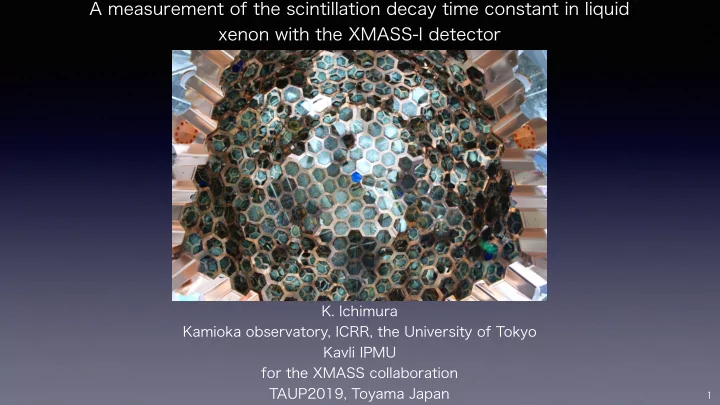
A measurement of the scintillation decay time constant in liquid xenon with the XMASS-I detector K. Ichimura Kamioka observatory, ICRR, the University of Tokyo Kavli IPMU for the XMASS collaboration TAUP2019, Toyama Japan 1 Motivation :


slide-1
SLIDE 1

A measurement of the scintillation decay time constant in liquid xenon with the XMASS-I detector

  • K. Ichimura

Kamioka observatory, ICRR, the University of Tokyo Kavli IPMU for the XMASS collaboration TAUP2019, Toyama Japan

1

slide-2
SLIDE 2

Motivation : Scintillation Process of LXe

  • 2 scintillation process in LXe :
  • Direct excitation and electron-ion recombination

(τ~30 ns)

  • Both lead to the formation of excited dimers, Xe2*

and emit light.

  • Two state : singlet (τs : a few ns) and triplet (τT : ~

20ns)

  • Fast component fraction (Fs) and recombination

time depend on the ionization density.

  • Such information can be used for the pulse shape

discrimination.

  • We have conducted the measurement of the

scintillation decay time of ER (NIM A 834 (2016) 192) and NR (JINST 13 (2018) P12032) using calibration source in XMASS-I

2

slide-3
SLIDE 3

XMASS-I detector

3

PMT-R10789 Detector Surface Water Tank 642 PMTs ~832kg LXe ~80cm

  • Single phase liquid Xenon detector (~832kg LXe in an active volume)

in Kamioka Mine

  • Successfully data taking until Feb. 2019
  • 642 low BG PMTs (Hamamatsu R10789, NIM A 922 (2019) 171)
  • each PMT signal is recorded by waveform digitizers (CAEN V1751)
  • 10m x 10.5 m water tank with 72 20 inch PMTs for muon veto

3

slide-4
SLIDE 4

4

Decay time constants of Electron recoil NIM A 834 (2016) 192

slide-5
SLIDE 5

Internal Calibration setup

5

Stepping motor Gate Valve Top PMT can be removed

  • Inner calibration : 55Fe, 109Cd, 241Am, 57Co and 137Cs
  • 55Fe, 241Am and 57Co source were used for the

evaluation of the scintillation decay time constant

  • Frequent calibration (57Co) to monitor
  • Photo-electron (PE) yield
  • optical parameter (Absorption, Scattering length

etc.) used for analysis.

5m

N.Y.Kim et al, NIM A784, (2015) 499

slide-6
SLIDE 6

6

Decay time constant of electron recoil

Raw waveform (1PMT, 1 event) Smoothing peak timing

The decay time constant is evaluated by comparing the reconstructed pulse timing distributions over all PMTs of data and simulated samples with various timing parameters To obtain the pulse timing, peak search algorithm based on Savitzky-Golay filter(1st,2nd,3rd derivative) is used.

[ns] [ns] [ns] [ADC] 1st derivative 2nd derivative 3rd derivative

Yj = 1 35(−3yj−2 + 12yj−1 + 17yj + 12yj+1 − 3yj+2)

<latexit sha1_base64="hg2yXKGw1HVW5PaJ/f5TYEgwUHI=">ACrHicSyrIySwuMTC4ycjEzMLKxs7BycXNw8vHLyAoFacX1qUnBqanJ+TXxSRlFicmpOZlxpaklmSkxpRUJSamJuUkxqelO0Mkg8vSy0qzszPCympLEiNzU1Mz8tMy0xOLAEKxQu4R8ZXZ9UqKNgqxKQVJSZXG9ZWG5vWaugaVwLFdY1qtQ2NwCxDIMscxIKJaBvWQhRpG9VqcnHFCygb6FkaGFqaGSpgMgz1DMBA2cHi/gXxWy8kA/IFljPEMKQw5DMkM5Qy5DKkMuQxlADZOQyJDMVAGM1gyGDAUAUi2WoBoVAVmZYPlUhloGLqDeUqCqVKCKRKBoNpBMB/KioaJ5QD7IzGKw7mSgLTlAXATUqcCganDVYKXBZ4MTBqsNXhr8wWlWNdgMkFsqgXQSRG9qQTx/l0Twd4K6coF0CUMGQhdeN5cwpDFYgN2aCXR7AVgE5ItkiP6yqumfg62CVKvVDBYZvAa6f6HBTYPDQB/klX1JXhqYGjSbARQBsFBWwM0IM9IzNYzCgTGhBMDBHAwSDMoMWgAw9ucwYHBgyGAIRo71qGywx3GO4y6TGFMEUzxUKUMjFC9QgzoACmNABLS6Z5</latexit>

Y

j = 1

12(yj2 − 8yj1 + 8yj+1 − yj+2)

<latexit sha1_base64="jrlxSTjog5zN/jOef+O7xBFy7QE=">ACoHicSyrIySwuMTC4ycjEzMLKxs7BycXNw8vHLyAoFacX1qUnBqanJ+TXxSRlFicmpOZlxpaklmSkxpRUJSamJuUkxqelO0Mkg8vSy0qzszPCympLEiNzU1Mz8tMy0xOLAEKxQtYR8ZXZ9WqKyjYKsSkFSUmVxvWVhsa1WpUAoV1jWp1LcAMw1ptMEPbsFYXTBvVanJxQsoG+hZGhamhkqYDIM9QzAQNnB4v4F8VsvJAPyBZYzxDCkMOQzJDOUMuQypDLkMZQA2TkMiQzFQBjNYMhgwFAFItlqAaKFQFZmWD5VIZaBi6g3lKgqlSgikSgaDaQTAfyoqGieUA+yMxisO5koC05QFwE1KnAoGpw1WClwWeDEwarDV4a/MFpVjXYDJBbKoF0EkRvakE8f5dE8HeCunKBdAlDBkIXjeXMKQxWIDdmgl0ewFYBOSLZIj+sqrpn4OtglSr1QwWGbwGun+hwU2Dw0Af5JV9SV4amBo0mwEUAbBQVsDNCDPSMzTWMwoExoQTAwRwMEgzKDFoAMPbnMGBwYMhgCEUaO9ChuMFxguMikxeTD5MwVClDIxQvUIM6ApigAZ7uibw=</latexit>

Y

j = 1

14(2yj2 − yj1 − 2yj − yj+1 + 2yj+2)

<latexit sha1_base64="qm19cfrIlBoEWUqXUwVN8ZXNuw=">ACqHichVHPT9RQEP4oirgqrHJQ46WR8EM3u5lXiIKJCZGLxwVcFgJk09a3WOm2TdvdZG36D/gPePAEiTHEP8OLN7iYuF68ajxi4sUD01cMIQSYpm9mvplv3vfeswLXiWKiXp/Wf+nywJXBq4Vr128MDRdv3lqO/HZoy5rtu364YpmRdB1P1mInduVKEqzZbmybm3NZ/V6R4aR43sv4m4gN1rmpuc0HduMGWoU51cbyet0YkLXn+rzdC0E5EmYjqdNLpcKBtpWXmRlhWQpyWRlRaMtIHhUKjOEqVWRKzj4R+OhAVUjY6N/Nj/b3n3erfvEj1vESPmy0YKEh5hjFyYi/tYgQAgY20DCWMiRo+oSKQrMbXOX5A6T0S1eNzlbO0I9zrOZkWLbvIvLf8hMHWP0lXbpgL7QJ/pF/86clagZmZYueyvnyqAx/PbO0t8LWS32MV4ds87VHKOJGaXVYe2BQrJT2Dm/8+bdwdKTxbFknHboN+vfph595hN4nT/2hwW5+B7ZA/y/Zf3sYNmoiKmKscAv8Qy5DeIe7mOS7/sx5vAcVdR4313s4Rt62kOtqtW1bxV6zvijOCEadYhpI2ldQ=</latexit>

Y

j

= 1 12(−yj2 + 2yj1 − 2yj+1 + yj+2)

<latexit sha1_base64="7zs0ubjd4MCN5qXulv2nY7G6ub0=">ACo3icSyrIySwuMTC4ycjEzMLKxs7BycXNw8vHLyAoFacX1qUnBqanJ+TXxSRlFicmpOZlxpaklmSkxpRUJSamJuUkxqelO0Mkg8vSy0qzszPCympLEiNzU1Mz8tMy0xOLAEKxQvYRcZXZ9Wq6srKNgqxKQVJSZXG9ZWGxrVauhWAmV0jWq1jcAMw1pdMEPbsFYbTBvVanJxQsoG+hZGhamhkqYDIM9QzAQNnB4v4F8VsvJAPyBZYzxDCkMOQzJDOUMuQypDLkMZQA2TkMiQzFQBjNYMhgwFAFItlqAaKFQFZmWD5VIZaBi6g3lKgqlSgikSgaDaQTAfyoqGieUA+yMxisO5koC05QFwE1KnAoGpw1WClwWeDEwarDV4a/MFpVjXYDJBbKoF0EkRvakE8f5dE8HeCunKBdAlDBkIXjeXMKQxWIDdmgl0ewFYBOSLZIj+sqrpn4OtglSr1QwWGbwGun+hwU2Dw0Af5JV9SV4amBo0mwEUAbBQVsDNCDPSMzTWMwoExoQTAwRwMEgzKDFoAMPbnMGBwYMhgCEUaO8ShlMlxmuMKkyeTMFMYVAlDIxQvUIM6AplgA1Wi+g=</latexit>
slide-7
SLIDE 7

7

Decay time constant of electron recoil

Raw waveform Detected peak reconstructed WF

The decay time constant is evaluated by comparing the reconstructed pulse timing distributions over all PMTs of data and simulated samples with various timing parameters Top figure shows 57Co, Z=0, 1PMT waveform τ1 = 2.2±0.3 ns (J. Raun, J. Phys. C 11 (1978) 2645.)

T = tEdep + tscinti + tT OF + tT T + telec

<latexit sha1_base64="Zcsa+iG7Alb3pWJuYAkuYzOXc=">ACnHicSyrIySwuMTC4ycjEzMLKxs7BycXNw8vHLyAoFacX1qUnBqanJ+TXxSRlFicmpOZlxpaklmSkxpRUJSamJuUkxqelO0Mkg8vSy0qzszPCympLEiNzU1Mz8tMy0xOLAEKxQuYhyjYKpTEV7umpBbUKmiDmMXJmXklmVBOiL8bjBUCZaTmpCbXxgsoG+hZGhamhkqYDIM9QzAQNlB5eu2w2Xc3wLyBZYzxDCkMOQzJDOUMuQypDLkMZQA2TkMiQzFQBjNYMhgwFAFItlqAaKFQFZmWD5VIZaBi6g3lKgqlSgikSgaDaQTAfyoqGieUA+yMxisO5koC05QFwE1KnAoGpw1WClwWeDEwarDV4a/MFpVjXYDJBbKoF0EkRvakE8f5dE8HeCunKBdAlDBkIXjeXMKQxWIDdmgl0ewFYBOSLZIj+sqrpn4OtglSr1QwWGbwGun+hwU2Dw0Af5JV9SV4amBo0m4ELGAGwUFbAzQgz0jM01jMKBMaEwMEcDBIMygxaAD25zBgcGDIYAhFGjvXIbDGcYzjLJMbkweTP5QpQyMUL1CDOgAKYwAD/ogs=</latexit>

In simulation :

f(t) = F1 τ1 exp(− t τ1 ) + (1 − F1 τ2 ) · exp(− t τ2 )

<latexit sha1_base64="TbgNotY0CW83nuw3TLMST1coyJ8=">AC1nichVHLSuRAFL0dx1ePj9bZCLMpFKVFbG5a8THg4Iwg4spXa4MtTVJWazCdxKS60Qk9u2FgVrNzMSsFEfED5gPc+AMifoK4VHCj4E2iqPi6IVWnzrn1q0q3TENTyKexpSqD9U1tX18Y8NjU3NiZbWec8uVxkuG3ablbXPGEalshIQ5oi67hCK+qmWNDXxgJ9oSxcz7CtObnpiKWitmIZBYNrkqh8Yr2QlN1shOUKrsb98byvVip+TmqlEIkNJ9kbSfIR3d3DkhHL1F72xJQmNceXbcle8gZqPtGBqWFUhwdU9hyoKQyjY/TreP/W/2+TU3ZiD3KwDZwKERBFgCZugUfIqiA4BC3BD5xLiEj1AVUIE7eEmUJytCIXaNxhVaLd6xF6CmF7o57WLS75KTQSce4z5e4BEe4Blev1rLD2sEvWzSrEde4eSb/7TNXr3rKtIsYfXB9WbPEgowFPZqUO9OyASn4JG/GPrYvbLTKfhTt4Tv1v4yke0gms8iXfnRYz/yBOD3B/y+x1MJ9OqX2p9DS9xHeIog4+Qzsk6b4HYRQmYAoytO8J3MRqYrVKVvmp/FJ+R6lK7M7zCZ6E8vcWVYa3rw=</latexit>

Tscinti follows :

χ2 =

  • i

(N data

i

− N MC

i

× S)2 N data

i

+ N MC

i

× S2

<latexit sha1_base64="ITvB+hv9IzA3J1q2ZuYsITKN+Lo=">AC3XichVHPTxQxFH4zoOAisOLFhEsjwWCMmzdrokBiQuSAFw2wLpAwMOmU7tIwvzLT3YjHL0YwpWDJ02MUf8MLvwDHLh4Nx4x8eLBNzNrjJrV17R9/fp9r19bN/JUohHPDHNg8MLFoeFLlZHLo2Pj1SsTa0nYiYVsitAL4w2XJ9JTgWxqpT25EcWS+64n1929xXx/vSvjRIXBE70fyS2ftwPVUoJrgpzqU1vsqu20nrH7zE46vpOqzG7FXKQzj7dTO/bZDtc8y2F2m/WgR4slYGvly4Q1buYFsvRPwa0+9ILtVKewNofW3F2L/Z1YNSxiamGJfbCd5+3lsPoObNiBEAR0wAcJAWjKPeCQUNsECxAiwrYgJSymTBX7EjKokLZDLEkMTugejW1abfbQgNZ5zaRQCzrFox6TksE0nuJ7PMcT/Iif8XvfWmlRI/eyT7NbamXkjL+81vj2X5VPs4bdX6p/etbQgtnCqyLvUYHktxClvs6Lwxvzqd3sA3+IX8v8YzPKYbBN2v4u2KXH0FfqAn6/M+idr9Zp1p1ZfoZ94AGUMwyRchxl673uwA9hGZp07idj0Bg1xkzHfGEemIcl1TR6mqvwW5hHPwB2Nrnx</latexit>

Find the best F1,τ2 for each calib. source

slide-8
SLIDE 8

8

Decay time constant of electron recoil

So without F1 (fast component fraction), MC cannot reproduce the timing distribution around 3 ~ 20 nsec.

slide-9
SLIDE 9

9

Decay time constant of electron recoil

By converting γ(X)-ray energy into electron energy, above figure is obtained. The obtained data almost reproduced previously reported results and extended them to the lower energy region relevant to direct dark matter searches.

55Fe 5.9 keV 57Co 122 keV

241Am 17.8 keV, 59.5 keV, W X-ray of 59.3 keV

slide-10
SLIDE 10

10

Decay time constants of Nuclear recoil JINST 13 (2018) P12032

slide-11
SLIDE 11

External Calibration setup

11

  • external calibration : 60Co
  • easy data taking to

monitor photo-electron yield

1/2 inch

  • Neutron calibration 252Cf
  • To understand the

detector response to nuclear recoil events in LXe.

  • Details are in the following

pages. Fasten the hose to the outer vacuum chamber Fish tape

slide-12
SLIDE 12

neutron calibration setup

12

Inside the water tank

XMASS detector

neutron calibration pipe

Plastic Scintillator (BC400) PMT R580

252Cf source was used for the calibration

(252Cf undergoes a spontaneous fission and emits neutrons and gammas)

slide-13
SLIDE 13

252Cf calibration data/MC

13

  • Timing distribution (Below 500 PEs)
  • ID trigger timing - Plastic Scintillator trigger timing
  • offset is adjusted by γ related events timing
  • neutron related events can be collected by using

the timing information γ related events n related events

  • PE distribution
  • ( 30 < ⊿T < 100 ns in the left figure)
  • 10 < PEs < 100 events were used for the

evaluation of the scintillation decay time of NR

  • This PE range corresponds to :
  • 1.5 < E < 8.3 keVee
  • 6.3 < E < 40 keVnr

Data : 1.5 hrs data taking, MC : Geant4 base XMASS MC

slide-14
SLIDE 14

Scintillation decay time constant for nuclear recoil events (1)

14

  • In MC, scintillation time is described as:

Peak finding tool based on Savitzky-Golay filter

  • By comparing the timing distribution between data and MC, we
  • btained τT and Fs
  • τS : 4.3±0.6 ns (Hitachi et al) Phys. Rev. B 27 (1983) 5279
  • τT : 21.0 ns ~ 30.5 ns (0.5 ns step)
  • Fs : 0.0 ~ 0.5 (0.025 step)

Fitting range (3-120 ns)

  • χ2 fit was performed to obtain the

best parameters

  • Photon detection timing is used for evaluation

Data Peak timing Fitted by one PE template WF

χ2 =

  • i

(N data

i

− N MC

i

× S)2 N data

i

+ N MC

i

× S2

<latexit sha1_base64="ITvB+hv9IzA3J1q2ZuYsITKN+Lo=">AC3XichVHPTxQxFH4zoOAisOLFhEsjwWCMmzdrokBiQuSAFw2wLpAwMOmU7tIwvzLT3YjHL0YwpWDJ02MUf8MLvwDHLh4Nx4x8eLBNzNrjJrV17R9/fp9r19bN/JUohHPDHNg8MLFoeFLlZHLo2Pj1SsTa0nYiYVsitAL4w2XJ9JTgWxqpT25EcWS+64n1929xXx/vSvjRIXBE70fyS2ftwPVUoJrgpzqU1vsqu20nrH7zE46vpOqzG7FXKQzj7dTO/bZDtc8y2F2m/WgR4slYGvly4Q1buYFsvRPwa0+9ILtVKewNofW3F2L/Z1YNSxiamGJfbCd5+3lsPoObNiBEAR0wAcJAWjKPeCQUNsECxAiwrYgJSymTBX7EjKokLZDLEkMTugejW1abfbQgNZ5zaRQCzrFox6TksE0nuJ7PMcT/Iif8XvfWmlRI/eyT7NbamXkjL+81vj2X5VPs4bdX6p/etbQgtnCqyLvUYHktxClvs6Lwxvzqd3sA3+IX8v8YzPKYbBN2v4u2KXH0FfqAn6/M+idr9Zp1p1ZfoZ94AGUMwyRchxl673uwA9hGZp07idj0Bg1xkzHfGEemIcl1TR6mqvwW5hHPwB2Nrnx</latexit>

f(t) = FS τS exp(− t τS ) + (1 − FS τT ) · exp(− t τT )

<latexit sha1_base64="2IPyoUKnKVfkxcLDwgs6kiFiagk=">AC1nichVHLSuRAFL2d8dk62s5sBDeF4tAiNjfO4IyC4gNEXKlta4MtTVJWO8F0kmqGzW0OxFcuXPhSkFE/ID5gNn4AyJ+gsxSwY3C3CSKio+5IVWnzrn1q0q3TENTyJexJQPVdU1tX18YbGj03NiZPc5dcrnIcNu03ayuecI0LJGRhjRF1nGFVtRNMa+vjAX6fFm4nmFbs3LNEYtFbdkyCgbXJFH5xK9CUnaxQZYruBr3x/N+ulLxc1IrhUisOsmeSJP6K5uloxYpvawZ6ZUnN8yZbsNW+g5hMdmOpHtb9PZS+BmsIwOoaHxr/t/h6ZnLITR5CDJbCBQwmKIMACSdgEDTz6FkAFBIe4RfCJcwkZoS6gAnHylihLUIZG7AqNy7RauGctWgc1vdDNaReTfpecDrxDI/xCk/xBC/x9s1aflgj6GWNZj3yCifvN2avmvq0izhJ+Prnd7lCAH2GvBvXuhExwCh75y+u7V+mBmU7/Cx7gX+p/Hy/wD53AKl/zw2kxswdxeoCHW2Zvg7nelPo1TtNLzEKUdRBG7RDku7OwzDBExBhvY9h7tYTaxWySobyqayFaUqsXvPZ3gWys4/GKy4ew=</latexit>
slide-15
SLIDE 15

Scintillation decay time constant for nuclear recoil events (2)

15

  • After parameter scan in discrete steps,

a parabolic function fit was performed to obtain the decay time constant

  • By changing τs, cross section library,

scintillation efficiency and so on, same analysis procedure was performed to evaluate the systematic uncertainties.

  • Finally we obtain the result of the scintillation

decay time constant for nuclear recoil events as :

  • τT : 26.9 +0.7 -1.1 ns
  • Fs : 0.252 +0.027 -0.019

χ2/NDF = 113.9/115

slide-16
SLIDE 16

Scintillation decay time constant for nuclear recoil events (3)

16

  • with various measurements
  • τT : consistent with XMASS(ER)
  • Fs : larger than that of XMASS (ER)
  • Lowest Energy threshold w/o applying an

electric field

  • Published : JINST 13 (2018) P12032
slide-17
SLIDE 17

17

Pulse Shape discrimination in single phase LXe

MC generated at the XMASS-I detector center

Since we measured the decay time constants of ER and NR, we evaluated the performance of the PSD in XMASS-I detector

these distributions were used as the PDF

  • f the PMT hit timings

MC generated uniformly in the XMASS-I detector R < 20 cm events were plotted

ER like NR like

slide-18
SLIDE 18

18

Pulse Shape discrimination in single phase LXe

ER acceptance with 50% NR acceptance Blue : XMASS-I detector with PMT jitter, TTS Red : Ideal case, no PMT jitter and TTS

ER acceptance (w/ 50% NR acceptance): 13.7 ± 1.0% for 5̶10 keVee 4.1 ± 0.7% for 10̶15 keVee

slide-19
SLIDE 19

Summary

  • We measured the decay time constant of ER and NR in liquid xenon with XMASS-I

detector

  • To reproduce the timing distribution of the PMT hits, fast component is needed.
  • τT = 27.8 +1.5 -1.1 ns, Fs = 0.145 +0.022 -0.020 for ER 5.9 keV 55Fe γ-ray
  • τT = 26.9 +0.7 -1.1 ns, Fs = 0.252 +0.027 -0.019 for NR
  • These measurements had the lowest energy threshold w/o electric field.
  • From the difference of the decay time constant, we evaluate the performance of the

PSD with XMASS-I detector.

  • 13.7±1.0% ER acceptance with 50% NR acceptance (5‒10 keV)
  • 4.1±0.7% ER acceptance with 50% NR acceptance (10‒15 keV)

19

slide-20
SLIDE 20

Backup

20

slide-21
SLIDE 21

MC simulation

21

  • XMASS full MC based on geant4.9.3
  • Plastic scintillator : included its geometry, but not included its response.
  • Generate n and γ separately with following the energy spectrum (bottom figures)
  • Then summed up with plastic scintillator efficiency and the multiplicity of neutron (γ) per fission.
  • As for neutron elastic scattering cross section library, ENDF/B VII.0 is used.
  • Leff : E.Aprile et al, Phys. Rev. Lett. 107 131302 (2011) : bottom figures
  • To simulate neutron recoil events effectively : (~ 10,000 events/15min/1CPU)
  • Stop the process of event that PMTs are detected more than 1000 photon (~ 70 keV)
  • Stop the process of event that neutron alive after 1μs from its generation.

Leff center Leff +1σ Leff -1σ

slide-22
SLIDE 22

MC simulation

22

  • XMASS full MC based on geant4.9.3
  • Plastic scintillator : included its geometry, but not included its response.
  • Generate n and γ separately with following the energy spectrum (bottom figures)
  • Then summed up with plastic scintillator efficiency and the multiplicity of neutron (γ) per fission.

gamma/MeV

Knoll (1973): Int.J.Appl.Radiat.Isotopes 24 (1973) Watt (1990): Nucl. Sci. Eng. 106 (1990) 345 MC (used Watt spectrum model ) Verbenski (1973, measurement) Jieum Kim (2007.03.27 , approximation) CLHEP code : We use this spectrum