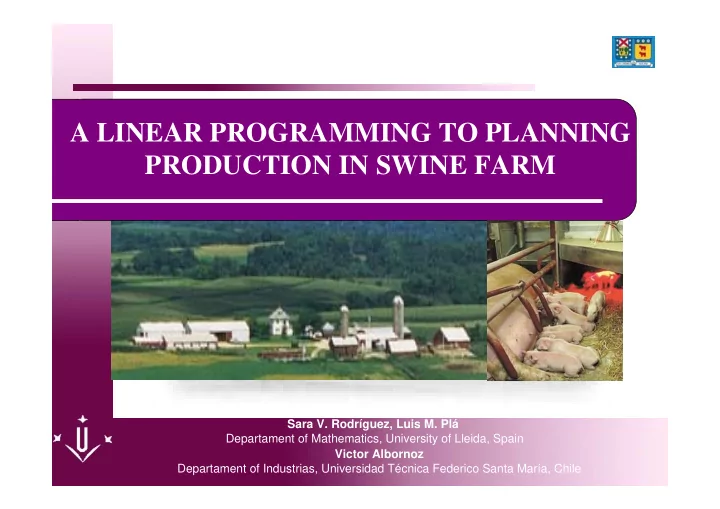
SLIDE 1 Sara V. Rodríguez, Luis M. Plá Departament of Mathematics, University of Lleida, Spain Victor Albornoz Departament of Industrias, Universidad Técnica Federico Santa María, Chile
A LINEAR PROGRAMMING TO PLANNING PRODUCTION IN SWINE FARM
SLIDE 2 Outline
- 1. Introduction
- Overview of swine industry
- Swine production system
- Literature review
- 2. Description problem
- Lifespand of the sow
- Reproductive cycle
- 3. Linear programming model
- Formulation of the problem
- Numerical test
- Sensitivity analysis
- Dealing with the weakness of LP
- Stochastic model extension
- 4. Further research and conclusions
SLIDE 3
UNCERTAINTY DECISION VARIABLES CONSTRAINTS
Overview to Swine Industry
Introduction Description problem LP model Stochastic programming Further research
Probabilistic System
SLIDE 4 PROFITABILITY MARGIN
In Europe the decreasing in the profit margin during the last years has motivated the use of operation reseach methods to make better decisions.
Overview to Swine Industry
Introduction Description problem LP model Stochastic programming Further research
SLIDE 5
Swine Production System
Introduction Description problem LP model Stochastic programming Further research
SLIDE 6
Danish Swine Production System
Introduction Description problem LP model Stochastic programming Further research
SLIDE 7
Spanish Production System
Introduction Description problem LP model Stochastic programming Further research Slaugtherhouse
SLIDE 8 Literature Review
- Strategic decisions
- Infinite horizon
Models
- Simulation
- Optimization
- Dynamic Programming; Markov models
Relevant aspects:
Introduction Description problem LP model Stochastic programming Further research
Pla, L.M., 2007. Review of mathematical models for sow herd
- management. Livestock Science 106, 107–119.
SLIDE 9 Introduction Description problem LP model Stochastic programming Further research
SIMULATION MODELS
- Allen, M.A., Stewart, T.S., 1983. A simulation model for a swine breeding
unit producing feeder pigs. Agricultural Systems 10, 193–211.
- Marsh, W.E., 1986. Economic decision making on health and management
livestock herds: examining complex problems through computer simulation. Ph.D. thesis, University of Minnesota, St. Paul.
- Jalving, A.W., 1992. The possible role of existing models in on-farm decision
support in dairy cattle and swine production. Livestock Production Science 31, 351–365.
- Plà, L.M., Pomar, C., Pomar, J., 2003. A Markov decision sow model
representing the productive lifespan of sows. Agricultural Systems76, 253–272.
SLIDE 10 OPTIMIZATION MODELS
Introduction Description problem LP model Stochastic programming Further research
- Dijkhuizen, A.A., Morris, R.S., Morrow, M., 1986. Economic optimisation of
culling strategies in swine breeding herds, using the “PORKCHOP computer program”. Preventive Veterinary Medicine 4, 341–353.
- Huirne, R.B., Dijkhuizen, A.A., Van Beek, P., Hendriks, Th.H.B., 1993.
Stochastic dynamic programming to support sow replacement decisions. European Journal of Operational Research 67, 161–171.
- Kristensen, A.R., Søllested, T.A., 2004b. A sow replacement model using
Bayesian updating in a three-level hierarchic Markov process II. Optimization
- model. Livestock Production Sciences 87, 25–36.
SLIDE 11
Aim
a) Formulate a linear optimization model. b) Formulate a linear stochastic extension. Tactical decisions Linear Finite horizon Stochastic two stage.
Introduction Description problem LP model Stochastic programming Further research
SLIDE 12
Swo farm
Introduction Description problem LP model Stochastic programming Further research
SLIDE 13 INSEMINATION GESTATION LACTATION ENTRY CYCLE NEXT CYCLE
Swine Production System
Introduction Description problem LP model Stochastic programming Further research
SLIDE 14 Identification of the problem
- How many sows the farmer should replace?
- How many sows the farmer should buy?
- How many insemintions the farmer should accept?
- What is the optimal cycle in which the sow should be replace?
- What is the optimal reproductive state in which the sow should be
replace?
Introduction Description problem LP model Stochastic programming Further research
SLIDE 15
Linear Programming Model
Introduction Description problem LP model Stochastic programming Further research
SLIDE 16 Linear Programming Model
Introduction Description problem LP model Stochastic programming Further research
Reference Dantzig, G.B. y Thapa, M.N., 1996. Linear Programming. Introduction. Springer Series in Operations Research, Springer. Max cTx s.a. Ax ≤ b x ≥ 0
SLIDE 17 L 1 L 3 L 4 L 2
Introduction Description problem LP model Stochastic programming Further research
WEEK
LACTATION
I 1
WEEK
INSEMINATION
PERIOD= WEEK
SLIDE 18 G 15 G 16 ZR 1 ZR 3 G 4 ZR 2
Introduction Description problem LP model Stochastic programming Further research
WEEK
GESTATION BREEDING- CONTROL
GESTATION
r ={1,2,3} k ={1,2,3}
SLIDE 19 ZR 1 Z G 15 G 16 L 1 L 3 L 4 L 2 ZR 1 Z G 15 G 16 L 1 L 3 L 4 L 2
Introduction Description problem LP model Stochastic programming Further research
PERIOD= WEEK
SLIDE 20
C={1, 2, 3, ...} Set of number of cycles. Sg={1, 2, ..., 16} Set of number of gestation week Sl={1, 2, 3, 4} Set of number of lactation week T={1, ... 52} Set of periods Nr={1,..3} Set of repetitions of insemination Sr={1,..,3} Set of insemination waiting week α(t,c,g) = Survival rate of gestation of the period t, cycle c and gestation week g. β(t,c,r) = Survival rate of insemination of the period t, cycle c, waiting the reinsemination r. γ(t,c) = Number of weaned piglets at period t and cycle c.
Introduction Description problem LP model Stochastic programming Further research
SLIDE 21
Y(t,c,l) Number of sows in lactation state at period t, cycle c, lactation week l. X(t,c,g) Number of sows in gestation state at period t, cycle c, gestation week g. Z(t,c) Number of sows in insemination state at period t, cycle c. ZR(t,c,r,k) Numer of sows in breedig-control state at period t, cycle c, waiting the reinsemination r, waiting week k. UL(t,c) Number of replaced sows at the end of lactation state. UZ(t,c,r) Number of replaced sows at the end of insemination state, waiting the reinsemination r.
Introduction Description problem LP model Stochastic programming Further research
SLIDE 22 ∑∑ ∑ ∑∑∑ ∑∑ ∑
∈ ∈ ∈ ∈ ∈ ∈ ∈ ∈ ∈
+ + +
T t c t C c t T t T t C c r c t Nr r t T t C c c t t C c l c t c t c t
AB ru UZ ru UL ru Y rl
, , , , , , , ,
* * * * *
*
γ
Objective Function
Introduction Description problem LP model Stochastic programming Further research
SLIDE 23
Objective Function
Introduction Description problem LP model Stochastic programming Further research
SLIDE 24 Objective Function
Introduction Description problem LP model Stochastic programming Further research
INSEMINATION GESTATION LACTATION BREEDING- CONTROL
l c t T t C c Sl l l c t g c t T t C c Sr Sg g g c t T t C c k r c t Nr r Sr k k c t T t C c c t c t
Y rl X rx ZR rzr Z rz
, , , , , , , , , , , , , , , ,
* * * *
∑ ∑ ∑ ∑ ∑ ∑ ∑ ∑ ∑ ∑ ∑ ∑
∈ ∈ ∈ ∈ ∈ − ∈ ∈ ∈ ∈ ∈ ∈ ∈
+ + +
rz t,1
SLIDE 25 Objective Function
Introduction Description problem LP model Stochastic programming Further research
l c t T t C c Sl l l c t g c t T t C c Sr Sg g g c t T t C c k r c t Nr r Sr k k c t T t C c c t c t
Y rl X rx ZR rzr Z rz
, , , , , , , , , , , , , , , ,
* * * *
∑ ∑ ∑ ∑ ∑ ∑ ∑ ∑ ∑ ∑ ∑ ∑
∈ ∈ ∈ ∈ ∈ − ∈ ∈ ∈ ∈ ∈ ∈ ∈
+ + +
∑∑ ∑ ∑∑ ∑ ∑∑ ∑
∈ ∈ ∈ ∈ ∈ ∈ ∈ ∈ ∈
+ + +
T t c t C c t T t T t C c r c t Nr r t T t C c c t t C c l c t c t c t
AB ru UZ ru UL ru Y rl
, , , , , , , ,
* * * * *
*
γ
SLIDE 26 ) 4 ( ) 3 ( ) 2 ( ) 1 ( } 1 {
, , , 1 , , , 1 , , , , , 1 , 1
… … … … C c Sl l Y Y C c Sg g X X C c Sr k Nr r ZR Z C c Z Z
l c l c g c g c k r c k r c c c
∈ ∈ = ∈ ∈ = ∈ ∈ ∈ = − ∈ =
Introduction Description problem LP model Stochastic programming Further research
Constraints
SLIDE 27 ) 5 ( } 1 { } 1 {
1 , 1 , 1 , 1 ,
*
… − ∈ − ∈ − =
− − − −
C c T t UL Y Z
c t l c t c t
LACTATION 4 INSEMINATION Z
Introduction Description problem LP model Stochastic programming Further research
SLIDE 28 ) 8 ( } 1 { } 1 { ) 7 ( } 1 { } 1 { ) 1 ( ) 6 ( } 1 {
1 , , , 1 , , , 1 , , 1 3 , 1 , , 1 1 , , 1 1 , , , , , 1 1 , 1 , ,
… … … − ∈ ∈ ∈ − ∈ = − ∈ ∈ − ∈ − − = ∈ − ∈ =
− − − − − − − − −
Sr k Nr r C c T t ZR ZR Nr r C c T t UZ ZR ZR C c T t Z ZR
k r c t k r c t r c t r c t r c t r c t c t c t
β ZR 1 Z ZR 1 ZR 2 G ZR 2 ZR 3 ZR 3
Introduction Description problem LP model Stochastic programming Further research
UR
1-β(t,c,r)
SLIDE 29 G 4 ZR G 1 G 16 G 4 G 15 G 16
) 10 ( } 1 { } 1 { ) 9 ( } 1 {
1 , , 1 1 , , , 3 , , , 1 , , 1 4 , ,
… … − − ∈ ∈ − ∈ = ∈ − ∈ =
− − − − ∈ −
∑
Sr Sg g C c T t X X C c T t ZR X
g c t g c g c t r c t Nr r r c t c t
α β
Introduction Description problem LP model Stochastic programming Further research
SLIDE 30 G 16 L 1 L 3 L 4 L 2 L 1 L 3 L 4 L 2
) 12 ( } 1 { } 1 { ) 11 ( } 1 {
1 , , 1 , , , , 1 , 1 1 , ,
* *
… … − ∈ ∈ − ∈ = ∈ − ∈ =
− − − −
Sl l C c T t Y Y C c T t X Y
l c t l c t g c t g c t c t
α
Introduction Description problem LP model Stochastic programming Further research
SLIDE 31 ) 15 ( ) 14 ( ) 13 (
, , , , } { , , , , , ,
* *
… … … T t CL Y X T t CG X T t CI ZR Z
C c L l l c t C c g c t C c g Sr Sg g g c t C c Nr r Sr k k r c t C c c t
∈ ≤ + ∈ ≤ ∈ ≤ +
∑∑ ∑ ∑ ∑ ∑∑∑ ∑
∈ ∈ ∈ ∈ − − ∈ ∈ ∈ ∈ ∈
Introduction Description problem LP model Stochastic programming Further research
SLIDE 32
BD-Porc databank [http://www.irta.es/bdporc/ OPL Development Studio Version 5
Introduction Description problem LP model Stochastic programming Further research
Maximun cycle: 8 Finit horizon: 52 weeks Initial conditions:
SLIDE 33 Numerical Test Results
- Objective function = 9,4781 e+5
500 1000 1500 2000 2500 1 3 5 7 9 11 13 15 17 19 21 23 25 27 29 31 33 35 37 39 41 43 45 47 49 51
The behaviour of the Z(t,1)
Period
Introduction Description problem LP model Stochastic programming Further research
50 100 150 200 1 3 5 7 9 11 13 15 17 19 21 23 25 27 29 31 33 35 37 39 41 43 45 47 49 51
The size of the herd
Period
SLIDE 34 ) 21 ( ) 20 ( ) 19 ( ) 18 (
, , , , , , , ,
* * * *
… … … …
∑ ∑ ∑ ∑ ∑
∈ ∈ ∈ ∈ ∈
∈ ≥ − ∈ ≥ ∈ ≥ ≥
C c l c t C c g c t k C c NR r k r c t C c c t
Sl l yf Y Sr Sg g xf X Sr k zrf ZR zf Z
Introduction Description problem LP model Stochastic programming Further research
SLIDE 35 Introduction Description problem LP model Stochastic programming Further research
500 1000 1500 2000 2500 1 3 5 7 9 11 13 15 17 19 21 23 25 27 29 31 33 35 37 39 41 43 45 47 49 51
The size of the herd without FSC
500 1000 1500 2000 2500 1 3 5 7 9 11 13 15 17 19 21 23 25 27 29 31 33 35 37 39 41 43 45 47 49 51
The size of the herd with FSC
- OF= 9,48 e+5
- OF= 6,11 e+5
SLIDE 36 ) 17 ( } { 40 20 ) 16 ( } { 10
* 1 , * 1 , 1 , 1
… … t T t Z t T t Z Z
t t t
− ∈ ≤ ≤ − ∈ ≤ −
+
What happen if we use purchase constraints?
Period
Introduction Description problem LP model Stochastic programming Further research
The behaviour of the Z(t,1) without purchase constraints
Period
20 40 60 80 100 120 140 1 3 5 7 9 11 13 15 17 19 21 23 25 27 29 31 33 35 37 39 41 43 45 47 49 51 20 40 60 80 100 120 140 1 3 5 7 9 11 13 15 17 19 21 23 25 27 29 31 33 35 37 39 41 43 45 47 49 51
- OF= 6,11 e+5
- OF= 6,03 e+5
SLIDE 37 ( )
T t t d c t Y c t
N c
∈ ≤
∑
∈
) ( ) 4 , , ( , γ
Introduction Description problem LP model Stochastic programming Further research
SLIDE 38
10 30 50 70 90 1 3 5 7 9 11 13 15 17 19 21 23 25 27 29 31 33 35 37 39 41 43 45 47 49 51
1900 2000 2100 2200 2300
The behaviour of the Z(t,1) and the size of the sow herd.
Period
Size of the herd Z(t,1)
Introduction Description problem LP model Stochastic programming Further research
SLIDE 39 Sensitive Analysis (data)
How sensitive is the optimal value when we change population dynamics parameters?. α(t,c,g) , β(t,c,r) , γ(t,c) α(t,c,g) β(t,c,r) γ(t,c) Model 1 Model 2 Model 3 Base Base Base +5% +5% +5%
Introduction Description problem LP model Stochastic programming Further research
SLIDE 40 Sensitive Analysis (result)
How sensitive is the optimal value when we change population dynamics parameters?.
Introduction Description problem LP model Stochastic programming Further research
100000 200000 300000 400000 500000 600000 700000 800000 900000 1 2 3
Modelo2 Modelo1 Modelo3
Modelo2 Modelo1 Modelo3 OF 3.9345e+5 6.0341e+5 8.1640e+5
SLIDE 41 Dealing with the weakness of LP
Introduction Description problem LP model Stochastic programming Further research
Kristensen A.R.,,2008. Advanced Herd Management.
SLIDE 42 Stochastic programming
Introduction Description problem LP model Stochastic programming Further research
The stochastic programming models can be considered as a extension of the linear optimization models where now the parameters are given in probabilistic terms. Historically the following autors and articles can be cited as the begining
- f this area.
- G.Dantzig, 1955. Linear Programming Under Uncertainty. Management
Science 1 (3), 197-206.
- A.Charnes and W.W. Cooper, 1959. Chance-Constrained Programming.
Management Science 6 (1).
- A. Madansky, 1960. Inequalities for Stochastic Linear Programming
Management Science 6, 197-204.
SLIDE 43
Two Steps Stochastic Model
Here and now Scenario 1 Scenario 2 Scenario 3 Scenario 4 Scenario |Ω| Wait and see
Introduction Description problem LP model Stochastic programming Further research
Reference Birge J.R. and Louveaux F., 2002. Introduction to Stochastic Programing, Springer.
SLIDE 44
The main sources of uncertainty observed in the previous model were precisely the population dynamics parameters. ω(t,c,s) = Survival rate of insemination at period t, cycle c and scenario s. α(t,c,g,s) = Survival rate of gestation at period t, cycle c, gestation week g and scenario s. γ(t,c,s) = Number of weaned piglets at period t, cycle c and scenario s.
Introduction Description problem LP model Stochastic programming Further research
Two Steps Stochastic Model
SLIDE 45
BD-Porc databank [http://www.irta.es/bdporc/ OPL Development Studio Version 5
Introduction Description problem LP model Stochastic programming Further research
SLIDE 46 α(t,c,g) β(t,c,r) γ(t,c) Scenary 1 Scenary 2 Scenary 3 Base Base Base +5% +5% +5%
Stochastic model
Stochastic Programming Model
Introduction Description problem LP model Stochastic programming Further research
SLIDE 47 Numerical Test Results
Introduction Description problem LP model Stochastic programming Further research
Modelo2 Modelo1 Modelo3 OF 3.9345e+5 6.0341e+5 8.1640e+5 Stochastic 5.8461e+5
SLIDE 48 Value of information and Stochastic Soluciton
Introduction Description problem LP model Stochastic programming Further research
Modelo2 Modelo1 Modelo3 OF 3.9345e+5 6.0341e+5 8.1640e+5
EVPI= VSS=
Stochastic 5.8461e+5 6.0442e+5 1.981e+4
∑
Ω ∈
=
s s IP s Z
w EEV1
VSS = EEV2-ZIP.
s IP
Z
VSS is the value of the Stochastic solution EEV1 is the expected value being the value of each deterministic model.
SLIDE 49 Further Research and Conclusions
- The proposed models seem to be a suitable and valuable
methodology for supporting the management of sow farms.
- All in all, the model characterizes significant tactical
decisions from commonly- implemented industry rules-of thumb and possesses the potencial to increase profitability in and industry characterized by narrow profit margins.
- Generating scenarios for one year period, ideally to be
robust to different scenario sets.
- Under a more complicated scenario tree we need to study a
multi-stage stochastic program.
Introduction Description problem LP model Stochastic programming Further research
SLIDE 50
THANKS FOR YOUR ATTENTION