A Global Solution to Global Shipping A transboundary nomination for - - PowerPoint PPT Presentation

a global solution to global shipping
SMART_READER_LITE
LIVE PREVIEW

A Global Solution to Global Shipping A transboundary nomination for - - PowerPoint PPT Presentation

A Global Solution to Global Shipping A transboundary nomination for the Salish Sea as a Particularly Sensitive Sea Area (PSSA) Photo credit: Chris Teren Stephanie Buffum, MPA/MURP Executive Director, Friends of the San Juans Washington, DC


slide-1
SLIDE 1

Photo credit: Chris Teren
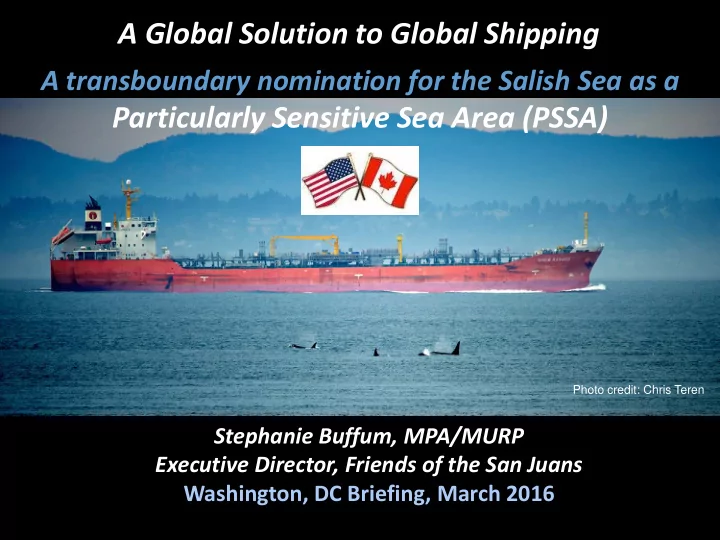
A Global Solution to Global Shipping

Stephanie Buffum, MPA/MURP Executive Director, Friends of the San Juans Washington, DC Briefing, March 2016

A transboundary nomination for the Salish Sea as a

Particularly Sensitive Sea Area (PSSA)

slide-2
SLIDE 2

Outline:

Terms Risk to our waters PSSA Criteria, comparison Protective Measures INTRODUCTION

Particularly Sensitive Sea Area Nomination for the Salish Sea

The Salish Sea is a trans- boundary inland sea shared between British Columbia, Canada and Washington State

slide-3
SLIDE 3

Terms

  • PSSA - Particularly Sensitive Sea Area: “an area that

needs special protection through action by IMO because of its significance for recognized ecological or socio- economic or scientific reasons and which may be vulnerable to damage by international maritime activities.”

  • IMO - International Maritime Organization: a “specialized

agency of the United Nations which is responsible for measures to improve the safety and security of international shipping and to prevent pollution from ships.” Membership: 171 member states; 77 NGOs; 65 IGOs

  • MEPC - Maritime Environment Protection Committee:

(Subsidiary IMO body) MEPC, which consists of all Member States, is empowered to consider any matter within the scope of the Organization concerned with prevention and control of pollution from ships.

  • APM - Associated Protective Measures are specific

protective measures that define the ways and the extent to which a PSSA is protected against listed environmental

  • threats. Examples include: no anchor zones, separation

schemes, areas to avoid, pilotage, vessel traffic system, special areas, and installation of Vessel Traffic Services.

slide-4
SLIDE 4

First Nations and Tribes in the Salish Sea

slide-5
SLIDE 5

Predates Dec 2015 Crude Export Ban

Increase in commercial shipping Traffic above 2013 levels = 43% - 48%

slide-6
SLIDE 6

2013 30 % increase w/o bunkering (refuel) 2015 43 % increase w/o bunkering 2015 48 % increase w bunkering + Grays Harbor Salish Sea Vessel Traffic Increase in commercial shipping Traffic 2013 = 30% in 2015 = 43% - 48%

slide-7
SLIDE 7
  • Social/Cultural Risk
  • f and oil spill
  • First Nations: Food,

medicine, and cultural practices

  • Non tribal people:

recreational fishing and boating, aesthetic

  • Recognition of these

cultural and social values: Obama designated the San Juan Islands National Monument in 2012.

Urgent and critical need

slide-8
SLIDE 8

“A major spill would have a significant impact on Washington state’s maritime economy worth $30 billion and supports 148,000 jobs. – US Senator Maria Cantwell

April 9, 2014

Economic Risk of an Oil Spill

Urgent and critical need

  • Fishing
  • Tourism
  • Property value
slide-9
SLIDE 9

Environmental Risk of an Oil Spill in the Salish Sea

  • 37 species of mammals
  • 172 birds
  • 300 fish
  • 3000 invertebrates
  • 113 endangered, threatened or

species of concern

  • 7 million people

Urgent and critical need Urgent and critical need

slide-10
SLIDE 10

Traffic The Rotary

slide-11
SLIDE 11

Accident and Oil Spill Risk

  • Accident frequency could

increase by 18%

  • Potential oil spill loss could

increase by 68%

  • Potential oil spill loss in Haro

Strait increases by 375% Urgent and critical need Source: 2014 VTRA

slide-12
SLIDE 12

Particularly Sensitive Sea Areas Designation

“A PSSA is…an area that needs special protection through action by the International Maritime Organization because

  • f significance for recognized ecological, socio-economic or

scientific reasons and because it may be vulnerable to being damaged by international shipping activities.”

  • Based on best international practice.
  • Notice to mariners that a designated area is of global

importance and additional protective measures are required.

INTRODUCTION

Bold new venture

slide-13
SLIDE 13

14 PSSAs globally, 2 in USA

slide-14
SLIDE 14

PSSA Criteria for Feasibility:

 PART I: Ecological, Social and/or Cultural Threat (One must be met,

ideally, throughout the entire area...The Salish Sea meets all three!)

 PART II: Vulnerability to Impacts from International Shipping  PART III: Associated Protective Measures (APMs) SensitivityG

slide-15
SLIDE 15

PART I: Ecological, Social and/or Cultural Threat

Ecological Criteria

  • Uniqueness or rarity, critical habitat, spawning or breeding
  • Highly dependent on systems (kelp forests, seagrass beds)
  • Productivity (oceanic fronts, upwelling areas, gyres)
  • Naturalness – a relative lack of human-induced disturbance
  • Rare biological, chemical, physical, or geological features

Social, cultural and economic criteria

  • Livelihood - people depend fishing, recreation, tourism
  • Human dependency - food / cultural / tourism
  • Cultural heritage (historical and archaeological sites)

Scientific and educational criteria will include:

  • Research – high scientific interest
  • Baseline for monitoring studies – suitable
  • Education – exceptional particular natural phenomena

Sensitivity: IMO Criteria for Feasibility

slide-16
SLIDE 16

Types of maritime activities

  • Vessel types, traffic, concentration and interaction
  • Traffic distance offshore or other dangers to nav
  • Harmful substances carried

Natural factors which increase the risk of collision

  • Hydrographical – water depth, bottom and coastline
  • Meteorological – weather, wind, visibility
  • Oceanographic – tidal streams, currents, ice
  • Significance and degree of risk: History of

groundings, collisions, or spill Adverse impacts

  • Stresses from other environmental sources
  • Any measures in effect and their actual or

anticipated beneficial impact

Part II Criteria: Vulnerability to Shipping

slide-17
SLIDE 17

Part III Criteria - Associated Protective Measures (APM)

  • Adoption of ships’ routing and reporting systems
  • No anchor and/or Limited anchorage, bunkering
  • Areas to avoid (ecological, cultural, social aesthetic)
  • Pilotage Routing requirements (voluntary or regulatory)
  • Traffic separation schemes (voluntary or regulatory)
  • Inshore traffic zones (voluntary or regulatory)
  • Prohibition of discharge (voluntary or regulatory)
  • Potential for the area to be listed on the World Heritage List,

declared a Biosphere Reserve, or included on a list of areas of international, regional, or national importance.

Types of Associated Protective Measures

slide-18
SLIDE 18

Draft PSSA Boundary (in evaluation)

Value of PSSA:

  • Highest early warning

system for mariners entering these waters

  • Acknowledgment of

Voluntary standards of care for pilotage, vessel traffic, etc.

  • May expand /

harmonize oversight of incidents

  • May reduce vessel

traffic speed

  • May increase pilotage

“No go areas” or limited areas for bunkering, anchorage

slide-19
SLIDE 19

PSSA Feasibility Criteria: Salish Sea Global Comparison

slide-20
SLIDE 20

Criteria PSSA Salish Sea Ecological World Heritage 7/14 Olympic National Park Ramsar 2/14 Fraser River 1982, 17 state recognized Important Bird Areas and 9 globally recognized IBAs Special Areas 1-3/14 Annex VI Emissions Control Area. Biosphere Reserves 4/14 Olympic National Park, Mount Arrowsmith Scientific Educational present Best International Standard Social Cultural & Economic present

  • 1. Indigenous culture
  • 2. Tourism
  • 3. Marine resource extraction

2 law review articles on the Salish Sea PSSA under review in 2 separate international law journals.

How does the Salish Sea Compare to the other 14 PSSA?

slide-21
SLIDE 21

PSSA Timeline

  • 1. PSSA Feasibility Report completed

May 2014

  • 2. PSSA criteria synthesis & draft nomination completed Aug-Jan 2016
  • 3. Write Law Review articles completed

Aug-Jan 2016

  • 4. Solicit feedback and endorsements for Nomination

Feb-Oct 2016

  • 5. Salish Sea Conf – Share Draft PSSA Nomination

April 2016

  • 6. Associative Protective Measures Workshop

June 2016

  • 7. Final Draft Salish Sea PSSA Nomination Paper

July 2016

  • 8. Governmental endorsements for nomination, cont.

Aug-Dec 2016

  • 9. Coast Salish Celebration, San Juan National Park

Mid Aug 2016 10 US and CAN submit Joint PSSA nomination to IMO Nov 2016 IMO Review (2017), IMO Assembly decision (2018) 2017-2018

slide-22
SLIDE 22

What you can do… Support the preparation and nomination of the Salish Sea PSSA

  • 1. Participate in June APM workshop
  • 2. Solicit letters of support for PSSA from

Tribal, federal, provincial, state and business leaders.

  • 3. Sign the petition sanjuans.org/safeshipping

Photo: Vancouver Sun. April 8, 2015. 3500 gallons of crude spilled from the grain ship the M/V Marathassa English Bay, British Columbia, causing the closure of beaches to swimming and fishing.

slide-23
SLIDE 23

Photo credit: Chris Teren

Thank you

For more information, please contact: Friends of the San Juans

Executive Director, Stephanie Buffum, MPA/MURP Stephanie@sanjuans.org 360.378.2319 tel PO Box 1344 Friday Harbor, WA 98250

A transboundary nomination for the Salish Sea as a Particularly Sensitive Sea Area (PSSA)