A FIBER INJECTION UNIT FOR EXOPLANET SPECTROSCOPY Presenter: Wenhao - - PowerPoint PPT Presentation

a fiber injection unit for exoplanet spectroscopy
SMART_READER_LITE
LIVE PREVIEW

A FIBER INJECTION UNIT FOR EXOPLANET SPECTROSCOPY Presenter: Wenhao - - PowerPoint PPT Presentation

A FIBER INJECTION UNIT FOR EXOPLANET SPECTROSCOPY Presenter: Wenhao Xuan Mentor: Dimitri Mawet Collaboratorsrs: Garreth Ruane, James Kent Wallace, Daniel Echeverri, Michael Randolph Marois et al. 2008 (2010) OUTLINE 1. Science Objectives


slide-1
SLIDE 1

A FIBER INJECTION UNIT FOR EXOPLANET SPECTROSCOPY

Presenter: Wenhao Xuan Mentor: Dimitri Mawet Collaboratorsrs: Garreth Ruane, James Kent Wallace, Daniel Echeverri, Michael Randolph
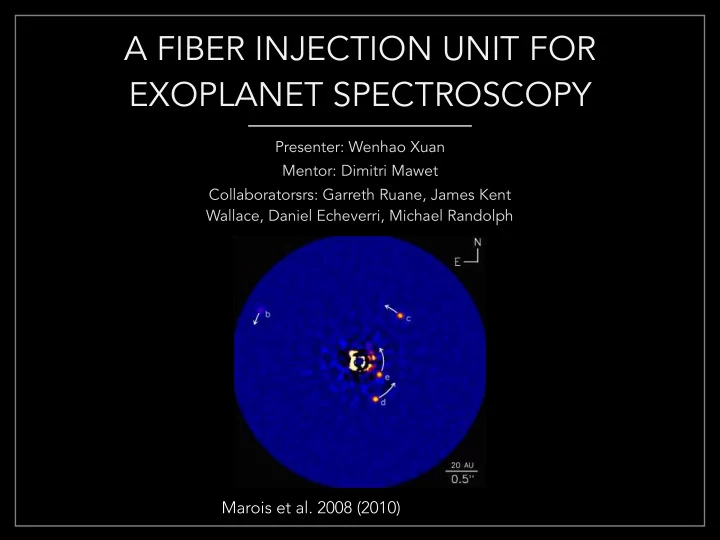
Marois et al. 2008 (2010)

slide-2
SLIDE 2

OUTLINE

1. Science Objectives (Exoplanet Characterization) & Context 2. Building the Fiber Injection Unit 3. Speckle Nulling Experiments 4. Integration of 2&3 5. Conclusions

slide-3
SLIDE 3

MAPPING ATMOSPHERES

Crossfield et al. 2014 NASA/NOAA

slide-4
SLIDE 4

1.0 Relative position (″) CC signal 0.5 0.0 –0.5 –1.0 –60 –40 –20 Velocity (km s–1) Velocity (km s–1) 20

Planet position Star position Stellar velocity

40 –100 –50 50

a b

Snellen et al. 2014

MEASURE PLANET SPIN

slide-5
SLIDE 5

EXOPLANET SPECTRA

Konopacky et al. 2013

slide-6
SLIDE 6

KECK PLANET IMAGER AND CHARACTERIZER (KPIC)

Mawet et al. 2016

slide-7
SLIDE 7

HIGH-CONTRAST IMAGING + HIGH-RESOLUTION SPECTROSCOPY

Elimination of modal noise. Bypasses speckle noise calibration issues (Snellen et al. 2015). Spectrograph receives less background noise. Spectrograph more compact (conservation of étendue).

slide-8
SLIDE 8

SINGLE-MODE TRANSMISSION OF PLANET

One single propagation mode (LP01) Very low losses Coupling efficiency hinged on entrance beam quality & alignment

E-field amplitude profiles for the guided modes of a multi-mode fiber. Credits to RP Photonics.

slide-9
SLIDE 9

A BRIEF INTRODUCTION TO ADAPTIVE OPTICS & CORONAGRAPHY

slide-10
SLIDE 10
slide-11
SLIDE 11

PROTOTYPING THE FIU

Lyot stop Tip-tilt mirror Tracking CCD Corner cube Fiber aligner Objective lens lens SM fiber

Overhead view of the fiber injection unit

slide-12
SLIDE 12

PERFORMANCE OF FIU

beacon image “planet” suppressed “star”

Image of star, planet and beacon taken by the tracking CCD

Fiber coupling efficiency of ~60%-70% achieved Proves to be a simple and smoothly repeatable design

slide-13
SLIDE 13

SPECKLE NULLING BASICS

What? — Blobs of residual starlight in final image plane that result from wavefront aberrations How? — Generate anti-speckle by imposing sinusoids on the deformable mirror & interfere it with existing speckle Why? — Improves SNR of planet image/spectra

Image of our speckle field taken with the tracking CCD

slide-14
SLIDE 14

h = 0.5h0(1+cos(2π Rcos(θ-q)/x0 + αlp))

  • h0: maximum poke height
  • q: angle of sinusoid
  • x0: actuators/cycle (spatial freq. = numAct/x0)
  • αlp: phase delay

π/2 Fourier transform Fourier transform

Pupil Plane Focal Plane

slide-15
SLIDE 15

SPECKLE NULLING: IN ACTION

(~3λ/d, pi/2)

slide-16
SLIDE 16

suppression factor ~ 11 (3λ/D speckle)

slide-17
SLIDE 17

suppression factor ~ 8 (2λ/D speckle)

slide-18
SLIDE 18

suppression factor ~ 6 (4λ/D speckle)

slide-19
SLIDE 19

INTEGRATION: SPECKLE NULLING @ FIBER (WORK IN PROGRESS)

Besides intensities from CCD, we record power with a photodiode Expect increased suppression of speckle noise through SM fibers

Results?

slide-20
SLIDE 20

CCD RESULTS V.S. PHOTODIODE RESULTS

Suppression: ~ 100;

  • ptimal params: 80nm & 2.83rads

Suppression: ~ 9;

  • ptimal params: 90nm & 3.14rads
slide-21
SLIDE 21

CONCLUSIONS NEXT STEPS

The FIU works! High coupling efficiencies could be achieved Speckle nulling with a SM fiber will improve contrast for the planet Automate planet coupling process with piezo actuators Full-scale High-Contrast Spectroscopy Testbed (HCST) On-sky demonstration

W.M. Keck Observatory

slide-22
SLIDE 22

COMING SOON!

Planned layout of future HCST

slide-23
SLIDE 23

ACKNOWLEDGEMENTS

Special thanks to Dimitri Mawet, Garreth Ruane, James Kent Wallace for their invaluable mentorship, Daniel Echeverri and Michael Randolph for being such talented lab partners, and Elodie Choquet, Ji Wang, Reed Riddle, Jason Fucik, Patrick Murphy, Judy McClain for their constant support and assistance.

slide-24
SLIDE 24

REFERENCES

  • C. Marois, B. Macintosh, T. Barman, B. Zuckerman, I. Song, J. Patience, D. Lafreniere, R. Doyon, “Direct

Imaging of Multiple Planets Orbiting the Star HR 8799,” Science, Volume 322, Issue 5906, pp. 1348- (2008). Crossfield, I. J. M., Biller, B., Schlieder, J. E., Deacon, N. R., Bonnefoy, M., Homeier, D., Allard, F., Buenzli, E., Henning, T., Brandner, W., Goldman, B., and Kopytova, T., “A global cloud map of the nearest known brown dwarf,” Nature 505, 654–656 (Jan. 2014).

  • D. Mawet, P

. Wizinowich, R. Dekany, M. Chun, D. Hall, S. Cetre, O. Guyon, J.K. Wallace, B. Bowler, M. Liu, G. Ruane, E. Serabyn, R. Bartos, J. Wang, G. Vasisht, M. Fitzgerald, A. Skemer, M. Ireland, J. Fucik,

  • J. Fortney, I. Crossfield, R. Hu, B. Benneke, “Keck Planet Imager and Characterizer: concept and phased

implementation,” Proc. SPIE 9909, Adaptive Optics Systems V, 99090D, (Jul. 2016). Snellen, I. A. G., Brandl, B. R., de Kok, R. J., Brogi, M., Birkby, J., and Schwarz, H., “Fast spin of the young extrasolar planet β Pictoris b,” Nature 509 , 63–65 (May 2014). Snellen, I., de Kok, R., Birkby, J. L., Brandl, B., Brogi, M., Keller, C., Kenworthy, M., Schwarz, H., and Stuik, R., “Combining high-dispersion spectroscopy with high contrast imaging: Probing rocky planets around our nearest neighbors,” A&A 576, A59 (Apr. 2015). Benneke, B., “Strict Upper Limits on the Carbon-to-Oxygen Ratios of Eight Hot Jupiters from Self- Consistent Atmospheric Retrieval,” arXiv.org , 7655 (Apr. 2015).