SLIDE 1
A couple billion lines of code later: static checking in the real world
Andy Chou, Ben Chelf, Seth Hallem Scott McPeak, Bryan Fulton, Charles Henri-Gros, Ken Block, Anuj Goyal, Al Bessey Chris Zak & many others Coverity Dawson Engler Associate Professor Stanford
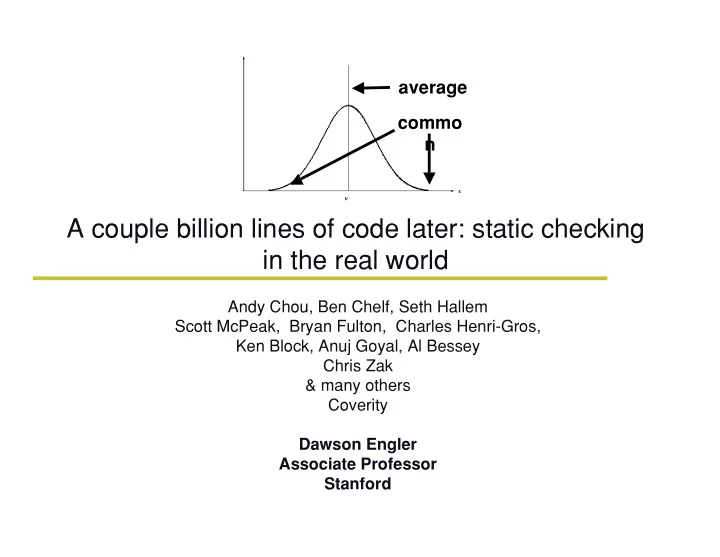
average commo n
SLIDE 2
One-slide of background.
υ Academic Lineage:
– MIT: PhD thesis = new operating system (“exokernel”) – Stanford (’99--): techniques that find as many serious bugs as possible in large, real systems.
υ Main religion = results.
– System-specific static bug finding [OSDI’00, SOSP’01…] – Implementation-level model checking [OSDI’02, ’04, ’06]. – Automatic, deep test generation [Spin’05,Sec’06,CCS’06, ISSTA’07]
υ Talk:
– Experiences commercializing our static checking work – Coverity: 400+ customers, 100+ employees. – Caveat: my former students run company; I am a voyeur.
SLIDE 3
Many stories, two basic plots.
υ Fun with normal distributions υ Social vs Technical: “What part of NO! do you not understand?”
– No: you cannot touch the build. – No: we will not change the source. – No: this code is not illegal C. – No: we will not understand your tool. – No: we do not understand static analysis. average common (n inf)
No!
SLIDE 4
υ Systems have many ad hoc correctness rules
– “acquire lock l before modifying x”, “cli() must be paired with sti(),” “don’t block with interrupts disabled” – One error = crashed machine
υ If we know rules, can check with extended compiler
– Rules map to simple source constructs – Use compiler extensions to express them – Nice: scales, precise, statically find 1000s of errors
Context: system-specific static analysis
lock_kernel(); if (!de->count) { printk("free!\n"); return; } unlock_kernel();
Linux fs/proc/ inode.c EDG frontend Lock checker “missing unlock!”
SLIDE 5
υ Lots of papers. System specific static checking [OSDI’00] (Best paper), Security checkers [Oakland’02,CCS’03, FSE’03] Race condition and deadlock [SOSP ’03], Others checkers: [ASPLOS’00,PLDI’02,FSE’02 (award)] Infer correctness rules [SOSP’01, OSDI’06] Statistical ranking of analysis decisions [SAS’03,FSE’03] υ PhDs, tenure, award stuff. υ Commercialization: Coverity.
– Successful enough to have a marketing dept. – Proof: next few slides. – Useful for where data came from & to see story settled on after N iterations.
The high bit: works well.
SLIDE 6
Our Mission
To improve software quality by automatically identifying and resolving critical defects and security vulnerabilities in your source code
SLIDE 7
Explore different visual
SLIDE 8
- 2. Multiple Origins of Source Code
Outsourced Code
– Offshore – Onshore
3rd Party Code
– Components and Objects – Libraries
Infrastructure Frameworks
– Java EE – Service Oriented Architecture (SOA)
Legacy Code Bases
– Code through Acquisitions – Code Created by Past Employees
SLIDE 9 Technological Leadership [2007:dated]
Stanford Research Program C analysis C++ analysis Security Concurrency Java Analysis Enterprise Management Satisfiability
SLIDE 10
Over 1 Billion Lines of Code
57% of Software companies
54% of Networking companies 50% of Computer companies 44% of Aerospace companies
Coverity Customers in the Fortune 500:
SLIDE 11
Over 1 Billion Lines of Code
SLIDE 12
Coverity Trial Process
Test your code quality
– Analyze your largest code base – One day set up, two hours for results presentation – Test drive the product at your facility
Benefit to your team
– Post trial report describing summary of findings – Sample defects from your code base – Fully functional defect resolution dashboard
SLIDE 13 Trial = main verb of company.
υ
Can’t do trial right, won’t have anything.
υ
First order dynamics:
– Setup, run, present “live” w/ little time. – Error reports must be good, setup easy since won’t understand code – Can’t have many false positives since can’t prune – Must have good bugs since can’t cherry pick
υ
Some features:
– $0. means anyone can get you in. Cuts days of
- negotiation. Sales guy goes farther.
– Straight-technology sale. Often buyer=user. – Filters high support costs: if customer buys, had a setup where we could configure and get good errors. – Con: trial requires shipping SE + sales guy.
SLIDE 14
Overview
υ
Context
υ
Now:
– A crucial myth. – Some laws of static analysis – And how much both matter.
υ
Then: The rest of the talk.
SLIDE 15
A naïve view
υ
Initial market analysis:
– “We handle Linux, BSD, we just need a pretty box!” – Obviously naïve. – But not for the obvious reasons.
υ
Academia vs reality difference #1:
– In lab: check one or two things. Even if big = monoculturish. – In reality: you check many things. Independently built. – Many independent things = normal distribution. – Normal dists have points several std dev from mean (“weird”) – Weird is not good.
υ
First law of checking: no check = no bug.
– Two even more basic laws we’d never have guessed mattered.
SLIDE 16
Law of static analysis: cannot check code you do not see.
SLIDE 17 How to find all code?
υ
`find . –name “*.c” ’ ?
– Lots of random things. Don’t know command line or includes.
υ
Replace compiler?
– “No.”
υ
Better: intercept and rewrite build commands.
– In theory: see all compilation calls and all options etc.
υ
Worked fine for a few customers.
– Then: “make?” – Then: “Why do you only check 10K lines of our 3MLOC system?” – Kept plowing ahead. – “Why do I have to re-install my OS from CD after I run your tool?” – Good question…
make –w > & out replay.pl out # replace ‘gcc’ w/ ‘prevent’
SLIDE 18 The right solution
υ
Kick off build and intercept all system calls
– “cov_build <your build command>” grab chdir, execve, … – Know exact location of compile, version, options, environ.
υ
Probably *the* crucial technical feature for initial success.
– Go into company cold, touch nothing, kick off, see all code. – In early 2000s more important than quality of analysis? – Not bulletproof. Little known law: “Can’t find code if you can’t get command prompt”
υ
A only-in-company-land sad story:
– On windows: intercept means we must run compiler in debugger. – Widely used version of msoft compiler has a use-after-free bug hit if source contains “#using” – Works fine normally. Until run w/ debugger! – Solution?
υ
Lesson learned?
– Well, no: Java.
SLIDE 19
(Another) Law of static analysis: cannot check code you cannot parse
SLIDE 20
Myth: the C language exists.
υ
Well, not really. The standard is not a compiler.
– The language people code in? – Whatever their compiler eats. Fed illegal code, your frontend will reject it. – It’s *your* problem. Their compiler “certified” it.
υ
Amplifiers:
– Embedded = weird.
Msoft: standard conformance = competitive disadvantage. C++ = language standard measured in kilos.
υ
Basic LALR law:
– What can be parsed will be written. Promptly. – The inverse of “the strong Whorfian hypothesis” is a empirical fact, given enough monkeys..
SLIDE 21 A sad storyline that will gross exactly $0.
υ
“Deep analysis?! Your tool is so weak it can’t even parse C!”
coreHdr.h some illegal construct #include “coreHdr.h” … File1.c #include “coreHdr.h” … …entire system… FileN.c “Parse error: illegal use of …”
yourTool
SLIDE 22
unsigned x = 0xdead_beef; unsigned x @”text”;
Some specific example stories.
coreHdr.h
int foo(int a, int a); “redefinition of parameter : ‘a’”
void x; “storage size of ‘x’ is not known” typedef char int; “invalid suffix ‘_beef’ on integer constant” “useless type name in empty declaration” “stray ‘@’ in program”
SLIDE 23
asm foo() { mov eax, eab; }
#pragma asm mov eax, eab #end_asm
#pragma cplusplus on inline float __msl_acos(float x) { … } inline double __msl_acos(double x) {… } #pragma cplusplus off
Some specific example stories.
coreHdr.h “expected '=', ',', ';',
'asm' or…” Int16 Int16 ErrSetJump(ErrJumpBuf ErrSetJump(ErrJumpBuf buf buf) ) = = { 0x4E40 + 15, 0xA085 }; { 0x4E40 + 15, 0xA085 };
“conflicting types for _msl_acos”;
SLIDE 24
Great moments in unsound hacks
υ Tool doesn’t handle (illegal) construct?
– Have reg-ex that runs before preprocessor to rip it out. – Amazingly gross. – Actually works. – Unsound = more bugs
ppp_translate (“/#pragma asm/#if 0/”); ppp_translate(“/#pragma end_asm/#endif/”); #pragma asm … #pragma end_asm #if 0 … #endif
SLIDE 25
Msoft story: ubiquitous, gross.
coreHdr.h
I can put whatever I want here. It doesn’t have to compile. If your compiler gives an error it sucks. #include <some-precompiled-header.h>
“ERROR! ERROR! ERROR! #import “file.tlb” “storage size of ‘bar’ is not known” #using “foo.net”
SLIDE 26 Making the depressing more precise
υ
Goal: you must approximate:
– Lang(Compiler) = { f | ∃ o,e,c Accepts(Compiler,f,o,e,c) }
υ
Where:
– Compiler = a specific version of a “native” compiler f = file.c, plus headers
- = ordered list of command line options and response files
e = environment c = compiler-specific configuration files
υ
To work well:
– Lang(Tool) ~ Lang(Compiler1) ∪ Lang(Compiler2) ∪ … – Where | Lang(Compiler1) ∪ Lang(Compiler2) ∪ … | = large.
SLIDE 27
OK: so just how much does C not exist?
υ We use Edison Design Group (EDG) frontend
– Pretty much everyone uses. Been around since 1989. – Aggressive support for gcc, microsoft, etc. (bug compat!)
υ Still: coverity by far the largest source of EDG bugs:
– 406 places where frontend hacked (“#ifdef COVERITY”) 266 “add compiler flag” calls still need custom rewriter for many supported compilers:
912 arm.cpp 629 bcc.cpp 334 cosmic.cpp 1848 cw.cpp 673 diab.cpp 914 gnu.cpp 1656 metrowerks.cpp 1294 microsoft.cpp 285 picc.cpp 160 qnx.cpp 1861 renesa.cpp 384 st.cpp 457 sun.cpp 294 sun_java_.cpp 756 xlc.cpp 280 hpux.cpp 603 iccmsa.cpp 421 intel.cpp 1425 keil.cpp
SLIDE 28 Completely unbelievable!
υ
Incredibly banal. But if not done, can’t play.
– Takes more effort than can imagine. – Full time team. – This is their mission. Never finished. – Certainly not in only 5 years.
υ
Two examples from trial reports from within *72 hours* of making this slide:
υ
*Never* would have guessed this is the first-order bound on how much bugs you find.
#pragma packed 4 struct foo {…}; __creregister volatile int x; volatile int x; #pragma packed (4) struct foo{…};
SLIDE 29
Annoying amplifier: Can we get source?
υ *NO*!
– Despite NDAs – Even for parse errors – Even for preprocessed – Might just be because coverity too small to sue?
υ Sales engineer has to type in from memory.
– And this works as well as you’d expect. – Even worse for performance problems. – Oh, and you get about 3 tries to fix a problem.
υ Bonus: add a TLA and things get worse.
– NSA = Can we see source? NO! – FDA, FAA = frozen toolchain. Theirs. Yours. Banal, crucial: Where to get license for a 20+yr/old compiler?
SLIDE 30 The end result
υ Heuristic: If you’ve heard of it, will wind up supporting it: υ Forced support for many things haven’t heard of (or read
– Tasking, Microtec, Metaware, Microchip C-18, Code Vision, National Instruments, Cosy, HiWare, Franklin Software, Watcom, Borland, Apogee, Cavium, Ceva, ImageCraft C compiler (favorite!)
A compiler development company / Photography company: "Specializing in Anime and SF/Fantasy Convention photography and other costuming photography. We can also do on-location photoshoots."
SLIDE 31
Overview
υ Context υ The banal hand of reality:
– Law: Cannot check code you can’t find – Law: Cannot check code you can’t parse – Myth: C exists
υ Next:
– Do bugs matter? – Do false positives matter? – Do false negatives matter?
υ The best bugs υ Academics meet reality. Reality wins.
– You fix all bugs, right? – The evils of non-determinism
SLIDE 32
Do bugs matter? (“Huh?”)
υ Shockingly common: clear, ugly crash error.
– “So?” – “Isn’t that bad? What happens?” – “Oh, will crash. We will get a call.” Shrug.
υ If developers don’t feel pain, they often don’t care.
– Technical: clustered applications that reboot quick. – Non-technical: if QA cannot reproduce, then no blame.
υ But bugs matter right?
– Not if: Too many. Too hard. [More later]
υ The next step down: “That’s not a bug”
– Recognition requires understanding. – Cubicles are plentiful. Understanding, not so much.
SLIDE 33
“No, your tool is broken: that’s not a bug”
υ “No, it’s *loop*.” υ “No, I meant to do that: they are next to each other” υ “No, that’s ok: there is no malloc() between” υ “No, ANSI lets you write 1 past end of the array!”
– (“We’ll have to agree to disagree.” !!!!)
int a[2], b; memset(a, 0, 12);
unsigned p[4]; p[4] = 1;
for(i=1; i < 0; i++) …deadcode… free(foo); foo->bar = …;
SLIDE 34
(Often) People don’t understand much.
υ Our initial naïve expectation: People who write code for
money understand it. Instead:
– “To build, I just press this button…” – “I’m just the security guy” – “That bug is in 3rd party code” – “Is it a leak? Author left years ago…”
υ People don’t understand compilers.
– “Static” analysis? What is the performance overhead? – Business card at customer site: “Static analyzer” (?!) – “We use purify, why do we need your tool?” – Anything that finds bugs = testing. – “Think of it as super compiler warnings”
SLIDE 35
How to handle cluelessness?
υ Can’t argue
– Stupidity works with modular & emotional arithmetic.
υ Instead: use normal distributions.
– Try to get a large meeting. (Schedule before lunch?)
υ More people in room = more likely someone in room that:
– Cares; is very smart; can diagnose error; has been burned by similar error; loses bonus for errors; … – Is in another group! – If layoffs happen: will be fired(!) – These guys beat these guys
SLIDE 36
What happens when can’t fix all the bugs?
υ Rough heuristic:
– < 1000 bugs? Fix them all. – >= 1000? “Baseline”
υ Tool improvement viewed as “bad”
– You are manager. Forall metrics X of badness you want: – No manager gets a bonus for:
X time
bad
SLIDE 37
How to upgrade when more bugs != good?
υ Upgrade cycles: – Never. Guaranteed “improvement.” – Never before release (when could be most crucial) – Never before a meeting (at least is rational). – Upgrade. Roll back. (~ once per company.) – Renew, but don’t upgrade. (Not cheap.) – Once a year (most large customers). “Rebaseline” Upgrade only checkers where you fix all/most errors. υ People really will complain when your tool gets better.
– V2.4: 2,400 initial errors. Fixed to get to 1,200 – Upgrade to V3.5 = 2,600 errors. – *MAD* For both reasons.
SLIDE 38
Do false positives matter?
υ > 30% false rate = big problem.
– Ignore tool. Miss true errors amidst false. – Low trust = Complex bugs called false positives. Vicious cycle. – Caveat: unless you wrap person around checker? – Caveat: some users accept 70% (or more: security guys). – Current deployment threshold = ~20%. – Unfortunately: many cases “high FP” rate not analysis problem
υ Not all false positives equal:
– Initial N reports false? “Tool sucks” (N ~ 3) – *Crucial*: no embarrassing FPs. – Stupid FP? Implies tool stupid. Not good for credibility. – Social: don’t want to embarrass tool champions internally – Important: no failed merges. – Mark FP once? Fine. Reappears & mark again? email support.
SLIDE 39
A false positive pop quiz
υ Remove false positives: good or bad?
– Initial trial: 700 reports – Fixed some problems. Remove 300 false positives. Yea! – What’s the problem if they want to rerun before buy?
υ Tool X flags more errors than your tool.
– However: Tool X sucks and these are almost all FPs! – Do you get sale or not? – What’s a bad evaluation method for your company?
υ Your checker X does tricky thing
– It finds *many* *many* good bugs. – Developer X does not understand your checker – What happens?
SLIDE 40 Do false negatives matter?
υ Of course not! Invisible! Oops:
– Trial: intentionally put in bugs. “Why didn’t you find it?” – Easiest sale: horribly burned by specific bug last week. You find
– Upgrade checker: set of defects shifts slightly = “Dude, where is my bug?” (Goal: 5% “jitter”) – Run A and B. Even if A >> B, often A’s bugs not a superset
υ A very nasty dynamic (static, testing, formal)
– Tool has bugs. Some lead to FPs some to FNs. – FPs visible = fixable. But each fix has chance of adding FN. – FNs invisible.
υ Currently: favor analysis hacks to remove FPs at cost of FNs
SLIDE 41
Overview
υ Context υ The banal, vicious laws of reality and its cruel myths.
υ Practical questions:
– Do bugs matter? – Do false positives matter? – Do false negatives matter?
υ Academics meet reality. Reality wins.
– The evils of non-determinism
υ The best bugs υ Commerce factoids
SLIDE 42
Non-determinism = very bad.
υ Major difference from academia – People really want the same result from run to run. – Even if they changed code base – Even if they upgraded tool. – Their model = compiler warnings. – Classic determism: same input + same function = same result. – Customer determinism: different input (modified code base) + different function (tool version) = same result. – They know in theory “not a verifier”. Different when they actually see you lose known errors. Rule: 5% jitter.
υ Determinism requirement really sucks.
– Often tool changes have very unclear implications. [Next.] – Often randomization = elegant solution to scalability. Can’t do.
SLIDE 43
An explosion of non-determ unfun: caching.
υ Code has exponential paths.
– At join points and in same state, prune. – So far so good. What about multiple pieces of state? {l == locked} … unlock(l); return 0; if(i) lock(l); cache: {l == locked} foo(); lock(l); {l == locked}
X
Cache hit! {l == locked}
SLIDE 44
Problem: more code = less cache hits
υ Analyze more code?
– Often don’t get cache hits b/c independent state
{l == locked} … unlock(l); return 0; if(i) lock(m); foo() lock(l); {m == locked} {l == locked} {m == locked} Cache miss! lock(l); lock(m); {m == locked, l == locked} Cache miss!
SLIDE 45
Subset caching
υ Hack:
– Cache = union of prior states. Hit = subset of that
υ What if we just unroll loop 1-2 times?
– Not enough: 1MLOC + if-statements = not terminate. – Misses bugs: want fixed point based on checker value
{l == locked} … unlock(l); return 0; {m == locked} {l == locked} {m == locked} Cache miss! {m == locked, l == locked} Cache hit! Cach e Miss!
SLIDE 46 So?
υ
Basically a deal with the devil [that we would do all over again]
– Works well for finding many bugs on large code bases. – Not so well at finding the *same* bugs
υ
Bad: Minor code change = different cache hit or miss.
– Effect is enormous.
υ
True story:
– Version2.0: follows true path, then false. – Version3.0: follows false path, then true. – People went *insane*. 20% fluctuation in errors. Soln?
υ
Bad: don’t analyze an interesting path b/c cache hit.
– The occasional *very* stupid false positive or negative – Hurts trust in tool. – – Lost *huge* sale: found lots of bugs just not this one:
x = 0; for(…) switch(…) … w = y / x;
SLIDE 47 Just how bad is non-determism?
υ
Users pick determinism over bugs, over manual labor
– CPrevent builds model of each analyzed function. – 1st scan: missing models for functions hasn’t analyzed yet – 2nd scan: has these models. If use them = less FPs + more bugs. – Common: people turn off so *discards* the prior results!
υ
Thwarts natural solutions to large code problems
– 10+MLOC can be more than 24hrs. Lose sales. – Natural sol’n for exponential paths: Random search, timeout. – Both are complete non-starters.
υ
No inference, no ranking.
– I think this is *literally* 10x dropped right on the floor.
υ
Even worse in java:
– Represent function models (summaries) as bytecode – Elegant! Clean! Yea!. – Uh oh: must be < 32K. Larger? Discard. – Small change = different discards. Ugh…
SLIDE 48
Overview
υ Context υ The banal, vicious laws of reality and its cruel myths υ What actually matters? υ Academics meet reality, good and hard.
– The evils of non-determinism
υ Bugs: often best come from analyzing programmer beliefs. υ Business factoids an academic finds amusing.
SLIDE 49
Myth: more analysis is always better
υ Does not always improve results, and can make worse υ The best error:
– Easy to diagnose – True error
υ More analysis used, the worse it is for both
– More analysis = the harder error is to reason about, since user has to manually emulate each analysis step. – Number of steps increase, so does the chance that one went wrong. No analysis = no mistake.
υ In practice:
– Demote errors based on how much analysis required – Revert to weaker analysis to cherry pick easy bugs – Give up on error classes that are too hard to diagnose.
SLIDE 50
More general: A too-hard bug didn’t happen.
υ In fact, can be worse.
– People don’t want to look stupid. – If they don’t understand error, what will they do?
υ Social has *major* big impact on technical.
– User not same as tool builder. – Uninformed. Inattentive. Cruel. – HUGE problem. Prevents getting many things out in world.
υ Give up on error classes that need too much sophistication.
– statistical inference, – race conditions, – heap tracking – globals. – In some ways, checkers lag much behind our research ones.
SLIDE 51
No bug is too stupid to check for.
υ Someone, somewhere will do anything you can think of. υ Best recent example:
– From security patch for bug found by Coverity in X windows that lets almost any local user get root. – Got on foxnews (website, not O’Riley) – So important marketing went to town:
SLIDE 52 Do you use X?
if (getuid() != 0 && geteuid == 0) {
- ErrorF(“
- nly root”);
- exit(1);
}
Since without the parentheses, the code is simply checking to see if the Since without the parentheses, the code is simply checking to see if the geteuid function in libc was loaded somewhere other than address 0 geteuid function in libc was loaded somewhere other than address 0 (which is pretty much guaranteed to be true), it was reporting it was safe (which is pretty much guaranteed to be true), it was reporting it was safe to allow risky options for all users, and thus a security hole was born. to allow risky options for all users, and thus a security hole was born.
- Alan Coopersmith, Sun Developer
SLIDE 53
Security Advisory
First exploit was published 5 hours after the hole was publicly reported
SLIDE 54
One of the best stupid checks: Deadcode
υ Programmer generally intends to do useful work
– Flag code where all paths to it are impossible or it makes no sense. Often serious logic bug.
υ From UU aodv
– After send, take packet off queue. Bug: if any packet on list before the one we want will discard them!
// packet_queue.c:packet_queue_send prev = null; while(curr) { if(curr->dst_addr == dst_addr) { if(prev == NULL) PQ.head = curr->next; else …DEADCODE [prev never updated]…
SLIDE 55
Deadcode: Most serious error ever(?)
υ Trial at chemotherapy machine company. υ During results meeting:
– Literally ran out to fix – Note: heavily sanitized & simplified code.
enum Tube { TUBE0, TUBE1 }; void PickAndMix(int i) { enum Tube tfirst, tlast; if (TUBE0 == i) { tfirst=TUBE0; tlast=TUBE1; } else if (TUBE0 == i) { tfirst=TUBE1; tlast=TUBE0; } MixDrugs(tfirst,tlast); }
SLIDE 56
υ MUST beliefs:
– Inferred from acts that imply beliefs code *must* have. – Check using internal consistency: infer beliefs at different locations, then cross-check for contradiction
υ MAY beliefs: could be coincidental
– Inferred from acts that imply beliefs code *may* have – Check as MUST beliefs; rank errors by belief confidence.
Best bugs: Cross-check code belief systems
x = *p / z; // MUST belief: p not null // MUST: z != 0 unlock(l); // MUST: l acquired x++; // MUST: x not protected by l // MAY: A() and B() // must be paired B(); // MUST: B() need not // be preceded by A() A(); … B(); A(); … B(); A(); … B(); A(); … B();
SLIDE 57
Internal null: trivial, probably best checker.
υ “*p” implies programmer believes p is not null υ A check (p == NULL) implies two beliefs:
– POST: p is null on true path, not null on false path – PRE: p was unknown before check
υ Cross-check beliefs: contradiction = error. υ Check-then-use (79 errors, 26 false pos) /* 2.4.1: drivers/isdn/svmb1/capidrv.c */ if(!card) printk(KERN_ERR, “capidrv-%d: …”, card->contrnr…)
SLIDE 58 Null pointer fun
υ Use-then-check: 102 bugs, 4 false υ Nice thing about belief analysis: perspective.
– Natural to reason about: “Does this code make any sense?” – And once you do that, some very interesting errors…
– X bug: Must know B is true but check – Chemo: Must know B is false, but check
υ
If only read one of my papers, read this one: “Bugs as deviant behavior…” [sosp’01] /* 2.4.7: drivers/char/mxser.c */ struct mxser_struct *info = tty->driver_data; unsigned flags; if(!tty || !info->xmit_buf) return 0;
SLIDE 59
Overview
υ Context υ The banal, vicious laws of reality and its cruel myths υ What actually matters? υ Academics meet reality, good and hard.
– The evils of non-determinism
υ Bugs: often best come from analyzing programmer beliefs. υ Business factoids an academic finds amusing.
SLIDE 60 Technical can help social
υ
Tool has simple message: “No touch, low false positives, good bugs”
– Can explain it to mom? Then can explain to almost all sales guys & customers – Complicated? Population that understands much smaller. – This effect is not trivial.
υ
Relationship therapy through tool “objectivity”
– UK company B outsources to India company A – B complains about A’s code quality. They fight. – Decide to use Coverity as arbitor. Happy. (I still can’t believe this.)
υ
Wide tool use = seismic change in the last ~4 years.
– People get it. “Static” no longer = “huh?” or “lint” (i.e., suck) – Networking effects. – Result: Much much much easier to sell tools now.
SLIDE 61 Some commercial experiences
υ
Surprise: Sales guys are great
– Easy to evaluate. Modular.
υ
Careful what you wish for: bad competitor tools
– Time to sale ~ max(time for all competitors to do trial). – Worst case: tool sounds “great” but requires lot of hacking on build system – – Take existing customer from really bad tool. Great? Well… – Culture = disdain rather than curiosity. – Social: Often have ugly processes in place in attempt to make tool usable. – Poetic justice: bad process left at your early-adopting customers!
υ
But sometimes bad is good:
– Huge company: early on did 15+ trials across company, in end lost seven figure perpetual license deal. Sad faces. – Have since made *2-3x* off of them! – Company X bought license, next week fired 110 people. Bad?
υ
VCs... Some are good, interesting people. Some are evil, and in dumb ways.
SLIDE 62
Some useful numbers
υ Already seen:
– 1000: number of bugs after which they baseline. – 1.0: probability error labeled as FP if they don’t understand – -m: slope of bug trend line for manager to get bonus.
υ Code numbers:
– 12hr, 24hr: common upper bounds for analysis time – 700 lines / second: ~speed of analysis to meet these times – 10M: “large” code base
υ Bugs:
– 3: number of attempts you can make to fix a bug in your tool – 10: reduction in fix time if you assign blame for bugs
υ People:
– 5 minutes before asymptotic decay in programmer interest – 40: upper bound on active opportunities sales guy can manage – 0: price of initial trial. – 20K: not even worth it to charge per trial
SLIDE 63
Academics don’t understand money.
υ “We’ll just charge per seat like everyone else”
– Finish the story: “Company X buys three Purify seats, one for Asia, one for Europe and one for the US…”
υ Try #2: “we’ll charge per lines of code”
– “That is a really stupid idea: (1) …, (2) … , … (n) …” – Actually works. I’m still in shock. Would recommend it.
υ Good feature for you the seller:
– No seat games. Revenue grows with code size. Run on another code base = new sale.
υ Good feature for buyer: No seat-model problems
– Buy once for project, then done. No per-seat or per-usage cost; no node lock problems; no problems adding, removing or renaming developers (or machines) – People actually seem to like this pitch.
SLIDE 64
Laws of static bug finding
υ Vacuous tautologies that imply trouble
– Can’t find code, can’t check. – Can’t compile code, can’t check.
υ A nice, balancing empirical tautology
– If can find code – AND checked system is big – AND can compile (enough) of it – THEN: will *always* find serious errors.
υ A nice special case:
– Check rule never checked? Always find bugs. Otherwise immediate kneejerk: what wrong with checker???
SLIDE 65
Outline
υ Context υ Experience. Assertions.
– Big problem 1: normal distributions. Not like the lab. – Big problem 2: 10x reduction in knowledge in user base.
υ Next: One of most consistently powerful tricks: belief analysis.
– Find errors where you don’t know what the truth is. – Infer rule. – Infer the state of the system – Old trick: but have used in every checker written since ’01. – Haven’t seen any checker that wouldn’t be improved.
υ Summary
SLIDE 66
Static vs dynamic bug finding
υ Static: precondition = compile (some) code.
– All paths + don’t need to run + easy diagnosis. – Low incremental cost per line of code – Can get results in an afternoon. – 10-100x more bugs.
υ Dynamic: precondition = compile all code + run
– What does code do? How to build? How to run? – Pros: on executed paths:
» Runs code, so can check implications. » End-to-end check: all ways to cause crash. » Reasonable coverage: surprised when crash. υ Result:
– Static better at checking properties visible in source, dynamic better at properties implied by source.
SLIDE 67
Assertion: Soundness is often a distraction
υ Soundness: Find all bugs of type X.
– Not a bad thing. More bugs good. – BUT: can only do if you check weak properties.
υ What soundness really wants to be when it grows up:
– Total correctness: Find all bugs. – Most direct approximation: find as many bugs as possible.
υ Opportunity cost:
– Diminishing returns: Initial analysis finds most bugs – Spend time on what gets the next biggest set of bugs – Easy experiment: bug counts for sound vs unsound tools.
υ Soundness violates end-to-end argument:
– “It generally does not make much sense to reduce the residual error rate of one system component (property) much below that of the others.”
SLIDE 68
Open Q: Do static tools really help?
– Danger: Opportunity cost. – Danger: Deterministic canary bugs to non-deterministic.
Bugs found Bad behavior The optimistic hope Bugs found The null hypothesis Bad behavior Bugs found An Ugly Possibility Bad behavior
SLIDE 69
Open Q: how to get the bugs that matter?
υ Myth: all bugs matter and all will be fixed
– *FALSE* – Find 10 bugs, all get fixed. Find 10,000…
υ Reality
– Sites have many open bugs (observed by us & PREfix) – Myth lives because state-of-art is so bad at bug finding – What users really want: The 5-10 that “really matter”
υ General belief: bugs follow 90/10 distribution
– Out of 1000, 100 (10? or 1?) account for most pain. – Fixing 900+ waste of resources & may make things worse
υ How to find worst? No one has a good answer to this.
– Possibilities: promote bugs on executed paths or in code people care about, …
SLIDE 70 Scan Scan’ ’s One Year Anniversary s One Year Anniversary
Website Website Relaunch Relaunch on March 6
th, 2007
, 2007
SLIDE 71 Authority on Open Source Code Authority on Open Source Code
Chosen by DHS to Harden Open Source Chosen by DHS to Harden Open Source
- Over 250 commonly used open source packages
Over 250 commonly used open source packages
- Over 55 Million LOC analyzed nightly on standard hardware
Over 55 Million LOC analyzed nightly on standard hardware
- Maintainers fixed over 7000 bugs and security violations to date
Maintainers fixed over 7000 bugs and security violations to date
SLIDE 72 History of History of Research&Growth Research&Growth of
Coverity [2007:outdated] [2007:outdated]
2003 2004 2005 2006
Customers
7 43 98 231 1
Employees
4 19 35 71 2
1999-2003 2007
Standardizes
1.0 release
C analysis
2.0 release
C++ analysis
2.3 release
Security Concurrency
3.0 release
Java Analysis Enterprise Management
Standardizes
DHS Vulnerability Initiative Contract Awarded Standardizes
Wall Street Journal Technology Innovation Award Standardizes
2000+ Defects Found in Linux
Stanford Checker