
SLIDE 1
1
Extended Static Checking Extended Static Checking
Michael Clarkson CS 711 November 15, 2005
Clarkson: Extended Static Checking 2
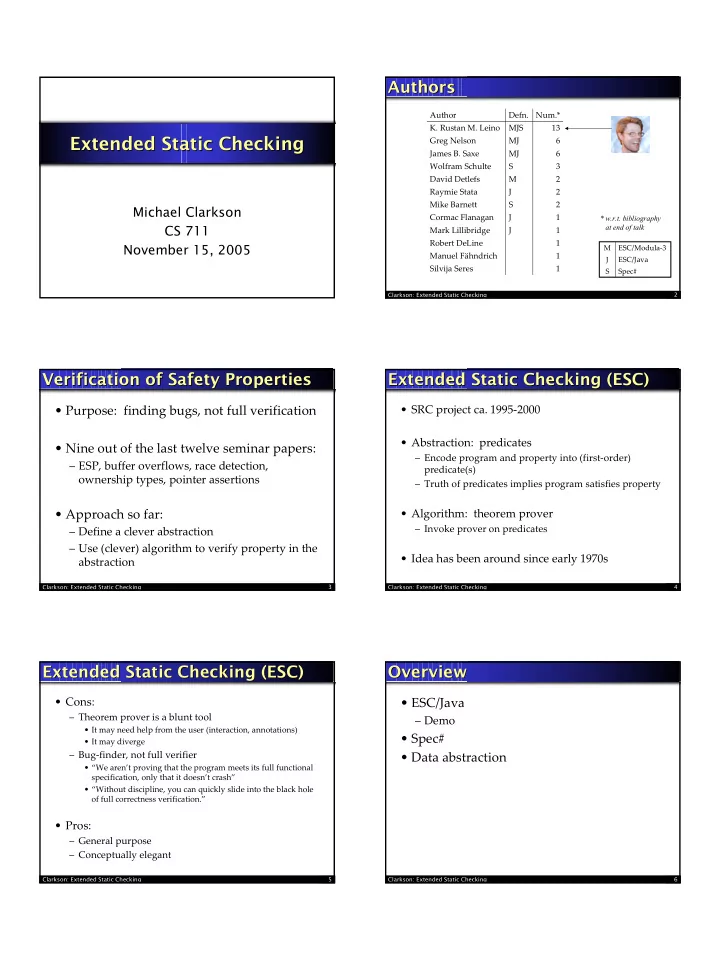
Authors Authors
Num.* Defn. Author 1 Silvija Seres 1 Manuel Fähndrich 1 Robert DeLine 1 J Mark Lillibridge 1 J Cormac Flanagan 2 S Mike Barnett 2 J Raymie Stata 2 M David Detlefs 3 S Wolfram Schulte 6 MJ James B. Saxe 6 MJ Greg Nelson 13 MJS
- K. Rustan M. Leino
Spec# S ESC/Java J ESC/Modula-3 M * w.r.t. bibliography at end of talk
Clarkson: Extended Static Checking 3
Verification of Safety Properties Verification of Safety Properties
- Purpose: finding bugs, not full verification
- Nine out of the last twelve seminar papers:
– ESP, buffer overflows, race detection,
- wnership types, pointer assertions
- Approach so far:
– Define a clever abstraction – Use (clever) algorithm to verify property in the abstraction
Clarkson: Extended Static Checking 4
Extended Static Checking (ESC) Extended Static Checking (ESC)
- SRC project ca. 1995-2000
- Abstraction: predicates
– Encode program and property into (first-order) predicate(s) – Truth of predicates implies program satisfies property
- Algorithm: theorem prover
– Invoke prover on predicates
- Idea has been around since early 1970s
Clarkson: Extended Static Checking 5
Extended Static Checking (ESC) Extended Static Checking (ESC)
- Cons:
– Theorem prover is a blunt tool
- It may need help from the user (interaction, annotations)
- It may diverge
– Bug-finder, not full verifier
- “We aren’t proving that the program meets its full functional
specification, only that it doesn’t crash”
- “Without discipline, you can quickly slide into the black hole
- f full correctness verification.”
- Pros:
– General purpose – Conceptually elegant
Clarkson: Extended Static Checking 6
Overview Overview
- ESC/Java
– Demo
- Spec#
- Data abstraction