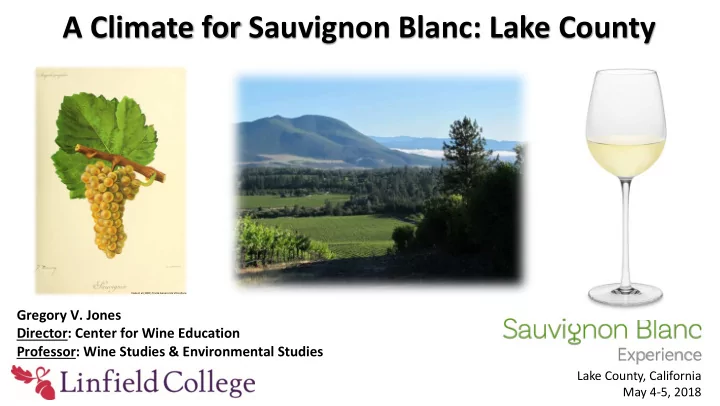
SLIDE 1 A Climate for Sauvignon Blanc: Lake County
Gregory V. Jones Director: Center for Wine Education Professor: Wine Studies & Environmental Studies
Lake County, California May 4-5, 2018
Viala et al (1901) Traite General de Viticulture
SLIDE 2
Talk Outline
§Weather/Climate and Wine §Weather/Climate and Sauvignon Blanc §Lake County and Sauvignon Blanc §Summary
SLIDE 3
§Combined, weather and climate are the most basic and most profound environmental factors in terms of : − Overall suitability − What wine styles can be produced − Substantial crop risk factors − Vintage variations in production and quality §Geology, landscape, and soil are important factors that mediate the interaction between climate and the vine, especially soil water supply and nutrition … ‒ Producing subtle nuances and terroir expression
Weather/Climate and Wine
SLIDE 4
§Wine regions have developed worldwide where the climate was most conducive §But climates of wine regions vary greatly: − Some more at the climatic margin − Some with warmer days, some warmer nights − Some drier, some wetter − Some more risk prone − Others more equitable and consistent §Is there a climate structure that is best suited for a given variety for optimum wine quality and production?
Weather/Climate and Wine
SLIDE 5
§Old world Sauvignon Blanc historically planted in mostly: − Intermediate maritime climates, with − Higher humidity, which results in − Lower Tmax and higher Tmin (low DTR) §New world Sauvignon Blanc has been planted across an array of different climates and landscapes: ‒ Some warmer, some cooler ‒ Often with much drier conditions ‒ With higher DTR
Weather/Climate and Sauvignon Blanc
SLIDE 6 Sauvignon Blanc Regions Examined
Loire Valley, France McMinnville, Oregon Graton, California Marlborough, New Zealand Potter Valley, California Healdsburg, California Bordeaux, France Covelo, California Cloverdale, California Central Otago, New Zealand Yarra Valley, Australia Santa Maria, California Tasmania, Australia Ukiah, California Carneros, California Adelaide Hills, Australia Clearlake, California Lompoc, California Salem, Oregon Sonoma, California Margaret River, Australia
SLIDE 7 §Growing season average temperatures represent a simple measure of climate suitability, highly correlated with all other climate indices §The 20 locations examined produce a range of growing season average temperatures of 58.1°F to 65.8°F, a 7.7°F ‘Sauvignon Blanc’ climate envelope (roughly equivalent to a 1000-1200 GDD range)
Jones, 2006
General Climate Suitability
Central Otago Ukiah
SLIDE 8 Growing Degree-Days in Sauvignon Blanc Regions
Unpublished, Data from numerous government sources
Average GDD = 2640 Maximum GDD = 3390 Minimum GDD = 1811 Differences driven by: § DTR, especially Tmax § Length of season § Truncation of season
100 200 300 400 500 600 700 800 1 2 3 4 5 6 7 8 9 10 11 12 Degree-Days (50°F base) Month (NH: Jan-Dec; SH: Jul-Jun)
SLIDE 9 15.0 20.0 25.0 30.0 35.0 40.0 45.0 1500 2000 2500 3000 3500 4000
NH: Aug-Sep; SH: Feb-Mar DTR (°F) Growing Degree-Days (Base 50°F)
Oregon France, NZ, Australia California
Ripening Period Diurnal Temperature Ranges
Santa Maria Clearlake
Differences in DTR are largely driven by VPD (humidity) differences High VPD = High DTR Low VPD = Low DTR
Unpublished, Data from numerous government sources
SLIDE 10 Precipitation in Sauvignon Blanc Regions
Unpublished, Data from numerous government sources
10 20 30 40 50 60 70 0.0 5.0 10.0 15.0 20.0 25.0 30.0 35.0 40.0 45.0 50.0 Lompoc Carneros Santa Maria Cloverdale Healdsburg Graton Sonoma Clearlake Ukiah Covelo Potter Valley Margaret River McMinnville Salem Adelaide Hills Tasmania Bordeaux Marlborough Yarra Valley Loire Valley Otago
% Growing Season to Annual Precipitation (mm) Annual Precipitation Growing Season Precipitation % Growing Season to Annual
32.8 inches Range in Annual Precipitation 17.4 inches Range in Growing Season Precipitation 32.2 inches Average Annual Precipitation
SLIDE 11
Lake County Wine Region
§ Landscape and climate conditions suitable for a wide range of varieties … − 2800-3800 GDD − Median last spring frost early to mid April − Median first fall frost early November to early December − Median frost-free period 200-250 days − Annual precipitation 33-45 inches
SLIDE 12
Lake County Sauvignon Blanc Factors
§ Landscape and climate conditions that influence quality and production … ‒ High UV radiation influences on ripening ‒ High DTR, retention of acidity ‒ Truncation of season to cool nights during ripening ‒ Moderation effects of Clear Lake ‒ Both mountain-valley breezes and strong lake-land breezes enhance local moderation
SLIDE 13
Summary and Discussion
§ Global Sauvignon Blanc climates are quite varied: – Having relatively cool to warm conditions (58.1-65.8°F GST or 1800-3400 GDD range) – Experiencing a 33” range in annual precipitation with a range of 10-65% coming during the growing season – With a ripening period DTR (Aug-Sept) that ranges from ~18-43°F § Significant differences in VPD (humidity) across regions produce a compensation effect with: – High Tmax and low Tmin producing high DTR (especially in CA) – Low Tmax and high Tmin producing lower DTR (Old world, NZ, AU) § Results in differences in respiration/metabolism that are important for ripening and ultimately producing wine style differences
SLIDE 14
§ Discussing the average structure of climates for any variety masks the underlying spatial differences that are often most important § Sauvignon Blanc produces well across a range climates, with important effects produced by day/night differences in temperatures and ambient moisture levels § Lake County is a relatively warm Sauvignon Blanc region with more of a continental climate than other coastal zones in CA and globally § Lake County has important quality factors of high UV, high DTR, and moderating effects of elevation and the lake § Is there an ideal Sauvignon Blanc climate? § Have the best Sauvignon Blanc regions/sites been found?
Conclusions
SLIDE 15 Thank You!
Gregory V. Jones
Director: Center for Wine Education Professor: Wine & Environmental Studies