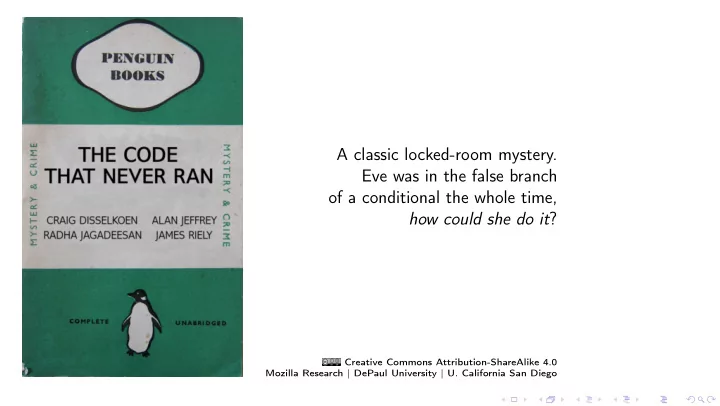
A classic locked-room mystery. Eve was in the false branch of a - - PowerPoint PPT Presentation

a classic locked room mystery eve was in the false branch
SMART_READER_LITE
LIVE PREVIEW

A classic locked-room mystery. Eve was in the false branch of a - - PowerPoint PPT Presentation

A classic locked-room mystery. Eve was in the false branch of a conditional the whole time, how could she do it ? Creative Commons Attribution-ShareAlike 4.0 Mozilla Research | DePaul University | U. California San Diego 3 January 2018 The


slide-1
SLIDE 1

A classic locked-room mystery. Eve was in the false branch

  • f a conditional the whole time,

how could she do it?

Creative Commons Attribution-ShareAlike 4.0 Mozilla Research | DePaul University | U. California San Diego

slide-2
SLIDE 2

The Code That Never Ran Craig Disselkoen, Radha Jagadeesan, Alan Jeffrey, James Riely Introduction Spectre Optimizations Simplified Spectre Results Experiments Conclusions

3 January 2018

A day out at the Tate Modern

slide-3
SLIDE 3

The Code That Never Ran Craig Disselkoen, Radha Jagadeesan, Alan Jeffrey, James Riely Introduction Spectre Optimizations Simplified Spectre Results Experiments Conclusions

3 January 2018

A day out at the Tate Modern

slide-4
SLIDE 4

The Code That Never Ran Craig Disselkoen, Radha Jagadeesan, Alan Jeffrey, James Riely Introduction Spectre Optimizations Simplified Spectre Results Experiments Conclusions

3 January 2018

A day out at the Tate Modern

slide-5
SLIDE 5

The Code That Never Ran Craig Disselkoen, Radha Jagadeesan, Alan Jeffrey, James Riely Introduction Spectre Optimizations Simplified Spectre Results Experiments Conclusions

Spectre

Attacks bypass run-time security checks. Can bypass array bounds checks, and read whole process memory. Can be exploited from JS, so evil.ad.com can read your bank.com data. Attacks speculative evaluation hardware optimization.

slide-6
SLIDE 6

The Code That Never Ran Craig Disselkoen, Radha Jagadeesan, Alan Jeffrey, James Riely Introduction Spectre Optimizations Simplified Spectre Results Experiments Conclusions

Optimizations in hardware

A lie we tell programmers: “computers execute instructions one after the other.” x:= x + 1; y:= 1 has execution: R x 1 W x 2 W y 1

slide-7
SLIDE 7

The Code That Never Ran Craig Disselkoen, Radha Jagadeesan, Alan Jeffrey, James Riely Introduction Spectre Optimizations Simplified Spectre Results Experiments Conclusions

Optimizations in hardware

A lie we tell programmers: “computers execute instructions one after the other.” x:= x + 1; y:= 1 has execution where W y 1 might happen first: R x 1 W x 2 W y 1

slide-8
SLIDE 8

The Code That Never Ran Craig Disselkoen, Radha Jagadeesan, Alan Jeffrey, James Riely Introduction Spectre Optimizations Simplified Spectre Results Experiments Conclusions

Optimizations in hardware

A lie we tell programmers: “computers execute instructions one after the other.” x:= x + 1; y:= 1 has execution: R x 1 W x 2 W y 1 Shared-memory concurrency leaks the abstraction

slide-9
SLIDE 9

The Code That Never Ran Craig Disselkoen, Radha Jagadeesan, Alan Jeffrey, James Riely Introduction Spectre Optimizations Simplified Spectre Results Experiments Conclusions

Optimizations in hardware

A lie we tell programmers: “computers execute instructions one after the other.” x:= x + 1; y:= 1 has execution: R x 1 W x 2 W y 1 Shared-memory concurrency leaks the abstraction Resulted in entire research area: weak memory models (e.g. Pugh et al.; C11)

slide-10
SLIDE 10

The Code That Never Ran Craig Disselkoen, Radha Jagadeesan, Alan Jeffrey, James Riely Introduction Spectre Optimizations Simplified Spectre Results Experiments Conclusions

Optimizations in hardware

Another lie we tell programmers: “only one branch of an if is executed.” if (x) { y:= 1; z:= 1 } else { y:= 2; z:= 1 } has execution: R x 1 W y 1 W z 1

slide-11
SLIDE 11

The Code That Never Ran Craig Disselkoen, Radha Jagadeesan, Alan Jeffrey, James Riely Introduction Spectre Optimizations Simplified Spectre Results Experiments Conclusions

Optimizations in hardware

Another lie we tell programmers: “only one branch of an if is executed.” if (x) { y:= 1; z:= 1 } else { y:= 2; z:= 1 } has execution where W z 1 might happen before W y 1: R x 1 W y 1 W z 1

slide-12
SLIDE 12

The Code That Never Ran Craig Disselkoen, Radha Jagadeesan, Alan Jeffrey, James Riely Introduction Spectre Optimizations Simplified Spectre Results Experiments Conclusions

Optimizations in hardware

Another lie we tell programmers: “only one branch of an if is executed.” if (x) { y:= 1; z:= 1 } else { y:= 2; z:= 1 } has execution where W y 2 might happen, then get rolled back: R x 1 W y 1 W z 1 W y 2 W z 1

slide-13
SLIDE 13

The Code That Never Ran Craig Disselkoen, Radha Jagadeesan, Alan Jeffrey, James Riely Introduction Spectre Optimizations Simplified Spectre Results Experiments Conclusions

Optimizations in hardware and compilers

Another lie we tell programmers: “only one branch of an if is executed.” if (x) { y:= 1; z:= 1 } else { y:= 2; z:= 1 } has execution where W z 1 might happen first: R x 1 W y 1 W z 1 W y 2

slide-14
SLIDE 14

The Code That Never Ran Craig Disselkoen, Radha Jagadeesan, Alan Jeffrey, James Riely Introduction Spectre Optimizations Simplified Spectre Results Experiments Conclusions

Optimizations in hardware and compilers

Another lie we tell programmers: “only one branch of an if is executed.” if (x) { y:= 1; z:= 1 } else { y:= 2; z:= 1 } has execution: R x 1 W y 1 W z 1 W y 2 No language-level model for this! As weak memory models are to OOO, so what is to speculation?

slide-15
SLIDE 15

The Code That Never Ran Craig Disselkoen, Radha Jagadeesan, Alan Jeffrey, James Riely Introduction Spectre Optimizations Simplified Spectre Results Experiments Conclusions

Simplified Spectre

Imagine a SECRET, protected by a run-time security check: if canRead(SECRET) { . . . use SECRET . . . } else { . . . } For attacker code canRead(SECRET) is always false

slide-16
SLIDE 16

The Code That Never Ran Craig Disselkoen, Radha Jagadeesan, Alan Jeffrey, James Riely Introduction Spectre Optimizations Simplified Spectre Results Experiments Conclusions

Simplified Spectre

Imagine a SECRET, protected by a run-time security check: if canRead(SECRET) { . . . use SECRET . . . } else { . . . } For attacker code canRead(SECRET) is always false, e.g. R y 1 W x 2 R SECRET 1 W x 1 is an execution of if y { if canRead(SECRET) { x:= SECRET } else { x:= 2 } }.

slide-17
SLIDE 17

The Code That Never Ran Craig Disselkoen, Radha Jagadeesan, Alan Jeffrey, James Riely Introduction Spectre Optimizations Simplified Spectre Results Experiments Conclusions

Simplified Spectre

Imagine a SECRET, protected by a run-time security check: if canRead(SECRET) { . . . use SECRET . . . } else { . . . } For attacker code canRead(SECRET) is always false, e.g. R y 1 W x 2 R SECRET 1 W x 1 is an execution of if y { if canRead(SECRET) { x:= SECRET } else { x:= 2 } }. Attacker goal: learn if SECRET is 0 or 1.

slide-18
SLIDE 18

The Code That Never Ran Craig Disselkoen, Radha Jagadeesan, Alan Jeffrey, James Riely Introduction Spectre Optimizations Simplified Spectre Results Experiments Conclusions

Simplified Spectre

A very simplified Spectre attack: if canRead(SECRET) { a[SECRET]:= 1 } else if touched (a[0]) { x:= 0 } else if touched (a[1]) { x:= 1 } with execution R SECRET 1 W a[1] 1 magic! W x 1 Information flow from SECRET to x, if there’s an implementation of “magic”.

slide-19
SLIDE 19

The Code That Never Ran Craig Disselkoen, Radha Jagadeesan, Alan Jeffrey, James Riely Introduction Spectre Optimizations Simplified Spectre Results Experiments Conclusions

Simplified Spectre

A very simplified Spectre attack: if canRead(SECRET) { a[SECRET]:= 1 } else if touched (a[0]) { x:= 0 } else if touched (a[1]) { x:= 1 } with execution R SECRET 1 W a[1] 1 magic! W x 1 Information flow from SECRET to x, if there’s an implementation of “magic”. Narrator: there was one.

slide-20
SLIDE 20

The Code That Never Ran Craig Disselkoen, Radha Jagadeesan, Alan Jeffrey, James Riely Introduction Spectre Optimizations Simplified Spectre Results Experiments Conclusions

Results

Formalization of pretty pictures as partially ordered multisets (Gisher, 1988). Compositional semantics based on weak memory models (e.g. C11). Examples modeling Spectre, Spectre mitigations, PRIME+ABORT attack on transactional memory. . .

slide-21
SLIDE 21

The Code That Never Ran Craig Disselkoen, Radha Jagadeesan, Alan Jeffrey, James Riely Introduction Spectre Optimizations Simplified Spectre Results Experiments Conclusions

Results

Formalization of pretty pictures as partially ordered multisets (Gisher, 1988). Compositional semantics based on weak memory models (e.g. C11). Examples modeling Spectre, Spectre mitigations, PRIME+ABORT attack on transactional memory. . . and a new family of attacks on compiler optimizations.

slide-22
SLIDE 22

The Code That Never Ran Craig Disselkoen, Radha Jagadeesan, Alan Jeffrey, James Riely Introduction Spectre Optimizations Simplified Spectre Results Experiments Conclusions

Modeling an attack on compiler optimizations

An attacker running two threads (initially x = y = 0): y:= x || if (y == 0) { x:= 1 } else if (canRead(SECRET)) { x:= SECRET } else { x:= 1; z:= 1 } If SECRET is 1, there is an execution: R x 1 W y 1 R y 1 W x 1 W z 1 If SECRET is 2, there is no execution (due to cyclic dependency): R x 1 W y 1 R y 1 W x 1 W x 2 W z 1

slide-23
SLIDE 23

The Code That Never Ran Craig Disselkoen, Radha Jagadeesan, Alan Jeffrey, James Riely Introduction Spectre Optimizations Simplified Spectre Results Experiments Conclusions

Implementing attacks on compiler optimizations

Spectre and Prime+Abort are implemented. Can we implement the attacks on compiler optimizations?

slide-24
SLIDE 24

The Code That Never Ran Craig Disselkoen, Radha Jagadeesan, Alan Jeffrey, James Riely Introduction Spectre Optimizations Simplified Spectre Results Experiments Conclusions

Implementing attacks on compiler optimizations

Spectre and Prime+Abort are implemented. Can we implement the attacks on compiler optimizations? Yes

slide-25
SLIDE 25

The Code That Never Ran Craig Disselkoen, Radha Jagadeesan, Alan Jeffrey, James Riely Introduction Spectre Optimizations Simplified Spectre Results Experiments Conclusions

Implementing attacks on compiler optimizations

Spectre and Prime+Abort are implemented. Can we implement the attacks on compiler optimizations? Yes, under unrealistic assumptions: ◮ SECRET is a constant known at compile-time ◮ canRead(SECRET) is a run-time check

slide-26
SLIDE 26

The Code That Never Ran Craig Disselkoen, Radha Jagadeesan, Alan Jeffrey, James Riely Introduction Spectre Optimizations Simplified Spectre Results Experiments Conclusions

Implementing an attack on load/store reordering

Main attacker thread: x:= 1; if (canRead(SECRET)) { x:= SECRET; }r:= y;

slide-27
SLIDE 27

The Code That Never Ran Craig Disselkoen, Radha Jagadeesan, Alan Jeffrey, James Riely Introduction Spectre Optimizations Simplified Spectre Results Experiments Conclusions

Implementing an attack on load/store reordering

Main attacker thread: x:= 1; if (canRead(SECRET)) { x:= SECRET; }r:= y;

When SECRET = 1, gcc generates: mov canReadSecret(%rip), %eax mov $1, x(%rip) test %eax, %eax je label1 mov $0, x(%rip) label1: mov y(%rip), %eax When SECRET = 1, gcc generates: mov canReadSecret(%rip), %eax mov y(%rip), %eax mov $1, x(%rip)

slide-28
SLIDE 28

The Code That Never Ran Craig Disselkoen, Radha Jagadeesan, Alan Jeffrey, James Riely Introduction Spectre Optimizations Simplified Spectre Results Experiments Conclusions

Implementing an attack on load/store reordering

Main attacker thread: x:= 1; if (canRead(SECRET)) { x:= SECRET; }r:= y;

When SECRET = 1, gcc generates: mov canReadSecret(%rip), %eax mov $1, x(%rip) test %eax, %eax je label1 mov $0, x(%rip) label1: mov y(%rip), %eax Writes x then reads y When SECRET = 1, gcc generates: mov canReadSecret(%rip), %eax mov y(%rip), %eax mov $1, x(%rip)

slide-29
SLIDE 29

The Code That Never Ran Craig Disselkoen, Radha Jagadeesan, Alan Jeffrey, James Riely Introduction Spectre Optimizations Simplified Spectre Results Experiments Conclusions

Implementing an attack on load/store reordering

Main attacker thread: x:= 1; if (canRead(SECRET)) { x:= SECRET; }r:= y;

When SECRET = 1, gcc generates: mov canReadSecret(%rip), %eax mov $1, x(%rip) test %eax, %eax je label1 mov $0, x(%rip) label1: mov y(%rip), %eax Writes x then reads y When SECRET = 1, gcc generates: mov canReadSecret(%rip), %eax mov y(%rip), %eax mov $1, x(%rip) Conditional has been eliminated! Reads y then writes x

slide-30
SLIDE 30

The Code That Never Ran Craig Disselkoen, Radha Jagadeesan, Alan Jeffrey, James Riely Introduction Spectre Optimizations Simplified Spectre Results Experiments Conclusions

Implementing an attack on load/store reordering

Main attacker thread: x:= 1; if (canRead(SECRET)) { x:= SECRET; }r:= y;

When SECRET = 1, gcc generates: mov canReadSecret(%rip), %eax mov $1, x(%rip) test %eax, %eax je label1 mov $0, x(%rip) label1: mov y(%rip), %eax Writes x then reads y When SECRET = 1, gcc generates: mov canReadSecret(%rip), %eax mov y(%rip), %eax mov $1, x(%rip) Conditional has been eliminated! Reads y then writes x

Forwarding thread x:= y allows attacker to spot the reordering

slide-31
SLIDE 31

The Code That Never Ran Craig Disselkoen, Radha Jagadeesan, Alan Jeffrey, James Riely Introduction Spectre Optimizations Simplified Spectre Results Experiments Conclusions

Implementing an attack on load/store reordering

Small delay between write x and read y: increases probability of round trip gcc will reorder across 30 straight-line instructions Repeat to leak multiple bits, error correction Bitwise accuracy 99.99% at 300Kbps

slide-32
SLIDE 32

The Code That Never Ran Craig Disselkoen, Radha Jagadeesan, Alan Jeffrey, James Riely Introduction Spectre Optimizations Simplified Spectre Results Experiments Conclusions

Implementing an attack on dead store elimination

A similar attack targets dead store elimination Works on clang + gcc Bitwise accuracy 99.99% at 1.2Mbps

slide-33
SLIDE 33

The Code That Never Ran Craig Disselkoen, Radha Jagadeesan, Alan Jeffrey, James Riely Introduction Spectre Optimizations Simplified Spectre Results Experiments Conclusions

Contributions

A compositional model of program execution that includes speculation. Examples including existing information flow attacks on branch prediction and transactional memory, and new attacks on optimizing compilers. Experimental evidence that the new attacks can be carried out, but only against compile-time secrets. (Phew, we failed to mount attacks on JIT compilers.) https://github.com/chicago-relaxed-memory/spec-eval