A CALL TO ACTION RED CLAY CONSOLIDATED SCHOOL DISTRICT RCCSD - - PDF document

a call to action
SMART_READER_LITE
LIVE PREVIEW

A CALL TO ACTION RED CLAY CONSOLIDATED SCHOOL DISTRICT RCCSD - - PDF document

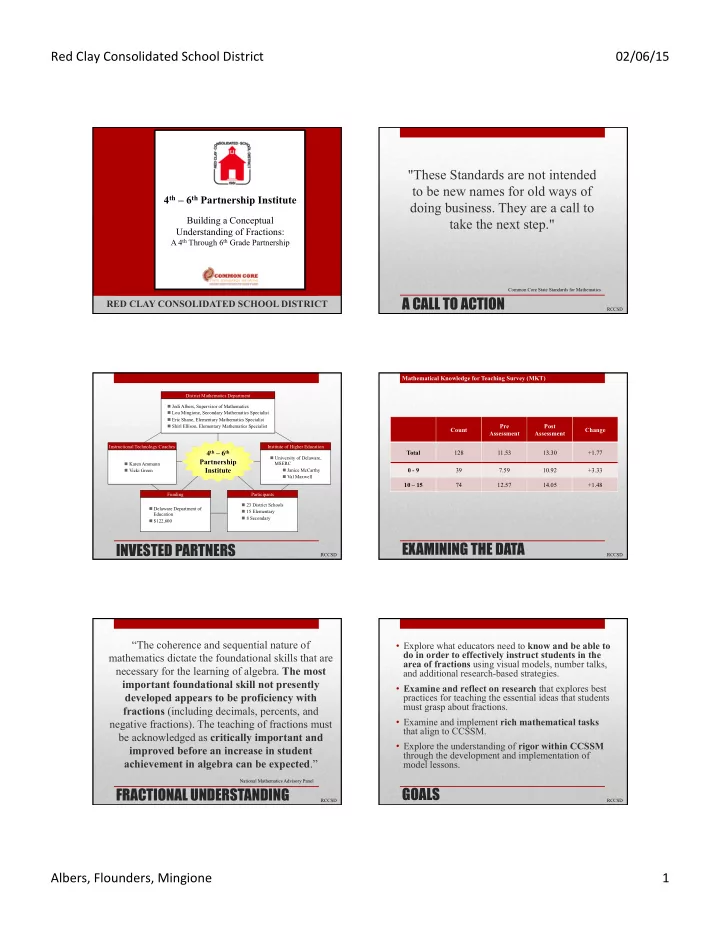
Red Clay Consolidated School District 02/06/15 "These Standards are not intended to be new names for old ways of 4 th 6 th Partnership Institute doing business. They are a call to Building a Conceptual take


slide-1
SLIDE 1

Red ¡Clay ¡Consolidated ¡School ¡District ¡ 02/06/15 ¡ Albers, ¡Flounders, ¡Mingione ¡ 1 ¡

RED CLAY CONSOLIDATED SCHOOL DISTRICT

4th – 6th Partnership Institute

Building a Conceptual Understanding of Fractions:

A 4th Through 6th Grade Partnership

A CALL TO ACTION

"These Standards are not intended to be new names for old ways of doing business. They are a call to take the next step."

Common Core State Standards for Mathematics RCCSD District Mathematics Department n Jodi Albers, Supervisor of Mathematics n Lou Mingione, Secondary Mathematics Specialist n Eric Shane, Elementary Mathematics Specialist n Shirl Ellison, Elementary Mathematics Specialist Participants n 23 District Schools n 15 Elementary n 8 Secondary Institute of Higher Education n University of Delaware, MSERC n Janice McCarthy n Val Maxwell Instructional Technology Coaches n Karen Ammann n Vicki Green Funding n Delaware Department of Education n $122,600

4th – 6th Partnership Institute

RCCSD

INVESTED PARTNERS EXAMINING THE DATA

Count Pre Assessment Post Assessment Change Total 128 11.53 13.30 +1.77 0 - 9 39 7.59 10.92 +3.33 10 – 15 74 12.57 14.05 +1.48 Mathematical Knowledge for Teaching Survey (MKT)

RCCSD

FRACTIONAL UNDERSTANDING

“The coherence and sequential nature of mathematics dictate the foundational skills that are necessary for the learning of algebra. The most important foundational skill not presently developed appears to be proficiency with fractions (including decimals, percents, and negative fractions). The teaching of fractions must be acknowledged as critically important and improved before an increase in student achievement in algebra can be expected.”

National Mathematics Advisory Panel RCCSD

GOALS

  • Explore what educators need to know and be able to

do in order to effectively instruct students in the area of fractions using visual models, number talks, and additional research-based strategies.

  • Examine and reflect on research that explores best

practices for teaching the essential ideas that students must grasp about fractions.

  • Examine and implement rich mathematical tasks

that align to CCSSM.

  • Explore the understanding of rigor within CCSSM

through the development and implementation of model lessons.

RCCSD

slide-2
SLIDE 2

Red ¡Clay ¡Consolidated ¡School ¡District ¡ 02/06/15 ¡ Albers, ¡Flounders, ¡Mingione ¡ 2 ¡

A TYPICAL DAY IN THE INSTITUTE

  • Formulated Norms
  • Conducted Exit Ticket Summary
  • Reviewed Homework
  • Participated in a Team Builder
  • Examined the Common Core State Standards
  • Examined the Standards for Mathematical Practices
  • Engaged in Rich Mathematical Tasks
  • Participated in a Book Study
  • Enhanced Smarter Balanced Assessment Items

RCCSD

PARTICIPANTS

167 total participants

  • 72 fourth grade teachers
  • 67 fifth grade teachers
  • 26 sixth grade teachers
  • 84 participants from Title I buildings
  • 8 participants from special schools

RCCSD

PARTICIPANT STRUCTURE

  • 167 Teachers
  • 4 Cohorts
  • 6 Teams per Cohort
  • 8 players per team (maximum)
  • At least 2 fourth, 2 fifth and 1 sixth grade

teacher per team

  • No more than 1 person per building per

team

RCCSD

RESEARCH

  • Developing Effective Fractions Instruction for

Kindergarten Through 8th Grade Practice Guide

RCCSD

RESEARCH

  • Putting Essential Understanding of Fractions into

Practice in Grades 3-5

RCCSD

CONTENT FOCI

The Institute

  • Session 1: Equivalence and Comparison
  • Session 2: Addition and Subtraction
  • Session 3: Addition, Subtraction, and Multiplication
  • Session 4: Multiplication, Division, and Ratios
  • Session 5: Ratios

RCCSD

slide-3
SLIDE 3

Red ¡Clay ¡Consolidated ¡School ¡District ¡ 02/06/15 ¡ Albers, ¡Flounders, ¡Mingione ¡ 3 ¡

CCSSM

Domains from Grade 3 to Grade 7:

  • Number and Operations – Fractions
  • Ratios and Proportional Relationships

RCCSD

Progressions Documents for the Common Core Math Standards

ICEBERG

RCCSD

CCSSM

  • The Standards for Mathematical Practices
  • Reasoning abstractly and quantitatively
  • Construct viable arguments and critique the

reasoning of others

RCCSD

CCSSM

Delaware Department of Education RCCSD

Mathematical Practices Student Dispositions Teacher Actions to Engage Students in Practices: Reasoning and Explaining Reason abstractly and quantitatively

  • Create multiple representations
  • Interpret problems in contexts
  • Estimate first/answer reasonable
  • Make connections
  • Represent symbolically
  • Talk about problems, real-life situations
  • Attend to units
  • Use context to think about a problem
  • Develop opportunities for problem-solving strategies
  • Give time for processing and discussing
  • Tie content areas together to help make connections
  • Give real-world situations
  • Demonstrate thinking aloud for students’ benefit
  • Value invented strategies and representations
  • More emphasis on the process instead of on the

answer Construct viable arguments and critique the reasoning of others

  • Ask questions
  • Use examples and counter examples
  • Reason inductively and make plausible arguments
  • Use objects, drawings, diagrams, and actions
  • Develop ideas about mathematics and support their

reasoning

  • Analyze others arguments
  • Encourage the use of mathematics vocabulary
  • Create a safe environment for risk-taking and

critiquing with respect

  • Provide complex, rigorous tasks that foster deep

thinking

  • Provide time for student discourse
  • Plan effective questions and student grouping
  • Probe students

SMARTER BALANCED

  • The Four Mathematical Claims
  • Concepts and Procedures
  • Problem Solving
  • Communicating Reasoning
  • Modeling and Data Analysis
  • Enhancing the Technology-Enabled questions

RCCSD

SBAC – GRADE 5 MATHEMATICS

  • Mr. Jones will cut 6 identical loaves of bread

into pieces that are loaf each. Part A After he cuts the 6 loaves, how many pieces will Mr. Jones have? Show your work using numbers, words, and/

  • r pictures.

1 4 pieces

RCCSD

slide-4
SLIDE 4

Red ¡Clay ¡Consolidated ¡School ¡District ¡ 02/06/15 ¡ Albers, ¡Flounders, ¡Mingione ¡ 4 ¡

CONTENT FOCI

The Institute

  • Session 1: Equivalence and Comparison
  • Session 2: Addition and Subtraction
  • Session 3: Addition, Subtraction, and Multiplication
  • Session 4: Multiplication, Division, and Ratios
  • Session 5: Ratios

RCCSD

MRI – MARILYN BURNS

Which fraction is greater?

  • r

5 12 5 8

How did you decide?

RCCSD

Session 1: Equivalence and Comparison

CONTENT FOCI

The Institute

  • Session 1: Equivalence and Comparison
  • Session 2: Addition and Subtraction
  • Session 3: Addition, Subtraction, and Multiplication
  • Session 4: Multiplication, Division, and Ratios
  • Session 5: Ratios

RCCSD

Book Study

RCCSD

Session 2: Addition and Subtraction

Putting Essential Understandings of Fractions into Practice - NCTM

CONTENT FOCI

The Institute

  • Session 1: Equivalence and Comparison
  • Session 2: Addition and Subtraction
  • Session 3: Addition, Subtraction, and Multiplication
  • Session 4: Multiplication, Division, and Ratios
  • Session 5: Ratios

RCCSD

CMP2

Connected Mathematics Project RCCSD

Session 3: Addition, Subtraction, and Multiplication

slide-5
SLIDE 5

Red ¡Clay ¡Consolidated ¡School ¡District ¡ 02/06/15 ¡ Albers, ¡Flounders, ¡Mingione ¡ 5 ¡

CONTENT FOCI

The Institute

  • Session 1: Equivalence and Comparison
  • Session 2: Addition and Subtraction
  • Session 3: Addition, Subtraction, and Multiplication
  • Session 4: Multiplication, Division, and Ratios
  • Session 5: Ratios

RCCSD

CONTENT FOCI

The Institute

  • Session 1: Equivalence and Comparison
  • Session 2: Addition and Subtraction
  • Session 3: Addition, Subtraction, and Multiplication
  • Session 4: Multiplication, Division, and Ratios
  • Session 5: Ratios

RCCSD

CMP2

  • 2. Examine these statements about the apple juice mixes in

Exercise 1. Decide whether each is accurate. Give reasons for your answers.

  • a. Mix Y has the most water, so it will taste least "appley".
  • b. Mix Z is the most "appley" because the difference between the

concentrate and water is 2 cups. It is 3 cups for each of the others.

  • c. Mix Y is the most "appley" because it has only 1 cups of water for

each cup of concentrate. The others have more water per cup.

  • d. Mix X and Mix Y taste the same because you just add 3 cups of

concentrate and 3 cups of water to turn Mix X into Mix Y. Connected Mathematics Project RCCSD

Session 5: Ratios

MEASURING IMPACT

  • Mathematical Knowledge for Teaching
  • District Created Walkthrough Tool
  • PLC Minutes
  • District Coach Observations
  • Anecdotal Information

RCCSD

FEEDBACK

What made learning easy or hard for you today?

  • Group work with our tables is nice.
  • It is always great to work cooperatively.
  • I am in an awesome group!
  • Discussions within the group was easy.
  • Great group I work with!
  • Collaboration with teammates made it easier.
  • Staying in groups produced a lot of responses.

At this point we are getting comfortable with each other and can share at will.

RCCSD

FINAL THOUGHTS

Questions?

RCCSD

jodi.albers@redclay.k12.de.us louis.mingione@redclay.k12.de.us courtney.flounders@redclay.k12.de.us