
9/3/2018 1
From registration to information, I
Anders Ringgaard Kristensen
Department of Veterinary and Animal Sciences
Outline
The decision making process The role of models Basic production monitoring as a source of information Key figures and their properties Interpretation of key figures Limitations of traditional production monitoring
Department of Veterinary and Animal Sciences Slide 2
Focus of this lecture
In last lecture, we discussed:
- Planning, classical
approach
In this lecture we direct our attention towards the other side of the management cycle:
- Production monitoring
We shall, however, try to look at it from a decision making perspective.
Making decisions
Decision making is based on knowledge:
- General knowledge: What you can read in a textbook on
animal nutrition, animal breeding, agricultural engineering etc.
- Context specific knowledge: What relates directly to the
unique decision problem. Examples:
- The milk yield of dairy cow No. 678 when considered for
culling.
- The estrus status of sow No. 345 when considered for
insemination.
- The current daily gain of the slaughter pigs in House 5
when considering whether or not to adjust protein contents of the diet.
When knowledge is represented in a form that may be used directly as basis for a decision, we call it information.
Department of Veterinary and Animal Sciences Slide 4
Information sources
General knowledge:
- Look in a textbook
- Ask an expert
Context specific knowledge:
- Obtained through registrations (observations) in the
herd:
- Traditional registrations
- Test day milk yield, cow 567
- Litter size of sow 123
- Sensor based registrations
- Conductivity or temperature of milk from AMS
- Accelerations of a sow from a censor node in
an ear tag
- Computer vision (image analysis)
Department of Veterinary and Animal Sciences Slide 5
From registrations to information
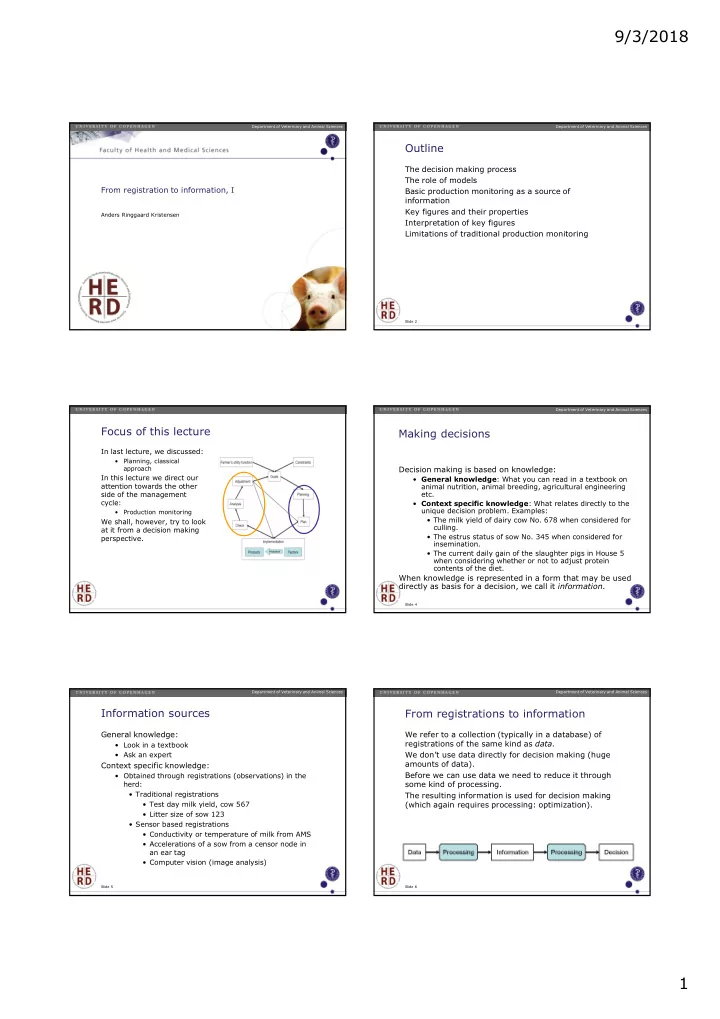
We refer to a collection (typically in a database) of registrations of the same kind as data. We don’t use data directly for decision making (huge amounts of data). Before we can use data we need to reduce it through some kind of processing. The resulting information is used for decision making (which again requires processing: optimization).
Department of Veterinary and Animal Sciences Slide 6