9/27/2010 Near-road NO 2 concentrations can be theoretically - - PDF document

9 27 2010
SMART_READER_LITE
LIVE PREVIEW

9/27/2010 Near-road NO 2 concentrations can be theoretically - - PDF document

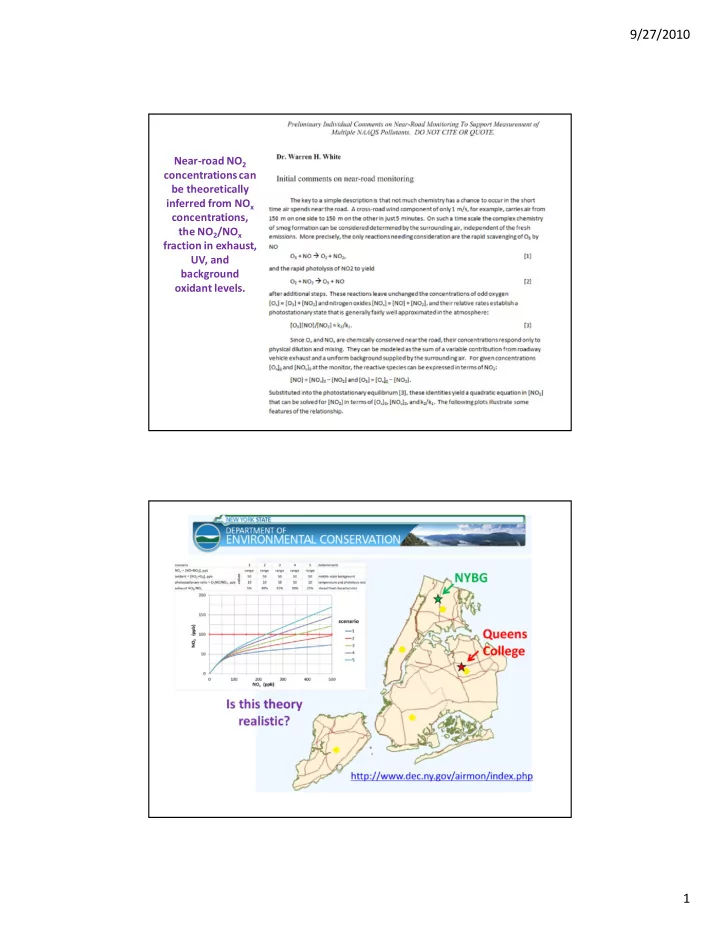
9/27/2010 Near-road NO 2 concentrations can be theoretically inferred from NO x concentrations, the NO 2 /NO x fraction in exhaust, UV, and background oxidant levels. 1 9/27/2010 Consider: 2009 2010 The March 19 th NO 2 spike came during an


slide-1
SLIDE 1

9/27/2010

Near-road NO2 concentrations can be theoretically inferred from NOx concentrations, the NO2/NOx fraction in exhaust, UV, and background

  • xidant levels.

1

slide-2
SLIDE 2

9/27/2010 Consider:

2009 2010

The March 19th NO2 spike came during an episode of elevated oxidant levels throughout the city. 2

slide-3
SLIDE 3

9/27/2010 Hourly oxidant (Ox = O3 + NO2) concentrations show little spatial variation at the urban scale. The near-road conversion of NO (most of the exhaust NOx) to NO2 is limited by Ox concentrations in the surroundings. 3

slide-4
SLIDE 4

9/27/2010 The only other source of near-road NO2 is its direct emission as a fraction of the exhaust NOx . The dependence of near-road NO2 on NOx exhibits the expected reduction in sensitivity at NOx > background Ox, which in this case was around 0.05 ppm. 4

slide-5
SLIDE 5

9/27/2010 Nominal constant values for background oxidant and exhaust NO2/NOx, plus a simplistic diurnal modulation of the photolysis rate, yield adequate predictions of near-road NO2 from NOx. Assuming the background oxidant to vary as observed at the NYBG yields a relationship that holds throughout the year. 5

slide-6
SLIDE 6

9/27/2010 We have used NOx only as a proxy for emission rates and

  • dispersion. Given a value for NOx/CO in exhaust, we could

equally well use CO. Unfortunately, CO data are cruder. Crude as they are, however, CO data are still good enough to identify the probable NO2 violations. 6

slide-7
SLIDE 7

9/27/2010 SUMMARY: The near-road increment in NO2 is no more mysterious than the increment in NOx or CO or BC or any other traffic-related species. It can be understood directly from exhaust emissions and atmospheric dispersion, with no need for complex chemistry. 7