9/1/16 September 8, 2016 6.453 Quantum Optical Communication - - PDF document

9 1 16
SMART_READER_LITE
LIVE PREVIEW

9/1/16 September 8, 2016 6.453 Quantum Optical Communication - - PDF document

9/1/16 September 8, 2016 6.453 Quantum Optical Communication Lecture 1 Jeffrey H. Shapiro Optical and Quantum Communications Group www.rle.mit.edu/qoptics 6.453 Quantum Optical Communication Lecture 1 Handouts Syllabus,


slide-1
SLIDE 1

9/1/16 1

Optical and Quantum Communications Group www.rle.mit.edu/qoptics September 8, 2016

6.453 Quantum Optical Communication Lecture 1 Jeffrey H. Shapiro

www.rle.mit.edu/qoptics 2
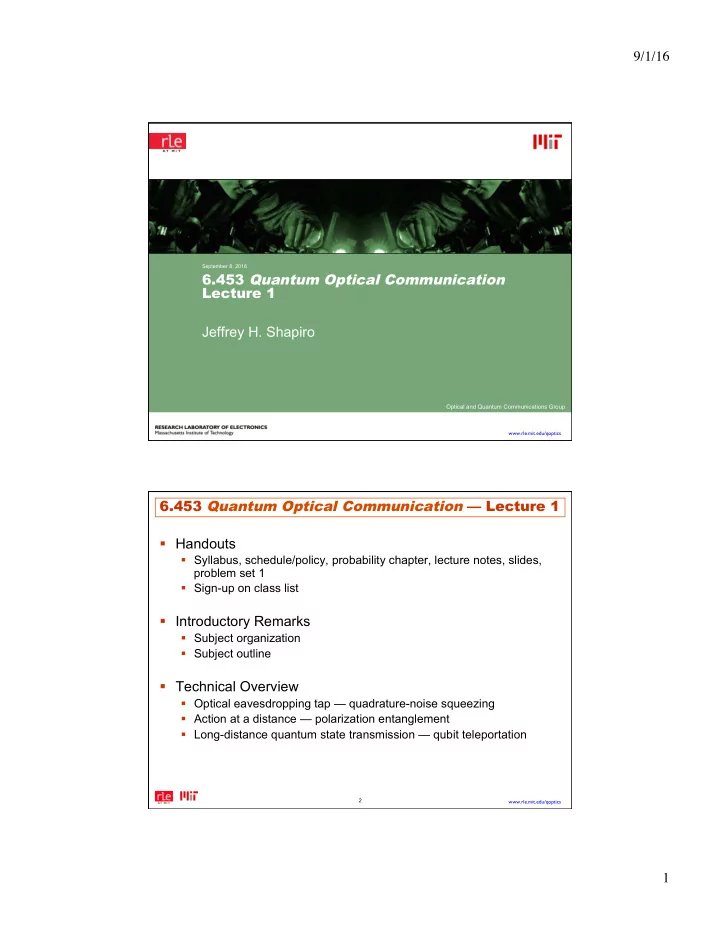
6.453 Quantum Optical Communication — Lecture 1 § Handouts

§ Syllabus, schedule/policy, probability chapter, lecture notes, slides, problem set 1 § Sign-up on class list

§ Introductory Remarks

§ Subject organization § Subject outline

§ Technical Overview

§ Optical eavesdropping tap — quadrature-noise squeezing § Action at a distance — polarization entanglement § Long-distance quantum state transmission — qubit teleportation

slide-2
SLIDE 2

9/1/16 2

www.rle.mit.edu/qoptics 3

Optical Homodyne Detection — Semiclassical

§ Signal is weak, LO is strong § Energy conservation § Detectors are noisy square laws § Output mean and variance Balanced Homodyne Receiver

www.rle.mit.edu/qoptics 4

Optical Waveguide Tap — Semiclassical

§ Coupler is a beam splitter § Tap input is zero § Homodyne SNR at signal input § Homodyne SNR at signal output § Homodyne SNR at tap output Fused Fiber Coupler

slide-3
SLIDE 3

9/1/16 3

www.rle.mit.edu/qoptics 5

Quantum Homodyne Detection and Waveguide Tap

Balanced Homodyne Receiver Fused Fiber Coupler Homodyne SNR at signal output Homodyne SNR at tap output

www.rle.mit.edu/qoptics 6

Billiard-Ball Photons and the Poincaré Sphere

§ Polarization of -going photon: § Poincaré sphere representation § polarization measurement

slide-4
SLIDE 4

9/1/16 4

www.rle.mit.edu/qoptics 7

Classical Correlation vs. Quantum Entanglement § Classically-Correlated, Randomly-Polarized Photons

§ Source produces photon pair with completely random § Conditional probability given photon 1 is instead of

§ Maximally-Entangled Photons

§ Source produces photon pair with completely random § Conditional probability given photon 1 is instead of

r r

www.rle.mit.edu/qoptics 8

Properties of Single-Photon Polarization States

§ Polarization cannot be perfectly measured § Polarization cannot be perfectly cloned § Photons can be lost in propagation:

→ ←

slide-5
SLIDE 5

9/1/16 5

www.rle.mit.edu/qoptics 9

Photon Polarization States Can Be Teleported Alice Bob

www.rle.mit.edu/qoptics 10

The Road Ahead: Problem Set 1, Lectures 2 and 3 § Problem Set 1

§ Reviews of essential probability theory and linear algebra

§ Lectures 2 and 3: Fundamentals of Dirac-Notation Quantum Mechanics

§ Quantum systems § States as ket vectors § State evolution via Schrödinger’s equation § Quantum measurements — observables § Schrödinger picture versus Heisenberg picture

slide-6
SLIDE 6

MIT OpenCourseWare https://ocw.mit.edu

6.453 Quantum Optical Communication

Fall 2016 For information about citing these materials or our Terms of Use, visit: https://ocw.mit.edu/terms.