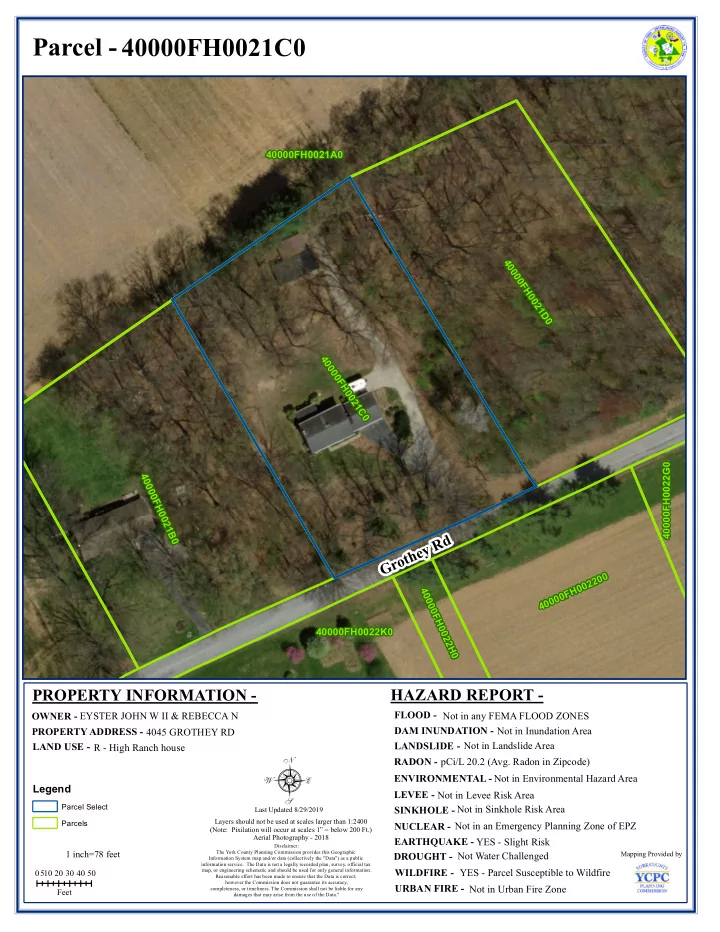
8 RADON - pC i / L 20. 2 ( A vg. R adon i n Zi pcode) - - PDF document

8
SMART_READER_LITE
LIVE PREVIEW

8 RADON - pC i / L 20. 2 ( A vg. R adon i n Zi pcode) - - PDF document

Parcel - 40000FH0021C0 40000FH0021A0 40000FH0021D0 4 0 0 0 0 F H 0 0 2 1 C 0 40000FH0022G0 40000FH0021B0 Grothey Rd 40000FH002200 4 0 0 0 0 F H 0 40000FH0022K0 0 2 2 H 0 HAZARD REPORT - PROPERTY INFORMATION -


slide-1
SLIDE 1

Grothey Rd

40000FH002200 4 F H 2 2 H 40000FH0022K0 40000FH0021B0 40000FH0021D0 40000FH0021A0 4 F H 2 1 C 40000FH0022G0

Parcel - 40000FH0021C0

0 1 0 20 30 4 0 50 5 Feet

1 i nch= 7 8 f eet

Legend

Parcel Select Parcels

8

EY STER JO H N W I I & R EB EC C A N OWNER - PROPERTY ADDRESS - LAND USE - 4 04 5 G R O TH EY R D R

  • H i

gh R anch house

D i scl ai m er: The Yor k C ount y Pl anni ng C om m i ssi

  • n

provi des t hi s G eogr aphi c I nf

  • r

m at i

  • n

Syst em m ap and/

  • r

dat a ( col l ect i vel y t he " D at a" ) as a publ i c i nf

  • r

m at i

  • n

servi ce. The D at a i s not a l egal l y r ecorded pl an, sur vey,

  • f

f i ci al t ax m ap,

  • r

engi neer i ng schem at i c and shoul d be used for

  • nl

y gener al i nf

  • rm at

i

  • n.

R easonabl e ef f

  • rt

has been m ade t

  • ensure

t hat t he D at a i s cor rect ; how ever t he C om m i ssi

  • n

does not guar ant ee i t s accur acy, com pl et eness,

  • r

t i m el i ness. T he C om m i ssi

  • n

shal l not be l i abl e f

  • r

any dam ages t hat m ay ar i se f r

  • m

t he use

  • f

t he D at a. "

Last U pdat ed 8/ 29/ 201 9 M appi ng Pr

  • vi

ded by Layers shoul d not be used at scal es l ar ger t han 1: 24 00 ( N ot e: Pi xi l at i

  • n

w i l l

  • ccur

at scal es 1” = bel

  • w

200 Ft . ) A er i al Phot

  • gr

aphy

  • 201 8

PROPERTY INFORMATION - HAZARD REPORT -

FLOOD - LANDSLIDE - RADON - ENVIRONMENTAL - LEVEE - SINKHOLE - NUCLEAR - EARTHQUAKE - N ot i n any FEM A FLO O D ZO N ES pC i / L 20. 2 ( A vg. R adon i n Zi pcode) N ot i n Envi r

  • nm ent

al H azar d A r ea N ot i n Levee R i sk A r ea N ot i n Si nkhol e R i sk A r ea N ot i n an Em er gency Pl anni ng Zone

  • f

EPZ Y ES

  • Sl

i ght R i sk DAM INUNDATION - N ot i n I nundat i

  • n

A r ea DROUGHT - WILDFIRE - N ot W at er C hal l enged Y ES

  • Par

cel Suscept i bl e t

  • W i

l df i r e N ot i n Landsl i de A rea URBAN FIRE - N ot i n U r ban Fi r e Zone

slide-2
SLIDE 2

SITE-SPECIFIC HAZARD LIST FOR 40000FH0021C0

1 - Radon Information 2 - Earthquake Information 3 - Wildfire Information

Page 1/1

slide-3
SLIDE 3

RADON EXPOSURE

A Supplemental Guide to the 2018 York County Hazard Mitigation Plan 1

DEFINITION – Radon is a cancer-causing natural radioactive gas that you can't see, smell, or taste.

It is a large component of the natural radiation that humans are exposed to and can pose a serious threat to public health when it accumulates in poorly ventilated residential and occupation settings. According to the USEPA, radon is estimated to cause about 21,000 lung cancer deaths per year, second

  • nly to smoking as the leading cause of lung cancer (EPA 402-R-03-003: EPA Assessment, 2003). An

estimated 40% of the homes in Pennsylvania are believed to have elevated radon levels (Pennsylvania Department of Environmental Protection, 2009). MITIGATION ACTIONS FOR RESIDENTS ► Testing – Conduct Radon testing to see if levels are above the safe level of 4 pCi/L established by the EPA. ► Remediation – If Radon levels are above 4 pCi/L, hire a certified Radon-Reduction Contractor to fix the problem.

MITIGATION ACTIONS FOR MUNICIPALITIES

► Adopt the York County Hazard Mitigation Plan by resolution or develop and implement a municipal hazard mitigation plan. York County Hazard Mitigation Plan ► Public Education and Outreach – Inform residents of the dangers and possibility of Radon in your municipality through mailings, web page, etc. and encourage testing and abatement.

slide-4
SLIDE 4

EARTHQUAKE

A Supplemental Guide to the 2018 York County Hazard Mitigation Plan 1

DEFINITION – An earthquake is the motion or trembling of the ground produced by sudden

displacement of rock usually within the upper 10-20 miles of the Earth's crust. Earthquakes result from crustal strain, volcanism, landslides, or the collapse of underground caverns. Earthquakes can affect hundreds of thousands of square miles, cause damage to property measured in the tens of billions of dollars, result in loss of life and injury to hundreds of thousands of persons, and disrupt the social and economic functioning of the affected area. Most property damage and earthquake- related deaths are caused by the failure and collapse of structures due to ground shaking which is dependent upon amplitude and duration of the earthquake. (FEMA, 1997).

MITIGATION ACTIONS FOR RESIDENTS

► Personal Preparedness – It is important to plan for disasters. Families may not be together or at

  • home. Consider completing the following to be prepared.
  • Family Emergency Communication Plan (FEMA) serves as a comprehensive checklist for

household disaster preparedness. FEMA Family Emergency Communication Plan Checklist

  • Family Disaster Plan (American Red Cross) – Communication networks and electricity could be
  • disrupted. Planning in advance will help ensure that all the members of your household know

how to reach each other and where to meet up in an emergency. American Red Cross Family Disaster Plan Template

  • Emergency Kits – It is always a good idea to have an emergency kit on hand. Consider basic

items as well as special needs. Build a Kit (Ready.gov) ready.gov Build-a-Kit Survival Kit Supplies (American Red Cross) American Red Cross Survival Kit Supplies Checklist ► Emergency Alerts and Warnings – To receive emergency alerts and warnings, refer to the following websites, mobile apps, and other resources.

  • American Red Cross Mobile Apps (Apple App Store, Google Play, or text to “90999”

Mobile Apps - The American Red Cross

  • South Central Alert – This service allows residents and businesses in an eight county area to be

notified of an emergency situation and important alert messages in a variety of ways, including

  • n their cell phones, home and work phones, by text messaging and e-mail.

South Central Alert - Sign Up

  • Monitor police news feeds, weather, and news on social media or websites. Receiving periodic

updates is vital. ► Retrofitting (Securing Building Components and Contents) – Many injuries in earthquakes are caused by nonstructural hazards, such as attachments to buildings. Activities that can reduce the

slide-5
SLIDE 5

EARTHQUAKE

A Supplemental Guide to the 2018 York County Hazard Mitigation Plan 2 risk of injury and damage include: anchoring tall bookcases and file cabinets, installing latches on drawers and cabinet doors, restraining desktop computers and appliances, using flexible connections on gas and water lines, mounting framed pictures and mirrors securely, and anchoring and bracing propane tanks and gas cylinders. ► Identify Safe Places – Within each room of home identify safe places under sturdy furniture, against insider walls, and away from glass. Outside of home locate safe places away from buildings, trees, electric lines, and bridges. ► In-Home Safety – Know how to turn off gas, electricity and water within home.

MITIGATION ACTIONS FOR MUNICIPALITIES

► Adopt the York County Hazard Mitigation Plan by resolution or develop and implement a municipal hazard mitigation plan. York County Hazard Mitigation Plan ► Prepare a Continuity of Operations Plan to ensure that essential functions continue to be performed under a broad range of circumstances, protecting residents and minimizing business

  • interruption. Consider what capital improvements are needed to adequately protect business or
  • properties. FEMA Continuity of Operations Brochure

► Prepare an Emergency Operations Plan which describe who will do what, as well as when, with what resources, and by what authority – before, during, and immediately after an emergency. FEMA Guide for All Hazards Emergency Operations Planning Guide ► Coordination – Develop pre-disaster Memorandums of Agreements or Memorandum of Understanding with adjacent jurisdictions. Build partnerships (neighborhoods, emergency management/first responders, businesses, utility service providers, and local government agencies to strengthen response and recovery. ► Public Education and Outreach – Educate residents regarding risk and impact of hazards, how to prepare and protect themselves and their property. Facilitate funding for mitigation measures and technical assistance programs that address measures that citizens can take. ► Seismic Hazard Mapping and Related Hazard Mapping – Information gained from seismic hazard mapping can be used to assess risk. The first step is collection of geologic information on seismic sources, soil conditions, and related potential hazards. The second step is to prepare a map showing the approximate locations of various hazards. Other earthquake-related hazards include liquefaction and landslides. Maps of these related hazards may be used for vulnerability analysis and risk assessment. ► HAZUS – FEMA's HAZUS is a computer-based tool that can be used to quantitatively estimate losses from an earthquake.

slide-6
SLIDE 6

EARTHQUAKE

A Supplemental Guide to the 2018 York County Hazard Mitigation Plan 3 ► Loss Estimation Studies – After seismic hazards have been identified, planners can create an earthquake scenario to estimate potential loss of life and injuries, the types of potential damage, and existing vulnerabilities within a community. Scenarios can be particularly useful in predicting lifeline performance, i.e., the sustainability of critical public services or systems such as electricity, water, or roadways. This knowledge can be used to develop earthquake mitigation priorities. ► Capital Improvement Planning – School districts, local governments, corporations, and others have developed capital improvement plans to ensure that facilities remain operational for years down the road. It is more efficient and cost effective to incorporate structural and nonstructural seismic strengthening actions into on-going building plans and activities, rather than to rehab later. ► Guidelines and Model Ordinances – Earthquake hazards can be mitigated through land use

  • planning. Communities can develop and distribute guidelines or pass ordinances that require

developers/building owners to locate lifelines, buildings, critical facilities, and hazardous materials

  • ut of areas subject to significant seismic hazards. Particular consideration should be given to

enforcing such ordinances in areas with steep slopes or subject to ground displacement, severe ground shaking, or liquefaction. ► Building Codes – Although land use management that avoids building on hazardous sites is an effective way to reduce earthquake risk, there may be times when it is necessary to build on such

  • sites. Engineers and architects have designed buildings in ways that reduce the impact of ground
  • shaking. Encouraging all local governments to adopt and enforce updated building code provisions

is one effective way to reduce earthquake damage risk. ► Infrastructure Hardening – Identification and hardening of critical lifeline systems, i.e., critical public services such as utilities and roads, to meet "Seismic Design Guidelines and Standards for Lifelines," or equivalent standards, may distinguish a manageable earthquake from a social and economic catastrophe.

► Bridge Strengthening – State and local highway departments should review construction plans for

all bridges to determine their susceptibility to collapse. Problem bridges should be retrofitted.

slide-7
SLIDE 7

WILDFIRE

A Supplemental Guide to the 2018 York County Hazard Mitigation Plan 1

DEFINITION – A wildfire is a raging, uncontrolled fire that spreads rapidly through vegetative fuels,

exposing and possibly consuming structures. Wildfires often begin unnoticed and can spread quickly, creating dense smoke that can be seen for miles. Wildfires can occur at any time of the year, but mostly occur during long, dry hot spells. Any small fire in a wooded area, if not quickly detected and suppressed, can get out of control. Most wildfires are caused by human carelessness, negligence, and

  • ignorance. However, some are precipitated by lightning strikes and in rare instances, spontaneous
  • combustion. Wildfires in Pennsylvania can occur in fields, grass, brush, and forests. 98% of wildfires

in Pennsylvania are a direct result of people, often caused by debris burns (PA DCNR, 1999).

MITIGATION ACTIONS FOR RESIDENTS

► Personal Preparedness – It is important to plan for disasters. Families may not be together or at

  • home. Consider completing the following to be prepared.
  • Family Emergency Communication Plan (FEMA) serves as a comprehensive checklist for

household disaster preparedness. FEMA Family Emergency Communication Plan Checklist

  • Family Disaster Plan (American Red Cross) – Communication networks and electricity could be
  • disrupted. Planning in advance will help ensure that all the members of your household know

how to reach each other and where to meet up in an emergency. American Red Cross Family Disaster Plan Template

  • Emergency Kits – It is always a good idea to have an emergency kit on hand. Consider basic

items as well as special needs. Build a Kit (Ready.gov) ready.gov Build-a-Kit Survival Kit Supplies (American Red Cross) American Red Cross Survival Kit Supplies Checklist ► Emergency Alerts and Warnings – To receive emergency alerts and warnings, refer to the following websites, mobile apps, and other resources.

  • American Red Cross Mobile Apps (Apple App Store, Google Play, or text to “90999”

Mobile Apps - The American Red Cross

  • South Central Alert – This service allows residents and businesses in an eight county area to be

notified of an emergency situation and important alert messages in a variety of ways, including

  • n their cell phones, home and work phones, by text messaging and e-mail.

South Central Alert - Sign Up

  • Monitor police news feeds, weather, and news on social media or websites. Receiving periodic

updates is vital. ► Smoke/Fire Detectors and Sprinklers – Citizens can install and maintain smoke detectors and fire extinguishers on each floor of their homes or other buildings. This equipment should be tested and/or inspected regularly, and smoke detector batteries should be changed twice a year.

slide-8
SLIDE 8

WILDFIRE

A Supplemental Guide to the 2018 York County Hazard Mitigation Plan 2 Everyone in a household or building can be taught how to use a fire extinguisher. Other valuable fire mitigation systems include interior and exterior sprinkler systems. ► Defensible Space – Damage potential can be reduced by ensuring that structures are surrounded by defensible space or buffer zones. Buffer zones are manageable areas, generally 30 to 100 feet and cleared of combustible materials. ► Building Foundations – In wildfire prone areas, risk may be decreased by enclosing the foundations

  • f homes and other buildings, rather than leaving them open where undersides can be exposed to

blown embers or other materials.

MITIGATION ACTIONS FOR MUNICIPALITIES

► Adopt the York County Hazard Mitigation Plan by resolution or develop and implement a municipal hazard mitigation plan. York County Hazard Mitigation Plan ► Prepare a Continuity of Operations Plan to ensure that essential functions continue to be performed under a broad range of circumstances, protecting residents and minimizing business

  • interruption. Consider what capital improvements are needed to adequately protect business or
  • properties. FEMA Continuity of Operations Brochure

► Prepare an Emergency Operations Plan which describe who will do what, as well as when, with what resources, and by what authority – before, during, and immediately after an emergency. FEMA Guide for All Hazards Emergency Operations Planning Guide ► Coordination – Develop pre-disaster Memorandums of Agreements or Memorandum of Understanding with adjacent jurisdictions. Build partnerships (neighborhoods, emergency management/first responders, businesses, utility service providers, and local government agencies to strengthen response and recovery. ► Public Education and Outreach – Educate residents regarding risk and impact of hazards, how to prepare and protect themselves and their property. Facilitate funding for mitigation measures and technical assistance programs that address measures that citizens can take. Public education can include promoting such items as noncombustible roof covering, fire safe construction, and the importance of clearing brush and grass away from buildings. Public education on smoking hazards and the risks of recreational fires. ► Zoning Regulations – Zoning can be used to cluster development into defensible areas and keep development away from fire hazards such as steep slopes, where fires are difficult to contain. It is important to note that hillsides facing south or west are more vulnerable to increased dryness and heat from sun exposure. Structures should be set back from slopes outside of the "convection cone" of intense heat that is projected up the slope of a hill as a wildfire "climbs" it. Additional considerations include development density, emergency access, landscaping, and water supply.

slide-9
SLIDE 9

WILDFIRE

A Supplemental Guide to the 2018 York County Hazard Mitigation Plan 3 ► GIS Mapping – GIS mapping of vegetative coverage can facilitate analysis and planning decisions through comparison with topography, zoning, developments, infrastructure, or other markers. ► Building Codes – Building codes can be used to require upgrades to existing as well as new

  • structures. Encouraging or requiring fire-resistant construction.

► Burning Restrictions – Local ordinances can require burn permits and restrict campfires and

  • utdoor burning.
slide-10
SLIDE 10

REGIONAL HAZARD LIST

A Supplemental Guide to the 2018 York County Hazard Mitigation Plan 1

  • 1. EXTREME TEMPERATURES
  • 2. CIVIL DISTURBANCE
  • 3. HAILSTORM
  • 4. HURRICANE TROPICAL STORM NOR’EASTER
  • 5. INVASIVE SPECIES
  • 6. LIGHTNING STRIKE
  • 7. MASS FOOD AND ANIMAL CONTAMINATION
  • 8. PANDEMIC AND INFECTIOUS DISEASE
  • 9. TERRORISM

10.

TORNADO/WINDSTORM

11. Winter Storm

slide-11
SLIDE 11

EXTREME TEMPERATURES

A Supplemental Guide to the 2018 York County Hazard Mitigation Plan 1

DEFINITION – Extreme cold temperatures drop well below what is considered normal for an area

during the winter months and often accompany winter storm events. Combined with increases in wind speed, such temperatures in Pennsylvania can be life threatening to those exposed for extended periods of time. Extreme heat can be described as temperatures that hover 10°F or more above the average high temperature for a region during the summer months. Extreme heat is responsible for more deaths in Pennsylvania than all other natural disasters combined (Lawrence County, PA HMP, 2004).

MITIGATION ACTIONS FOR RESIDENTS

► Personal Preparedness – It is important to plan for disasters. Families may not be together or at

  • home. Consider completing the following to be prepared.
  • Family Emergency Communication Plan (FEMA) serves as a comprehensive checklist for

household disaster preparedness. FEMA Family Emergency Communication Plan Checklist

  • Family Disaster Plan (American Red Cross) – Communication networks and electricity could be
  • disrupted. Planning in advance will help ensure that all the members of your household know

how to reach each other and where to meet up in an emergency. American Red Cross Family Disaster Plan Template

  • Emergency Kits – It is always a good idea to have an emergency kit on hand. Consider basic

items as well as special needs. Build a Kit (Ready.gov) ready.gov Build-a-Kit Survival Kit Supplies (American Red Cross) American Red Cross Survival Kit Supplies Checklist ► Emergency Alerts and Warnings – To receive emergency alerts and warnings, refer to the following websites, mobile apps, and other resources.

  • American Red Cross Mobile Apps (Apple App Store, Google Play, or text to “90999”

Mobile Apps - The American Red Cross

  • South Central Alert – This service allows residents and businesses in an eight county area to be

notified of an emergency situation and important alert messages in a variety of ways, including

  • n their cell phones, home and work phones, by text messaging and e-mail.

South Central Alert - Sign Up

  • Monitor police news feeds, weather, and news on social media or websites. Receiving periodic

updates is vital. ► Awareness – Educate self on how to prepare and protect from the impacts of extreme cold and heat.

slide-12
SLIDE 12

EXTREME TEMPERATURES

A Supplemental Guide to the 2018 York County Hazard Mitigation Plan 2 ► Vulnerable Populations – Be aware of and offer to assist neighbors who may be at risk during these events.

MITIGATION ACTIONS FOR MUNICIPALITIES

► Adopt the York County Hazard Mitigation Plan by resolution or develop and implement a municipal hazard mitigation plan. York County Hazard Mitigation Plan ► Prepare a Continuity of Operations Plan to ensure that essential functions continue to be performed under a broad range of circumstances, protecting residents and minimizing business

  • interruption. Consider what capital improvements are needed to adequately protect business or
  • properties. FEMA Continuity of Operations Brochure

► Prepare an Emergency Operations Plan which describe who will do what, as well as when, with what resources, and by what authority – before, during, and immediately after an emergency. FEMA Guide for All Hazards Emergency Operations Planning Guide ► Coordination – Develop pre-disaster Memorandums of Agreements or Memorandum of Understanding with adjacent jurisdictions. Build partnerships (neighborhoods, emergency management/first responders, businesses, utility service providers, and local government agencies to strengthen response and recovery. ► Public Education and Outreach – Educating residents regarding risk and impact of hazards, how to prepare and protect themselves and their property including how to protect and locate pipes correctly, and letting a faucet drip during extreme cold to prevent freezing. Facilitate funding for mitigation measures and technical assistance programs that address measures that citizens can take. ► Awareness – A local government can organize outreach to vulnerable populations during periods

  • f extreme temperature, including establishing and promoting accessible heating or cooling

centers in the community. ► Heating Requirements – Housing/landlord codes can require minimum temperatures. ► Reduce Urban Heat Island – Increase tree plantings around buildings, parking lots, and public right-

  • f-ways, encourage the use of green roofs, and using products that reflect sunlight and heat away

from buildings.

slide-13
SLIDE 13

CIVIL DISTURBANCE

A Supplemental Guide to the 2018 York County Hazard Mitigation Plan 1

DEFINITION - Civil disturbance hazards encompass a set of hazards emanating from a wide range of

possible events that cause civil disorder, confusion, strife, and economic hardship. Civil disturbance hazards include the following: ► Famine; involving a widespread scarcity of food leading to malnutrition and increased mortality (Robson, 1981). ► Economic Collapse, Recession; Very slow or negative growth, for example (Economist, 2009). ► Misinformation; erroneous information spread unintentionally (Makkai, 1970). ► Civil Disturbance, Public Unrest, Mass Hysteria, Riot; group acts of violence against property and individuals, for example (18 U.S.C. § 232, 2008). ► Strike, Labor Dispute; controversies related to the terms and conditions of employment, for example (29 U.S.C. § 113, 2008).

MITIGATION ACTIONS FOR RESIDENTS

► Personal Preparedness – It is important to plan for disasters. Families may not be together or at

  • home. Consider completing the following to be prepared.
  • Family Emergency Communication Plan (FEMA) serves as a comprehensive checklist for

household disaster preparedness. FEMA Family Emergency Communication Plan Checklist

  • Family Disaster Plan (American Red Cross) – Communication networks and electricity could be
  • disrupted. Planning in advance will help ensure that all the members of your household know

how to reach each other and where to meet up in an emergency. American Red Cross Family Disaster Plan Template

  • Emergency Kits – It is always a good idea to have an emergency kit on hand. Consider basic

items as well as special needs. Build a Kit (Ready.gov) ready.gov Build-a-Kit Survival Kit Supplies (American Red Cross) American Red Cross Survival Kit Supplies Checklist ► Emergency Alerts and Warnings – To receive emergency alerts and warnings, refer to the following websites, mobile apps, and other resources.

  • American Red Cross Mobile Apps (Apple App Store, Google Play, or text to “90999”

Mobile Apps - The American Red Cross

slide-14
SLIDE 14

CIVIL DISTURBANCE

A Supplemental Guide to the 2018 York County Hazard Mitigation Plan 2

  • South Central Alert – This service allows residents and businesses in an eight county area to be

notified of an emergency situation and important alert messages in a variety of ways, including

  • n their cell phones, home and work phones, by text messaging and e-mail.

South Central Alert - Sign Up

  • Monitor police news feeds, weather, and news on social media or websites. Receiving periodic

updates is vital. ► Prepare a Get Home Bag (GHB) and keep it in your vehicle – The essentials for your GHB normally recommended include food, water, change of clothes, comfortable footwear (you do not want to walk miles in heels), wind-up AM/FM radio, flashlight, small first aid kit, emergency whistle, paper map, list of emergency contacts, extra cell-phone charger, and prescription medication (at least 24 hours supply). ► Other Suggestions Include:

  • Have cash on hand and don’t let your gas tank go below a quarter of a tank.

MITIGATION ACTIONS FOR MUNICIPALITIES

► Adopt the York County Hazard Mitigation Plan by resolution or develop and implement a municipal hazard mitigation plan. York County Hazard Mitigation Plan ► Prepare a Continuity of Operations Plan to ensure that essential functions continue to be performed under a broad range of circumstances, protecting residents and minimizing business

  • interruption. Consider what capital improvements are needed to adequately protect business or
  • properties. FEMA Continuity of Operations Brochure

► Prepare an Emergency Operations Plan which describe who will do what, as well as when, with what resources, and by what authority – before, during, and immediately after an emergency. FEMA Guide for All Hazards Emergency Operations Planning Guide ► Coordination – Develop pre-disaster Memorandums of Agreements or Memorandum of Understanding with adjacent jurisdictions. Build partnerships (neighborhoods, emergency management/first responders, businesses, utility service providers, and local government agencies to strengthen response and recovery. Related to Civil Disturbance, government and local law enforcement (LLE) should have access and a detailed understanding of critical facilities that may be targeted. Introducing an organization’s key personnel to law enforcement is especially beneficial as it gives first responders a good idea what is critical or dangerous to the public. Law enforcement’s integration into existing plans should

  • ccur well in advance of events. Traffic considerations are especially important, as this aids in

keeping key routes open and safe.

slide-15
SLIDE 15

CIVIL DISTURBANCE

A Supplemental Guide to the 2018 York County Hazard Mitigation Plan 3 Damage to equipment and the inability to resupply can be addressed through the establishment

  • f mutual aid agreements to provide assistance if local resources are not available.

► Public Education and Outreach – Educate residents regarding risk and impact of hazards, how to prepare and protect themselves and their property. Facilitate funding for mitigation measures and technical assistance programs that address measures that citizens can take. ► Threat Identification – Maintain active awareness of possible protests and movements in

  • municipality. Social media contractors may be especially helpful in providing an early warning

system by datamining social media posts associated with civil unrest to identify times and locations

  • f planned events and associated actions that are identified.

► Promoting Signage – Delineating property lines helps prevent confusion and provide clarity to both protestors and law enforcement at what point trespassing occurs. ► Promoting Highly Visible Security – Visible security measures can deter aggressors. Perimeter- focused monitoring, placement of security personnel, and increased illumination can make people reconsider the difficulty of entering or damaging a facility. ► Promote Facility Hardening – Perimeter security such as walls, fences and restricted areas should be well defined and in proper working order. Additionally, standoff distance between demonstrators and buildings and facilities should be created. Improvements to ground floor glass could mitigate building damage.

slide-16
SLIDE 16

HAILSTORM

A Supplemental Guide to the 2018 York County Hazard Mitigation Plan 1

DEFINITION – In addition to flooding and severe winds, hail is another potential damaging product

  • f severe thunderstorms. Hailstorms occur when ice crystals form within a low pressure front due to

the rapid rise of warm air into the upper atmosphere and the subsequent cooling of the air mass. Frozen droplets gradually accumulate on the ice crystals until, having developed sufficient weight, they fall as precipitation in the form of balls or irregularly shaped masses of ice greater than 0.75 inches in diameter (FEMA, 1997). The size of hailstones is a direct function of the size and severity of the storm. High velocity updraft winds are required to keep hail in suspension in thunderclouds. The strength of the updraft is a function of the intensity of heating at the Earth's surface. Damage to crops and vehicles are typically the most significant impacts of hailstorms. Areas in eastern and central Pennsylvania typically experience less than 2 hailstorms per year while areas in western Pennsylvania experience 2-3 annually. (FEMA, 1997).

MITIGATION ACTIONS FOR RESIDENTS

► Emergency Alerts and Warnings – To receive emergency alerts and warnings, refer to the following websites, mobile apps, and other resources.

  • American Red Cross Mobile Apps (Apple App Store, Google Play, or text to “90999”

Mobile Apps - The American Red Cross

  • South Central Alert – This service allows residents and businesses in an eight county area to be

notified of an emergency situation and important alert messages in a variety of ways, including

  • n their cell phones, home and work phones, by text messaging and e-mail.

South Central Alert - Sign Up

  • Monitor police news feeds, weather, and news on social media or websites. Receiving periodic

updates is vital. ► Home Protection – For new construction as well as retrofitting existing buildings, techniques to minimize hail damage include:

  • Measures such as structural bracing, shutters, laminated glass in window panes, and hail-

resistant roof coverings or flashing in building design to minimize damage.

  • Improving roof sheathing to prevent hail penetration.
  • Installing hail resistant roofing and siding.
  • Contacting the Insurance Institute for Business and Home Safety (IBHS) to learn more about the

most appropriate type of roof covering for your geographic region.

slide-17
SLIDE 17

HAILSTORM

A Supplemental Guide to the 2018 York County Hazard Mitigation Plan 2

MITIGATION ACTIONS FOR MUNICIPALITIES

► Adopt the York County Hazard Mitigation Plan by resolution or develop and implement a municipal hazard mitigation plan. York County Hazard Mitigation Plan ► Public Education and Outreach – Facilitate funding for mitigation measures and technical assistance programs that address measures that citizens can take. Educate residents regarding risk and impact of hazards, how to prepare and protect themselves and their property. Conduct

  • utreach activities to increase public awareness of hail dangers, including:
  • Mailing safety brochures with monthly water bills.
  • Posting warning signage at local parks, county fairs, and other outdoor venues.
  • Teaching school children about the dangers of hail and how to take safety precautions.
slide-18
SLIDE 18

HURRICANE, TROPICAL STORM, NOR’EASTER

A Supplemental Guide to the 2018 York County Hazard Mitigation Plan 1

DEFINITION – Hurricanes, tropical storms, and nor'easters are classified as cyclones and are any

closed circulation developing around a low-pressure center in which the winds rotate counter- clockwise (in the Northern Hemisphere) and whose diameter averages 10-30 miles across. While most

  • f Pennsylvania is not directly affected by the devastating impacts cyclonic systems can have on

coastal regions, many areas in the State are subject to the primary damaging forces associated with these storms including high-level sustained winds, heavy precipitation, and tornadoes. Areas in southeastern Pennsylvania could be susceptible to storm surge and tidal flooding. The majority of hurricanes and tropical storms form in the Atlantic Ocean, Caribbean Sea, and Gulf of Mexico during the official Atlantic hurricane season (June through November). (FEMA, 1997).

MITIGATION ACTIONS FOR RESIDENTS

► Personal Preparedness – It is important to plan for disasters. Families may not be together or at

  • home. Consider completing the following to be prepared.
  • Family Emergency Communication Plan (FEMA) serves as a comprehensive checklist for

household disaster preparedness. FEMA Family Emergency Communication Plan Checklist

  • Family Disaster Plan (American Red Cross) – Communication networks and electricity could be
  • disrupted. Planning in advance will help ensure that all the members of your household know

how to reach each other and where to meet up in an emergency. American Red Cross Family Disaster Plan Template

  • Emergency Kits – It is always a good idea to have an emergency kit on hand. Consider basic

items as well as special needs. Build a Kit (Ready.gov) ready.gov Build-a-Kit Survival Kit Supplies (American Red Cross) American Red Cross Survival Kit Supplies Checklist ► Emergency Alerts and Warnings – To receive emergency alerts and warnings, refer to the following websites, mobile apps, and other resources.

  • American Red Cross Mobile Apps (Apple App Store, Google Play, or text to “90999”

Mobile Apps - The American Red Cross

  • South Central Alert – This service allows residents and businesses in an eight county area to be

notified of an emergency situation and important alert messages in a variety of ways, including

  • n their cell phones, home and work phones, by text messaging and e-mail.

South Central Alert - Sign Up

  • Monitor police news feeds, weather, and news on social media or websites. Receiving periodic

updates is vital. ► More tips are available from the American Red Cross.

slide-19
SLIDE 19

HURRICANE, TROPICAL STORM, NOR’EASTER

A Supplemental Guide to the 2018 York County Hazard Mitigation Plan 2

MITIGATION ACTIONS FOR MUNICIPALITIES

► Adopt the York County Hazard Mitigation Plan by resolution or develop and implement a municipal hazard mitigation plan. York County Hazard Mitigation Plan ► Prepare a Continuity of Operations Plan to ensure that essential functions continue to be performed under a broad range of circumstances, protecting residents and minimizing business

  • interruption. Consider what capital improvements are needed to adequately protect business or
  • properties. FEMA Continuity of Operations Brochure

► Prepare an Emergency Operations Plan which describe who will do what, as well as when, with what resources, and by what authority – before, during, and immediately after an emergency. FEMA Guide for All Hazards Emergency Operations Planning Guide ► Coordination – Develop pre-disaster Memorandums of Agreements or Memorandum of Understanding with adjacent jurisdictions. Build partnerships (neighborhoods, emergency management/first responders, businesses, utility service providers, and local government agencies to strengthen response and recovery. ► Public Education and Outreach – Educate residents regarding risk and impact of hazards, how to prepare and protect themselves and their property. Facilitate funding for mitigation measures and technical assistance programs that address measures that citizens can take. ► Underground Utilities – Promoting the burial of power lines can help reduce the impact of storms. ► Generators – Promoting the acquisition of back-up generators, can help reduce to the impact of storms and help in response.

slide-20
SLIDE 20

INVASIVE SPECIES

A Supplemental Guide to the 2018 York County Hazard Mitigation Plan 1

DEFINITION – An invasive species is a species that is not indigenous to the ecosystem under

consideration and whose introduction causes or is likely to cause economic or environmental harm or harm to human health. These species can be any type of organism: plant, fish, invertebrate, mammal, bird, disease, or pathogen. Infestations may not necessarily impact human health, but can create a nuisance or agricultural hardships by destroying crops, defoliating populations of native plant and tree species, or interfering with ecological systems (Governor’s Invasive Species Council of Pennsylvania, 2009).

MITIGATION ACTIONS FOR RESIDENTS

► Native Plant Landscaping – Landscaping with native plants has many benefits and helps prevent the introduction of invasive species.

MITIGATION ACTIONS FOR MUNICIPALITIES

► Adopt the York County Hazard Mitigation Plan by resolution or develop and implement a municipal hazard mitigation plan. York County Hazard Mitigation Plan ► Coordination – Develop pre-disaster Memorandums of Agreements or Memorandum of Understanding with adjacent jurisdictions. Build partnerships (neighborhoods, emergency management/first responders, businesses, utility service providers, and local government agencies to strengthen response and recovery. ► Public Education and Outreach – Educate residents regarding risk and impact of hazards, how to prepare and protect themselves and their property. Facilitate funding for mitigation measures and technical assistance programs that address measures that citizens can take. ► Threat Identification – Research which invasive species have the potential or currently do impact your community and how to deal with them. PennState Extension has information available for York County. ► Plans and Ordinances – Promote the use of native species in plans and ordinances.

slide-21
SLIDE 21

LIGHTNING STRIKE

A Supplemental Guide to the 2018 York County Hazard Mitigation Plan 1

DEFINITION – Lightning is a discharge of electrical energy resulting from the build-up of positive

and negative charges within a thunderstorm. The flash or "bolt" of light usually occurs within clouds

  • r between clouds and the ground. A bolt of lightning can reach temperatures approaching 50,000°F.

On average, 89 people are killed each year by lightning strikes in the United States. Within Pennsylvania, the annual average number of thunder and lightning events a given area can expect ranges between 40-70 events per year (FEMA, 1997).

MITIGATION ACTIONS FOR RESIDENTS

► Personal Preparedness – It is important to plan for disasters. Families may not be together or at

  • home. Consider completing the following to be prepared.
  • Family Emergency Communication Plan (FEMA) serves as a comprehensive checklist for

household disaster preparedness. FEMA Family Emergency Communication Plan Checklist

  • Family Disaster Plan (American Red Cross) – Communication networks and electricity could be
  • disrupted. Planning in advance will help ensure that all the members of your household know

how to reach each other and where to meet up in an emergency. American Red Cross Family Disaster Plan Template

  • Emergency Kits – It is always a good idea to have an emergency kit on hand. Consider basic

items as well as special needs. Build a Kit (Ready.gov) ready.gov Build-a-Kit Survival Kit Supplies (American Red Cross) American Red Cross Survival Kit Supplies Checklist ► Emergency Alerts and Warnings – To receive emergency alerts and warnings, refer to the following websites, mobile apps, and other resources.

  • American Red Cross Mobile Apps (Apple App Store, Google Play, or text to “90999”

Mobile Apps - The American Red Cross

  • South Central Alert – This service allows residents and businesses in an eight county area to be

notified of an emergency situation and important alert messages in a variety of ways, including

  • n their cell phones, home and work phones, by text messaging and e-mail.

South Central Alert - Sign Up

  • Monitor police news feeds, weather, and news on social media or websites. Receiving periodic

updates is vital. ► Surge Protectors and Lightning Protection – Surge protection can be installed on critical electronic

  • equipment. Lightning protection devices and methods such as lightning rods and grounding, can

be installed on buildings.

slide-22
SLIDE 22

LIGHTNING STRIKE

A Supplemental Guide to the 2018 York County Hazard Mitigation Plan 2 ► Be Prepared – The American Red Cross provides the following instruction for dealing with lightning: “When the thunder roars, go indoors! Always pay attention to weather reports. If there is a chance

  • f thunderstorms, stay indoors and save outdoor fun for another day! During a thunderstorm, stay

away from windows and glass doors in case they break. Lightning can come in through the plumbing, so don’t do things that need running water. If you can’t get inside, stay away from trees and power lines, and make sure you aren’t the tallest object in the area. If you are in a car, stay there and don’t touch anything metal. If you are in the water when a thunderstorm happens, get

  • ut immediately and go indoors for safety.”

MITIGATION ACTIONS FOR MUNICIPALITIES

► Adopt the York County Hazard Mitigation Plan by resolution or develop and implement a municipal hazard mitigation plan. York County Hazard Mitigation Plan ► Prepare a Continuity of Operations Plan to ensure that essential functions continue to be performed under a broad range of circumstances, protecting residents and minimizing business

  • interruption. Consider what capital improvements are needed to adequately protect business or
  • properties. FEMA Continuity of Operations Brochure

► Prepare an Emergency Operations Plan which describe who will do what, as well as when, with what resources, and by what authority – before, during, and immediately after an emergency. FEMA Guide for All Hazards Emergency Operations Planning Guide ► Coordination – Develop pre-disaster Memorandums of Agreements or Memorandum of Understanding with adjacent jurisdictions. Build partnerships (neighborhoods, emergency management/first responders, businesses, utility service providers, and local government agencies to strengthen response and recovery. ► Public Education and Outreach – Educate residents regarding risk and impact of hazards, how to prepare and protect themselves and their property. Facilitate funding for mitigation measures and technical assistance programs that address measures that citizens can take. ► Early Warning Systems – Local and state governments can invest in public early warning systems/networks, as well as train people to serve as weather spotters. ► Surge Protectors and Lightning Protection – Surge protection can be installed on critical electronic

  • equipment. Lightning protection devices and methods such as lightning rods and grounding, can

be installed on a community's communications infrastructure and other critical facilities.

slide-23
SLIDE 23

MASS FOOD AND ANIMAL FEED CONTAMINATION

A Supplemental Guide to the 2018 York County Hazard Mitigation Plan 1

DEFINITION – Mass food or animal feed contamination hazards occur when food or food sources

are contaminated with pathogenic bacteria, viruses, or parasites, as well as chemical or natural toxins. They may lead to foodborne illnesses and/or interruptions in the food supply. Contamination may

  • ccur due to natural foodborne illnesses and chemical, biological, radiological, or nuclear exposure.

Most foodborne illnesses are caused by Campylobacter in poultry, E. Coli in beef, leafy greens, and raw milk, Listeria in deli meats, unpasteurized soft cheeses, and produce, Salmonella in eggs, poultry, meat, and produce, Vibrio in raw oysters, Norovirus in many foods, and Toxoplasma in meats (Center for Disease Control (CDC), 2013). Contamination usually occurs accidentally during the production/preparation process but can also be the result of intentional acts.

MITIGATION ACTIONS FOR RESIDENTS

► Emergency Alerts and Warnings – To receive emergency alerts and warnings, refer to the following websites, mobile apps, and other resources.

  • American Red Cross Mobile Apps (Apple App Store, Google Play, or text to “90999”

Mobile Apps - The American Red Cross

  • South Central Alert – This service allows residents and businesses in an eight county area to be

notified of an emergency situation and important alert messages in a variety of ways, including

  • n their cell phones, home and work phones, by text messaging and e-mail.

South Central Alert - Sign Up

  • Monitor police news feeds, weather, and news on social media or websites. Receiving periodic

updates is vital. ► Awareness – Monitor FDA website and local news for warnings and recalls regarding food and animal feed contamination. Follow instructions for disposing of or returning items.

MITIGATION ACTIONS FOR MUNICIPALITIES

► Adopt the York County Hazard Mitigation Plan by resolution or develop and implement a municipal hazard mitigation plan. York County Hazard Mitigation Plan ► Coordination – Develop pre-disaster Memorandums of Agreements or Memorandum of Understanding with adjacent jurisdictions. Build partnerships (neighborhoods, emergency management/first responders, businesses, utility service providers, and local government agencies to strengthen response and recovery. ► Public Education and Outreach – Educate residents regarding risk and impact of hazards, how to prepare and protect themselves and their property. Provide educational materials on possible sources of food and feed contamination and proper disposal. Make residents aware of any

slide-24
SLIDE 24

MASS FOOD AND ANIMAL FEED CONTAMINATION

A Supplemental Guide to the 2018 York County Hazard Mitigation Plan 2 localized events of possible food and animal feed contamination. Facilitate funding for mitigation measures and technical assistance programs that address measures that citizens can take. ► Threat Identification – Identify facilities that could be impacted and work with them to develop a plan for notification and response.

slide-25
SLIDE 25

PANDEMIC AND INFECTIOUS DISEASE

A Supplemental Guide to the 2018 York County Hazard Mitigation Plan 1

DEFINITION – A pandemic occurs when infection from of a new strain of a certain disease, to which

most humans have no immunity, substantially exceeds the number of expected cases over a given period of time. Such a disease may or may not be transferable between humans and animals. (Martin & Martin-Granel, 2006).

MITIGATION ACTIONS FOR RESIDENTS

► Personal Preparedness – It is important to plan for disasters. Families may not be together or at

  • home. Consider completing the following to be prepared.
  • Family Emergency Communication Plan (FEMA) serves as a comprehensive checklist for

household disaster preparedness. FEMA Family Emergency Communication Plan Checklist

  • Family Disaster Plan (American Red Cross) – Communication networks and electricity could be
  • disrupted. Planning in advance will help ensure that all the members of your household know

how to reach each other and where to meet up in an emergency. American Red Cross Family Disaster Plan Template

  • Emergency Kits – It is always a good idea to have an emergency kit on hand. Consider basic

items as well as special needs. Build a Kit (Ready.gov) ready.gov Build-a-Kit Survival Kit Supplies (American Red Cross) American Red Cross Survival Kit Supplies Checklist ► Emergency Alerts and Warnings – To receive emergency alerts and warnings, refer to the following websites, mobile apps, and other resources.

  • American Red Cross Mobile Apps (Apple App Store, Google Play, or text to “90999”

Mobile Apps - The American Red Cross

  • South Central Alert – This service allows residents and businesses in an eight county area to be

notified of an emergency situation and important alert messages in a variety of ways, including

  • n their cell phones, home and work phones, by text messaging and e-mail.

South Central Alert - Sign Up

  • Monitor police news feeds, weather, and news on social media or websites. Receiving periodic

updates is vital. ► Immunization – Immunization against communicable diseases can help stem contraction and spread of these diseases.

slide-26
SLIDE 26

PANDEMIC AND INFECTIOUS DISEASE

A Supplemental Guide to the 2018 York County Hazard Mitigation Plan 2 Mitigation Actions for Municipalities ► Adopt the York County Hazard Mitigation Plan by resolution or develop and implement a municipal hazard mitigation plan. York County Hazard Mitigation Plan ► Prepare a Continuity of Operations Plan to ensure that essential functions continue to be performed under a broad range of circumstances, protecting residents and minimizing business

  • interruption. Consider what capital improvements are needed to adequately protect business or
  • properties. FEMA Continuity of Operations Brochure

► Prepare an Emergency Operations Plan which describe who will do what, as well as when, with what resources, and by what authority – before, during, and immediately after an emergency. FEMA Guide for All Hazards Emergency Operations Planning Guide ► Coordination – Develop pre-disaster Memorandums of Agreements or Memorandum of Understanding with adjacent jurisdictions. Build partnerships (neighborhoods, emergency management/first responders, businesses, utility service providers, and local government agencies to strengthen response and recovery. ► Public Outreach – Facilitate funding for mitigation measures and technical assistance programs that address measures that citizens can take. ► Promote Immunization – Immunization against communicable diseases can be encouraged among residents of a community. ► Ventilation Retrofits – The spread of communicable diseases can be thwarted by compart- mentalizing ventilation systems in areas/facilities prone to crowding, or areas that may involve exposure to contagions or noxious atmospheres. ► Water and Sewer Maintenance – Communities need to maintain water and sewer infrastructure at acceptable operating standards. Back-up generators for water and wastewater treatment facilities can help maintain acceptable operating levels during power failures. Separation of storm and sanitary sewer systems can also prevent release of untreated sanitary waste when stormwater might otherwise overfill a sewer system. ► Public Health Systems and Public Awareness – Communities can maintain public health systems with sufficient disease monitoring and surveillance capabilities to protect the population from large-scale outbreaks; they can also support free or reduced-cost clinics and school health services. Public awareness campaigns can emphasize the causes, symptoms, and protective actions for disease outbreaks or other potential public health emergencies.

slide-27
SLIDE 27

TERRORISM

A Supplemental Guide to the 2018 York County Hazard Mitigation Plan 1

DEFINITION – Terrorism is use of force or violence against persons or property with the intent to

intimidate or coerce. Acts of terrorism include threats of terrorism; assassinations; kidnappings; hijackings; bomb scares and bombings; cyber-attacks (computer-based); and the use of chemical, biological, nuclear and radiological weapons. (FEMA, 2009).

MITIGATION ACTIONS FOR RESIDENTS

► Report Suspicious Activity – If you see something, say something to authorities. ► Personal Preparedness – It is important to plan for disasters. Families may not be together or at

  • home. Consider completing the following to be prepared.
  • Family Emergency Communication Plan (FEMA) serves as a comprehensive checklist for

household disaster preparedness. FEMA Family Emergency Communication Plan Checklist

  • Family Disaster Plan (American Red Cross) – Communication networks and electricity could be
  • disrupted. Planning in advance will help ensure that all the members of your household know

how to reach each other and where to meet up in an emergency. American Red Cross Family Disaster Plan Template

  • Emergency Kits – It is always a good idea to have an emergency kit on hand. Consider basic

items as well as special needs. Build a Kit (Ready.gov) ready.gov Build-a-Kit Survival Kit Supplies (American Red Cross) American Red Cross Survival Kit Supplies Checklist ► Emergency Alerts and Warnings – To receive emergency alerts and warnings, refer to the following websites, mobile apps, and other resources.

  • American Red Cross Mobile Apps (Apple App Store, Google Play, or text to “90999”

Mobile Apps - The American Red Cross

  • South Central Alert – This service allows residents and businesses in an eight county area to be

notified of an emergency situation and important alert messages in a variety of ways, including

  • n their cell phones, home and work phones, by text messaging and e-mail.

South Central Alert - Sign Up

  • Monitor police news feeds, weather, and news on social media or websites. Receiving periodic

updates is vital.

MITIGATION ACTIONS FOR MUNICIPALITIES

► Adopt the York County Hazard Mitigation Plan by resolution or develop and implement a municipal hazard mitigation plan. York County Hazard Mitigation Plan

slide-28
SLIDE 28

TERRORISM

A Supplemental Guide to the 2018 York County Hazard Mitigation Plan 2 ► Prepare a Continuity of Operations Plan to ensure that essential functions continue to be performed under a broad range of circumstances, protecting residents and minimizing business

  • interruption. Consider what capital improvements are needed to adequately protect business or
  • properties. FEMA Continuity of Operations Brochure

► Prepare an Emergency Operations Plan which describe who will do what, as well as when, with what resources, and by what authority – before, during, and immediately after an emergency. FEMA Guide for All Hazards Emergency Operations Planning Guide ► Coordination – Develop pre-disaster Memorandums of Agreements or Memorandum of Understanding with adjacent jurisdictions. Build partnerships (neighborhoods, emergency management/first responders, businesses, utility service providers, and local government agencies to strengthen response and recovery. ► Public Education and Outreach – Educate residents regarding risk and impact of hazards, how to prepare and protect themselves and their property. Facilitate funding for mitigation measures and technical assistance programs that address measures that citizens can take. ► Threat Assessment – Local governments can start with development of a thorough community risk and threat assessment that identifies potential vulnerabilities and targets for a sabotage/ terrorism/WMD attack. ► Critical Infrastructure Protection – Critical Infrastructure Protection (CIP) is extremely important. The federal government has begun a systematic effort to define, prioritize, and develop effective strategies for protecting the Nation's critical infrastructure. Local governments are an integral part

  • f the effort with regard to critical local services, such as water, electricity, telephones, roads and
  • bridges. CIP should be a prominent part of community risk and threat assessment.

► Hazard Resistant Building Materials – Public buildings and critical facilities can be constructed or retrofitted using laminated glass, metal shutters, structural bracing, and other hazard-resistant, durable construction techniques. ► COOP Planning – Communities can encourage private sector development and testing of internal emergency plans and procedures including Continuity of Operations (COOP) planning.

slide-29
SLIDE 29

TORNADO, WINDSTORM

A Supplemental Guide to the 2018 York County Hazard Mitigation Plan 1

DEFINITION – A wind storm can occur during severe thunderstorms, winter storms, coastal storms,

  • r tornadoes. Straight-line winds such as a downburst have the potential to cause wind gusts that

exceed 100 miles per hour. Based on 40 years of tornado history and over 100 years of hurricane history, FEMA identifies western and central Pennsylvania as being more susceptible to higher winds than eastern Pennsylvania. (FEMA, 1997). A tornado is a violent windstorm characterized by a twisting, funnel-shaped cloud extending to the ground. Tornadoes are most often generated by thunderstorm activity (but sometimes result from hurricanes or tropical storms) when cool, dry air intersects and overrides a layer of warm, moist air forcing the warm air to rise rapidly. The damage caused by a tornado is a result of high wind velocities and windblown debris. According to the National Weather Service, tornado wind speeds can range between 30 to more than 300 miles per hour. They are more likely to occur during the spring and early summer months of March through June and are most likely to form in the late afternoon and early evening. Most tornadoes are a few dozen yards wide and touch down briefly, but even small, short-lived tornadoes can inflict tremendous damage. Destruction ranges from minor to catastrophic depending on the intensity, size, and duration of the

  • storm. Structures made of light materials such as mobile homes are most susceptible to damage.

Waterspouts are weak tornadoes that form over warm water and are relatively uncommon in

  • Pennsylvania. Each year, an average of over 800 tornadoes is reported nationwide, resulting in an

average of 80 deaths and 1,500 injuries (NOAA, 2002). Based on NOAA Storm Prediction Center Statistics, the number of recorded F3, F4, & F5 tornadoes between 1950-1998 ranges from <1 to 15 per 3,700 square mile area across Pennsylvania (FEMA, 2009). A water spout is a tornado over a body

  • f water (American Meteorological Society, 2009).

MITIGATION ACTIONS FOR RESIDENTS

► Personal Preparedness – It is important to plan for disasters. Families may not be together or at

  • home. Consider completing the following to be prepared.
  • Family Emergency Communication Plan (FEMA) serves as a comprehensive checklist for

household disaster preparedness. FEMA Family Emergency Communication Plan Checklist

  • Family Disaster Plan (American Red Cross) – Communication networks and electricity could be
  • disrupted. Planning in advance will help ensure that all the members of your household know

how to reach each other and where to meet up in an emergency. American Red Cross Family Disaster Plan Template

  • Emergency Kits – It is always a good idea to have an emergency kit on hand. Consider basic

items as well as special needs. Build a Kit (Ready.gov) ready.gov Build-a-Kit Survival Kit Supplies (American Red Cross) American Red Cross Survival Kit Supplies Checklist ► Emergency Alerts and Warnings – To receive emergency alerts and warnings, refer to the following websites, mobile apps, and other resources.

slide-30
SLIDE 30

TORNADO, WINDSTORM

A Supplemental Guide to the 2018 York County Hazard Mitigation Plan 2

  • American Red Cross Mobile Apps (Apple App Store, Google Play, or text to “90999”

Mobile Apps - The American Red Cross

  • South Central Alert – This service allows residents and businesses in an eight county area to be

notified of an emergency situation and important alert messages in a variety of ways, including

  • n their cell phones, home and work phones, by text messaging and e-mail.

South Central Alert - Sign Up

  • Monitor police news feeds, weather, and news on social media or websites. Receiving periodic

updates is vital. ► Safe Rooms – Risk to lives can be improved through construction and use of concrete safe rooms in homes and shelter areas of mobile home parks. ► Anchoring Manufactured Homes – Damage and injury can be prevented by anchoring manufactured homes and exterior attachments such as carports and porches.

MITIGATION ACTIONS FOR MUNICIPALITIES

► Adopt the York County Hazard Mitigation Plan by resolution or develop and implement a municipal hazard mitigation plan. York County Hazard Mitigation Plan ► Prepare a Continuity of Operations Plan to ensure that essential functions continue to be performed under a broad range of circumstances, protecting residents and minimizing business

  • interruption. Consider what capital improvements are needed to adequately protect business or
  • properties. FEMA Continuity of Operations Brochure

► Prepare an Emergency Operations Plan which describe who will do what, as well as when, with what resources, and by what authority – before, during, and immediately after an emergency. FEMA Guide for All Hazards Emergency Operations Planning Guide ► Coordination – Develop pre-disaster Memorandums of Agreements or Memorandum of Understanding with adjacent jurisdictions. Build partnerships (neighborhoods, emergency management/first responders, businesses, utility service providers, and local government agencies to strengthen response and recovery. ► Public Education and Outreach – Educate residents regarding risk and impact of hazards, how to prepare and protect themselves and their property. Facilitate funding for mitigation measures and technical assistance programs that address measures that citizens can take. Conduct tornado drills in schools and public buildings and distribute shelter location information. ► Construction Standards and Techniques – To strengthen public and private structures against severe wind damage, communities can require or encourage wind engineering measures and construction techniques that may include structural bracing, straps and clips, anchor bolts,

slide-31
SLIDE 31

TORNADO, WINDSTORM

A Supplemental Guide to the 2018 York County Hazard Mitigation Plan 3 laminated or impact-resistant glass, reinforced pedestrian and garage doors, window shutters, waterproof adhesive sealing strips, interlocking roof shingles, or passive ventilation. Also, architectural design can make roofs less susceptible to uplift. Engineered construction can accommodate foundation design, braced elevated platforms, and the ability of a structure to withstand the lateral forces of winds. Promote natural environmental features as wind buffers in site design. ► Promote/Provide Safe Rooms – Risk to lives can be improved through construction and use of concrete safe rooms in homes and shelter areas of mobile home parks, fairgrounds, shopping malls, or other vulnerable public areas. ► Require Anchoring of Manufactured Homes – Damage and injury can be prevented by anchoring manufactured homes and exterior attachments such as carports and porches. ► Protect Power Lines and Infrastructure – Establish standards for tree pruning around lines, and burying power lines.

slide-32
SLIDE 32

WINTER STORM

A Supplemental Guide to the 2018 York County Hazard Mitigation Plan 1

DEFINITION – Winter storms may include snow, sleet, freezing rain, or a mix of these wintry forms

  • f precipitation. A winter storm can range from a moderate snowfall or ice event over a period of a

few hours to blizzard conditions with wind-driven snow that lasts for several days. Many winter storms are accompanied by low temperatures and heavy and/or blowing snow, which can severely impair visibility and disrupt transportation. The Commonwealth of Pennsylvania has a long history of severe winter weather. (NOAA, 2009).

MITIGATION ACTIONS FOR RESIDENTS

► Personal Preparedness – It is important to plan for disasters. Families may not be together or at

  • home. Consider completing the following to be prepared.
  • Family Emergency Communication Plan (FEMA) serves as a comprehensive checklist for

household disaster preparedness. FEMA Family Emergency Communication Plan Checklist

  • Family Disaster Plan (American Red Cross) – Communication networks and electricity could be
  • disrupted. Planning in advance will help ensure that all the members of your household know

how to reach each other and where to meet up in an emergency. American Red Cross Family Disaster Plan Template

  • Emergency Kits – It is always a good idea to have an emergency kit on hand. Consider basic

items as well as special needs. Build a Kit (Ready.gov) ready.gov Build-a-Kit Survival Kit Supplies (American Red Cross) American Red Cross Survival Kit Supplies Checklist ► Emergency Alerts and Warnings – To receive emergency alerts and warnings, refer to the following websites, mobile apps, and other resources.

  • American Red Cross Mobile Apps (Apple App Store, Google Play, or text to “90999”

Mobile Apps - The American Red Cross

  • South Central Alert – This service allows residents and businesses in an eight county area to be

notified of an emergency situation and important alert messages in a variety of ways, including

  • n their cell phones, home and work phones, by text messaging and e-mail.

South Central Alert - Sign Up

  • Monitor police news feeds, weather, and news on social media or websites. Receiving periodic

updates is vital. ► Personal and Family Preparation – FEMA offers a wide range of suggestions for winter storm preparation.

slide-33
SLIDE 33

WINTER STORM

A Supplemental Guide to the 2018 York County Hazard Mitigation Plan 2

MITIGATION ACTIONS FOR MUNICIPALITIES

► Adopt the York County Hazard Mitigation Plan by resolution or develop and implement a municipal hazard mitigation plan. York County Hazard Mitigation Plan ► Prepare a Continuity of Operations Plan to ensure that essential functions continue to be performed under a broad range of circumstances, protecting residents and minimizing business

  • interruption. Consider what capital improvements are needed to adequately protect business or
  • properties. FEMA Continuity of Operations Brochure

► Prepare an Emergency Operations Plan which describe who will do what, as well as when, with what resources, and by what authority – before, during, and immediately after an emergency. FEMA Guide for All Hazards Emergency Operations Planning Guide ► Coordination – Develop pre-disaster Memorandums of Agreements or Memorandum of Understanding with adjacent jurisdictions. Build partnerships (neighborhoods, emergency management/first responders, businesses, utility service providers, and local government agencies to strengthen response and recovery. ► Public Education and Outreach – Facilitate funding for mitigation measures and technical assistance programs that address measures that citizens can take. Educate residents regarding risk and impact of hazards, how to prepare and protect themselves and their property. Public awareness and education can include:

  • Informing public about impacts of severe winter weather;
  • Distributing family and traveler emergency preparedness information;
  • Encouraging the use of carbon monoxide detectors; and
  • Educating residents regarding proper ventilation.

► Protecting Power Lines – Burying or otherwise protecting electric and other utility lines can prevent utility disruption by protecting lines from ice, wind or snow damage. Nevertheless, lines buried in frozen soil may be difficult to reach if repair is necessary. Additionally, establishing standards for tree pruning can help protect power lines. ► Code Enforcement and Building Maintenance – Local governments can impact building/site design through building code enforcement of snow-related ordinances such as snow loads, roof slope, snow removal, and storage. Communities can also monitor snow amounts to provide site specific snow load data. ► Reducing Roadway Impacts – Strategies to lesson roadway impacts include:

  • Maintaining adequate road and debris clearing capabilities; and
slide-34
SLIDE 34

WINTER STORM

A Supplemental Guide to the 2018 York County Hazard Mitigation Plan 3

  • Using Snow fencing or living snow fencing (rows of trees) to limit blowing and drifting of snow.

► Vulnerable Populations – Identifying and organizing outreach to vulnerable populations. Establishing and promoting accessible heating centers in the community.