
SLIDE 1
8: Lyrics, Riddles, and Wisdom Literature
17 December 2015
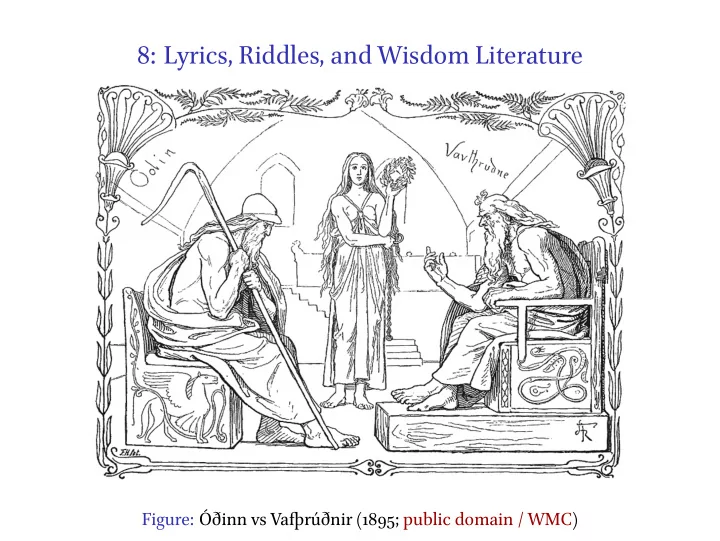
Figure: Óðinn vs Vafþrúðnir (1895; public domain / WMC)
8: Lyrics, Riddles, and Wisdom Literature 17 December 2015 Figure: - - PowerPoint PPT Presentation
8: Lyrics, Riddles, and Wisdom Literature 17 December 2015 Figure: inn vs Vafrnir (1895; public domain / WMC) Key Questions Norse wisdom literature? What is (Old English) lyric? What is (Old English) elegy? What are the
17 December 2015
Figure: Óðinn vs Vafþrúðnir (1895; public domain / WMC)
▶ What is (Old English) lyric? ▶ What is (Old English) elegy? ▶ What are the themes and motifs that characterize Old English elegy? ▶ What is the role of religion in the elegies? ▶ What is the cultural background of the Old English riddles? ▶ What are the conventions and concerns of Old English and Old
Norse wisdom literature?
▶ What considerations went into the making of the Exeter Book?
Part II: Riddles and Wisdom Literature Part III: Connecting the Dots
Lyric
Any verse text as much concerned with the communication of a sentiment as with the telling of a story
Elegy
A text of mourning
▶ Deor ▶ (The Husband’s Message) ▶ Resignation B ▶ The Rhyming Poem ▶ The Ruin ▶ The Seafarer ▶ The Wanderer ▶ The Wife’s Lament ▶ Wulf and Eadwacer
Heht nu sylfa þe 20 lustum læran, þæt þu lagu drefde, siþþan þu gehyrde
galan geomorne geac on bearwe. 23
He [your husband] himself has now ordered that you joyfully be instructed to sail the water once you have heard the sad cuckoo calling in the hillside grove.
▶ Deor ▶ The Husband’s Message ▶ Resignation B ▶ The Rhyming Poem ▶ The Ruin ▶ The Seafarer ▶ The Wanderer ▶ The Wife’s Lament ▶ Wulf and Eadwacer
Azarias Bede’s Death Song Caedmon’s Hymn The Descent into Hell The Gloria The Kentish Hymn The Paternoster Psalms 51–151 Resignation A . . .
▶ Deor ▶ The Husband’s Message ▶ Resignation B ▶ The Rhyming Poem ▶ The Ruin ▶ The Seafarer ▶ The Wanderer ▶ The Wife’s Lament ▶ Wulf and Eadwacer ▶ Azarias ▶ Bede’s Death Song ▶ Caedmon’s Hymn ▶ The Descent into Hell ▶ The Gloria ▶ The Kentish Hymn ▶ The Paternoster ▶ Psalms 51–151 ▶ Resignation A ▶ . . .
The present life of man upon earth, O king, seems to me, in comparison with that time which is unknown to us like to the swift flight of a sparrow through the house wherein you sit at supper in winter, with your ealdormen and thegns, while the fire blazes in the midst, and the hall is warmed, but the wintry storms of rain or snow are raging abroad. The sparrow, flying in at one door and immediately out at another, whilst he is within, is safe from the wintry tempest; but after a short space
passing from winter into winter again. (Sellar, Ecclesiastical History, 2.13)”
Beorht wæron burgræced, burnsele monige, 21 heah horngestreon, heresweg micel, meodoheall monig mondreama full,
wyrd seo swiþe. 24
The city’s halls were bright, the bathhouses many, the multitude of horns lofty, many a meadhall full of the joys of men; until violent fate changed that.
Hrofas sind gehrorene, hreorge torras, 3 hrungeat berofen, hrim on lime, scearde scurbeorge scorene, gedrorene, ældo undereotone. 6
The roofs have collapsed, the towers are in ruins, the barred gate bereft, there is hoarfrost on the mortar, shards of the raincover have been shorn away, have fallen down, undermined by old age.
Social Ideal
▶ Service with a good lord ▶ Companions ▶ A well-stocked meadhall shut-
ting out the seasons
Dystopia
▶ Unemployment ▶ Solitary exile ▶ Exposure to winter weather
Ðonne onwæcneð eft wineleas guma, gesihð him biforan fealwe wegas, baþian brimfuglas, brædan feþra, 5 hreosan hrim ond snaw, hagle gemenged. Þonne beoð þy hefigran heortan benne, sare æfter swæsne. Sorg bið geniwad, þonne maga gemynd mod geondhweorfeð; greteð gliwstafum, georne geondsceawað 10 secga geseldan. Swimmað eft on weg.
Then the friendless man comes to again. Before him he sees the pale waves, sea-birds bathing, spreading their wings, hoarfrost and snow falling, mingled with hail. Then the heart’s wounds are the heavier, sore for the beloved man. Grief is renewed when the memory of kinsmen haunts the mind: he greets them joyfully, keenly looks upon the companions of
Se þonne þisne wealsteal wise geþohte
deope geondþenceð, frod in ferðe, feor oft gemon 90 wælsleahta worn,
‘Hwær cwom mearg? Hwær cwom mago? Hwær cwom maþþumgyfa? Hwær cwom symbla gesetu? Hwær sindon seledreamas? Eala beorht bune! Eala byrnwiga! Eala þeodnes þrym! Hu seo þrag gewat, 95 genap under nihthelm, swa heo no wære. Stondeð nu on laste leofre duguþe weal wundrum heah, wyrmlicum fah. Eorlas fornoman asca þryþe, wæpen wælgifru, wyrd seo mære, 100
stormas cnyssað, hrið hreosende hrusan bindeð, wintres woma.’
Wise-minded, he will then reflect deeply on these walls and on this dark life. He will often remember many a slaughter-carnage and speak these words: ‘What has become of the horse? What of the strong one? What of the giver of treasure? What of the seats of banquet? Where are the hall-joys? Oh bright cup! Oh mailcoated warrior! Oh kingly glory! How the time has passed, grown dark under the cover of night, as if it had never been. Now stands in the tracks of the beloved retinue a wall wondrously tall, decorated with serpentine patterns. Hosts of ashen spears, weapons greedy for slaughter, unassailable fate has seized the men, and storms beat down upon these rocky slopes; the raging tempest, blast of winter, binds the earth.’
Figure: The Two Towers ubi sunt scene (YouTube link)
Brief is the joy of this world, modest the glory of this life; the power of time is fallen and fragile. Tell me, where are the kings? where the princes? where the emperors? where those rich in possessions? where are the powerful ones of the world? where the riches of the earth? They have passed like shadows, vanished like a dream. They are sought, and they are not there. (Synonyma §91)
Nearon nu cyningas ne caseras 82 ne goldgiefan swylce iu wæron, þonne hi mæst mid him mærþa gefremedon
dome lifdon. 85 Gedroren is þeos duguð eal, dreamas sind gewitene, wuniað þa wacran
brucað þurh bisgo. 88
Now there are no kings, nor emperors, nor gold-givers as they
themselves and lived in the most splendid glory. All this troop has fallen; joys have passed. The weaker remain and govern this world, possess it by their toil.
Crungon walo wide, cwoman woldagas, 25 swylt eall fornom secgrof wera; wurdon hyra wigsteal westen staþolas, brosnade burgsteall. 28
The slaughtered perished widely. Days of pestilence came; death seized the whole host of men. Their battle-plains turned to wastelands; the town crumbled.
Hryre wong gecrong 31 gebrocen to beorgum, þær iu beorn monig glædmod ond goldbeorht gleoma gefrætwed, wlonc ond wingal wighyrstum scan; 34 seah on sinc, on sylfor,
bradan rices. 37
Broken into rubble, the ruin fell to the plain where long ago many a warrior shone in his war-trappings, cheerful and bright with gold, decked out with splendour, proud and merry with wine; he gazed on the treasure, on the silver, on the wondrous gems, on the riches, on his possession, on a precious stone, on this bright city of a vast kingdom.
Now, earth, keep, now heroes cannot, the possessions of
terrible deadly attack, took everyone of them, my people, those who gave up this life; they saw the last of the joys of the hall. There is no one to carry a sword or bring forth a decorated cup, a precious drinking-vessel; the company has passed elsewhere. The hard helmet, decorated in gold, is deprived of its plating; the polishers sleep, those who ought to burnish the war-masks; and likewise the war-shirt that endured in battle the bite of iron weapons beyond the crash of shields decays after the
war-chieftains, beside the heroes. There was no harp’s joy, pleasure from the glee-wood, nor does a good hawk swing through the hall, nor does the swift steed pound the fortified
(Trans. Orchard, “Not What It Was,” 109)
Heht mec mon wunian
27 under actreo in þam eorðscræfe. Eald is þes eorðsele, eal ic eom oflongad, sindon dena dimme, duna uphea, 30 bitre burgtunas, brerum beweaxne, wic wynna leas. Ful oft mec her wraþe begeat fromsiþ frean. 33
I was told to live in a wooded grove, in an underground cave below an oak. This earthen hall is old; I am entirely beset with
home-enclosures bitter, overgrown with briars; the dwelling-places are joyless. The departure of my lord has very
Sy æt him sylfum gelong 45 eal his worulde wyn, sy ful wide fah feorres folclondes, þæt min freond siteð under stanhliþe storme behrimed, 48 wine werigmod, wætre beflowen
May all his joy in the world depend on himself; may he be widely outlawed from his distant holdings, so that my friend sits below a rocky slope, covered with hoarfrost by the storm, so that my friend sits sad, surrounded with water in a dreary hall. ”
Ðonne onwæcneð eft wineleas guma, gesihð him biforan fealwe wegas, baþian brimfuglas, brædan feþra, 5 hreosan hrim ond snaw, hagle gemenged. Þonne beoð þy hefigran heortan benne, sare æfter swæsne. Sorg bið geniwad, þonne maga gemynd mod geondhweorfeð; greteð gliwstafum, georne geondsceawað 10 secga geseldan. Swimmað eft on weg.
Then the friendless man comes to again. Before him he sees the pale waves, sea-birds bathing, spreading their wings, hoarfrost and snow falling, mingled with hail. Then the heart’s wounds are the heavier, sore for the beloved man. Grief is renewed when the memory of kinsmen haunts the mind: he greets them joyfully, keenly looks upon the companions of
Mæg ic be me sylfum soðgied wrecan, siþas secgan, hu ic geswincdagum earfoðhwile
bitre breostceare gebiden hæbbe, gecunnad in ceole cearselda fela, 5 atol yþa gewealc, þær mec oft bigeat nearo nihtwaco æt nacan stefnan, þonne he be clifum cnossað. Calde geþrungen wæron mine fet, forste gebunden, caldum clommum, þær þa ceare seofedun 10 hat ymb heortan; hungor innan slat merewerges mod. Þæt se mon ne wat þe him on foldan fægrost limpeð, hu ic earmcearig iscealdne sæ winter wunade wræccan lastum, 15 winemægum bidroren, bihongen hrimgicelum; hægl scurum fleag. Þær ic ne gehyrde butan hlimman sæ, / iscaldne wæg.”
I can tell a sorrowful song about myself, recount my travels, how I have often suffered times of hardship on days of toil, experienced bitter sorrows of the chest, known many abodes of sorrow, the terrible billowing of the waves, where many an anxious nightwatch afflicted me at the ship’s prow as it tosses below the cliffs. My feet were pinched with cold, bound with frost, with cold bonds, while hot sorrows grieved around the
from within. He whose life on land passes most pleasantly does not know how, sorrowful at my wretched condition, I spent the winter on the ice-cold sea, on the exile’s path, deprived of friends and kinsmen, weighed down with icicles; hail came flying down in showers. I heard nothing there but the sea roaring, the ice-cold wave.
Nap nihtscua, norþan sniwde, 31 hrim hrusan bond, hægl feol on eorþan, corna caldast. Forþon cnyssað nu heortan geþohtas, þæt ic hean streamas, 34 sealtyþa gelac sylf cunnige; monað modes lust mæla gehwylce ferð to feran, þæt ic feor heonan 37 elþeodigra eard gesece.
The shade of night grew dark, it snowed from the north, hoarfrost bound the earth; hail fell on the earth, the coldest of
to explore the high currents, the expanse of the salty waves, myself; every time, my heart’s desire compels me to undertake a journey, to seek the homeland of foreigners far from here.
Forþon me hatran sind 64 dryhtnes dreamas þonne þis deade lif, læne on londe. Ic gelyfe no þæt him eorðwelan ece stondað. 67
Therefore the joys of the Lord are more desirable to me than this dead, transitory life on land. I do not believe that its earthly riches remain for ever.
Nu is þon gelicost swa we on laguflode 850
ceolum liðan, geond sidne sæ sundhengestum, flodwudu fergen. Is þæt frecne stream yða ofermæta þe we her on lacað geond þas wacan woruld, windge holmas 855
Wæs se drohtað strong ærþon we to londe geliden hæfdon
Þa us help bicwom, þæt us to hælo hyþe gelædde godes gæstsunu
860 þæt we oncnawan magun
hwær we sælan sceolon sundhengestas, ealde yðmearas, ancrum fæste.
The present time is most like the way we travel on the ocean, by ship across cold water, with swimming-horses across the wide sea, journey by water-wood. The perilous stream of the waves on which we toss here throughout this insubstantial world is beyond measure; the waves are windy over the deep
across the stormy ridge. Then help came to us, so that God’s spirit-son led us into the safe harbour and gave us his gift, that we might know where firmly to moor our swimming-horses, the old wave-mares, with the anchor over the ship’s board.
Oft him anhaga are gebideð, 1 metudes miltse, þeah þe he modcearig geond lagulade longe sceolde hreran mid hondum hrimcealde sæ, 4 wadan wræclastas. […] Wel bið þam þe him are seceð, 114 frofre to fæder on heofonum, þær us eal seo fæstnung stondeð.
The solitary often experiences grace, the Lord’s mercy, even if sorrowful across the waterways he has to stir the rime-cold sea with his hands for a long time, travel the paths of exile. […] It will be well for those who seek grace, comfort from our Father in heaven, where resides all that is lasting for us.
Desirable Characteristics
▶ Patience ▶ An awareness of the terror of
days to come
Undesirable Characteristics
▶ Hotheartedness ▶ Impatience ▶ Cowardice ▶ Foolhardiness ▶ Greed ▶ Boastfulness
Part I: Lyrics
Part III: Connecting the Dots
Figure: The Hobbit: “Riddles in the Dark” (YouTube link)
I was an orphan before I was born Cast without breath by both parents Into a world of brittle death, I found The comfort of kin in a mother not mine. She wrapped and robed my subtle skin, 5 Brooding warm in her guardian gown, Cherished a changeling as if close kin In a nest of strange siblings. This Mother-carequickenedmyspirit,mynatural Fate to feed, fatten, and grow great, 10 Gorged on love. Bating a fledgling Brood, I cast off mother-kin, lifting Windward wings for the wide road. (Trans. Williamson, A Feast of Creatures, 67) ”
Figure: Cuckoo hatchling forces out stepsibling (crop; CC-BY M. Bán)
I was an orphan before I was born Cast without breath by both parents Into a world of brittle death, I found The comfort of kin in a mother not mine. She wrapped and robed my subtle skin, 5 Brooding warm in her guardian gown, Cherished a changeling as if close kin In a nest of strange siblings. This Mother-carequickenedmyspirit,mynatural Fate to feed, fatten, and grow great, 10 Gorged on love. Bating a fledgling Brood, I cast off mother-kin, lifting Windward wings for the wide road. (Trans. Williamson, A Feast of Creatures, 67) ”
Figure: Cuckoo hatchling forces out stepsibling (crop; CC-BY M. Bán)
I am a prince’s property and joy, Sometimes his shoulder-companion, Close comrade in arms, king’s servant, Lord’s treasure. Sometimes my lady, A bright-haired beauty, lays serving 5 Hands on my body, though she is noble And the daughter of an earl. I bear In my belly what blooms in the wood, The bee’s delight. Sometimes I ride A proud horse in the rush of battle — 10 Harsh is my voice, hard is my tongue. Ibearthescop’smeedwhenhissongisdone. My gift is good, my way winning, My color dark. Say what I’m called. (Trans. Williamson, AFeastofCreatures, 138) ”
Figure: Drinking horn (CC-BY NTNU Vitenskapsmuseet)
I am a prince’s property and joy, Sometimes his shoulder-companion, Close comrade in arms, king’s servant, Lord’s treasure. Sometimes my lady, A bright-haired beauty, lays serving 5 Hands on my body, though she is noble And the daughter of an earl. I bear In my belly what blooms in the wood, The bee’s delight. Sometimes I ride A proud horse in the rush of battle — 10 Harsh is my voice, hard is my tongue. Ibearthescop’smeedwhenhissongisdone. My gift is good, my way winning, My color dark. Say what I’m called. (Trans. Williamson, AFeastofCreatures, 138) ”
Figure: Drinking horn (CC-BY NTNU Vitenskapsmuseet)
I am a wonderful help to women, The hope of something to come. I harm No citizen except my slayer. Rooted I stand on a high bed. I am shaggy below. Sometimes the beautiful 5 Peasant’s daughter, an eager-armed, Proud woman grabs my body, Rushes my red skin, holds me hard, Claims my head. The curly-haired Woman who catches me fast will feel 10 Our meeting. Her eye will be wet. (Trans. Williamson, A Feast of Creatures, 83)”
Figure: Onion (crop; public domain / USDA)
I am a wonderful help to women, The hope of something to come. I harm No citizen except my slayer. Rooted I stand on a high bed. I am shaggy below. Sometimes the beautiful 5 Peasant’s daughter, an eager-armed, Proud woman grabs my body, Rushes my red skin, holds me hard, Claims my head. The curly-haired Woman who catches me fast will feel 10 Our meeting. Her eye will be wet. (Trans. Williamson, A Feast of Creatures, 83)”
Figure: Onion (crop; public domain / USDA)
▶ House of Wessex ▶ Abbot of Malmesbury ▶ Notable works: ▶ De laude virginitatis ▶ Carmen de virginitate ▶ Enigmata: 100 verse riddles
Figure: Aldhelm (public domain / WMC)
Figure: The Hobbit: “Inside Information” (YouTube link)
Sigurd hid his name because in olden days it was believed that the words of the dying man had great power, if he cursed his enemy by name. He said: 2 ‘Noble Beast’ I’m called, and I’ve wandered a motherless boy; I have no father, like other sons of men; I always wander alone. (Trans. Orchard, The Elder Edda)
Fáfnir said: 11 ‘The norns’ decree you’ll get at the nesses: that of a foolish blockhead; you’ll drown in the water, if you row in the wind: all’s a danger to the doomed.’ Sigurd said: 12 ‘Tell me, Fáfnir, since they call you wise, and you know very much: who are the norns, who come to those in need, and deliver mothers of children?’ Fáfnir said: 13 ‘Those norns, I say, are born from different kin, they don’t share a common family; some are born of the Æsir, some of the elves, some are the daughters of Dawdler.’ (Trans. Orchard, The Elder Edda)
Vafþrúðnir said: 11 ‘Tell me, Gagnrád, since you wish from the floor to make a test of your talents, what’s the name of the horse who always drags the day over troops of men?’ Gagnrád said: 12 ‘He’s called Shining-mane who always drags the day over troops of men. The glorious Goths think him the best horse: his mane shines always aflame.’ (Trans. Orchard, The Elder Edda)
Odin said: 52 ‘Much have I travelled, much have I tried, much have I tested the powers: what end of life will Odin have when the powers are rent?’ Vafþrúðnir said: 53 ‘The wolf will swallow the Father of Men; this Vídar will avenge: he’ll rip apart the wolf’s cold jaws in battle with the beast.’ (Trans. Orchard, The Elder Edda)
Odin said: 54 ‘Much have I travelled, much have I tried, much have I tested the powers: what did Odin himself say into the ear of his son before he mounted the pyre?’ Vafþrúðnir said: 55 ‘No one knows what you said in ancient days into the ear of your son; with a doomed mouth did I tell my ancient lore and speak of Ragnarök. It was with Odin I’ve now traded my wits: you are always the wisest of men.’ (Trans. Orchard, The Elder Edda)
Figure: The Judgement of Solomon (1 Kings 3; YouTube link)
▶ Job ▶ Psalms ▶ Proverbs ▶ Ecclesiastes ▶ Song of Songs ▶ Wisdom ▶ Sirach / Ecclesiasticus
Biblical books attributed to King Solomon (s. x bce) of the Kingdom of Israel and Judah:
▶ Proverbs (aphorisms and advice on wisdom) ▶ “The fear of the Lord is the beginning of wisdom.” (1:7) ▶ Ecclesiastes (aphorisms with an emphasis on the vanity of all
worldly affairs)
▶ “And when I turned myself to all the works which my hands
had wrought, and to the labours wherein I had laboured in vain, I saw in all things vanity, and vexation of mind, and that nothing was lasting under the sun.” (2:11)
▶ Song of Songs (erotic religious poetry) ▶ “Thy two breasts like two young roes that are twins, which feed
among the lilies.” (4:5)
▶ Wisdom (advice on and prayers for wisdom) ▶ “Wisdom is better than strength, and a wise man is better than
a strong man.” (6:1)
No man ought to boast about his brains, but rather beware with his wits; when one sensible and silent comes to the house seldom wrong befalls the wary; no man ever had a friend more faithful than a good store of common sense. 19 A man shouldn’t clutch at a cup, but moderately drink his mead; he should be sparing of speech or shut up; no man will blame you for bad behaviour if you go early to bed. (Trans. Orchard, The Elder Edda)
▶ Unique to Anglo-Saxon England; elsewhere, the interlocutor is
Marcolfus, whose name is thought to derive from “Mercurius”
▶ By name, both interlocutors representatives of Roman paganism ▶ In Solomon and Saturn II represented rather as a representative of
Babel (= Babylon)
▶ “Your people […] strove against the Lord’s might, therefore they
did not complete that work.” (Trans. Anlezark ll. 150–51)
feet.
most oppressive burden, sleep is most like death.” (Trans. Anlezark l. 135)
will be according to merit.
determines their outcome.
unfortunate [or wicked?] ones cannot.
between fate and providence.
Part I: Lyrics Part II: Riddles and Wisdom Literature
▶ Christ A ▶ Christ B ▶ Christ C ▶ Guthlac A ▶ Guthlac B ▶ Azarias ▶ The Phoenix ▶ Juliana ▶ The Wanderer ▶ The Gifts of Men ▶ Precepts ▶ The Seafarer ▶ Vainglory ▶ Widsith ▶ The Fortunes of
Men
▶ Maxims I ▶ The Order of the
World
▶ The Rhyming
Poem
▶ The Panther ▶ The Whale ▶ The Partridge ▶ Soul and Body II ▶ Deor ▶ Wulf and
Eadwacer
▶ Riddles 1–59 ▶ The Wife’s
Lament
▶ Judgement Day I ▶ Resignation A ▶ Resignation B ▶ The Descent into
Hell
▶ Alms-Giving ▶ Pharaoh ▶ The Lord’s Prayer
I
▶ Homiletic
Fragment II
▶ Riddle 30b ▶ Riddle 60 ▶ (The Husband’s
Message)
▶ The Ruin ▶ Riddles 61–95
Nu ic onsundran þe secgan wille :::::: treocyn ic tudre aweox; in mec æld::: sceal ellor londes settan:::::: sealte streamas :::sse Ful oft ic on bates 5 :::::: gesohte þær mec mondryhten min::::::
Eom nu her cumen
hu þu ymb modlufan mines frean 10
Rooted near water, raised by the shore, I was earth-fast, bound in a bed, My native land. Few men walked In this wilderness, watched as the wave Played round my body with its dark arms 5 At dusk and dawn. I did not dream That someday I should speak, slip words Over benches, mouthless in the mead-hall. That is a miracle to men who do not know This craft — how the point of a knife, 10 A skilled right hand and a man’s intent Tooling together should shape me so That boldly I bring you my message, Singing in silence so no man in the wider World may share our words and understand. 15 (Trans. Williamson, AFeastofCreatures, 120) ”
Figure: Rune stave (crop; CC-BY WMC user)
Rooted near water, raised by the shore, I was earth-fast, bound in a bed, My native land. Few men walked In this wilderness, watched as the wave Played round my body with its dark arms 5 At dusk and dawn. I did not dream That someday I should speak, slip words Over benches, mouthless in the mead-hall. That is a miracle to men who do not know This craft — how the point of a knife, 10 A skilled right hand and a man’s intent Tooling together should shape me so That boldly I bring you my message, Singing in silence so no man in the wider World may share our words and understand. 15 (Trans. Williamson, AFeastofCreatures, 120) ”
Figure: Rune stave (crop; CC-BY WMC user)
The Ruin
þæt is cynelic þing, 48 hu se [::::::] burg [::::]
Riddle 60
þæt is wundres dæl, 10 […] hu […] 12
Riddle 31
Wrætlic me þinceð, 18 hu […]
7 January 2016
Anlezark, Daniel, ed. and trans. The Old English Dialogues of Solomon and
Bitterli, Dieter. Say What I am Called: The Old English Riddles of the Exeter Book and the Anglo-Latin Riddle Tradition. Toronto: Toronto University Press, 2009. Klein, Stacy S. “Gender and the Nature of Exile in Old English Elegies.” In A Place to Believe in: Locating Medieval Landscapes, edited by Clare A. Lee and Gillian R. Overing, 113–31. University Park, PA: Pennsylvania State University Press, 2006. Klinck, Anne L., ed. The Old English Elegies: A Critical Edition and Genre
Magennis, Hugh. Images of Community in Old English Poetry. Cambridge Studies in Anglo-Saxon England 18. Cambridge: Cambridge University Press, 1996.
Murphy, Patrick J. Unriddling the Exeter Riddles. University Park, PA: Pennsylvania State University Press, 2011. Niles, John D. Old English Enigmatic Poems and the Play of the Texts. Turnhout: Brepols, 2006. Orchard, Andy. “Not What It Was: The World of Old English Elegy.” In The Oxford Handbook of the Elegy, edited by Karen Weisman, 101–117. Oxford: Oxford University Press, 2010. , trans. The Elder Edda: A Book of Viking Lore. London: Penguin, 2011. Roberts, Adam. The Riddles of the Hobbit. Basingstoke: Palgrave / Macmillan, 2013. Sellar, A. M., trans. Bede’s Ecclesiastical History of England: A Revised
Williamson, Craig, trans. A Feast of Creatures: Anglo-Saxon Riddle-Songs. London: Scolar, 1982.